
 English
 Español
 中文
中文 हिन्दी
 Français
Government and Politics
Government and Politics of Gibraltar
Government structure, leadership, capital, military, and national symbols of Gibraltar.
Government Structure
Constitutional foundations, branches, parties, and leadership.
- Government Type
- NA
- Administrative Divisions
- none (overseas territory of the UK)
- Legal System
- English law
- Suffrage
- 18 years of age; universal, plus other UK subjects who have been residents six months or more
- Citizenship
- See United Kingdom
- Executive Branch
- chief of state: King CHARLES III (since 8 September 2022), represented by Governor Sir David STEEL (since 8 February 2020) head of government: Chief Minister Fabian PICARDO (since 9 December 2011) cabinet: Council of Ministers appointed from among the 17 elected members of the Gibraltar Parliament by the governor in consultation with the chief minister elections: none; the monarch is hereditary; governor appointed by the monarch; following legislative elections, the leader of the majority party or the leader of the majority coalition is usually appointed chief minister by the governor
- Legislative Branch
- Unicameral Parliament of Gibraltar (17 seats; 10 members elected by popular vote from a single constituency using a modified block voting system, with voters casting up to 10 votes; members serve four-year terms; the Speaker, who is elected by the Parliament and need not be a member, presides but does not vote; the Governor may also appoint an Attorney General and a Financial Secretary as ex officio members in certain circumstances) Elections: last held on 12 October 2023 (next to be held no later than 2027) Election results: percent of vote by party - GSLP-Liberal Alliance 52.0%, GSD 47.7%; seats by party - GSLP-Liberal Alliance 8, GSD 7; the GSLP-Liberal Alliance, led by Chief Minister Fabian Picardo, retained power for a fourth consecutive term
- Judicial Branch
- Supreme Court; Court of Appeal
- Political Parties
- Gibraltar Liberal Party [Joseph GARCIA]; Gibraltar Social Democrats or GSD [Peter CARUANA]; Gibraltar Socialist Labor Party or GSLP [Joseph John BOSSANO]
- Head of State
- King CHARLES III, represented by Governor Sir David STEEL
- Head of Government
- Chief Minister Fabian PICARDO
- Cabinet
- Council of Ministers appointed from among the 17 elected members of the Parliament by the governor in consultation with the chief minister
- Elections
- last held on 12 October 2023 (next to be held no later than 2027)
- Election Results
- In the most recent Gibraltar general election, held in October 2023, the GSLP-Liberal Alliance secured victory with approximately 49.9% of the vote, while the GSD received around 47.1%. In terms of seats, the GSLP-Liberal Alliance won 8 seats and the GSD won 7 seats in the Gibraltar Parliament. Chief Minister Fabian Picardo and the GSLP-Liberal Alliance retained power, marking their fourth consecutive term in government.
- Constitution
- 30-May-69
- Independence
- none (overseas territory of the UK)
- National Holiday
- National Day, 10 September (1967); note - day of the national referendum to decide whether to remain with the UK or go with Spain
- International Organization Participation
- Interpol (subbureau)
- Diplomatic Representation in the U.S.
- none (overseas territory of the UK)
- U.S. Diplomatic Representation
- none (overseas territory of the UK)
Capital City
Seat of government and political history.
- Capital City
- Gibraltar
- Location
- 36 08 N, 5 21 W
- Time Difference
- UTC+1 (6 hours ahead of Washington, DC, during Standard Time)
- History
- From the Spanish derivation of the Arabic "Jabal Tariq," which means "Mountain of Tariq" and which refers to the Rock of Gibraltar
Military
Branches, service obligations, expenditures, and manpower.
- Military Branches
- Royal Gibraltar Regiment
National Symbols
Flag, anthem, and other symbols of national identity.
National Flag
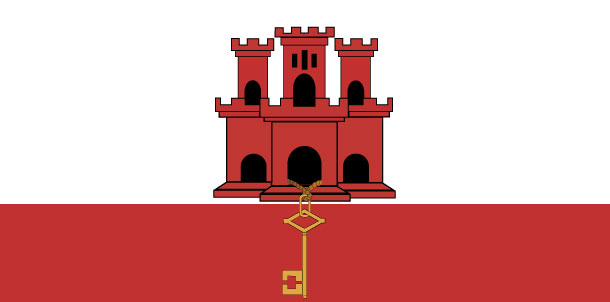
- Flag Symbolism
- The flag of Gibraltar is an elongated banner of the Arms of Gibraltar, granted by Royal Warrant Queen Isabella of Castille on the 10th July 1502. An escutcheon on which the upper two thirds shall be a white field and on the said field set a red castle, and below the said castle, on the other third of the escutcheon, which must be a red field in which there must be a white line between the castle and the said red field, there shall be a golden key which hangs by a chain from the said castle, as are here figured
- Flag History
- The castle and the key symbolize the strategic importance of the Gibraltar fortress as the key to the Mediterranean.
- Date of Adoption
- 8 November 1982
National Anthem
- Anthem Lyrics (English)
- Gibraltar, Gibraltar the rock on which I stand, May you be forever free, Gibraltar, my own land. Mighty pillar, rock of splendour, guardian of the sea, Port of hope in times of need, rich in history. Gibraltar, Gibraltar, the rock on which I stand, May you be forever free, Gibraltar my own land. God give grace to this our homeland, help us to live as one, Strong in freedom, truth and justice, let this be our song: Gibraltar, Gibraltar, the rock on which I stand, May you be forever free, Gibraltar! Gibraltar! My own land.
- Anthem History
- Gibraltar retains as its official anthem God Save the Queen in common with the other United Kingdom dependencies. However, it also has its own local anthem which was chosen in a competition in 1994. Both the lyrics and music were composed by Peter Emberley.
Other National Symbols
Coat of Arms
crown jewels
Arms consisting of a triple-towered castle with a golden key dependent from the centre were granted to “The Most Loyal City of Gibraltar” by Ferdinand and Isabella in the year 1502. The original grant on vellum is now in the archives of the Municipality of San Roque. The words usually found underneath the Arms are “Montis Insignia Calpe”, meaning “Badge of the Rock of Gibraltar” and these words also appear on the Colours of the Suffolk Regiment, which Regiment obtained permission to have the Arms of Gibraltar inscribed on their Colours in recognition of the gallant part they played in the Siege of Gibraltar. The words “Nulli Expugnabilis Hosti” meaning “Conquered By No Enemy” also occasionally appear under the Arms of Gibraltar, having been copied from the Official Seal of the Colony which consists of a picture of the Rock with these words underneath. In 1869, a Circular despatch was sent to all Colonies requesting that a sketch of the Arms or Badge to be adorned in the centre of the Union Jack used by the Governor should be supplied to the Colonial Office. The sketch which was submitted by this Government on the 1 st January 1870, depicted the triple towered castle with dependent key with the words “Montis Insignia Calpe” underneath. This design was approved by the then Secretary of State and concurred in by the Lords Commissioners of the Admiralty. In 1875 a copy of an Admiralty Flag Book was forwarded to all Colonies with an enquiry as to whether the devices shown in the centre of the flags were correct. It was also stated in the same despatch that in those Colours in which Badges for Flags had been approved which differed from the Armorial Bearings or device shown on the Seal of the Colony, no objection would be offered to their continued use but that it was hoped that the first opportunity would be taken of adopting the device on the Seal. The reply to this despatch was to the effect that the Badge for the Union Jack shown in the Flag Book was correct but that it differed from the device on the Seal of the Colony and that the earliest opportunity of adopting the latter device would be taken. The origin of the device on the Seal of the Colony which consists of a picture of the Rock with a sailing ship in the foreground and the words “Nulli Expugnabilis Hosti” underneath cannot be traced but it has been suggested that it has been taken from a Commemorative Medal of the Siege, which is believed to have been designed under instructions from General Eliott. No record of such a model can, however, be traced. No action has been taken with regard to replacing the badge originally approved for the centre of the Union Jack by the device shown on the Seal and in his despatch No. 171 of the 28 th September 1926, the late Sir Charles Monro recommended that the Arms originally granted by Ferdinand and Isabella should be regarded as the true and proper Arms of Gibraltar and that the device on the Seal should be changed to conform with this as soon as opportunity offered. He also recommended that the words “Montis Insignia Calpe” should be regarded as part of the device. The Secretary of State sought the advice of the Garter King of Arms as to whether the Arms granted by Ferdinand and Isabella could be regarded as the recognised ones without the necessity for a Royal Warrant and, if so, whether they could be placed on record officially with the addition of the motto “Montis Insignia Calpe”. He was advised that this could be done without the issue of a Royal Warrant and it was suggested that a properly attested and accurate copy of the Grant of Arms in 1502 should be recorded at the College of Arms.
Coat of Arms
Arms consisting of a triple-towered castle with a golden key dependent from the centre were granted to “The Most Loyal City of Gibraltar” by Ferdinand and Isabella in the year 1502. The original grant on vellum is now in the archives of the Municipality of San Roque. The words usually found underneath the Arms are “Montis Insignia Calpe”, meaning “Badge of the Rock of Gibraltar” and these words also appear on the Colours of the Suffolk Regiment, which Regiment obtained permission to have the Arms of Gibraltar inscribed on their Colours in recognition of the gallant part they played in the Siege of Gibraltar. The words “Nulli Expugnabilis Hosti” meaning “Conquered By No Enemy” also occasionally appear under the Arms of Gibraltar, having been copied from the Official Seal of the Colony which consists of a picture of the Rock with these words underneath. In 1869, a Circular despatch was sent to all Colonies requesting that a sketch of the Arms or Badge to be adorned in the centre of the Union Jack used by the Governor should be supplied to the Colonial Office. The sketch which was submitted by this Government on the 1 st January 1870, depicted the triple towered castle with dependent key with the words “Montis Insignia Calpe” underneath. This design was approved by the then Secretary of State and concurred in by the Lords Commissioners of the Admiralty. In 1875 a copy of an Admiralty Flag Book was forwarded to all Colonies with an enquiry as to whether the devices shown in the centre of the flags were correct. It was also stated in the same despatch that in those Colours in which Badges for Flags had been approved which differed from the Armorial Bearings or device shown on the Seal of the Colony, no objection would be offered to their continued use but that it was hoped that the first opportunity would be taken of adopting the device on the Seal. The reply to this despatch was to the effect that the Badge for the Union Jack shown in the Flag Book was correct but that it differed from the device on the Seal of the Colony and that the earliest opportunity of adopting the latter device would be taken. The origin of the device on the Seal of the Colony which consists of a picture of the Rock with a sailing ship in the foreground and the words “Nulli Expugnabilis Hosti” underneath cannot be traced but it has been suggested that it has been taken from a Commemorative Medal of the Siege, which is believed to have been designed under instructions from General Eliott. No record of such a model can, however, be traced. No action has been taken with regard to replacing the badge originally approved for the centre of the Union Jack by the device shown on the Seal and in his despatch No. 171 of the 28 th September 1926, the late Sir Charles Monro recommended that the Arms originally granted by Ferdinand and Isabella should be regarded as the true and proper Arms of Gibraltar and that the device on the Seal should be changed to conform with this as soon as opportunity offered. He also recommended that the words “Montis Insignia Calpe” should be regarded as part of the device. The Secretary of State sought the advice of the Garter King of Arms as to whether the Arms granted by Ferdinand and Isabella could be regarded as the recognised ones without the necessity for a Royal Warrant and, if so, whether they could be placed on record officially with the addition of the motto “Montis Insignia Calpe”. He was advised that this could be done without the issue of a Royal Warrant and it was suggested that a properly attested and accurate copy of the Grant of Arms in 1502 should be recorded at the College of Arms.
Motto
“Montis Insignia Calpe”, meaning “Badge of the Rock of Gibraltar”