
 English
 Español
 中文
中文 हिन्दी
 Français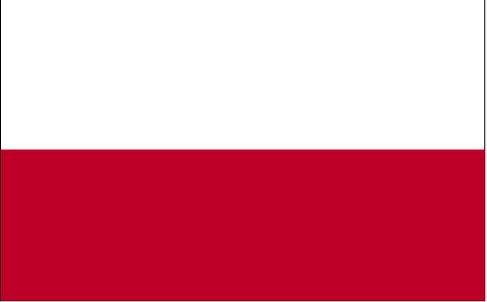
Poland
Polska
Declare Your Relationship to Poland
CountryReports Community
- Studying23
- From Poland3
- Poland heritage15
- Visited5
- Want to visit6
Customs and Culture
Customs and Culture
Cultural Attributes
Poles place great emphasis on family and education. Self-reliance is valued in Polish society.
Wealth is best defined by powerful positions and different types of ownership and possessions, usually cars, clothes, and houses. Some in Poland live in deplorable conditions and wish for things like running water, electricity, and money to pay debts and bills.

Land of Resilient Fields
Get More Customs and Culture
6 more cultural topics for members
Social Customs & Etiquette · Diet · Family · Dating Customs · Recreation · Student Life
Every country, every topic, all activities & recipes
✓ Instant access on this device · ✓ No subscription
Holidays
Constitution Day
5/3Independence
Birth date - Pope John Paul II (Karol Wojtyla)
5/18Birthday
Birth date - Pope John Paul II (Karol Wojtyla), first non-Italian to be elected pope in 456 years and first Polish pope. He was born in Wadowice, Poland on May 18, 1920.
Birth date - Maria Sklodowska Curie
11/7Birthday
Birth date - Maria Sklodowska Curie, Polish-born French physicist, first person to win two Nobel prizes, was born in Warsaw, Poland on Nov. 7, 1867.
Christmas
12/25Christmas
Poland started celebrating Gwiazdka (Little Star, Christmas) in the late tenth century when Mieszko introduced Christianity to the land. Advent customs such as Roraty (mass held each morning during Advent) are observed. Homes and churches display szopka(Nativity scenes) and the city of Kraków, host a national crèche competition at its historical museum and the entries are displayed from early December until February.
Festive gatherings celebrate St. Barbara, and Swiety Mikolaj (St Nicholars) arrives on his feast day to examine children and to leave them treats such as apples, nuts and cookies.
Sightseeing the first star of Wigilia (Christmas Eve) heralds Christmas and the Christmas Eve supper, which breaks a fast observed throughout the day. An extra place is set for any unexpected guest, commemorative of Mary and Joseph who sought shelter, for no one is turned away on this night. The Christmas Eve meal is a meatless meal and traditionally consists of an odd number of courses (at least 12 in memory of the Twelve Apostles) and an even number of diners for good luck. The menu often consists of cooked or dried carp, herring, soups such as red beet, or fermented rye; fish and barszcz (mushroom), sauerkraut with beans, pierogi (dumplings stuffed with mushrooms, cabbage or fruit), makowiec(baked poppy seed bread), strudel, and kutia (poppy seed and wheat pasta with honey raisins almonds and spices).
After the Christmas Eve dinner, children receive gifts from the Star Man who symbolizes the Star of Bethlehem. Wigilia ends with the Pasterka (Mass of the Shepherds) the term for Midnight Mass.
Christmas day is spent at home, St Stephen’s day (December 26th) is reserved for visiting.
Dates of Interest
- November 29th
This international festival, held in Kraków during Holy Week, celebrates early music and historically informed performances. Renowned musicians and ensembles from around the world present works from the Renaissance and Baroque periods.
How do people greet each other in Poland?
Adults generally shake hands upon meeting, while close female friends kiss both cheeks; titles are used with last names in formal settings.
Do
- Use a professional person's title before their last name
- Use only the title in formal or business conversation
- Shake hands with adults when meeting
- Say "Dzien dobry" (Good morning/afternoon) or "Dobry wieczor" (Good evening)
Don’t
- Don't use first names between adults without mutual consent
Good to know
- Women greet close friends by kissing both cheeks; young girls often kiss one cheek
- "Czeoa" is a casual hello
What are the dining customs in Poland?
The main meal, "obiad," is eaten around 3 PM when the family gathers, and continental-style eating is used with both hands kept above the table.
Do
- Wait until everyone is served and the host or head of family has begun
- Finish your first helping when eating as a guest
- Keep both hands above the table
Don’t
- Don't put your elbows on the table
- Don't begin eating before the host starts
Good to know
- Breakfast ("niadanie") is before 8 AM, and a lighter evening meal ("kolacja") is before 8:30 PM
- Common dishes include pierogi, uszka, and bigos; pork is more popular than beef
- Meals are usually eaten at home
How does visiting and hospitality work in Poland?
Unannounced visits among friends and relatives are standard, while formal extended visits are arranged in advance; entertaining is commonly done at home.
Do
- Bring flowers for your hosts, even for a brief arranged visit
- Arrange formal, extended visits in advance
Good to know
- Home parties involve sitting at the table, eating, and drinking wine or vodka, sometimes with dancing
- Young people socialize in city-center pubs and clubs, often meeting for beer on weekends
- Entertaining is more common at home because going out is expensive
How should I dress in Poland?
Fashions are generally conservative, with business people wearing conservative suits or dresses, though youth favor current European trends.
Do
- Wear conservative suits or dresses for business
Good to know
- Youth favor current European trends
- Jeans are worn by students, children, and those in casual workplaces
- Because clothing is expensive, wardrobes tend to be small
How do people get attention in Poland?
To get someone's attention, people usually call out "Przepraszam!" (Excuse me).
Good to know
- Use "Przepraszam!" to get someone's attention
What is family life like in Poland?
Family and education are highly valued, with the average family having one or two children and the father seen as an authority figure.
Good to know
- Both parents typically work outside the home, though women bear most homemaking responsibility
- Fathers demand obedience but want children to be self-disciplined and independent
- Living together before marriage is discouraged; parents often help couples financially early on
What do people do for recreation in Poland?
Football is very popular in schools and communities, and Poles enjoy a range of sports year-round including swimming and winter sports.
Good to know
- Football, volleyball, basketball, handball, and table tennis are common at school
- Swimming is quite popular
- Skiing, snowboarding, and ice skating are practiced in winter
Last updated: 2026-07-12 · Sources: CountryReports
Photos of Poland
Photos of Poland
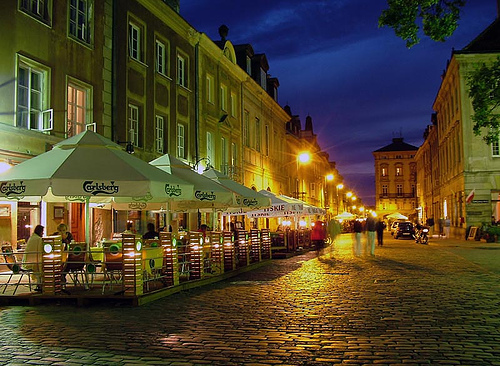
Restaurant district in Warsaw Poland
Farmland in Poland
Lower Silesia river at Sunset.
Public telephones in Poland
Wroclaw, Poland
Auschwitz Concentration Camp
Auschwitz Concentration Camp
Gdansk, Poland
Shopping district in Warsaw, Poland
Royal castle in Warsaw, Poland
A farm house out in the country. Pisarzowice, Poland
Poland countryside in the Fall.


Travel and Tourism
Travel and Tourism
- Travel Alert Status
- Level 1: Exercise Normal Precautions
- Currency
- zloty (PLN)
- Time Difference
- UTC+1 (6 hours ahead of Washington, DC, during Standard Time)
- Airports
- 122
Read the full travel guide — health, safety, vaccinations, disease risk, sanitation, and transit details.
View full travel guideRecipes
Recipes
Pierogies With Cottage Cheese
Main Dish
Main Dish
Bitka (Polish Beef Dish)
Main Dish
Pierogi (Stuffed Dumplings with Sauerkraut Filling)
Main Dish
Pierogi (Stuffed Dumplings with Cottage Cheese Filling and Sour Cream Gravy)
Main Dish
Placki Kartoflane (Potato Pancakes)
Main Dish
Golabki (Stuffed Cabbage Rolls)
Main Dish
Klopsy (Meatloaf)
Main Dish
PremiumFladra Z Grzybami (Flounder with Mushrooms)
Main Dish
PremiumPierogies With Cottage Cheese
Side Dish
PremiumKAPUSTA KISZONA Z GRZYBAMI (STEWED SAUERKRAUT
History
History
Historical Eras
Piast Dynasty
966 – 1382
Poland's history as a Christian kingdom begins with Duke Mieszko I's baptism in 966, uniting the Polanian tribes under the Piast dynasty. The early Piasts consolidated royal power, established the Church as a pillar of state, and expanded territory. Bolesław I the Brave became the first crowned king in 1025, laying the foundations of a distinctly Polish national identity.
Jagiellonian Era
1382 – 1572
The Jagiellonian dynasty transformed Poland into a major European power through the 1386 dynastic union with Lithuania, creating one of the continent's largest states. The era culminated in a cultural and political golden age during the 16th century, marked by Renaissance humanism, the Copernican revolution, and the Nihil Novi statute of 1505, which gave the nobility unprecedented legislative rights.
Royal Republic
1572 – 1795
Following the extinction of the Jagiellonian line, Poland became an elective monarchy dominated by the szlachta, or noble class, whose liberum veto paralyzed legislative governance. Despite producing great military figures such as Jan III Sobieski, who relieved Vienna from Ottoman siege in 1683, chronic internal disorder invited foreign interference. Russia, Prussia, and Austria exploited this weakness to partition Poland entirely across three agreements between 1772 and 1795.
Partitions & Occupation
1795 – 1918
Erased from the map of Europe for over a century, Poland existed only as a cultural and national idea sustained through literature, language, and periodic uprisings. The Congress Kingdom created at Vienna in 1815 offered brief autonomy under Russian suzerainty, but insurrections in 1830 and 1863 were brutally suppressed. Tsarist Russification and Prussian Germanization campaigns sought to eradicate Polish identity, paradoxically hardening national consciousness.
Interwar & World War II
1918 – 1947
Poland reemerged as a sovereign state after World War I, confirmed by the Treaty of Versailles and secured by victory over Soviet Russia in the 1920 Battle of Warsaw. Marshal Józef Piłsudski's 1926 coup inaugurated an authoritarian Sanacja regime. In September 1939, simultaneous invasion by Nazi Germany and the Soviet Union annihilated the state; the subsequent occupation produced the Holocaust, the Warsaw Uprising of 1944, and the deaths of nearly six million Polish citizens.
Communist Poland
1947 – 1989
Installed as a Soviet satellite under the Polish United Workers' Party, the People's Republic of Poland collectivized the economy and suppressed political dissent, though it remained comparatively less rigid than other Eastern Bloc states. The Catholic Church preserved an independent civic space, and recurring waves of labor unrest — peaking with the 1980 founding of the Solidarity trade union led by Lech Wałęsa — eroded the regime's legitimacy until free elections in 1989 swept Solidarity to power.
Democratic Poland
1989 – present
Poland's transition to liberal democracy was anchored by radical 'shock therapy' economic reforms that rapidly dismantled central planning and produced one of Central Europe's most dynamic market economies. NATO membership in 1999 and European Union accession in 2004 firmly embedded Poland in Western institutions. The country has since navigated tensions between liberal democratic norms and nationalist political movements, while emerging as a significant regional power and a frontline state amid the post-2022 war in Ukraine.
Overview
Clio, the muse of history, from a sculpture in
Every country, every topic, all activities & recipes
✓ Instant access on this device · ✓ No subscription
Timeline of Key Events
966 – 1370
The Piast Polish Dynasty
The Piast Polish Dynasty.
966
Duke Mieszko I became Poland’s first recorded Christian leader.
Duke Mieszko I became Poland’s first recorded Christian leader.
1382 – 1572
The Jagiellonian Dynasty
The Jagiellonian Dynasty.
1572 – 1795
The Royal Republic
The Royal Republic.
1596
Poland’s capital city is moved from Krakow to Warsaw.
Poland’s capital city is moved from Krakow to Warsaw.
1700
The Three Partitions of Poland - Russia, Prussia and Austria divide Poland amongst themselves.
The Three Partitions of Poland - Russia, Prussia and Austria divide Poland amongst themselves.
1793
During the Second Partition, Russia and Prussia take over half of what was left of Poland.
During the Second Partition, Russia and Prussia take over half of what was left of Poland.
Read the full history profile — narrative overview, defining eras, and the complete timeline in one place.
View expanded historyInteresting Facts
Interesting Facts
The word pole means “field” in Polish. Thus Poland, some believe, means “the land of fields.” Others contend that the Poland stems from Polanie, an ancient local tribe.
A particular feature of Polish forests is wild mushrooms, which are exported worldwide. The tasty mushrooms add unique flavour to Polish dishes. Families and school groups often go mushroom picking, and many Polish children learn while still young how to distinguish good mushrooms from poisonous ones.
In 1983, Lech Walesa was awarded the Nobel Peace Prize for his leadership of Solidarity.
Hanna Suckocka was elected Poland's first female Prime Minister in 1992. She was the only woman in her entire coalition government.
2 more facts for members
Every country, every topic, all activities & recipes
✓ Instant access on this device · ✓ No subscription
Geography and Environment
Geography and Environment
- Terrain
- mostly flat plain; mountains along southern border
- Climate
- Poland’s climate is continental European. Winters can be severe, with heavy snows possible from December through March. Winter temperatures in Warsaw average about -3.9ºC to 0ºC. The lowest temperature in recent years was - 30ºC. Spring is usually cold and rainy. Summer can bring temperatures topping 37ºC, but a few days at about 32ºC is more typical. Autumn is usually cloudy and can be quite cold. Yearly rainfall averages about 59.69 centimeters.
- Natural Hazards
- flooding
- Current Environmental Issues
- situation has improved since 1989 due to decline in heavy industry and increased environmental concern by post-Communist governments; air pollution nonetheless remains serious because of sulfur dioxide emissions from coal-fired power plants, and the resulting acid rain has caused forest damage; water pollution from industrial and municipal sources is also a problem, as is disposal of hazardous wastes; pollution levels should continue to decrease as industrial establishments bring their facilities up to European Union code, but at substantial cost to business and the government
Read the full geography and environment profile — terrain, climate, natural resources, hazards, land use, and international agreements.
View full geographyPeople & Demographics
People & Demographics
Religion
Languages Spoken
Polish
- Polish
Population
- Population
- 38,179,800
- Population: Male/Female
- total: 38,746,310 male: 18,441,415 female: 20,304,895
- Population Distribution
- population concentrated in the southern area around Krakow and the central area around Warsaw and Lodz, with an extension to the northern coastal city of Gdansk
- Urban Population
- urban population: 60.2% of total population rate of urbanization: -0.16% annual rate of change
- Population in Major Urban Areas
- 1.798 million WARSAW (capital), 769,000 Krakow
- Nationality Noun
- noun: Pole(s) adjective: Polish
- Ethnic Groups
- Polish 96.9%, Silesian 1.1%, German 0.2%, Ukrainian 0.1%, other and unspecified 1.7%
- Language Note
- Polish (official) 98.2%, Silesian 1.4%, other 1.1%, unspecified 1.2%; note - data represent the language spoken at home; shares sum to more than 100% because some respondents gave more than one answer on the census; Poland ratified the European Charter for Regional or Minority Languages in 2009 recognizing Kashub as a regional language, Czech, Hebrew, Yiddish, Belarusian, Lithuanian, German, Armenian, Russian, Slovak, and Ukrainian as national minority languages, and Karaim, Lemko, Romani (Polska Roma and Bergitka Roma), and Tatar as ethnic minority languages
Education
- Literacy Definition
- age 15 and over can read and write
Health Information
- Major Infectious Diseases — degree of risk
- degree of risk: intermediate vectorborne diseases: tickborne encephalitis
- Alcohol consumption per capita
- total: 10.96 liters of pure alcohol beer: 5.72 liters of pure alcohol wine: 0.88 liters of pure alcohol spirits: 4.36 liters of pure alcohol other alcohols: 0 liters of pure alcohol
- Tobacco Use
- total: 24% male: 27.9% female: 20.1%
Life Expectancy
- Life Expectancy at Birth
- Total population: 78.8 years Male: 75.0 years Female: 82.4 years
- Median Age
- total: 42.9 years male: 41.5 years female: 44.3 years
- Age Structure
- 0-14 years: 14.2% (male 2,830,048/female 2,676,300) 15-64 years: 65.9% (male 12,513,402/female 13,036,977) 65 years and over: 19.8% (male 3,097,965/female 4,591,618)
- Infant Mortality Rate
- total: 3.4 deaths/1,000 live births male: 3.7 deaths/1,000 live births female: 3.1 deaths/1,000 live births
Read the full people and society profile — demographics, health, education, religion, languages, and notable people.
View full people and societyGovernment & Politics
Government & Politics
Country Identity
- Country Name
- Poland
- Full Country Name
- Republic of Poland
- Local - Long
- Rzeczpospolita Polska
- Local - Short
- Polska
Government Structure
- Government Type
- republic
- Legal System
- mixture of Continental (Napoleonic) civil law and holdover Communist legal theory; changes being gradually introduced as part of broader democratization process; limited judicial review of legislative acts, but rulings of the Constitutional Tribunal are final; court decisions can be appealed to the European Court of Justice in Strasbourg
- Executive Branch
- chief of state: President Andrzej DUDA (since 6 August 2015; reelected for a second five-year term in July 2020) head of government: Prime Minister Donald TUSK (since 13 December 2023); Deputy Prime Ministers Krzysztof GAWKOWSKI, Wladyslaw KOSINIAK-KAMYSZ, and Tomasz SIEMONIAK (since December 2023) cabinet: Council of Ministers responsible to the prime minister and the Sejm; the prime minister proposes, the president appoints, and the Sejm approves the Council of Ministers elections: president elected by popular vote for a five-year term; election last held 28 June and 12 July 2020 (next to be held in May 2025); prime minister and deputy prime ministers appointed by the president and confirmed by the Sejm election results: Andrzej DUDA reelected president in second round; percent of popular vote - Andrzej DUDA 51.0%, Rafal TRZASKOWSKI 49.0%
- Legislative Branch
- Bicameral legislature consisting of an upper house, the Senate or Senat (100 seats; members are elected by a majority vote on a provincial basis to serve four-year terms), and a lower house, the Sejm (460 seats; members are elected under a system of proportional representation to serve four-year terms); the designation National Assembly or Zgromadzenie Narodowe is used only on those rare occasions when the two houses meet jointly. Elections: Senate and Sejm elections were last held on 15 October 2023 (next to be held in October 2027). Election results: Senate - seats by party - KO 41, PiS 34, TD 11, Lewica 9, independents 5; Sejm - percent of vote by party - PiS 35.4%, KO 30.7%, TD 14.4%, Lewica 8.6%, Konfederacja 7.2%, other 3.7%; seats by party - PiS 194, KO 157, TD 65, Lewica 26, Konfederacja 18. Note: One seat in the Sejm is reserved for a representative of the German ethnic minority, which is exempt from the electoral threshold requirement applied to other parties.
- Judicial Branch
- Supreme Court (judges are appointed by the president on the recommendation of the National Council of the Judiciary for an indefinite period); Constitutional Tribunal (judges are chosen by the Sejm for nine-year terms)
- Suffrage
- 18 years of age; universal
- Constitution
- 16 October 1997; adopted by the National Assembly 2 April 1997; passed by national referendum 23 May 1997
- Independence
- 11 November 1918 (independent republic proclaimed)
- National Holiday
- Constitution Day, 3 May (1791)
Capital City
- Capital Name
- Warsaw
- Capital - geographic coordinate
- 52 15 N, 21 00 E
- Capital Time Difference
- UTC+1 (6 hours ahead of Washington, DC, during Standard Time)
the origin of the name is unknown; the Polish designation "Warszawa" was the name of a fishing village and several legends/traditions link the city's founding to a man named Wars or Warsz
Military
Branches: Polish Armed Forces: Land Forces, Navy, Air and Air Defense Aviation Forces, Special Forces
Embassy / Diplomatic Mission
U.S. Embassy Warsaw
Aleje Ujazdowskie 29/31, 00-540 Warszawa
Telephone: (48) (22) 504-2784
Emergency after-hours telephone: (48) (22) 504-2000
Fax: (48) (22) 504-2122
U.S. Consulate General Kraków
Ulica Stolarska 9, 31-043 Kraków
Telephone: (48) (12) 424-5100
Emergency after-hours telephone: (48) 601-483-348
Fax: (48) (12) 424-5103
Consular Agency Pozna?
Ulica Paderewskiego 8, 61-770 Pozna?
Telephone: (48) (61) 851-8516
Fax: (48) (61) 851-8966
Please check the individual web page for the embassy or consulate you will visit to verify the public hours and security regulations. You are not allowed to bring electronic devices such as cell phones and laptops into our facilities. You need an appointment for most services; you can find instructions for making appointments on our website.
Read the full government profile — flag symbolism, national anthem, and other national symbols.
View full government detailsEconomy
Economy
Poland has pursued sustained economic liberalization since the early 1990s and stands as one of the most successful transition economies in Central Europe.
Snapshot
- Currency Name and Code
- Polish Zloty (PLN)
- GDP — official exchange rate
- $246,200,000,000 (USD)
- GDP Real Growth Rate
- 2.9%
- Gini Index
- 34.1
Every country, every topic, all activities & recipes
✓ Instant access on this device · ✓ No subscription
News & Weather
News & Weather
Current Weather
Latest News
If Poland Gets a US Base It’ll Be Called Fort Trump, Nawrocki Says - Bloomberg.com
Bloomberg.com · 15h ago
Poland warns Russia planning ‘hybrid strikes’ against countries supporting Ukraine – as it happened - The Guardian
The Guardian · 5d ago
Russian military helicopter violates Polish airspace - Notes From Poland
Notes From Poland · 39m ago
NATO jets scrambled in Poland, Romania as Russia strikes Ukraine - ABC News - Breaking News, Latest News and Videos
ABC News - Breaking News, Latest News and Videos · 5h ago
Poland concludes military air operations, says no airspace violation - Reuters
Reuters · 1d ago
Poland under constant air-raid sirens as Putin threatens to expand Ukraine war, top pol warns: ‘We are next’ - nypost.com
nypost.com · 17h ago
Race Report: 4X ProTour 2026 - Round 4: Szczawno Zdrój, Poland - Pinkbike
Pinkbike · 19h ago
Poland watchdog fines Neuca in decade-long drug pricing cartel - Reuters
Reuters · 1d ago
News via Google News
Videos
Videos
1 curated YouTube videos.
Source: YouTube
Frequently Asked Questions
Frequently Asked Questions
What is the population of Poland?
What is the capital of Poland?
Where is Poland located?
What countries border Poland?
What is the predominant religion in Poland?
What currency is used in Poland?
What language is spoken in Poland?
What is Poland's geography like?
What is Poland known for?
Last reviewed 2026