
 English
 Español
 中文
中文 हिन्दी
 Français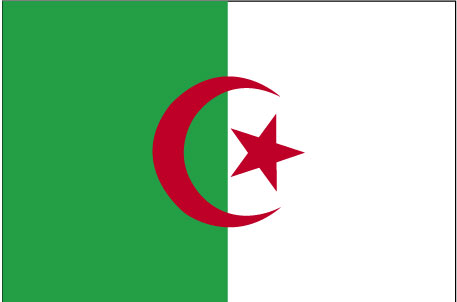
Algeria
Algeria
Declare Your Relationship to Algeria
CountryReports Community
- Studying31
- From Algeria11
- Algeria heritage17
- Visited12
- Want to visit8
Customs and Culture
Customs and Culture
Cultural Attributes
One is expected to speak one's mind manner. Although Algerians enjoy good conversation, being overly frank and direct in speech is considered impolite. Expressiveness, courtesy, individualism, and formality are key attributes of the Algerian character.
In this male dominant society, sex roles are clearly defined. Nevertheless, some women do fill important positions in public and private professions. About ten percent of the labor force is female.

Land of Deglet Noor and Desert Horizons
Get More Customs and Culture
5 more cultural topics for members
Social Customs & Etiquette · Diet · Family · Dating Customs · Recreation
Every country, every topic, all activities & recipes
✓ Instant access on this device · ✓ No subscription
Holidays
Independence Day
8/19Independence Day
Christmas
12/25Christmas
Algeria is a country in North Africa. The country is predominantly of Islamic religion, but a good number of Christians reside in Algeria and the community has accepted the celebrations of the Christmas holidays in their area. The country uses the Arabic language as a primary communications medium in the country and thus has used the Arabic greeting of Merry Christmas that is “Idah Saidan Wa Sanah Jadidah,” pronounced ‘ee-da sigh-dah-wa- sa-na ja-dee-da.’
Santa Claus plays a more subtle role because the majority of the people are Muslims. The Christian community tries to lessen the importance of such figures and symbols as they celebrate the occasion. Celebrations vary from community to community, the aspect of gift giving is somewhat diminished and less commercialized as the people try to stay more in focus with the religious part of the festival that honors the birth of Christ. This may be also due to the fact that many of the Algerians are poor and cannot afford to buy gifts.
In the poorer areas of the Christian community, gifts may be soap, clothes, candles and food products that can be used in day to day life. The Christmas season usually ends after the New Year celebrations are finished.
Christmas Eve midnight mass is traditionally held every year at churches and cathedrals of the Christian faith. Traditional Christmas decors that are used in the country are the Advent Wreath and Advent calendars which originally started in East Germany. During Christmas Eve, a midnight feast and dinner is also served with dishes like roast turkey, chicken breast dishes, pies, and salads
Christmas Trees are scarce, as there are only few stores and shops that sell decorations and ornaments for the trees
Dates of Interest
- April 16th
This internationally acclaimed music festival takes place annually in Oran, showcasing the vibrant genre of Raï music. It attracts renowned Raï artists from Algeria and around the world, with concerts, performances, and cultural events spread over several days.
How do people greet each other in Algeria?
Greetings are warm and cordial to friends and strangers alike, usually with a handshake and often an embrace between members of the same sex. Anything less friendly is considered impolite.
Do
- Shake hands when greeting
- Greet each individual present in small gatherings
- Greet elders first
- Address strangers and acquaintances by title and family name
- Use given names only with friends and relatives
What are the dining customs in Algeria?
Algerians generally eat with utensils, but some dishes with rich sauces are eaten by using bread as a scoop, and only the right hand should touch food. Couscous, lamb and chicken dishes are popular.
Do
- Use only the right hand when eating with your hands
- Leave a little food on your plate to compliment the host
Don’t
- Don't offer pork or alcohol to Muslims
- Don't use the left hand to touch food
What should I know about etiquette and hospitality in Algeria?
Courtesy, formality and hospitality are central to Algerian culture. You are expected to speak your mind, but in an inoffensive, indirect manner.
Do
- Bring the host a small gift for social visits
- Make plans in advance unless visiting family or close friends
- Speak courteously and avoid being overly blunt
Don’t
- Don't be overly frank or direct in speech
How should I dress in Algeria?
Western clothing is common in urban areas, but traditional North African Muslim attire is also prominent. Dressing conservatively and modestly in public is proper for everyone.
Do
- Dress conservatively and modestly in public
Which gestures should I avoid in Algeria?
Certain gestures involving the fingers, feet and left hand are considered impolite.
Do
- Use both hands or the right hand only when giving or receiving items
Don’t
- Don't point at people or objects with your fingers
- Don't use the left hand separately
- Don't let the sole of your foot point at another person
What is family life like in Algeria?
This is a male-dominant society with clearly defined sex roles: fathers handle family finances while mothers care for children. Urban families tend to be smaller than rural ones.
Good to know
- Women generally marry in their early twenties and men a few years later
What do people do for recreation in Algeria?
Soccer is popular and played by children and adults in streets and parks. In desert regions, horse and camel racing are popular, along with festival traditions like camel dancing.
Good to know
- Men often gather in coffeehouses to play dominoes, checkers and chess
- Women are more likely to socialize at home
Last updated: 2026-07-12 · Sources: CountryReports
Photos of Algeria
Photos of Algeria


Travel and Tourism
Travel and Tourism
- Travel Alert Status
- Level 2: Exercise Increased Caution
- Currency
- 108.9
- Time Difference
- UTC+1 (6 hours ahead of Washington, DC during Standard Time)
- Airports
- 137
- Recommended Vaccinations
- How important is it to do your research about vaccinations? It might just save your life! Make yourself aware of the different types of vaccinations and which ones you may need to travel to your destination. Schedule an appointment with your doctor at least four to six weeks before you travel to ensure you receive all important shots. Be sure that you and your family are up to date on your routine vaccinations. Which vaccinations you need will depend on a number of factors including your destination, whether you will be spending time in rural areas, the season of the year you are traveling, your age, health status, and previous immunizations.
Read the full travel guide — health, safety, vaccinations, disease risk, sanitation, and transit details.
View full travel guideRecipes
Recipes
History
History
Historical Eras
Prehistoric & Berber
6000 BCE – 146 BCE
Neolithic communities flourished across the Saharan and Mediterranean Maghrib, leaving vivid records in the Tassili-n-Ajjer cave paintings. The indigenous Berber peoples developed agriculture, trade, and political organization, forming loosely governed kingdoms. Phoenician traders established coastal footholds around 900 BCE, and Carthage grew into a dominant regional power before its destruction by Rome in 146 BCE.
Classical & Roman
146 BCE – 642
Rome absorbed Numidia and Mauretania, transforming the region into a vital granary of the empire and driving rapid urbanization. Berber resistance to Roman rule remained persistent, even as Christianity spread widely by the fourth century, producing influential theologians such as Augustine of Hippo. The Vandal conquest of 439 CE ended Roman authority, ushering in a period of instability before the Arab arrival.
Islamic & Dynastic
642 – 1518
Arab military expeditions beginning in 642 spread Islam across the Maghrib, and by 711 the Umayyads had consolidated control with significant Berber participation. Successive dynasties — including the Rustumids, Zirids, Almoravids, and Almohads — competed for dominance, each reshaping the region's political and cultural landscape. Large influxes of Arab bedouins gradually Arabized the Berber countryside, forging the linguistic and religious identity that defines Algeria today.
Ottoman Algeria
1518 – 1830
The corsair captain Khayr ad-Din (Barbarossa) placed Algiers under Ottoman suzerainty in 1518, establishing it as a formidable Barbary state and a base for Mediterranean privateering. Ottoman regencies governed through a succession of deys and janissary corps, maintaining relative autonomy from Istanbul while generating revenue through piracy and ransom. Repeated European naval punitive expeditions, including Lord Exmouth's 1816 bombardment, gradually weakened the regency's power.
French Colonial
1830 – 1962
France occupied Algiers in 1830 and over subsequent decades dispossessed vast numbers of Algerians of land, imposing a settler-colonial order that treated the Muslim majority as subjects rather than citizens. Rigged elections in 1948 extinguished Algerian hopes for meaningful political participation, catalyzing the National Liberation Front's (FLN) armed uprising in 1954. After a brutal eight-year war of independence marked by widespread atrocities on both sides, Algeria gained sovereignty on 5 July 1962.
Independent Algeria
1962 – present
The FLN established a single-party state, guiding Algeria through socialist-oriented development and nationalization of its substantial oil and gas wealth. Mounting discontent over unemployment and political exclusion culminated in 1988 riots, forcing multiparty reforms, but the army's cancellation of the 1992 elections — after the Islamic Salvation Front's (FIS) first-round victory — plunged the country into a devastating civil conflict lasting through the 1990s. Algeria has since maintained authoritarian stability under military-backed governments while grappling with continued demands for democratic reform, most recently expressed in the 2019 Hirak protest movement.
Overview
Early inhabitants of the central Maghrib (also seen as Maghreb; designates North Africa west of Egypt) left behind significant remains including remnants of hominid occupation found near Saïda. Neolithic civilization (marked by animal domestication and subsistence agriculture) developed in the Saharan and Mediterranean Maghrib between 6000 and 2000 B.C. This type of economy, so richly depicted in the Tassili-n-Ajjer cave paintings in southeastern Algeria, predominated in the Maghrib until the classical period.
Every country, every topic, all activities & recipes
✓ Instant access on this device · ✓ No subscription
Timeline of Key Events
4000 BCE – 2500 BCE
A rock painting illustrates a battle between 2 prehistoric groups.
A rock painting from this time in Tassili n’Ajjer, southeastern Algeria, illustrates a battle between 2 prehistoric groups armed with bows and arrows.
105 BCE
The heart of ancient Numidia lay in the eastern region of what is now Algeria in Northern Africa.
The heart of ancient Numidia lay in the eastern region of what is now Algeria in Northern Africa. The Numidians were originally nomadic horsemen. They were defeated by Roman troops in the Jugurthine War in 105 BC and conquered by Rome in 46 BC. The Vandals and Byzantines ruled successively before Arabs conquered the area in the seventh century AD. Jugurtha was the king of Numidia.
49 BCE
Mauretania (now northern Morocco and Algeria) became a client kingdom of Rome.
Mauretania (now northern Morocco and Algeria) became a client kingdom of Rome.
46 BCE
Numidia was conquered by Rome.
Numidia was conquered by Rome. The Vandals and Byzantines ruled successively before Arabs conquered the area in the seventh century AD.
40
Mauretania was divided into the provinces of Tingitana and Caesariensis.
Mauretania was divided into the provinces of Tingitana and Caesariensis.
200 – 400
Christianity spread rapidly in Numidia and the diocese of Lamiggiga was established.
Christianity spread rapidly in Numidia and the diocese of Lamiggiga was established. It was later abandoned and just the name was used as an honorary jurisdiction for Catholic auxiliary bishops
439
In Mauretania (now northern Morocco and Algeria) Roman rule ceased.
In Mauretania (now northern Morocco and Algeria) Roman rule ceased in the mid 5th century when barbarian incursions forced the legions to withdraw.
Read the full history profile — narrative overview, defining eras, and the complete timeline in one place.
View expanded historyInteresting Facts
Interesting Facts
Clementine oranges are originally from west Algeria. They are named after a French priest called Father Clément, who found them growing in the village of Misserghin, near Oran, in the early 20th century.
The best-known variety of date in Algeria is the "deglet nour", known as the "fruit of the light".
The Sahara Desert stretches across Africa from the Atlantic Ocean in the west to the Red Sea in the east and covers 9 million square kilometers.
In the flat, barren areas of the Sahara desert, the temperature is often 45°C and may reach 50°C.
2 more facts for members
Every country, every topic, all activities & recipes
✓ Instant access on this device · ✓ No subscription
Geography and Environment
Geography and Environment
- Terrain
- mostly high plateau and desert; some mountains; narrow, discontinuous coastal plain
- Climate
- In Algeria the climate varies. Coastal areas, including Algiers, are hot in summer and chilly and rainy for several months in winter. Inland mountain regions between the coast and the desert have cooler weather; temperatures are below freezing for long periods of winter. Spring and fall in the "Tell" (a part of northern Algeria in which the average annual rainfall is 16 inches or more, making it usable for agriculture), are mild and enjoyable. The Tell and the Sahara have climate extremes, although in different ways. The Tell is very cold in winter and very hot in summer. The Sahara’s extremes are between daytime (warm in winter; hot in late spring, summer, early fall) and nighttime (cold year round). Algiers has four distinct seasons, with temperature variations ranging normally between 40-110 degrees Fahrenheit. It tends to be extremely hot during the month of August, and some winters can be cold and rainy. In general, however, the weather is quite pleasant, but mold and mildew can be a real problem. Despite its warm summer, Algiers has what is often described as a "cold climate with a hot sun." Winter temperatures rarely fall below freezing. Cool weather generally begins in November and lasts into March. The rainy season spans about five months.
- Natural Hazards
- mountainous areas subject to severe earthquakes; mudslides and floods in rainy season
- Current Environmental Issues
- soil erosion from overgrazing and other poor farming practices; desertification; dumping of raw sewage, petroleum refining wastes, and other industrial effluents is leading to the pollution of rivers and coastal waters; Mediterranean Sea, in particular, becoming polluted from oil wastes, soil erosion, and fertilizer runoff; inadequate supplies of potable water
Read the full geography and environment profile — terrain, climate, natural resources, hazards, land use, and international agreements.
View full geographyPeople & Demographics
People & Demographics
Religion
Languages Spoken
Arabic (official), French, Berber dialects
- Arabic
- French
Population
- Population
- 46,164,219
- Population: Male/Female
- male: 23,854,821 female: 23,167,652
- Population Distribution
- the vast majority of the populace is found in the extreme northern part of the country along the Mediterranean Coast
- Urban Population
- urban population: 75.3% of total population rate of urbanization: 1.99% annual rate of change
- Population in Major Urban Areas
- 2.902 million ALGIERS (capital), 936,000 Oran
- Nationality Noun
- noun: Algerian(s) adjective: Algerian
- Ethnic Groups
- Arab-Amazigh 99%, European less than 1%
- Language Note
- Arabic (official), French (lingua franca), Tamazight (official) (dialects include Kabyle (Taqbaylit), Shawiya (Tacawit), Mzab, Tuareg (Tamahaq))
Demographic Profile
For the first two thirds of the 20th century, Algeria's high fertility rate caused its population to grow rapidly. However, about a decade after independence from France in 1962, the total fertility rate fell dramatically from 7 children per woman in the 1970s to about 2.4 in 2000, slowing Algeria's population growth rate by the late 1980s. The lower fertility rate was mainly the result of women's rising age at first marriage (virtually all Algerian children being born in wedlock) and to a lesser extent the wider use of contraceptives. Later marriages and a preference for smaller families are attributed to increases in women's education and participation in the labor market; higher unemployment; and a shortage of housing forcing multiple generations to live together. The average woman's age at first marriage increased from about 19 in the mid-1950s to 24 in the mid-1970s to 30.5 in the late 1990s.
Algeria's fertility rate experienced an unexpected upturn in the early 2000s, as the average woman's age at first marriage dropped slightly. The reversal in fertility could represent a temporary fluctuation in marriage age or, less likely, a decrease in the steady rate of contraceptive use.
Thousands of Algerian peasants - mainly Berber men from the Kabylia region - faced with land dispossession and economic hardship under French rule migrated temporarily to France to work in manufacturing and mining during the first half of the 20th century. This movement accelerated during World War I, when Algerians filled in for French factory workers or served as soldiers. In the years following independence, low-skilled Algerian workers and Algerians who had supported the French (known as Harkis) emigrated en masse to France. Tighter French immigration rules and Algiers' decision to cease managing labor migration to France in the 1970s limited legal emigration largely to family reunification.
Not until Algeria's civil war in the 1990s did the country again experience substantial outmigration. Many Algerians legally entered Tunisia without visas claiming to be tourists and then stayed as workers. Other Algerians headed to Europe seeking asylum, although France imposed restrictions. Sub-Saharan African migrants came to Algeria after its civil war to work in agriculture and mining. In the 2000s, a wave of educated Algerians went abroad seeking skilled jobs in a wider range of destinations, increasing their presence in North America and Spain. At the same time, legal foreign workers principally from China and Egypt came to work in Algeria's construction and oil sectors. Illegal migrants from Sub-Saharan Africa, particularly Malians, Nigeriens, and Gambians, continue to come to Algeria in search of work or to use it as a stepping stone to Libya and Europe.
Since 1975, Algeria also has been the main recipient of Sahrawi refugees from the ongoing conflict in Western Sahara (today part of Morocco). More than 100,000 Sahrawis are estimated to be living in five refugee camps in southwestern Algeria near Tindouf.
Education
- Literacy Definition
- age 15 and over can read and write
Health Information
- Major Infectious Diseases — degree of risk
- on 23 August 2023, the US Centers for Disease Control and Prevention (CDC) issued a Travel Alert for polio in Africa; Algeria is currently considered a high risk to travelers for circulating vaccine-derived polioviruses (cVDPV); vaccine-derived poliovirus (VDPV) is a strain of the weakened poliovirus that was initially included in oral polio vaccine (OPV) and that has changed over time and behaves more like the wild or naturally occurring virus; this means it can be spread more easily to people who are unvaccinated against polio and who come in contact with the stool or respiratory secretions, such as from a sneeze, of an “infected” person who received oral polio vaccine; the CDC recommends that before any international travel, anyone unvaccinated, incompletely vaccinated, or with an unknown polio vaccination status should complete the routine polio vaccine series; before travel to any high-risk destination, the CDC recommends that adults who previously completed the full, routine polio vaccine series receive a single, lifetime booster dose of polio vaccine
- Alcohol consumption per capita
- total: 0.59 liters of pure alcohol beer: 0.31 liters of pure alcohol wine: 0.2 liters of pure alcohol spirits: 0.08 liters of pure alcohol other alcohols: 0 liters of pure alcohol
- Tobacco Use
- total: 21% male: 41.3% female: 0.7%
- Child Marriage
- women married by age 18: 3.8
Life Expectancy
- Life Expectancy at Birth
- total population: 77.6 years male: 76.3 years female: 78.9 years
- Median Age
- total: 29.1 years male: 28.8 years female: 29.4 years
- Age Structure
- 0-14 years: 30.8% (male 7,411,337/female 7,062,794) 15-64 years: 62.3% (male 14,846,102/female 14,441,034) 65 years and over: 6.9% (male 1,597,382/female 1,663,824)
- Infant Mortality Rate
- total: 21.3 deaths/1,000 live births male: 23.1 deaths/1,000 live births female: 19.4 deaths/1,000 live births
Read the full people and society profile — demographics, health, education, religion, languages, and notable people.
View full people and societyGovernment & Politics
Government & Politics
Country Identity
- Country Name
- Algeria
- Full Country Name
- People's Democratic Republic of Algeria
- Local - Long
- Al Jumhuriyah al Jaza'iriyah ad Dimuqratiyah ash Sha'biyah
- Local - Short
- Algeria
- Former Name
- Al Jaza'ir
Government Structure
- Government Type
- republic
- Legal System
- socialist, based on French and Islamic law; judicial review of legislative acts in ad hoc Constitutional Council composed of various public officials, including several Supreme Court justices; has not accepted compulsory ICJ jurisdiction
- Executive Branch
- chief of state: President Abdelmadjid TEBBOUNE (since 19 December 2019) head of government: Prime Minister Nadir LARBAOUI (since 16 November 2023) cabinet: Council of Ministers appointed by the president elections: president elected by popular vote for a five-year term; election last held on 7 September 2024 (next to be held in 2029); prime minister appointed by the president election results: Abdelmadjid TEBBOUNE reelected president for a second term; percent of vote - Abdelmadjid TEBBOUNE 94.7%, Abdelaali HASSANI CHERIF 3.2%, Youcef AOUCHICHE 2.2%
- Legislative Branch
- Bicameral Parliament consisting of the National People's Assembly (Al-Majlis Al-Watani Al-Chaabi) and the Council of the Nation (Senate). The National People's Assembly has 407 seats, with members elected by popular vote to serve five-year terms. The Council of the Nation has 174 seats; one-third of the members are appointed by the president, and two-thirds are elected by indirect vote through an electoral college composed of local and regional elected officials. Members of the Council serve six-year terms, with half the council renewed every three years as required by the constitution. Elections: National People's Assembly — last held on 12 June 2021; Council of the Nation — last held on 5 February 2022. Election results: National People's Assembly — percent of vote by party — NA; seats by party — FLN 98, MSP 65, RND 58, Future Front 48, National Construction Movement 39, other parties and independents 99. Council of the Nation — percent of vote by party — NA; seats by party — FLN 54, RND 22, MSP 9, other parties and independents 55, presidential appointees 58.
- Judicial Branch
- Supreme Court
- Suffrage
- 18 years of age; universal
- Constitution
- 19 November 1976, effective 22 November 1976; revised 3 November 1988, 23 February 1989, and 28 November 1996
- Independence
- 5 July 1962 (from France)
- National Holiday
- Revolution Day, 1 November (1954)
Capital City
- Capital Name
- Algiers
- Capital - geographic coordinate
- 36 45 N, 3 03 E
- Capital Time Difference
- UTC+1 (6 hours ahead of Washington, DC during Standard Time)
name derives from the Arabic "al-Jazair" meaning "the islands" and refers to the four islands formerly off the coast of the capital but joined to the mainland since 1525
Military
Branches: People's National Army (Armee Nationale Populaire, ANP), Land Forces (Forces Terrestres, FT), Navy of the Republic of Algeria (Marine de la Republique Algerienne, MRA), Air Force (Al-Quwwat al-Jawwiya al-Jaza'eriya, QJJ), Territorial Air Defense Force
Embassy / Diplomatic Mission
U.S. Embassy, Algiers, Algeria
5 Chemin Cheikh Bachir Ibrahimi, El-Biar 16030 Alger Algerie
Telephone: [213] 770-08-20-00, which can also be reached after hours.
Email: ACSAlgiers@state.gov
Read the full government profile — flag symbolism, national anthem, and other national symbols.
View full government detailsEconomy
Economy
The hydrocarbons sector remains the backbone of Algeria's economy, accounting for roughly 90% of export earnings, about 40-50% of budget revenues, and around 20% of GDP.
Snapshot
- Currency Name and Code
- Algerian dinars (DZD)
- GDP — official exchange rate
- $85,310,000,000 (USD)
- GDP Real Growth Rate
- 3.8%
- GDP by Sector
- agriculture: 10.2% industry: 56.6% services: 33.2%
- Gini Index
- 35.3
Every country, every topic, all activities & recipes
✓ Instant access on this device · ✓ No subscription
News & Weather
News & Weather
Current Weather
Latest News
Algeria projects its power in the Sahara - Financial Times
Financial Times · 1d ago
Russia’s Algeria Military Air Bridge Runs Straight Through NATO Airspace - UNITED24 Media
UNITED24 Media · 10h ago
Algeria vs. Niger (6 Oct, 2026) Live Score - ESPN
ESPN · 1d ago
Algeria vs Niger: Friendlies stats & head-to-head - BBC
BBC · 1d ago
Algeria’s rift with the UAE hands Morocco an opening - The Africa Report
The Africa Report · 10h ago
Algerian government invites Mayor Brad Finkeldei, Lawrence delegation for a visit - Lawrence Journal-World
Lawrence Journal-World · 19h ago
Air Canada exits entire market - TheStreet
TheStreet · 1d ago
Stanislas Hutin, Jesuit seminarian who chronicled French atrocities during the Algerian War - The Telegraph
The Telegraph · 2d ago
News via Google News
Videos
Videos
2 curated YouTube videos.
Source: YouTube
Source: YouTube
Frequently Asked Questions
Frequently Asked Questions
What is the population of Algeria?
What is the capital of Algeria?
Where is Algeria located?
What countries border Algeria?
What religion is practiced in Algeria?
What is the currency of Algeria?
What languages are spoken in Algeria?
What is Algeria known for?
Who shaped modern Algeria's political history?
Last reviewed 2026