
 English
 Español
 中文
中文 हिन्दी
 Français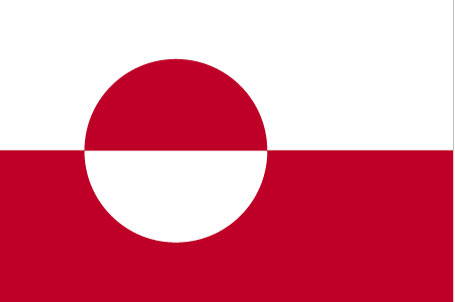
Greenland
Kalaallit Nunaat
Declare Your Relationship to Greenland
CountryReports Community
- Studying7
- From Greenland1
- Greenland heritage2
- Visited1
- Want to visit6
Customs and Culture
Customs and Culture
Cultural Attributes
Greenland's culture is deeply shaped by its Inuit heritage, Arctic environment, and its long political relationship with Denmark. The majority of the population identifies as Greenlandic Inuit, and the Kalaallisut language — a West Greenlandic Inuit dialect — serves as the official language alongside Danish. This linguistic identity is central to cultural pride and has been actively promoted through education and public life since Greenland gained Home Rule from Denmark in 1979 and expanded Self-Rule in 2009. Traditional Inuit practices remain a meaningful part of daily life, particularly in smaller settlements. Hunting and fishing are not only economic activities but cultural cornerstones. Seal hunting, in particular, carries deep cultural significance, providing food, materials for clothing, and a connection to ancestral ways of life. The kayak, originally developed by Greenlandic Inuit, is still used and celebrated as a symbol of indigenous ingenuity and skill. Greenlandic arts reflect the landscape and spiritual traditions of the Arctic. Drum dancing, one of the oldest Inuit art forms, is performed at cultural festivals and community gatherings. Throat singing, stone carving, and the creation of traditional garments known as national costumes — worn proudly during celebrations such as Greenland's National Day on June 21 — are visible expressions of cultural identity. The national costume, called the kalaallisuut, features intricate beadwork and is considered a mark of cultural distinction. Christianity, specifically Lutheranism introduced by Danish missionaries in the 18th century, is the predominant religion and has become interwoven with local traditions. The Greenlandic Lutheran Church conducts services in Kalaallisut, reinforcing the language's role in spiritual life. Storytelling, known as oqaatsit, has historically served as the primary means of transmitting knowledge, moral values, and history across generations. Contemporary Greenlandic artists and writers increasingly blend these oral traditions with modern media, contributing to a cultural renaissance that seeks to preserve indigenous identity while engaging with the wider world.

The World's Largest Island, Untamed and Pure
Get More Customs and Culture
4 more cultural topics for members
Social Customs & Etiquette · Family · Dating Customs · Recreation
Every country, every topic, all activities & recipes
✓ Instant access on this device · ✓ No subscription
Holidays
Christmas
12/25Christmas
Dates of Interest
- December 25th
How do people greet each other in Greenland?
Everyday greetings mix Kalaallisut and Danish, with a modest handshake standard for first meetings and warmer embraces or cheek kisses among close friends and family.
Do
- Try a friendly "Aluu" (hi) or ask "Kutaa?" (how are you?) with friends
- Use Danish greetings like "Hej" or "Goddag" in urban centers such as Nuuk, Sisimiut, and Ilulissat
- Offer a handshake for formal introductions
- Make eye contact as a sign of sincerity
Don’t
- Don't use the intimate kunik greeting with strangers or acquaintances
- Avoid boastful or aggressive self-introductions
- Don't hold an intense or extended stare, which can seem confrontational
Good to know
- Even a small effort to greet locals in Kalaallisut is warmly received
- Speak in measured tones; humility and respect are valued
What should I wear in Greenland?
Everyday dress is practical and weather-appropriate, resembling northern European style, while the traditional national costume is reserved for special occasions.
Do
- Wear heavy parkas, insulated boots, wool layers, and waterproof outerwear for the Arctic climate
Good to know
- Larger towns stock international and Scandinavian fashion brands
- The women's kalaallisut costume features beaded collars, sealskin kamik boots, and embroidered anoraks, worn for holidays, weddings, and celebrations
- Sealskin remains an important material in both traditional and contemporary Greenlandic clothing
What gestures should I know in Greenland?
Greenlandic communication favors restraint and subtle facial cues, reflecting a strong value on social harmony and avoiding confrontation.
Do
- Gesture toward things with an open hand or a nod
- Keep calm, measured body language
- Observe local cues and remain patient
Don’t
- Don't point directly at people, especially in traditional communities
- Avoid loud or exaggerated gestures, seen as disrespectful by older generations
- Don't use overbearing physical contact with people you don't know well
Good to know
- An eyebrow raise can mean "yes" and a slight nose wrinkle can mean "no"
- The kunik (nose-and-lip press with an inhale) is reserved for close family, especially parents and young children
What is family life like in Greenland?
Family life centers on close-knit community bonds and extended networks, though smaller nuclear families are increasingly common in urban centers.
Good to know
- Children are highly valued, and naming babies after deceased relatives remains meaningful
- Community interdependence stays strong in smaller towns through shared resources, hunting, and fishing
- Children start school at age six in the Danish-modeled Folkeskole, learning both Kalaallisut and Danish
What do people do for recreation in Greenland?
Recreation blends traditional Arctic pursuits like hunting, fishing, dog sledding, and kayaking with modern sports such as football and cross-country skiing.
Good to know
- Dog sledding is both winter transport and sport, including the ~1,000 km Avannaata Qimussersua race
- Football is the most popular organized team sport, run by the Greenland Football Association since 1971
- Traditional qajaq (kayak) rolling competitions celebrate Inuit heritage
- Tasermiut Fjord in the south draws international rock climbers and hikers
- Greenland regularly competes in the Arctic Winter Games
What should I know before visiting Greenland?
Greenland is a remote Arctic destination reached mainly by air, with high costs and rapidly changing weather; a valid passport is required and most travelers need no visa under Danish rules.
Do
- Plan carefully, as costs are high due to remoteness and import dependency
- Bring a valid passport
Good to know
- Summer (June–August) offers the midnight sun, milder temperatures, hiking, boat tours, and whale watching
- Winter (November–February) offers the northern lights, dog sledding, and ice fishing
- Travel between towns is by small aircraft or helicopter with Air Greenland, plus summer ferries on the west coast
- Most international flights connect through Copenhagen or Reykjavik
- Weather can change rapidly and disrupt transportation
- Highlights include Nuuk, the Ilulissat Icefjord (a UNESCO site), Qaqortoq, and Tasiilaq
Last updated: 2026-07-12 · Sources: CountryReports
Photos of Greenland
Photos of Greenland
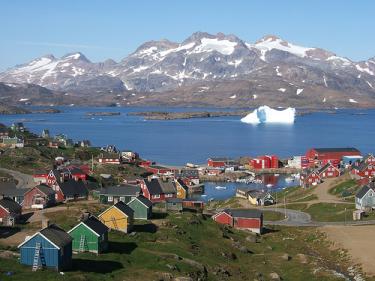
Tasiilaq and Iceberg
Tasiilaq
Iceberg in the Bay at Tasiilaq
Iceberg
Soccer
Greenlandic Buffet by the Kangerlussuaq Tourism Board
Greenlandic Buffet by the Kangerlussuaq Tourism Board
Santa - Christmas decoration
Santa bringing presents to the sick kids at hospital
Santa visitng a hospital and orphanage.
Christmas tree in a Nuuk roundabout.


Travel and Tourism
Travel and Tourism
- Currency
- Danish krone (DKK)
- Time Difference
- UTC-2 (3 hours ahead of Washington, DC, during Standard Time) Time zone note: Greenland has four time zones
- Airports
- 14
Read the full travel guide — health, safety, vaccinations, disease risk, sanitation, and transit details.
View full travel guideHistory
History
Historical Eras
Paleo-Eskimo Cultures
2500 BCE – 986
Greenland's earliest inhabitants arrived from the Canadian Arctic in successive waves, including the Saqqaq, Dorset, and Independence cultures. These Paleo-Eskimo peoples developed sophisticated adaptations to the Arctic environment over millennia. The last of these pre-Norse cultures had largely disappeared by the time Viking settlers arrived in the late 10th century.
Norse Settlement
986 – 1500
Erik the Red, exiled from Iceland, discovered and named Greenland around 982 CE and led the first permanent Norse settlements beginning in 986, establishing the Eastern and Western Settlements. At its peak, the Norse population numbered several thousand and maintained trade ties with Europe. By approximately 1400–1500, all Norse colonies had vanished, likely due to a combination of climate cooling, economic decline, and conflict with Inuit peoples.
Inuit Dominance
1500 – 1721
Following the collapse of Norse settlements, Greenland was inhabited solely by Thule culture Inuit, ancestors of the modern Greenlandic people, who had migrated from the northwest from around 1200 onward. European whalers and explorers made sporadic contact during this period, including English expeditions under Martin Frobisher and John Davis. Greenland remained beyond effective European colonial control until the 18th century.
Danish Colonial Era
1721 – 1953
In 1721, Norwegian-Danish missionary Hans Egede established a Lutheran mission and trading post, inaugurating formal Danish colonization. The Danish crown assumed a full trade monopoly in 1776, tightly controlling Greenland's economy. During World War II the United States assumed protective custody of the island, and in 1953 a constitutional amendment formally made Greenland an integral county of the Kingdom of Denmark, ending its colonial status.
Danish County & EEC
1953 – 1979
As a Danish county from 1953, Greenland gained representation in the Folketing but saw significant social disruption, including the forced relocation of Inuit hunters from ancestral lands in the far north. Greenland joined the European Community alongside Denmark in 1973, though fishing quota disputes quickly generated public resentment. Growing Greenlandic political consciousness and demands for self-determination laid the groundwork for home rule.
Home Rule & Self-Government
1979 – present
Greenland was granted home rule on May 1, 1979, establishing the Landsting parliament and the Landsstyre government with broad domestic policy authority. Greenlanders voted to withdraw from the European Community in 1982, completing the exit in 1985. Expanded self-government was granted in 2009, transferring additional powers to Nuuk while Denmark retained control over foreign affairs, defense, and currency, amid ongoing discussions about full independence.
Overview
Greenland, the world’s largest island, is about 81% ice-capped. Vikings reached the island in the 10th century from Iceland;
Every country, every topic, all activities & recipes
✓ Instant access on this device · ✓ No subscription
Timeline of Key Events
982
Eric the Red (Eiric Rauthornpi), father of Leif Ericson, discovered Greenland.
Eric the Red (Eiric Rauthornpi), father of Leif Ericson, discovered Greenland.
986
Eric the Red and his followers began to settle Greenland.
Eric the Red and his followers began to settle Greenland.
986 – 1000
Eric the Red and his followers began to settle Greenland.
More settlers arrive from Scandinavia and they gradually settle the Southwest coast of Greenland from Cape Farewell to present-day Nuuk. The Norse population center around two major settlements, the Western and the Eastern.
1000
Eric the Red and his followers began to settle Greenland.
Leif Eriksson, son of Erik the Red, returns to Greenland from Norway, bringing along the first Christian missionary. Soon hereafter, the first Christian church on the North American continent, Thjódhildur’s Church, is built at Brattahlid.
1350 – 1360
Eric the Red and his followers began to settle Greenland.
Ivar Bardarsson, an Icelandic clerical official, reports the Western Settlement abandoned. Inuit begin to appear near the Norse areas, settling along the coastline.
1600
By this time all Norse settlements in Greenland have vanished.
By this time all Norse settlements in Greenland have vanished. The only inhabitants are Inuit.
1776
Danish government assumes a full monopoly of trade with Greenland.
Danish government assumes a full monopoly of trade with Greenland.
Read the full history profile — narrative overview, defining eras, and the complete timeline in one place.
View expanded historyInteresting Facts
Interesting Facts
The world's largest island is Greenland which is 840,000 square miles. The coastline is 24,4000 miles long and the island stretches about 1,660 miles long
Greenland is one of the least inhabited areas of the world. There are only about 150 towns and villages in all of Greenland. There are no railroads, few roads, and not many cars. People usually travel by plane, helicopter or dog sled.
See every fact — trivia, oddities, and curious tidbits gathered from across the country.
View all interesting factsGeography and Environment
Geography and Environment
- Terrain
- flat to gradually sloping icecap covers all but a narrow, mountainous, barren, rocky coast
- Climate
- arctic to subarctic; cool summers, cold winters
- Natural Hazards
- continuous permafrost over northern two-thirds of the island
- Current Environmental Issues
- protection of the arctic environment; preservation of the Inuit traditional way of life, including whaling and seal hunting
Read the full geography and environment profile — terrain, climate, natural resources, hazards, land use, and international agreements.
View full geographyPeople & Demographics
People & Demographics
Languages Spoken
Greenlandic (East Inuit), Danish, English
- Danish
- Greenlandic
Population
- Population
- 56,370
- Population in Major Urban Areas
- NUUK (capital) 16,000
- Nationality Noun
- Greenlander(s)
- Ethnic Groups
- Greenlander 88% (Inuit and Greenland-born whites), Danish and others 12%
Life Expectancy
- Life Expectancy at Birth
- Life expectancy at birth in Greenland stands at approximately 73 years overall, with notable differences between male and female populations. Women in Greenland can expect to live to around 76 years, while men have a life expectancy of closer to 70 years — a gap that reflects broader patterns seen across Arctic and subarctic populations. These figures place Greenland notably below the averages of neighboring Denmark, which administers the island as an autonomous territory, where life expectancy exceeds 81 years. The disparity highlights the unique social and environmental challenges that shape health outcomes in one of the world's most remote and sparsely populated territories. Several factors contribute to Greenland's life expectancy profile. The island faces significant public health challenges, including persistently high rates of suicide, particularly among young men, which measurably impact average lifespan statistics. Substance abuse, limited access to specialized medical care in remote communities, and a high prevalence of certain chronic diseases — including cardiovascular conditions — also weigh on overall health outcomes. Geographic isolation plays a meaningful role as well. Many of Greenland's small settlements are accessible only by helicopter or boat, making timely emergency medical response and routine specialist care difficult to provide consistently. The concentration of more advanced healthcare services in the capital, Nuuk, means residents of outlying towns and villages often face significant barriers to receiving care. On the positive side, Greenland benefits from a strong tradition of physical activity tied to its Indigenous Greenlandic Inuit culture and hunting lifestyle, and the population has access to a publicly funded healthcare system. Nutritional patterns, however, continue to shift with increased access to imported processed foods, which has introduced new diet-related health risks alongside the traditional reliance on marine mammals and fish. Life expectancy has improved gradually over recent decades as healthcare infrastructure has expanded, but closing the gap with broader European standards remains an ongoing public health priority for Greenlandic authorities.
- Infant Mortality Rate
- Greenland's infant mortality rate has shown meaningful improvement over recent decades, reflecting broader advances in healthcare access and public health infrastructure across the territory. As of the most recent available data, Greenland's infant mortality rate stands at approximately 8 to 9 deaths per 1,000 live births, a figure that places it notably higher than its administrative parent country, Denmark, which consistently records one of the lowest infant mortality rates in the world at around 3 to 4 per 1,000 live births. The disparity between Greenland and Denmark highlights the persistent challenges of delivering consistent healthcare services across a vast, sparsely populated Arctic territory. Greenland covers an area of over 2 million square kilometers but is home to fewer than 57,000 people, many of whom live in remote communities accessible only by helicopter, boat, or small aircraft. This geographic isolation makes timely medical intervention during pregnancy and childbirth considerably more difficult than in more densely populated regions. Prenatal care and maternal health services are concentrated primarily in the capital, Nuuk, and a handful of larger towns. Residents of smaller settlements may need to travel significant distances to access specialist care, which can complicate outcomes for both mothers and newborns. The Greenlandic health system, managed through the government of Greenland in cooperation with Danish health authorities, has worked to expand telehealth services and improve the capacity of regional health centers to address this challenge. Factors such as higher rates of smoking among pregnant women, limited access to specialized neonatal care, and socioeconomic inequalities within Greenlandic communities also contribute to the elevated infant mortality rate compared to Western European averages. Indigenous Greenlandic Inuit populations, who make up the majority of the population, have historically faced greater health disparities, a pattern observed in many Arctic Indigenous communities worldwide. Despite these challenges, the long-term trend has been one of gradual improvement, driven by investments in maternal healthcare education, improved nutrition programs, and expanded healthcare infrastructure throughout the territory.
Read the full people and society profile — demographics, health, education, religion, languages, and notable people.
View full people and societyGovernment & Politics
Government & Politics
Country Identity
- Country Name
- Greenland
- Local - Short
- Kalaallit Nunaat
Government Structure
- Government Type
- parliamentary democracy within a constitutional monarchy
- Legal System
- Danish
- Executive Branch
- chief of state: King FREDERIK X of Denmark (since 14 January 2024), represented by High Commissioner Julie Praest WILCHE (since 2022) head of government: Prime Minister Mute B. EGEDE (since 23 April 2021) cabinet: Naalakkersuisut (Government of Greenland) is appointed by the prime minister and is accountable to the parliament (Inatsisartut) elections: the monarchy is hereditary; high commissioner appointed by the monarch; prime minister is elected by the Inatsisartut (usually the leader of the majority party or coalition); election last held on 6 April 2021 election results: Mute B. EGEDE elected prime minister following his party's victory in the April 2021 parliamentary election note: government coalition led by Inuit Ataqatigiit (IA); Greenland exercises self-rule under the 2009 Act on Greenland Self-Government, granting broad autonomy from Denmark while remaining part of the Kingdom of Denmark
- Legislative Branch
- unicameral Parliament or Inatsisartut (31 seats; members are elected by popular vote on the basis of proportional representation to serve four-year terms) elections: last held on 6 April 2021 (next to be held in 2025) election results: percent of vote by party - Inuit Ataqatigiit 36.6%, Siumut 29.4%, Naleraq 12.4%, Demokraatit 9.8%, Atassut 7.6%, other 4.2%; seats by party - Inuit Ataqatigiit 12, Siumut 10, Naleraq 4, Demokraatit 3, Atassut 2 note: two representatives are elected to the Danish Parliament or Folketing; seats by party - Siumut 1, Inuit Ataqatigiit 1
- Judicial Branch
- High Court or Landsret (appeals can be made to the Ostre Landsret or Eastern Division of the High Court or Supreme Court in Copenhagen)
- Suffrage
- 18 years of age; universal
- Constitution
- 5 June 1953 (Danish constitution)
- Independence
- none (part of the Kingdom of Denmark; self-governing overseas administrative division of Denmark since 1979)
- National Holiday
- June 21 (longest day)
Capital City
- Capital Name
- Nuuk (Godthaab)
- Capital - geographic coordinate
- 64 11 N, 51 45 W
- Capital Time Difference
- UTC-2 (3 hours ahead of Washington, DC, during Standard Time) Time zone note: Greenland has four time zones
"Nuuk" is the Inuit word for "cape" and refers to the city's position at the end of the Nuup Kangerlua fjord
Military
Branches: No regular military forces
Read the full government profile — flag symbolism, national anthem, and other national symbols.
View full government detailsEconomy
Economy
Greenland's economy is small, open, and heavily dependent on a few key sectors, with fishing serving as the dominant industry.
Snapshot
- Currency Name and Code
- Danish Krone (DKK)
- GDP Real Growth Rate
- 1.5%
Every country, every topic, all activities & recipes
✓ Instant access on this device · ✓ No subscription
News & Weather
News & Weather
Current Weather
Latest News
Trump signs US-Denmark-Greenland agreement to bolster Arctic security after prolonged tensions - AP News
AP News · 1d ago
How to Say ‘Stop Invading Greenland’ With Reindeer Sausage - The Atlantic
The Atlantic · 14h ago
Three things to know about Trump’s Greenland deal - Atlantic Council
Atlantic Council · 20h ago
What to know about the agreement signed by President Trump and the leaders of Denmark and Greenland - AP News
AP News · 9h ago
Trump signs 'tremendous' Greenland security deal - dw.com
dw.com · 17h ago
WATCH: Trump signs agreement with leaders of Denmark and Greenland - PBS
PBS · 1d ago
US, Greenland, Denmark sign deal in bid to end Arctic standoff - Reuters
Reuters · 2d ago
Understanding Trump's Deal With Denmark—and What It Means for Greenland's Sovereignty - Time Magazine
Time Magazine · 1d ago
News via Google News
Frequently Asked Questions
Frequently Asked Questions
What is the population of Greenland?
What is the capital of Greenland?
Where is Greenland located?
What are Greenland's ocean and sea borders?
What currency is used in Greenland?
What languages are spoken in Greenland?
What is the geography of Greenland like?
What is Greenland known for?
Who governs Greenland?
Last reviewed 2026