
 English
 Español
 中文
中文 हिन्दी
 Français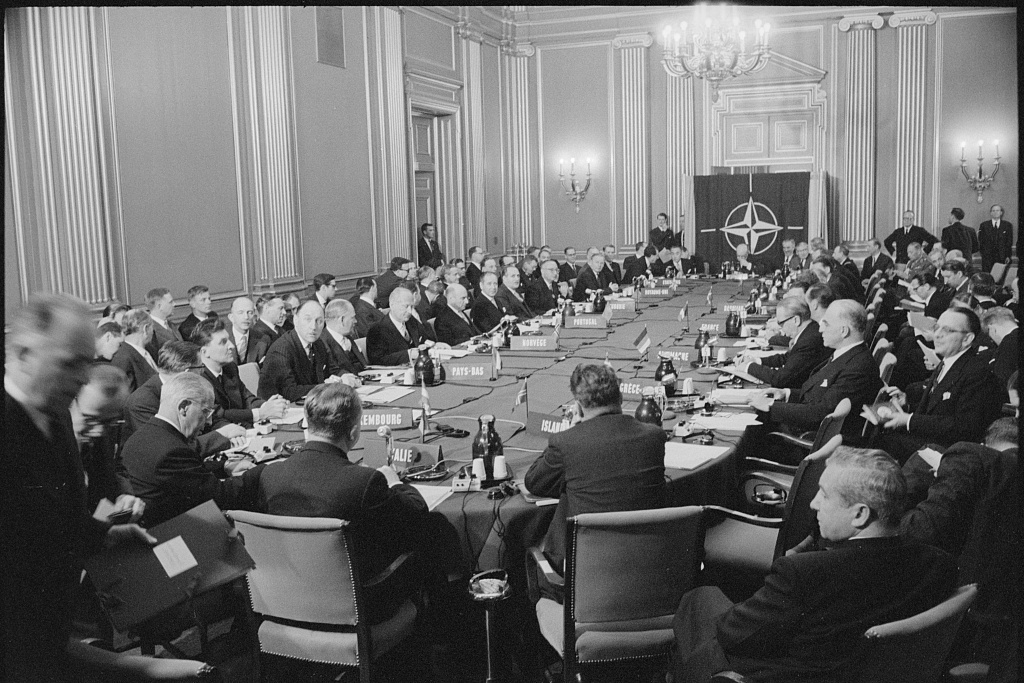
NATO (North Atlantic Treaty Organization)
A transatlantic political and military alliance founded in 1949 and built on the principle of collective defense.
The North Atlantic Treaty Organization, commonly known as NATO, is a transatlantic political and military alliance of thirty-two member states drawn from North America and Europe. Founded on April 4, 1949 by the signing of the North Atlantic Treaty in Washington, D.C., the alliance is built on the principle of collective defense codified in Article 5 of the treaty, under which an armed attack against one member is considered an attack against all. Over more than seven decades, NATO has evolved from a Cold War deterrent directed at the Soviet Union into a broader instrument of crisis management, cooperative security, and political consultation among the world's liberal democracies.
Overview
NATO was established in the immediate aftermath of the Second World War to bind the United States, Canada, and the democracies of Western Europe into a permanent security community. Its founding treaty was signed in Washington, D.C., on April 4, 1949, by twelve original member states. The organization has its political headquarters in Brussels, Belgium, and its military nerve center, the Supreme Headquarters Allied Powers Europe (SHAPE), at Mons in southern Belgium. Membership has grown in ten successive waves of enlargement to thirty-two states, most recently with the accession of Finland in 2023 and Sweden in 2024.
The alliance is governed by consensus among the member states through the North Atlantic Council, chaired by the Secretary General, a senior civilian diplomat chosen by common agreement of the allies. The Military Committee, composed of the chiefs of defense of the member states, provides military advice to the council and directs the work of NATO's two strategic commands: Allied Command Operations, led from SHAPE by the Supreme Allied Commander Europe, and Allied Command Transformation, led from Norfolk, Virginia, by the Supreme Allied Commander Transformation. National armed forces remain under national control in peacetime but are trained, exercised, and, where necessary, employed together under NATO command.
Although NATO was created as a defensive alliance and its founding treaty describes a limited geographic area of application, its activities now extend well beyond the territory of its members. The alliance has undertaken operations in Kosovo, Afghanistan, the Mediterranean Sea, off the Horn of Africa, and in Iraq, and it maintains partnerships with more than forty countries around the world, including dialogue with neighbors in the Mediterranean, Middle East, and Indo-Pacific. Since the full-scale Russian invasion of Ukraine in February 2022, the alliance has returned to its core deterrence and defense mission with renewed intensity, reinforcing its eastern flank and revising its strategic concept.
Key Facts
- Founded
- April 4, 1949 (North Atlantic Treaty signed in Washington, D.C.)
- Headquarters
- Brussels, Belgium (political); SHAPE, Mons, Belgium (military)
- Member states
- 32 (as of 2024, following the accession of Sweden)
- Original members (1949)
- United States, United Kingdom, France, Canada, Italy, Netherlands, Belgium, Luxembourg, Denmark, Norway, Portugal, Iceland
- Secretary General
- Mark Rutte (Netherlands), since October 1, 2024
- Supreme Allied Commander Europe (SACEUR)
- A four-star United States general or admiral, based at SHAPE in Mons, Belgium. SACEUR is always an American officer, while the Secretary General is always a European.
- Active military personnel
- Approximately 3.5 million across allied armed forces (2024 estimate, drawn from national contributions)
- Defense spending target
- At least 2 percent of gross domestic product, as agreed at the 2014 Wales Summit; a majority of allies had met the target by 2024
- Article 5 invoked
- Once in NATO's history, on September 12, 2001, following the terrorist attacks on the United States the previous day
- Official languages
- English and French
- Current Strategic Concept
- Adopted at the Madrid Summit in June 2022; identifies Russia as the most significant and direct threat to allied security
Continue reading with a membership
Every country, every topic, all activities & recipes
✓ Instant access on this device · ✓ No subscription