
 English
 Español
 中文
中文 हिन्दी
 Français
Government and Politics
Government and Politics of Romania
Government structure, leadership, capital, military, and national symbols of Romania.
Government Structure
Constitutional foundations, branches, parties, and leadership.
- Government Type
- republic
- Administrative Divisions
- 41 counties (judete, singular - judet) and 1 municipality* (municipiu); Alba, Arad, Arges, Bacau, Bihor, Bistrita-Nasaud, Botosani, Braila, Brasov, Bucuresti*, Buzau, Calarasi, Caras-Severin, Cluj, Constanta, Covasna, Dimbovita, Dolj, Galati, Gorj, Giurgiu, Harghita, Hunedoara, Ialomita, Iasi, Ilfov, Maramures, Mehedinti, Mures, Neamt, Olt, Prahova, Salaj, Satu Mare, Sibiu, Suceava, Teleorman, Timis, Tulcea, Vaslui, Vilcea, Vrancea
- Legal System
- former mixture of civil law system and communist legal theory; is now based on the constitution of France's Fifth Republic
- Suffrage
- 18 years of age; universal
- Citizenship
- citizenship by birth: no citizenship by descent only: at least one parent must be a citizen of Romania dual citizenship recognized: yes residency requirement for naturalization: 5 years
- Executive Branch
- chief of state: President Klaus IOHANNIS (since 21 December 2014; reelected 24 November 2019) head of government: Prime Minister Marcel CIOLACU (since 15 June 2023) cabinet: Council of Ministers appointed by the prime minister and confirmed by Parliament elections: president elected by popular vote for a five-year term (eligible for a second term); prime minister appointed by the president with the consent of Parliament election results: In the November 2019 presidential runoff, Klaus IOHANNIS won reelection with approximately 66.1% of the vote, defeating challenger Viorica DANCILA who received approximately 33.9%
- Legislative Branch
- Bicameral Parliament or Parlament consists of the Senate or Senat (136 seats; members are elected by direct, popular vote on a proportional representation basis to serve four-year terms) and the Chamber of Deputies or Camera Deputatilor (330 seats; members are elected by direct, popular vote on a proportional representation basis to serve four-year terms) Elections: Senate - last held on 1 December 2024 (next expected to be held in December 2028); Chamber of Deputies - last held on 1 December 2024 (next expected to be held in December 2028) Election results: Senate - percent of vote by party - AUR 17.9%, PSD 16.4%, POT 14.4%, PNL 13.3%, USR 11.9%, UDMR 5.8%, other 20.3%; seats by party - AUR 31, PSD 24, POT 21, PNL 20, USR 16, UDMR 8, other 16; Chamber of Deputies - percent of vote by party - AUR 18.4%, PSD 15.8%, POT 14.2%, PNL 13%, USR 12.2%, UDMR 5.8%, other 20.6%; seats by party - AUR 65, PSD 54, POT 46, PNL 47, USR 40, UDMR 22, ethnic minorities and other 56
- Judicial Branch
- Supreme Court of Justice (comprised of 11 judges appointed for three-year terms by the president in consultation with the Superior Council of Magistrates, which is comprised of the minister of justice, the prosecutor general, two civil society representatives appointed by the Senate, and 14 judges and prosecutors elected by their peers); a separate body, the Constitutional Court, validates elections and makes decisions regarding the constitutionality of laws, treaties, ordinances, and internal rules of the Parliament; it is comprised of nine members serving nine-year terms, with three members each appointed by the president, the Senate, and the Chamber of Deputies
- Political Parties
- Conservative Party or PC [Dan VOICULESCU], formerly Humanist Party or PUR; Democratic Party or PD [Emil BOC]; Democratic Union of Hungarians in Romania or UDMR [Bela MARKO]; National Liberal Party or PNL [Calin Popescu-TARICEANU]; Romania Mare Party (Greater Romanian Party) or PRM [Corneliu Vadim TUDOR]; Social Democratic Party or PSD [Mircea Dan GEOANA], formerly Party of Social Democracy in Romania or PDSR
- Head of State
- President Klaus IOHANNIS (since 21 December 2014
- Head of Government
- Prime Minister Marcel CIOLACU
- Cabinet
- Council of Ministers appointed by the prime minister
- Elections
- Senate - last held on 1 December 2024 (next expected to be held in December 2028); Chamber of Deputies - last held on 1 December 2024 (next expected to be held in December 2028)
- Election Results
- Senate - percent of vote by party - AUR 17.9%, PSD 16.4%, POT 14.4%, PNL 13.3%, USR 11.9%, UDMR 5.8%, other 20.3%; seats by party - AUR 31, PSD 24, POT 21, PNL 20, USR 16, UDMR 8, other 16; Chamber of Deputies - percent of vote by party - AUR 18.4%, PSD 15.8%, POT 14.2%, PNL 13%, USR 12.2%, UDMR 5.8%, other 20.6%; seats by party - AUR 65, PSD 54, POT 46, PNL 47, USR 40, UDMR 22, ethnic minorities and other 56
- Constitution
- 8-Dec-91
- Independence
- 9 May 1877 (independence proclaimed from Turkey; independence recognized 13 July 1878 by the Treaty of Berlin; kingdom proclaimed 26 March 1881; republic proclaimed 30 December 1947)
- National Holiday
- Unification Day (of Romania and Transylvania), 1 December (1918)
- International Organization Participation
- ACCT, Australia Group, BIS, BSEC, CE, CEI, EAPC, EBRD, EU (applicant), FAO, G- 9, G-77, IAEA, IBRD, ICAO, ICC, ICCt, ICFTU, ICRM, IFAD, IFC, IFRCS, ILO, IMF, IMO, Interpol, IOC, IOM, ISO, ITU, LAIA (observer), MONUC, NAM (guest), NSG, OAS (observer), OPCW, OSCE, PCA, PFP, UN, UN Security Council (temporary), UNCTAD, UNESCO, UNIDO, UNMEE, UNMIK, UNMIL, UPU, WCL, WCO, WEU (associate partner), WFTU, WHO, WIPO, WMO, WToO, WTrO, ZC
- Diplomatic Representation in the U.S.
- chief of mission: Ambassador Sorin Dumitru DUCARU chancery: 1607 23rd Street NW, Washington, DC 20008 telephone: [1] (202) 332-4846, 4848, 4851 FAX: [1] (202) 232-4748 consulate(s) general: Chicago, Los Angeles, New York
- U.S. Diplomatic Representation
- chief of mission: Ambassador Nicholas F. TAUBMAN embassy: Strada Tudor Arghezi 7-9, Bucharest mailing address: American Embassy Bucharest, Department of State, 5260 Bucharest Place, Washington, DC 20521-5260 (pouch) telephone: [40] (21) 316-4052 FAX: [40] (21) 316-0395 branch office(s): Cluj-Napoca
Capital City
Seat of government and political history.
- Capital City
- Bucharest
- Location
- 44 26 N, 26 06 E
- Time Difference
- UTC+2 (7 hours ahead of Washington, DC, during Standard Time)
- History
- related to the Romanian word "bucura" that is believed to be of Dacian origin and whose meaning is "to be glad (happy)"; Bucharest's meaning is thus akin to "city of joy"
Embassy and Diplomatic Representation
Embassy location and contact details.
U.S. Embassy Bucharest B-dul Dr. Liviu Librescu Nr. 4-6 Sector 1, Bucharest 015118 Romania Telephone: (40) 21 200-3300 and/or (40) 21 270-6000 Emergency after-hours telephone: (40) 21 200-3433 Fax: (40) 21 200-3578 Email: ACSBucharest@state.gov
Military
Branches, service obligations, expenditures, and manpower.
- Military Branches
- Land Forces, Naval Forces (Fortele Naval, FN), Romanian Air Force (Fortele Aeriene Romane, FAR)
- Service Age and Obligation
- 20-35 years of age for compulsory male military service; conscription ended 2006, but military service remains mandatory; 18 years of age for male and female voluntary service; all military inductees (including women) contract for an initial 5-year term of service, with subsequent successive 3-year terms until age 36
National Symbols
Flag, anthem, and other symbols of national identity.
National Flag
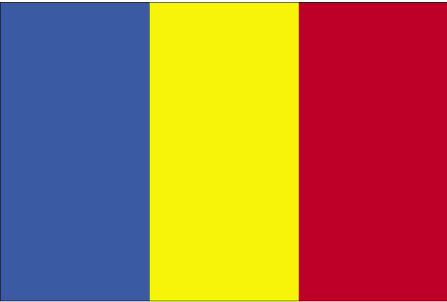
- Flag Symbolism
- three equal vertical bands of blue (hoist side), yellow, and red; the national coat of arms that used to be centered in the yellow band has been removed; now similar to the flag of Chad, also resembles the flags of Andorra and Moldova
- Date of Adoption
- 27 December 1989
National Anthem
- Anthem Lyrics
- Desteapta-te, Romane! Desteapta-te, romane, din somnul cel de moarte, In care te-adancira barbarii de tirani! Acum ori niciodata croieste-ti alta soarte, La care sa se-nchine si cruzii tai dusmani! Acum ori niciodata sa dam dovezi in lume Ca-n aste mani mai curge un sange de roman, Si ca-n a noastre piepturi pastram cu fala-un nume Triumfator in lupte, un nume de Traian! Priviti, marete umbre, Mihai, Stefan, Corvine, Romana natiune, ai vostri stranepoti, Cu bratele armate, cu focul vostru-n vine, Viata-n libertate ori moarte! striga toti. Preoti, cu crucea-n frunte! caci oastea e crestina, Deviza-i libertate si scopul ei preasfant, Murim mai bine-n lupta, cu glorie deplina, Decat sa fim sclavi iarasi in vechiul nost' pamant!
- Anthem Lyrics (English)
- Awaken Thee, Romanian! Awaken thee, Romanian, shake off the deadly slumber The scourge of inauspicious barbarian tyrannies And now or never to a bright horizon clamber That shall to shame put all your nocuous enemies. Its now or never to the world we readily proclaim In our veins throbs and ancestry of Roman And in our hearts for ever we glorify a name Resounding of battle, the name of gallant Trajan. Do look imperial shadows, Michael, Stephen, Corvinus At the Romanian nation, your mighty progeny With arms like steel and hearts of fire impetuous Its either free or dead, thats what they all decree. Priests, rise the cross, this Christian armys liberating The word is freedom, no less sacred is the end Wed rather die in battle, in elevated glory Than live again enslaved on our ancestral land.
Other National Symbols
Coat of Arms
Put Description here... With all peoples the national coat of arms - the supreme heraldic sign - is of special importance. Its images evoke history, through it tradition remains alive, while its bearings awaken the national feeling. In most states’ coats of arms, the bearings are devoted to the specific national past and are commonly recognised by citizens. Such lofty symbols however are not established only by laws and decrees. They are equally the melting pot for the citizens’ ideas and aspirations, for their common thoughts. In Romania the preoccupation with a representative, synthetic coat of arms dates back to the 19th century. It led to the formation of a fine team of heraldry specialists rallying outstanding Romanian scientific figures. As the State Archives were set up and sigillography studies developed, the heraldry experts identified the coats of arms of districts, provinces, the heraldic bearings of the big landowners, a.o. After 1859 (when Wallachia and Moldavia united into one state) the question of a representative coat of arms arose. In 1863 the solution was found of joining the ancient, traditional symbols of Wallachia (the golden eagle with cross) and Moldavia (the auroch with a star between its horns). Later (1872), Romania’s heraldry commission proposed a synthetic coat of arms that combined the traditional symbols of all the Romanian provinces: Wallachia, Moldavia, Bukovina, Transylvania, Maramures, Crisana, Banat and Oltenia. The coat of arms was adopted by the Government of Romania and was in use until 1921 when, following the great Union of December 1, 1918, the new coat of arms of Greater Romania was devised, with the addition of the symbols instituted in 1872: the insignia of the House of Hohenzollern (a European royal house with origins in the early Middle Ages, which gave Romania four kings, the first of whom - Carol I, 1866-1914 - was the one that raised the country to the rank of a kingdom in 1881), the crown of Romania (made from the steel of a cannon captured at Pleven, during the 1877-1878 Independence War through which the country, by the valour of the Romanian soldiers, won its independence from the Ottoman Empire) and two face-to-face dolphins with their tails up, symbolising the Black Sea. The coat of arms of Greater Romania was replaced in 1947, when the Romanian People’s Republic was proclaimed under pressure from the Soviet occupation troops, with a decorative effigy symbolising the country’s riches guarded by ears of wheat and a rising sun as a background as well as a red star in the chief. Immediately after the 1989 Revolution, the idea came up of giving Romania a new, representative coat of arms. In fact, the very symbol of the Revolution was the flag with a hole in its middle wherefrom the communist coat of arms had been cut out. The heraldic commission set up to design a new coat of arms for Romania worked intensely, subjecting to Parliament two final designs which were then combined. What emerged is the current design adopted by the two Chambers of Romania’s Parliament in their joint session of September 10, 1992. Romania’s coat of arms has as a central element the golden eagle with cross. Traditionally, this eagle appears in the arms of the Arges county, the town of Pitesti and the town of Curtea de Arges. It stands for the “nest of the Basarabs,” the nucleus around which Wallachia, was organised, the province that determined the historical fate of the whole Romania. The eagle, being the symbol of Latinity and a heraldic bird of the first order, symbolises courage, determination, the soaring toward great heights, power, grandeur. It is to be found also in Transylvania’s coat of arms. The shield on which it is placed is azure, symbolising the sky. The eagle holds in its talons the insignia of sovereignty: a sceptre and a saber, the latter reminding of Moldavia’s ruler, Stephen the Great (1456-1504), also called “Christ’s athlete” whereas the sceptre reminds of Michael the Brave (1593-1601), the first unifier of the Romanian Countries. On the bird’s chest there is a quartered escutcheon with the symbols of the historical Romanian provinces (Wallachia, Moldavia, Transylvania, Banat and Crisana) as well as two dolphins reminding of the country’s Black Sea Coast. In the first quarter there is again Wallachia’s coat of arms on azure: an eagle or holding in its beak a golden Orthodox cross, accompanied by a golden sun on the right and a golden new moon on the left. In the second quarter there is Moldavia’s traditional coat of arms, gules: an auroch head sable with a mullet of or between its horns, a cinquefoil rose on the dexter and a waning crescent on the sinister, both argent. The third quarter features the traditional coat of arms of Banat and Oltenia, gules: over waves, a golden bridge with two arched openings (symbolising Roman emperor Trajan’s bridge over the Danube), wherefrom comes a golden lion holding a broadsword in its right forepaw. The fourth quarter shows the coat of arms of Transylvania with Maramures and Crisana: a shield parted by a narrow fesse, gules; in the chief, on azure, there is an eagle sable with golden beak coming out of the fesse, accompanied by a golden sun on the dexter and a crescent argent on the sinister; on the base, on or, there are seven crenellated towers, placed four and three. Also represented are the lands adjacent to the Black Sea, on azure: two dolphins affronts, head down.