
 English
 Español
 中文
中文 हिन्दी
 Français
Government and Politics
Government and Politics of Norfolk Island
Government structure, leadership, capital, military, and national symbols of Norfolk Island.
Government Structure
Constitutional foundations, branches, parties, and leadership.
- Government Type
- NA
- Administrative Divisions
- none (territory of Australia)
- Legal System
- based on the laws of Australia, local ordinances and acts; English common law applies in matters not covered by either Australian or Norfolk Island law
- Suffrage
- 18 years of age; universal
- Citizenship
- see Australia
- Executive Branch
- chief of state: King CHARLES III (since 8 September 2022); represented by Administrator George PLANT (since 1 July 2023) head of government: Assembly President and Chief Minister Andre NOBBS; the Chief Minister is elected by and from the members of the Norfolk Island Regional Council cabinet: The Norfolk Island Regional Council replaced the former Legislative Assembly following the 2015 restructuring of Norfolk Island's governance under Australian federal administration; the council handles local government matters while broader administrative authority rests with the Commonwealth of Australia through the appointed Administrator elections: the monarch is hereditary; administrator appointed by the Governor-General of Australia; following the abolition of the Norfolk Island Legislative Assembly in 2015, the island transitioned to a regional council model under the Norfolk Island Legislation Amendment Act 2015, significantly reducing the territory's self-governing powers; council elections are held periodically in accordance with Australian local government frameworks election results: The 2015 governance reforms were contentious among many Norfolk Island residents, who had previously enjoyed a higher degree of self-government; advocates for restored autonomy continue to engage with Australian federal authorities on the matter
- Legislative Branch
- Norfolk Island previously had its own unicameral Legislative Assembly, consisting of 9 seats. Members were elected under a unique voting system in which electors held nine equal votes each, with no more than four votes allocable to any single candidate. Members served three-year terms, and all seats were held by independents, as no formal political parties operated on the island. However, Norfolk Island's governance structure underwent significant change following the Norfolk Island Legislation Amendment Act 2015, passed by the Australian federal government. This legislation effectively abolished the Norfolk Island Legislative Assembly and ended the island's self-governing status. Since 1 July 2016, Norfolk Island has been governed more directly as an Australian external territory, with a regional council — the Norfolk Island Regional Council — taking over local administrative functions. The council consists of five elected members serving four-year terms. Federal and state-level legislative matters are now handled by the Australian Parliament, and Norfolk Island residents became eligible to vote in Australian federal elections from 2016 onward.
- Judicial Branch
- Supreme Court; Court of Petty Sessions
- Political Parties
- none
- Head of State
- King CHARLES III
- Head of Government
- Assembly President and Chief Minister Andre NOBBS
- Election Results
- Norfolk Island operates under a unique administrative arrangement as an Australian external territory, and its electoral framework reflects this status. The island does not hold elections for a sovereign national government; instead, it participates in two distinct democratic processes: elections for the Norfolk Island Regional Council and participation in Australian federal elections. The Norfolk Island Regional Council was established in July 2016 following the Australian government's decision to abolish the former Norfolk Island Legislative Assembly, which had provided the island with a degree of self-governance since 1979. The Regional Council consists of five elected members who serve four-year terms and handle local government matters such as community services, infrastructure, and land management. Council elections are conducted in accordance with Australian electoral law, with the Australian Electoral Commission overseeing the process. In the most recent Norfolk Island Regional Council election held in May 2021, candidates stood as independents rather than under formal party affiliations, which has historically been the norm for local island politics. Voter participation tends to be relatively high given the island's small population of approximately 2,200 people, and community members are generally well acquainted with the candidates personally. Since the 2016 administrative changes, Norfolk Island residents who hold Australian citizenship are also eligible to vote in Australian federal elections, including elections for the House of Representatives and the Senate. Norfolk Island falls within the Australian Electoral Division of Bean in the Australian Capital Territory for Senate purposes, integrating the island's electorate into the broader Australian democratic system. The transition from a self-governing legislative assembly to a regional council model was controversial among many Norfolk Islanders, with critics arguing it significantly reduced the island's political autonomy. Advocacy groups have continued to campaign for restored self-governance, citing the island's distinct cultural identity, particularly its Pitcairner heritage and the recognized Norf'k language. This ongoing debate over the appropriate level of self-determination remains a defining feature of Norfolk Island's political landscape.
- Constitution
- Norfolk Island Act of 1979
- Independence
- none (territory of Australia)
- National Holiday
- Pitcairners Arrival Day, 8 June (1856)
- International Organization Participation
- none
- Diplomatic Representation in the U.S.
- none (territory of Australia)
- U.S. Diplomatic Representation
- none (territory of Australia)
Capital City
Seat of government and political history.
- Capital City
- Kingston
- Location
- 29 03 S, 167 58 E
- Time Difference
- UTC+11 (16 hours ahead of Washington, DC, during Standard Time)
- History
- the name is a blending of the words "king's" and "town"; the British king at the time of the town's settlement in the late 18th century was GEORGE III
National Symbols
Flag, anthem, and other symbols of national identity.
National Flag
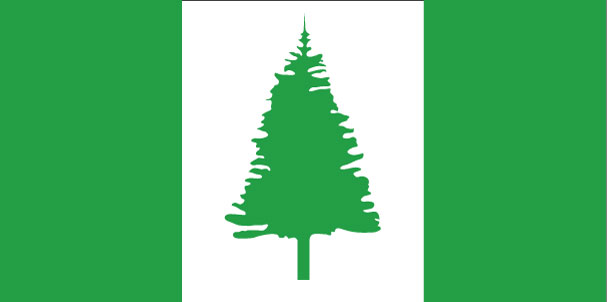
- Flag Symbolism
- three vertical bands of green (hoist side), white, and green with a large green Norfolk Island pine tree centered in the slightly wider white band
- Date of Adoption
- 17 January 1980
National Anthem
- Anthem History
- territory of Australia