
 English
 Español
 中文
中文 हिन्दी
 Français
Guinea
Guinee
Declare Your Relationship to Guinea
CountryReports Community
- Studying0
- From Guinea1
- Guinea heritage1
- Visited1
- Want to visit1
Customs and Culture
Customs and Culture
Cultural Attributes
Guinea is a culturally rich nation located in West Africa, home to more than 24 ethnic groups, each with distinct traditions, languages, and social customs. The three largest groups — the Fula (Peul), Malinke (Mandinka), and Susu — together account for the majority of the population and have profoundly shaped the country's cultural identity. Music and dance occupy a central place in Guinean society. Guinea is widely regarded as the birthplace of some of West Africa's most influential musical traditions, including the jeliya (griot) tradition, in which professional storytellers and musicians preserve oral history through song. The kora, a 21-string lute-harp, and the balafon, a wooden xylophone, are emblematic instruments. The Ballet Africains de Guinée, founded in 1958, brought Guinean performing arts to international audiences and remains a symbol of national cultural pride. Islam is the predominant religion, practiced by approximately 85 percent of the population, and it deeply influences daily life, social norms, dress, and calendrical celebrations such as Eid al-Fitr and Eid al-Adha. Traditional animist beliefs, however, continue to coexist with Islam in many communities, blending spiritual practices in ways that reflect the country's layered cultural heritage. Family and community are foundational values in Guinean culture. Extended family networks, known locally through kinship systems tied to clan lineages, govern many aspects of life including marriage arrangements, conflict resolution, and resource sharing. Hospitality is highly valued, and guests are typically welcomed with food, tea, and ceremony regardless of the host's economic means. Artisan crafts such as hand-woven textiles, leather goods, and wood carving are important both economically and culturally. The distinctive boubou, a flowing robe worn by both men and women, is the most common traditional garment and reflects regional variations in color and embroidery style. Oral tradition remains vital across generations, with storytelling functioning as a primary means of transmitting history, moral values, and community identity — particularly in rural areas where literacy rates remain lower than in urban centers.

Heartbeat of West Africa
Get More Customs and Culture
5 more cultural topics for members
Social Customs & Etiquette · Diet · Family · Dating Customs · Recreation
Holidays
Independence Day
10/2Independence Day
Dates of Interest
- October 2nd
How do people greet each other in Guinea?
Greetings often begin by asking about the well-being of each other's families, and people touch their right hand to their heart to show respect.
Do
- Ask about the other person's family when greeting
- Touch your right hand to your heart to show respect
- Greet reunited friends by placing hands on shoulders and touching cheeks three times
Don’t
- Don't shake hands with someone of the opposite gender, as this is usually avoided
What are the dining customs in Guinea?
Most Guineans eat the main meal at midday, with leftovers, porridge, bread, and tea in the evening.
Good to know
- Palm nut stew with white rice is a popular dish
- Palm nuts, from the African oil palm, are about the size of grapes and grow in large bunches
What should I wear in Guinea?
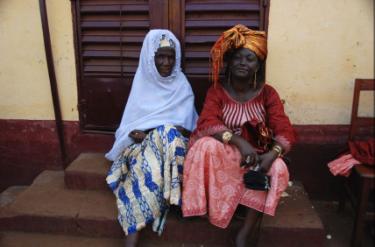
The boubou, a loose-fitting robe open on both sides for air circulation, is the most common garment for both men and women, worn with matching pants.
Do
- Women often wear matching turbans
- Men often wear Muslim skullcaps
Good to know
- Western-style clothing is becoming more common for businessmen
- Boubous vary in color and embroidery style by region
What is family life like in Guinea?
Family and community are foundational, with extended kinship networks governing marriage, conflict resolution, and resource sharing; under Muslim law men may have up to four wives.
Good to know
- Wives usually live in separate homes from their husband
- Children refer to their father's other wives as co-mères, or co-mothers
- Hospitality is highly valued, and guests are welcomed with food, tea, and ceremony
What do people do for fun in Guinea?
Football (soccer) is the most popular pastime, with children playing wherever they can, and basketball is popular at schools with hoops.
Good to know
- Music and dance are central to Guinean society, including the griot (jeliya) storytelling tradition
- The kora (21-string lute-harp) and balafon (wooden xylophone) are emblematic instruments
What should I know before visiting Guinea?
Guinea is home to more than 24 ethnic groups, with the Fula, Malinke, and Susu being the largest, and Islam is practiced by about 85 percent of the population.
Good to know
- Islam deeply influences daily life, dress, and celebrations like Eid al-Fitr and Eid al-Adha
- Traditional animist beliefs coexist with Islam in many communities
- Oral storytelling remains a vital way of passing on history and values, especially in rural areas
Last updated: 2026-07-12 · Sources: CountryReports
Photos of Guinea
Photos of Guinea


Travel and Tourism
Travel and Tourism
- Travel Alert Status
- Level 2: Exercise Increased Caution
- Currency
- Guinean franc (GNF)
- Time Difference
- UTC 0 (5 hours ahead of Washington, DC, during Standard Time)
- Climate
- The coastal areas and most of the inland regions of Guinea have a tropical climate, with a rainy season lasting from May to October, uniformly warm temperatures, and moderate to high humidity. The upper Guinea region has a hotter, drier, more desert-like climate. The Niger, Gambia, and Senegal Rivers are among the 22 West African rivers that originate in Guinea. Conakry is located on a narrow, 36-kilometer-long peninsula that juts into the Atlantic Ocean. The peninsula has low, rolling hills, tropical vegetation, and many vistas of the sea. Conakry”™s year-round high temperature averages 85°F, and rarely rises above 90°F or falls below the mid-70s. Relative humidity is generally 70% or higher. Conakry”™s average annual rainfall of 169 inches, almost all of which falls during the May-October period, makes it one of the world's rainiest capital cities. Americans living in Guinea generally find the climate pleasant overall, although the dry season can be very dusty and the rainy season quite damp.
- Airports
- 16
Read the full travel guide — health, safety, vaccinations, disease risk, sanitation, and transit details.
View full travel guideRecipes
Recipes
History
History
Historical Eras
Pre-Colonial Empires
900 – 1850
The territory of present-day Guinea fell within the orbit of successive West African empires, including the Ghana, Mali, and Songhai empires, between the 10th and 15th centuries. Indigenous states and trading networks flourished, with Malinke, Fulani, and Susu peoples establishing distinct political and cultural identities. European maritime contact along the coast began in the 15th century, gradually drawing the region into Atlantic commerce.
French Colonial Rule
1850 – 1958
French military penetration began in the mid-19th century and was decisively consolidated by the defeat in 1898 of Almamy Samory Touré, the Malinke warlord who had led fierce armed resistance to colonial expansion. In 1891 Guinea was declared a distinct French colony, and by 1906 it was incorporated into the Federation of French West Africa, administered from Dakar. France negotiated Guinea's modern borders with Britain, Portugal, and Liberia during this period.
Touré's First Republic
1958 – 1984
On October 2, 1958, Guinea became the first French African territory to reject membership in the French Community, declaring full independence under President Ahmed Sékou Touré and his Democratic Party of Guinea (PDG). France immediately withdrew all aid and personnel, yet Touré forged a one-party socialist state aligned with the Soviet bloc. His increasingly paranoid regime imprisoned thousands in brutal gulags, drove over a million citizens into exile, and left the economy in ruin by his death on April 3, 1984.
Military Rule
1984 – 1993
One week after Sékou Touré's death, Lt. Col. Lansana Conté seized power through the Military Committee of National Recovery (CMRN), abolishing the constitution and the PDG and declaring the Second Republic. The junta released political prisoners, pledged to restore human rights, and moved to liberalize the economy and attract foreign investment. A transitional parliament, the CTRN, drafted a new constitution adopted in 1990, gradually setting the stage for a return to civilian governance.
Multiparty Era & Instability
1993 – 2008
Guinea held its first multiparty presidential elections in 1993, with Conté winning amid widespread allegations of fraud; he was reelected in 1998 and 2003. Regional instability from the Sierra Leone and Liberian civil wars repeatedly spilled across Guinea's borders, generating refugee crises and armed incursions. Domestic tensions persisted through a 1996 military mutiny, recurring labor strikes, and deteriorating governance as Conté's health declined until his death in December 2008.
Post-Conté & Democratic Transition
2008 – present
Conté's death in December 2008 triggered a swift military coup led by Capt. Moussa Dadis Camara, whose junta was itself destabilized after a massacre of opposition protesters in September 2009. Alpha Condé won Guinea's first freely contested presidential election in 2010, marking a historic democratic milestone, though his tenure was marred by ethnic tensions and disputed elections. A military coup in September 2021 ousted Condé, returning Guinea to junta rule under Col. Mamadi Doumbouya amid ongoing negotiations over a transition to civilian government.
Overview
The area occupied by Guinea today was included in several large West African political groupings, including the Ghana, Mali, and Songhai empires, at various times from the 10th to the 15th century, when the region came into contact with European commerce. Guinea’s colonial period began with French military penetration into the area in the mid-19th century.
Timeline of Key Events
1891
France declares Guinea to be a colony, separate from Senegal.
France declares Guinea to be a colony, separate from Senegal.
1906
Guinea becomes part of French West African Federation.
Guinea becomes part of French West African Federation.
1958
Guinea becomes independent, with Ahmed Sekou Toure as president.
Guinea becomes independent, with Ahmed Sekou Toure as president.
1990
Constitution paving the way for civilian government is adopted.
Constitution paving the way for civilian government is adopted.
1993
First multiparty elections are held.
First multiparty elections are held.
1999
Guinea said that it had reinforced its border with Sierra Leone.
Guinea said that it had reinforced its border with Sierra Leone following the fall of Kambia to rebels and raids by rebels against Guinean villages.
2002
Guinea, Sierra Leone, Liberia agree on measures to secure mutual borders.
Guinea, Sierra Leone, Liberia agree on measures to secure mutual borders and to tackle insurgency.
Read the full history profile — narrative overview, defining eras, and the complete timeline in one place.
View expanded historyInteresting Facts
Interesting Facts
The Portuguese, the first Europeans to explore the West African coast, arrived at the end of the fifteenth century.
In 2000 half a million refugees arrived in Guinea to escape fighting in Liberia and Sierra Leone.
See every fact — trivia, oddities, and curious tidbits gathered from across the country.
View all interesting factsGeography and Environment
Geography and Environment
- Terrain
- generally flat coastal plain, hilly to mountainous interior
- Climate
- The coastal areas and most of the inland regions of Guinea have a tropical climate, with a rainy season lasting from May to October, uniformly warm temperatures, and moderate to high humidity. The upper Guinea region has a hotter, drier, more desert-like climate. The Niger, Gambia, and Senegal Rivers are among the 22 West African rivers that originate in Guinea. Conakry is located on a narrow, 36-kilometer-long peninsula that juts into the Atlantic Ocean. The peninsula has low, rolling hills, tropical vegetation, and many vistas of the sea. Conakry’s year-round high temperature averages 85 °F, and rarely rises above 90 °F or falls below the mid-70s. Relative humidity is generally 70% or higher. Conakry’s average annual rainfall of 169 inches, almost all of which falls during the May–October period, makes it one of the world’s rainiest capital cities. Americans living in Guinea generally find the climate pleasant overall, although the dry season can be very dusty and the rainy season quite damp.
- Natural Hazards
- hot, dry, dusty harmattan haze may reduce visibility during dry season
- Current Environmental Issues
- deforestation; inadequate supplies of potable water; desertification; soil contamination and erosion; overfishing, overpopulation in forest region; poor mining practices have led to environmental damage
Read the full geography and environment profile — terrain, climate, natural resources, hazards, land use, and international agreements.
View full geographyPeople & Demographics
People & Demographics
Religion
Languages Spoken
French (official), each ethnic group has its own language
- French
Population
- Population
- 13,531,906
- Population in Major Urban Areas
- CONAKRY (capital) 1.786 million
- Nationality Noun
- Guinean(s)
- Ethnic Groups
- Peuhl 40%, Malinke 30%, Soussou 20%, smaller ethnic groups 10%
Education
- Literacy Definition
- Age 15 and over can read and write
Health Information
- Life Expectancy at Birth
- Life expectancy at birth in Guinea stands at approximately 60 to 61 years, reflecting the persistent public health challenges the country continues to face. This figure places Guinea among the lower-ranked nations globally in terms of longevity, though it represents meaningful progress compared to earlier decades when life expectancy hovered closer to 45 years. Several interconnected factors contribute to the relatively low life expectancy. Guinea struggles with high rates of infectious and communicable diseases, including malaria, which remains one of the leading causes of death and illness, particularly among children under five. Tuberculosis, respiratory infections, and diarrheal diseases also take a significant toll on the population. Access to clean drinking water and adequate sanitation infrastructure remains limited in many rural areas, creating conditions that accelerate the spread of preventable illness. Maternal and infant mortality rates are notably high, which significantly weighs down the overall life expectancy figure. Guinea has one of the higher maternal mortality ratios in sub-Saharan Africa, with many births occurring outside of formal medical facilities due to geographic remoteness and limited healthcare infrastructure. Undernourishment and food insecurity further compound health risks, particularly for young children and pregnant women. The country's healthcare system faces considerable strain from underfunding, shortages of trained medical personnel, and insufficient medical supplies. Rural communities are especially underserved, as most specialized healthcare facilities are concentrated in Conakry, the capital city. There is a notable gender gap in life expectancy, with women in Guinea generally outliving men by approximately two to three years. Women are estimated to live to around 62 years on average, while men reach roughly 59 to 60 years. Ongoing efforts by the Guinean government, international health organizations, and non-governmental groups are targeting improvements in childhood vaccination coverage, maternal healthcare, malaria prevention, and access to clean water. Gradual improvements in these areas have contributed to a slow but steady upward trend in life expectancy recorded over recent decades, and continued investment in public health infrastructure is expected to further extend average lifespans in the years ahead.
- Major Infectious Diseases — degree of risk
- Very high
- Infant Mortality Rate
- Guinea faces one of the highest infant mortality rates in the world, reflecting the significant public health challenges that continue to affect the country's youngest and most vulnerable population. As of recent estimates, Guinea's infant mortality rate stands at approximately 60 to 65 deaths per 1,000 live births, meaning that roughly 1 in every 15 to 17 infants born in Guinea does not survive to see their first birthday. This figure, while representing a notable improvement from past decades, remains far above the global average of around 28 deaths per 1,000 live births. Several interconnected factors drive this persistently high rate. Neonatal conditions, including birth asphyxia, premature birth, and neonatal sepsis, account for a significant share of infant deaths. Beyond the newborn period, preventable infectious diseases such as malaria, diarrheal diseases, pneumonia, and measles continue to claim the lives of infants at alarming rates. Malnutrition compounds these risks considerably, weakening immune responses and making infants far more susceptible to illness. Access to quality healthcare remains uneven across Guinea. Rural populations, which make up the majority of the country's residents, often face long distances to the nearest health facility, shortages of trained medical personnel, and limited availability of essential medicines and equipment. Urban centers such as Conakry offer comparatively better access to maternal and child health services, though even there, infrastructure gaps persist. Skilled birth attendance and antenatal care coverage have gradually improved through targeted health programs supported by international organizations and the Guinean government. Vaccination campaigns targeting diseases like measles and polio have also contributed to reductions in infant deaths over time. Still, Guinea's under-five mortality rate and infant mortality rate both remain among the highest on the African continent. Continued investment in primary healthcare infrastructure, community health worker programs, clean water and sanitation access, and maternal nutrition support will be essential to sustaining progress and meaningfully reducing infant mortality across Guinea's diverse regions in the coming years.
Life Expectancy
- Life Expectancy at Birth
- Life expectancy at birth in Guinea stands at approximately 60 to 61 years, reflecting the persistent public health challenges the country continues to face. This figure places Guinea among the lower-ranked nations globally in terms of longevity, though it represents meaningful progress compared to earlier decades when life expectancy hovered closer to 45 years. Several interconnected factors contribute to the relatively low life expectancy. Guinea struggles with high rates of infectious and communicable diseases, including malaria, which remains one of the leading causes of death and illness, particularly among children under five. Tuberculosis, respiratory infections, and diarrheal diseases also take a significant toll on the population. Access to clean drinking water and adequate sanitation infrastructure remains limited in many rural areas, creating conditions that accelerate the spread of preventable illness. Maternal and infant mortality rates are notably high, which significantly weighs down the overall life expectancy figure. Guinea has one of the higher maternal mortality ratios in sub-Saharan Africa, with many births occurring outside of formal medical facilities due to geographic remoteness and limited healthcare infrastructure. Undernourishment and food insecurity further compound health risks, particularly for young children and pregnant women. The country's healthcare system faces considerable strain from underfunding, shortages of trained medical personnel, and insufficient medical supplies. Rural communities are especially underserved, as most specialized healthcare facilities are concentrated in Conakry, the capital city. There is a notable gender gap in life expectancy, with women in Guinea generally outliving men by approximately two to three years. Women are estimated to live to around 62 years on average, while men reach roughly 59 to 60 years. Ongoing efforts by the Guinean government, international health organizations, and non-governmental groups are targeting improvements in childhood vaccination coverage, maternal healthcare, malaria prevention, and access to clean water. Gradual improvements in these areas have contributed to a slow but steady upward trend in life expectancy recorded over recent decades, and continued investment in public health infrastructure is expected to further extend average lifespans in the years ahead.
- Infant Mortality Rate
- Guinea faces one of the highest infant mortality rates in the world, reflecting the significant public health challenges that continue to affect the country's youngest and most vulnerable population. As of recent estimates, Guinea's infant mortality rate stands at approximately 60 to 65 deaths per 1,000 live births, meaning that roughly 1 in every 15 to 17 infants born in Guinea does not survive to see their first birthday. This figure, while representing a notable improvement from past decades, remains far above the global average of around 28 deaths per 1,000 live births. Several interconnected factors drive this persistently high rate. Neonatal conditions, including birth asphyxia, premature birth, and neonatal sepsis, account for a significant share of infant deaths. Beyond the newborn period, preventable infectious diseases such as malaria, diarrheal diseases, pneumonia, and measles continue to claim the lives of infants at alarming rates. Malnutrition compounds these risks considerably, weakening immune responses and making infants far more susceptible to illness. Access to quality healthcare remains uneven across Guinea. Rural populations, which make up the majority of the country's residents, often face long distances to the nearest health facility, shortages of trained medical personnel, and limited availability of essential medicines and equipment. Urban centers such as Conakry offer comparatively better access to maternal and child health services, though even there, infrastructure gaps persist. Skilled birth attendance and antenatal care coverage have gradually improved through targeted health programs supported by international organizations and the Guinean government. Vaccination campaigns targeting diseases like measles and polio have also contributed to reductions in infant deaths over time. Still, Guinea's under-five mortality rate and infant mortality rate both remain among the highest on the African continent. Continued investment in primary healthcare infrastructure, community health worker programs, clean water and sanitation access, and maternal nutrition support will be essential to sustaining progress and meaningfully reducing infant mortality across Guinea's diverse regions in the coming years.
Read the full people and society profile — demographics, health, education, religion, languages, and notable people.
View full people and societyGovernment & Politics
Government & Politics
Country Identity
- Country Name
- Guinea
- Full Country Name
- Republic of Guinea
- Local - Short
- Guinee
- Former Name
- French Guinea
Government Structure
- Government Type
- republic
- Legal System
- based on French civil law system, customary law, and decree; legal codes currently being revised; has not accepted compulsory ICJ jurisdiction
- Executive Branch
- chief of state: President Mamadi DOUMBOUYA (since 1 October 2021, following a military coup on 5 September 2021 that ousted President Alpha CONDE) head of government: Prime Minister Mamadou Oury BAH (since 27 February 2024) cabinet: Transitional National Council serves as the legislative body; Council of Ministers appointed by the president elections: Guinea is currently under a transitional military-led government; presidential elections have been promised but no confirmed date has been set; prior to the coup, the president was elected by popular vote for a five-year term and required a majority of votes cast to win election results: The most recent competitive presidential election was held on 18 October 2020, in which Alpha CONDE (RPG) was declared the winner with approximately 59.5% of the vote, a result disputed by opposition candidates; CONDE was subsequently removed from power in September 2021 by a military junta led by Colonel Mamadi DOUMBOUYA, who then assumed the role of head of state and was promoted to General
- Legislative Branch
- Guinea's legislature is unicameral, consisting of the National Assembly (Assemblée Nationale), which has 114 seats. Members are elected by direct popular vote to serve five-year terms. Legislative elections have had a turbulent history in Guinea. Following the military coup in September 2021, the National Assembly was dissolved by the ruling military junta, the National Committee of Rally and Development (CNRD), led by Colonel Mamadi Doumbouya. The junta suspended the constitution and assumed executive and legislative powers. A transitional charter was adopted in place of the constitution, and a National Transitional Council (CNT) was established to serve in a legislative capacity during the transition period. The CNT comprises 81 members appointed by the transitional government rather than elected by popular vote. As of the most recent available information, Guinea remains under transitional governance, and a timeline for the restoration of elected legislative institutions continues to be subject to negotiation between the junta and regional bodies, including the Economic Community of West African States (ECOWAS). Full legislative elections have not yet been restored, and Guinea's political transition remains ongoing.
- Judicial Branch
- Court of Appeal or Cour d'Appel
- Suffrage
- 18 years of age; universal
- Constitution
- 23 December 1990 (Loi Fundamentale)
- Independence
- 2 October 1958 (from France)
- National Holiday
- Independence Day, 2 October (1958)
Capital City
- Capital Name
- Conakry
- Capital - geographic coordinate
- 9 30 N, 13 42 W
- Capital Time Difference
- UTC 0 (5 hours ahead of Washington, DC, during Standard Time)
According to tradition, the name derives from the fusion of the name Cona, a Baga wine and cheese producer who lived on Tombo Island (the original site of the present-day capital), and the word nakiri, which in Susu means "the other bank" or "the other side"; supposedly, Baga's palm grove produced the best wine on the island and people traveling to sample his vintage, would say: "I am going to Cona, on the other bank (Cona-nakiri)," which over time became Conakry
Military
Branches: National Armed Forces: Army, Guinean Navy (Armee de Mer or Marine Guineenne, includes Marines), Guinean Air Force (Force Aerienne de Guinee)
Embassy / Diplomatic Mission
Embassy Conakry
The U.S. Embassy is located on the Transversale No. 2, Centre Administratif de Koloma, opposite the New Radio Station in Ratoma, Conakry, Guinea.
Telephone: 224-65-10-4000
Emergency after-hours telephone: 224-67-10-4311
Facsimile: 224-65-10-4297
Read the full government profile — flag symbolism, national anthem, and other national symbols.
View full government detailsEconomy
Economy
Guinea possesses major mineral, hydropower, and agricultural resources, yet remains one of the world's poorest nations despite this wealth.
Snapshot
- Currency Name and Code
- Guinea Franc (GNF)
- GDP — official exchange rate
- $3,576,000,000 (USD)
- GDP Real Growth Rate
- 6.1%
- Gini Index
- 10.3
News & Weather
News & Weather
Current Weather
Latest News
Guinea opts out of planned ECOWAS single currency, the eco - africanews.com
africanews.com · 1d ago
Inside CDC's Guinea Monkeypox Response - Centers for Disease Control and Prevention | CDC (.gov)
Centers for Disease Control and Prevention | CDC (.gov) · 2d ago
AHS grad to continue her guinea pig rescue operating - Your Arlington
Your Arlington · 19h ago
The first crack in West Africa’s plan to unify its currency is showing, as one of its members decides to play safe - Business Insider Africa
Business Insider Africa · 7h ago
Taiwan tests economic leverage after Papua New Guinea closes representative office - Radio Free Asia
Radio Free Asia · 5d ago
SATMO Concludes Comprehensive Medical and Tactical Training with Papua New Guinea Defence Force - army.mil
army.mil · 3d ago
The Last Mile: Inside the Extraordinary Mission Flying Hope Into Papua New Guinea's Remote Villages - cbn.com
cbn.com · 2d ago
Taiwan Halts $800 Million in Spot LNG Buys From Papua New Guinea - Crude Oil Prices Today | OilPrice.com
Crude Oil Prices Today | OilPrice.com · 5d ago
News via Google News
Climate Overview
The coastal areas and most of the inland regions of Guinea have a tropical climate, with a rainy season lasting from May to October, uniformly warm temperatures, and moderate to high humidity. The upper Guinea region has a hotter, drier, more desert-like climate. The Niger, Gambia, and Senegal Rivers are among the 22 West African rivers that originate in Guinea.
Conakry is located on a narrow, 36-kilometer-long peninsula that juts into the Atlantic Ocean. The peninsula has low, rolling hills, tropical vegetation, and many vistas of the sea. Conakry”™s year-round high temperature averages 85°F, and rarely rises above 90°F or falls below the mid-70s. Relative humidity is generally 70% or higher. Conakry”™s average annual rainfall of 169 inches, almost all of which falls during the May-October period, makes it one of the world's rainiest capital cities. Americans living in Guinea generally find the climate pleasant overall, although the dry season can be very dusty and the rainy season quite damp.
Frequently Asked Questions
Frequently Asked Questions
What is the population of Guinea?
How do people greet each other in Guinea?
What are the dining customs in Guinea?
What should I wear in Guinea?
What is family life like in Guinea?
What do people do for fun in Guinea?
What should I know before visiting Guinea?
What is the capital of Guinea?
Where is Guinea located?
What countries border Guinea?
What is the predominant religion in Guinea?
What is the currency of Guinea?
What language is spoken in Guinea?
What is Guinea's geography and terrain like?
What is Guinea known for?
Last reviewed 2026