
 English
 Español
 中文
中文 हिन्दी
 Français
Government and Politics
Government and Politics of Guinea
Government structure, leadership, capital, military, and national symbols of Guinea.
Government Structure
Constitutional foundations, branches, parties, and leadership.
- Government Type
- republic
- Administrative Divisions
- 33 prefectures and 1 special zone (zone special)*; Beyla, Boffa, Boke, Conakry*, Coyah, Dabola, Dalaba, Dinguiraye, Dubreka, Faranah, Forecariah, Fria, Gaoual, Gueckedou, Kankan, Kerouane, Kindia, Kissidougou, Koubia, Koundara, Kouroussa, Labe, Lelouma, Lola, Macenta, Mali, Mamou, Mandiana, Nzerekore, Pita, Siguiri, Telimele, Tougue, Yomou
- Legal System
- based on French civil law system, customary law, and decree; legal codes currently being revised; has not accepted compulsory ICJ jurisdiction
- Suffrage
- 18 years of age; universal
- Citizenship
- Citizenship by birth: No Citizenship by descent only: At least one parent must be a citizen of Guinea Dual citizenship recognized: No Residency requirement for naturalization: NA
- Executive Branch
- chief of state: President Mamadi DOUMBOUYA (since 1 October 2021, following a military coup on 5 September 2021 that ousted President Alpha CONDE) head of government: Prime Minister Mamadou Oury BAH (since 27 February 2024) cabinet: Transitional National Council serves as the legislative body; Council of Ministers appointed by the president elections: Guinea is currently under a transitional military-led government; presidential elections have been promised but no confirmed date has been set; prior to the coup, the president was elected by popular vote for a five-year term and required a majority of votes cast to win election results: The most recent competitive presidential election was held on 18 October 2020, in which Alpha CONDE (RPG) was declared the winner with approximately 59.5% of the vote, a result disputed by opposition candidates; CONDE was subsequently removed from power in September 2021 by a military junta led by Colonel Mamadi DOUMBOUYA, who then assumed the role of head of state and was promoted to General
- Legislative Branch
- Guinea's legislature is unicameral, consisting of the National Assembly (Assemblée Nationale), which has 114 seats. Members are elected by direct popular vote to serve five-year terms. Legislative elections have had a turbulent history in Guinea. Following the military coup in September 2021, the National Assembly was dissolved by the ruling military junta, the National Committee of Rally and Development (CNRD), led by Colonel Mamadi Doumbouya. The junta suspended the constitution and assumed executive and legislative powers. A transitional charter was adopted in place of the constitution, and a National Transitional Council (CNT) was established to serve in a legislative capacity during the transition period. The CNT comprises 81 members appointed by the transitional government rather than elected by popular vote. As of the most recent available information, Guinea remains under transitional governance, and a timeline for the restoration of elected legislative institutions continues to be subject to negotiation between the junta and regional bodies, including the Economic Community of West African States (ECOWAS). Full legislative elections have not yet been restored, and Guinea's political transition remains ongoing.
- Judicial Branch
- Court of Appeal or Cour d'Appel
- Political Parties
- Democratic Party of Guinea-African Democratic Rally or PDG-RDA [El Hadj Ismael Mohamed Gassim GUSHEIN]; National Union for Progress or UPN [Mamadou Bhoye BARRY]; Party for Unity and Progress or PUP [Lansana CONTE] - the governing party; People's Party of Guinea or PPG [Pascal TOLNO]; Rally for the Guinean People or RPG [Alpha CONDE]; Union for Progress and Renewal or UPR [Siradiou DIALLO]; Union for Progress of Guinea or UPG [Jean-Marie DORE, secretary-general]; Union of Republican Forces or UFR [Sidya TOURE]
- Head of State
- President Mamadi DOUMBOUYA (since 1 October 2021, following a military coup on 5 September 2021 that ousted President Alpha CONDE)
- Head of Government
- Prime Minister Mamadou Oury BAH
- Cabinet
- Council of Ministers appointed by the president
- Election Results
- Guinea's electoral history has been marked by significant political turbulence, military intervention, and contested outcomes since the country gained independence in 1958. The most recent presidential election took place in October 2020, in which incumbent President Alpha Condé claimed victory with approximately 59.5 percent of the vote. His main challenger, Cellou Dalein Diallo of the Union of Democratic Forces of Guinea (UFDG), received around 33.5 percent. The election was marred by widespread allegations of fraud, ethnic tensions, and pre- and post-election violence that resulted in dozens of deaths. International observers noted serious irregularities in the process, and Diallo declared himself the winner before official results were announced, deepening the political crisis. A critical backdrop to the 2020 election was a controversial constitutional referendum held in March 2020, which approved a new constitution that effectively reset presidential term limits, allowing Condé to seek a third term despite significant public opposition. Mass protests organized by the National Front for the Defense of the Constitution (FNDC) drew hundreds of thousands of demonstrators and were met with a crackdown by security forces. The political situation changed dramatically on September 5, 2021, when military forces led by Colonel Mamadi Doumbouya ousted President Condé in a coup d'état. Condé had been Guinea's first democratically elected president when he first took office in 2010. Following the coup, the military dissolved the government and suspended the constitution. Doumbouya subsequently became transitional president, and a transitional government was established. Guinea faced international pressure, including suspension from the African Union and the Economic Community of West African States (ECOWAS), demanding a return to civilian rule. A transition timeline was negotiated under regional pressure, with elections expected to eventually restore civilian democratic governance, though firm electoral dates remained subject to ongoing negotiation as of the mid-2020s. Guinea's electoral environment continues to reflect deep ethnic, regional, and political divisions that complicate the path toward stable democratic governance.
- Constitution
- 23 December 1990 (Loi Fundamentale)
- Independence
- 2 October 1958 (from France)
- National Holiday
- Independence Day, 2 October (1958)
- International Organization Participation
- ACCT, ACP, AfDB, AU, ECOWAS, FAO, G-77, IBRD, ICAO, ICCt, ICFTU, ICRM, IDA, IDB, IFAD, IFC, IFRCS, ILO, IMF, IMO, Interpol, IOC, IOM, ITU, MINURSO, NAM, OIC, OPCW, UN, UNAMSIL, UNCTAD, UNESCO, UNHCR, UNIDO, UPU, WCL, WCO, WFTU, WHO, WIPO, WMO, WToO, WTrO
- Diplomatic Representation in the U.S.
- chief of mission: Ambassador Rafiou Alpha Oumar BARRY chancery: 2112 Leroy Place NW, Washington, DC 20008 telephone: [1] (202) 986-4300 FAX: [1] (202) 478-3010
- U.S. Diplomatic Representation
- chief of mission: Ambassador Barrie R. WALKLEY embassy: Rue Ka 038, Conakry mailing address: B. P. 603, Conakry telephone: [224] 41 15 20, 41 15 21, 41 15 23 FAX: [224] 41 15 22
Capital City
Seat of government and political history.
- Capital City
- Conakry
- Location
- 9 30 N, 13 42 W
- Time Difference
- UTC 0 (5 hours ahead of Washington, DC, during Standard Time)
- History
- According to tradition, the name derives from the fusion of the name Cona, a Baga wine and cheese producer who lived on Tombo Island (the original site of the present-day capital), and the word nakiri, which in Susu means "the other bank" or "the other side"; supposedly, Baga's palm grove produced the best wine on the island and people traveling to sample his vintage, would say: "I am going to Cona, on the other bank (Cona-nakiri)," which over time became Conakry
Embassy and Diplomatic Representation
Embassy location and contact details.
Embassy Conakry The U.S. Embassy is located on the Transversale No. 2, Centre Administratif de Koloma, opposite the New Radio Station in Ratoma, Conakry, Guinea. Telephone: 224-65-10-4000 Emergency after-hours telephone: 224-67-10-4311 Facsimile: 224-65-10-4297
Military
Branches, service obligations, expenditures, and manpower.
- Military Branches
- National Armed Forces: Army, Guinean Navy (Armee de Mer or Marine Guineenne, includes Marines), Guinean Air Force (Force Aerienne de Guinee)
- Service Age and Obligation
- 18-25 years of age for compulsory and voluntary military service; 18-month conscript service obligation
National Symbols
Flag, anthem, and other symbols of national identity.
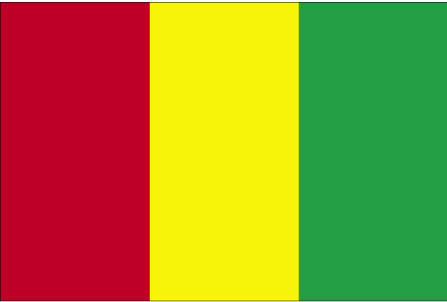
National Flag
- Flag Symbolism
- three equal vertical bands of red (hoist side), yellow, and green; uses the popular pan-African colors of Ethiopia
- Flag History
- The first French colony to achieve independence, Guinea pattered its flag on the French tricolor. Sekou Toure, the first President of Guinea, stated that by choosing the same colors as those of Ghana his country intended to show its dedication to Aftican unity. The colors reflect the national motto “Work, Justice, Solidarity”. The red is the colro of blood and reflects the spirit of sacrifice and hard work, and symbolizes the will for progress. The yellow is the color of the gold of Guinea and of the African sun, which is the source of energy, gernerosity and equality as it shines on everyone. The green is the color of the vegetation, agriculture, the productivity of the peasants and the spirit of solidarity in collective enterprises. Thus the three colors of the flag symbolize the three bases of the republic: labor, justice, and solidarity.
- Date of Adoption
- 10 November 1958
National Anthem
- Anthem Lyrics
- Liberté Peuple d'Afrique! Le Passé historique! Que chante l'hymne de la Guinée fière et jeune Illustre epopée de nos frères Morts au champ d'honneur en libérant l'Afrique! Le peuple de Guinée prêchant l'unité Appelle l'Afrique. Liberté! C'est la voix d'un peuple Qui appelle tous ses frères a se retrouver. Liberté! C'est la voix d'un peuple Qui appelle tous ses frères de la grande Afrique. Bâtissons l'unité africaine dans l'indépendance retrouvée.
- Anthem Lyrics (English)
- People of Africa! The historic past! Sing the hymn of a Guinea proud and young Illustrious epic of our brothers Who died on the field of honour while liberating Africa! The people of Guinea, preaching Unity, Call to Africa. Liberty! The voice of a people Who call all her brothers to find their way again. Liberty! The voice of a people Who call all her brothers of a great Africa. Let us build African Unity in a newly found independence!
- Anthem History
- Liberté (Liberty) has been the national anthem of Guinea since independence in 1958. It was composed by Fodeba Keita. The author of the lyrics is unknown