
 English
 Español
 中文
中文 हिन्दी
 Français
Government and Politics
Government and Politics of Germany
Government structure, leadership, capital, military, and national symbols of Germany.
Government Structure
Constitutional foundations, branches, parties, and leadership.
- Government Type
- federal republic
- Administrative Divisions
- 16 states (Laender, singular - Land); Baden-Wuerttemberg, Bayern, Berlin, Brandenburg, Bremen, Hamburg, Hessen, Mecklenburg-Vorpommern, Niedersachsen, Nordrhein-Westfalen, Rheinland-Pfalz, Saarland, Sachsen, Sachsen-Anhalt, Schleswig-Holstein, Thueringen
- Legal System
- civil law system with indigenous concepts; judicial review of legislative acts in the Federal Constitutional Court; has not accepted compulsory ICJ jurisdiction
- Suffrage
- 18 years of age; universal
- Citizenship
- citizenship by birth: no citizenship by descent only: at least one parent must be a German citizen or a resident alien who has lived in Germany at least 8 years dual citizenship recognized: yes, but requires prior permission from government residency requirement for naturalization: 8 years
- Executive Branch
- chief of state: President Frank-Walter STEINMEIER (since 19 March 2017; reelected 13 February 2022 for a second term beginning 19 March 2022) head of government: Chancellor Friedrich MERZ (since 6 May 2025) cabinet: Cabinet or Bundesminister (Federal Ministers) appointed by the president on the recommendation of the chancellor elections: president elected for a five-year term by a Federal Convention, comprising all members of the Federal Assembly (Bundestag) and an equal number of delegates elected by the state parliaments (Landtage); chancellor elected by an absolute majority of the Federal Assembly for a four-year term following federal elections election results: Frank-Walter STEINMEIER reelected president on 13 February 2022; received 1,045 votes of the Federal Convention against 96 for Max OTTE; Friedrich MERZ elected chancellor on 6 May 2025 following the February 2025 federal elections, in which his CDU/CSU alliance secured a plurality; voted in by the Federal Assembly on the first ballot with 325 votes in favor
- Legislative Branch
- Bicameral Parliament or Parlament consists of the Federal Assembly or Bundestag (736 seats; elected by popular vote under a system combining direct and proportional representation; a party must win 5% of the national vote or three direct mandates to gain representation; members serve four-year terms) and the Federal Council or Bundesrat (69 votes; state governments are directly represented by votes; each has three to six votes depending on population and are required to vote as a block) Elections: Federal Assembly - last held 23 February 2025 (next to be held by 2029); note - there are no elections for the Bundesrat; composition is determined by the composition of the state-level governments; the composition of the Bundesrat has the potential to change any time one of the 16 states holds an election Election results: Federal Assembly - percent of vote by party - CDU/CSU 28.5%, AfD 20.8%, SPD 16.4%, Greens 11.6%, FDP 4.3%, Left 8.8%, BSW 4.9%; seats by party - CDU/CSU 208, AfD 152, SPD 120, Greens 85, Left 64, BSW 0 (failed to clear the threshold); note - final seat allocations are subject to adjustment pending official certification
- Judicial Branch
- Federal Constitutional Court or Bundesverfassungsgericht (half the judges are elected by the Bundestag and half by the Bundesrat)
- Political Parties
- Alliance '90/Greens [Angelika BEER and Reinhard BUETIKOFER]; Christian Democratic Union or CDU [Angela MERKEL]; Christian Social Union or CSU [Edmund STOIBER, chairman]; Free Democratic Party or FDP [Guido WESTERWELLE, chairman]; Left Party or PDS/WASG [Oskar LAFONTAINE and Gregor GYSI]; Party of Democratic Socialism or PDS [Lothar BISKY]; Social Democratic Party or SPD [Franz MUENTEFERING]
- Head of State
- President Frank-Walter STEINMEIER (since 19 March 2017
- Head of Government
- Chancellor Friedrich MERZ
- Cabinet
- Cabinet or Bundesminister (Federal Ministers) appointed by the president on the recommendation of the chancellor
- Elections
- Federal Assembly - last held 23 February 2025 (next to be held by 2029); note - there are no elections for the Bundesrat; composition is determined by the composition of the state-level governments; the composition of the Bundesrat has the potential to change any time one of the 16 states holds an election
- Election Results
- Federal Assembly (Bundestag) election held on February 23, 2025 — percent of vote by party: CDU/CSU 28.6%, AfD 20.8%, SPD 16.4%, Greens 11.6%, Left 8.8%, BSW 4.9%, FDP 4.3%; seats by party: CDU/CSU 208, AfD 152, SPD 120, Greens 85, Left 64, FDP 0 (failed to clear the 5% threshold), BSW 0 (failed to clear the 5% threshold); note — final seat allocations remain subject to adjustment pending official certification and coalition negotiations.
- Constitution
- 23 May 1949, known as Basic Law; became constitution of the united German people 3 October 1990
- Independence
- 18 January 1871 (German Empire unification); divided into four zones of occupation (UK, US, USSR, and later, France) in 1945 following World War II; Federal Republic of Germany (FRG or West Germany) proclaimed 23 May 1949 and included the former UK, US, a
- National Holiday
- Unity Day, 3 October (1990)
- International Organization Participation
- AfDB, AsDB, Australia Group, BDEAC, BIS, BSEC (observer), CBSS, CDB, CE, CERN, EAPC, EBRD, EIB, EMU, ESA, EU, FAO, G- 5, G- 7, G- 8, G-10, IADB, IAEA, IBRD, ICAO, ICC, ICCt, ICFTU, ICRM, IDA, IEA, IFAD, IFC, IFRCS, IHO, ILO, IMF, IMO, Interpol, IOC, IOM, ISO, ITU, NAM (guest), NATO, NEA, NSG, OAS (observer), OECD, OPCW, OSCE, Paris Club, PCA, UN, UN Security Council (temporary), UNAMSIL, UNCTAD, UNESCO, UNHCR, UNIDO, UNMIK, UNMOVIC, UNOMIG, UPU, WADB (nonregional), WCO, WEU, WHO, WIPO, WMO, WToO, WTrO, ZC
- Diplomatic Representation in the U.S.
- chief of mission: Ambassador Klaus SCHARIOTH chancery: 4645 Reservoir Road NW, Washington, DC 20007 telephone: [1] (202) 298-4000 FAX: [1] (202) 298-4249 consulate(s) general: Atlanta, Boston, Chicago, Houston, Los Angeles, Miami, New York, San Francisco
- U.S. Diplomatic Representation
- chief of mission: Ambassador William R. TIMKEN, Jr. embassy: Neustaedtische Kirchstrasse 4-5, 10117 Berlin; note - a new embassy will be built near the Brandenburg Gate in Berlin; ground was broken in October 2004 and completion is scheduled for 2008 mailing address: PSC 120, Box 1000, APO AE 09265 telephone: [49] (030) 2385 174 FAX: [49] (030) 8305-1215 consulate(s) general: Duesseldorf, Frankfurt am Main, Hamburg, Leipzig, Munich
Capital City
Seat of government and political history.
- Capital City
- Berlin
- Location
- 52 31 N, 13 24 E
- Time Difference
- UTC+1 (6 hours ahead of Washington, DC during Standard Time)
- History
- the origin of the name is unclear but may be related to the old West Slavic (Polabian) word "berl" or "birl," meaning "swamp"
Embassy and Diplomatic Representation
Embassy location and contact details.
U.S. Embassy Berlin Clayallee 170, 14191 Berlin Tel. (49) (30) 8305-0 (emergency services only) Tel. (49) (30) 8305-1200 (routine calls, 2-4 p.m. Monday-Thursday) Fax (49) (30) 8305-1215 American Citizen Services e-mail: ACSBerlin@state.gov U.S. Consulate General Frankfurt Giessener Str. 30, 60435 Frankfurt am Main Tel. (49) (69) 7535-0 (emergency services only) Tel. (49) (69) 7535-2102 (routine calls, 2-4 p.m. Monday-Friday) Fax (49) (69) 7535-2252 American Citizen Services e-mail: GermanyACS@state.gov Passport Inquiries e-mail: FrankfurtPassports@state.gov U.S. Consulate General Munich Koeniginstrasse 5, 80539 Munich Tel. (49) (89) 2888-0 (emergency services only, after hours) Tel. (49) (89) 2888-580 (emergency services only, 8 a.m.-5 p.m. Monday-Friday) Tel. (49) (89) 2888-575 (routine calls, 8 a.m.-5 p.m. Monday-Friday) Fax (49) (89) 280-9998 American Citizen Services e-mail: ConsMunich@state.gov There is also a U.S. Consular Agency in Bremen at: Flughafenallee 18, 28199 Bremen Tel. (49) (421) 301-5860 Fax: (49) (421) 301-5861 Consular services are only provided at the Consulates General in Hamburg and Dusseldorf through periodic visits by consular staff from Berlin and Frankfurt, respectively.
Military
Branches, service obligations, expenditures, and manpower.
- Military Branches
- Federal Armed Forces (Bundeswehr): Army (Heer); Navy (Deutsche Marine, includes naval air arm); Air Force (Luftwaffe); Joint Support Services (Streitkraeftebasis, SKB); Central Medical Service (Zentraler Sanitaetsdienst, ZSanDstBw)
- Service Age and Obligation
- 17-23 years of age for male and female voluntary military service; conscription ended 1 July 2011; service obligation 8-23 months or 12 years; women have been eligible for voluntary service in all military branches and positions since 2001
National Symbols
Flag, anthem, and other symbols of national identity.
National Flag
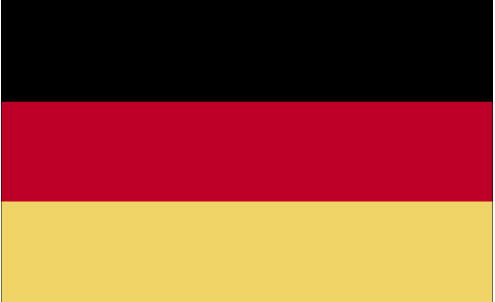
- Flag Symbolism
- The federal flag consists of three horizontal stripes of equal width, black at the top, red in the middle and gold at the bottom; the proportion of the hoist (width) to the fly (length) of the bunting shall be 3:5. The federal flag may also be displayed in the form of a banner. The banner shall consist of three vertical stripes of equal width, black at the left, red in the middle and gold at the right. Flags shall be displayed on the following days: 27 January Day of Remembrance for the Victims of National Socialism* 1 May Labor Day 5 May Europe Day 23 May Anniversary of the promulgation of the Basic Law 17 June Anniversary of 17 June 1953 20 July Anniversary of 20 July 1944 3 October Day of German Unity Second Sunday before the first Sunday in Advent Day of National Mourning* As specifically scheduled: Day of the elections to the German Bundestag Day of the elections to the European Parliament It is generally believed the colors come from the uniforms of the Lützow Free Corps, comprised mostly of university students, that formed during the end of the struggle against the Napoleonic occupation of much of Germany.
- Date of Adoption
- 9 May 1949
National Anthem
- Anthem Lyrics
- The "Deutschlandlied" Einigkeit und Recht und Freiheit Für das Deutsche Vaterland. Danach laßt uns alle streben, Brüderlich mit Herz und Hand. Einigkeit und Recht und Freiheit Sind des Glückes Unterpfand. Blüh' im Glanze dieses Glückes, Blühe deutsches Vaterland.
- Anthem Lyrics (English)
- Unity and Rights and Freedom For the German Fatherland Let us all strive for that Brotherly with heart and hand Unity and Rights and Freedom Are the foundation for happiness Bloom in the glow of happiness Bloom German Fatherland
- Anthem History
- The "Deutschlandlied", the German national anthem, dates back to the liberal national movement of the 19th century. The words stem from the pen of August Heinrich Hoffmann The "Deutschlandlied" was initially unable to compete successfully against other songs. After 1871 the Prussian royal anthem "Heil dir im Siegerkranz" ("Hail to Thee in Victor's Laurels"), which had been designated the imperial anthem, was sung wherever Emperor William I appeared. Not until around the turn of the century did Hoffman's song become popular. In 1922, in a speech marking the third anniversary of the Weimar constitution, Reich President Friedrich Ebert publicly proclaimed the "Deutschlandlied", although the term "national anthem" was not yet used on that day. In his speech, Friedrich Ebert stated: "Unity and right and freedom - in times of internal fragmentation and oppression, this triad from the poet's song voiced the longing of all Germans; may it now accompany us on our arduous path to a better future." After the end of World War II, the newly founded Federal Republic of Germany had difficulty reaching a decision on a national anthem. In contrast to the federal flag, no provision was made for an anthem in the Basic Law. Not until 1952 was an arrangement reached. In a letter dated 29 April 1952, Federal Chancellor Dr. Konrad Adenauer asked the Federal President, Prof. Dr. Theodor Heuss, to "designate the song by Hoffmann and Haydn the national anthem. At state functions the third verse should be sung." President Heuss gave his consent in a response dated 2 May 1952, after his prior attempt to initiate a new anthem had proved unsuccessful. After the reunification of Germany, in an exchange of letters in August 1991, Federal President Dr. Richard von Weizsäcker and Federal Chancellor Dr. Helmut Kohl designated the third verse of the "Deutschlandlied" the national anthem.
Other National Symbols
National Flower
Cornflower
National Tree
oak