
 English
 Español
 中文
中文 हिन्दी
 Français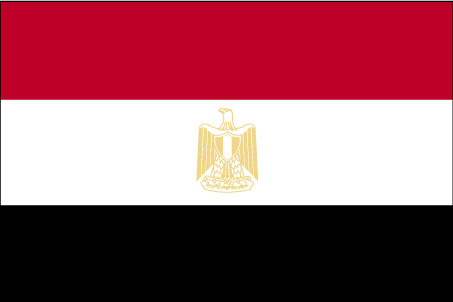
Egypt
Misr
Declare Your Relationship to Egypt
CountryReports Community
- Studying4
- From Egypt3
- Egypt heritage3
- Visited1
- Want to visit2
Customs and Culture
Customs and Culture
About the People
Part of Egyptian humor is a love for riddles (especially during the month of Ramadan), jokes, sarcasm, and wordplays. Egyptiansfrequently identify with community, to the point that personal needs become secondary to that of the community.
Cultural Attributes
Part of Egyptian humor is a love for riddles (especially during the month of Ramadan), jokes, sarcasm, and wordplays. Egyptians frequently identify with community, to the point that personal needs become secondary to that of the community.

Gift of the Nile
Greetings, Gestures & Visiting
Friends of the same sex usually shake hands and kiss each other on the right and left cheek. This process may repeat a few times if the friends have not seen each other for a long period of time. If a woman extends her hand, then a man may shake it. First names are not used unless one is given permission.
Diet
Egyptians eat rice, bread, fish, lamb, chicken, turkey, and stuffed vegetables. Tahina (sesame seed paste), tomatoes, yogurt and cucumbers are also eaten with meals. The Qurán prohibits the consumption of pork and alcohol. Traditional foods include fava beans prepared as foul or ta’miyya, and flat Egyptian bread. Meat is expensive and eaten only occasionally, sometimes just once a month. Bread, usually unleavened, is eaten with every meal. Tahina is a common condiment in Egypt.

Family
In most homes, a girl is protected by her brothers and may even be accompanied by them in public. Traditionally, a man's honor is based on how well he protects the women in his care. In rural areas, a girl may discontinue her schooling when she comes of age. It is customary for extended families, including families of brothers and sisters, to live under the same roof.
Dating Customs
Although attitudes toward dating are changing, dating is not widespread. Moral purity is highly valued in a woman and is usually a key requirement in the marriage contract. Traditionally, marriages were arranged between heads of families, often with little input from the couple involved. Now, however, individuals have more say as to whom they wish to marry. Because marriages join not just two people but two families, both families are heavily involved in wedding preparations.
Recreation
The main form of recreation in cities and villages is socializing. People enjoy going to the bazaar, an outdoor market, to do their shopping and to visit friends. They like to sit and talk while drinking tea or coffee. In rural areas, relaxing after a hard day's labor in the fields is a favorite way to spend time.
Student Life
Daily habits of children and their everyday routine could vary in many ways depending on the demographics. Different areas of the country, whether rural or urban, will differ in their daily routine. Furthermore, different income classes will also lead their daily lives in different ways. Those of a lower and lower-middle class income tend to have a fixed daily diet.
Holidays
Revolution Day
7/23Independence
Christmas
12/25Christmas
The Coptic Orthodox Church observes Christmas on January 7th which corresponds to the Coptic month of Khiahk or December 25th on the Julian calendar. To celebrate Christ’s suffering in the wilderness Christmas is preceded by a 40 day fast with abstinence from meat and dairy products. Christmas Eve includes Midnight Masses. After services people usually observe an early morning breakfast of bread, rice, garlic, and boiled meat. On Christmas Day, the wealthy distribute zalabya (doughnuts), bouri (mullet fish) and candles to the poor; the candles symbolizing the light that illuminated the scene of the Nativity. Christmas is a time of visiting friends with the serving of kahk (sweet biscuits marked with a cross). In January 2003 President Murbarak issued a presidential decree authorizing the celebration of Christmas as a national holiday, the first time the Egyptian government recognized a Christian holiday.
Dates of Interest
- October 6th
Celebrates the birth of the Prophet Muhammad with various festivities, including religious sermons and events.
How do people greet each other in Egypt?
Friends of the same sex usually shake hands and kiss each other on the right and left cheek, sometimes repeating this if they haven't seen each other for a long time.
Do
- Shake a woman's hand only if she extends hers first
- Respond to a compliment with a compliment of your own or by giving Allah's blessings
Don’t
- Use first names unless given permission
What are the dining customs in Egypt?
Bread (unleavened) is eaten with every meal and is so important that "Aish" translates to "life." In restaurants, leaving food behind is a sign of wealth.
Do
- Expect bread with every meal
- Try tahina, a common condiment
Don’t
- Do not offer or consume pork or alcohol, which are prohibited by the Qurán
Good to know
- Meat is expensive and eaten only occasionally
- Konafah is a dessert eaten during Ramadan and for feasts
- Sahalab is a pre-packaged spice drink sold in powder form
What etiquette should I know when visiting in Egypt?
Visiting regularly signals the importance of a relationship, and hospitality follows careful customs around gifts and religious respect.
Do
- Pass and receive gifts with both hands or the right hand only
- Remove your shoes before entering a mosque
- Wear clothing covering the entire body in a mosque
Don’t
- Do not give or receive with the left hand
- Do not give alcohol as a gift to Muslims
- Do not stay away for long periods, which signals the relationship is insignificant
How should I dress in Egypt?
Dress standards are modest and traditional; traditional women cover their hair and bodies except the face and hands, while men wear modest clothing.
Do
- Dress modestly and traditionally
Good to know
- Modest Western-style clothing is popular in large cities
- A beard can signal religious faith or membership in certain political organizations
What gestures are considered rude in Egypt?
Certain gestures and physical contact are impolite, particularly involving feet, pointing, and touching between men and women.
Don’t
- Do not point the bottom of your foot at another person
- Do not point at a person
- Do not walk in front of someone praying
- A man should not touch a woman in public
Good to know
- Very good friends of the same sex may walk hand in hand in public
- Do not walk arm in arm unless married or engaged
What is family life like in Egypt?
Family is central: extended families often live together, children support parents in old age, and close ties are strongly maintained.
Good to know
- Cousins are often as close as siblings
- Children are expected to support parents in old age rather than use rest homes
- Parents often play a key role in planning children's future, including profession and choice of spouse
- A girl may be protected and accompanied in public by her brothers
What do Egyptians do for fun?
Socializing is the main form of recreation, including visiting bazaars, drinking tea or coffee, and enjoying sports and films.
Good to know
- Coffeehouses are large, noisy places with lively discussions and arguments
- Soccer is the most popular sport
- Films and TV soap operas are popular entertainment
- People enjoy reciting poetry or singing folk songs
Last updated: 2026-07-12 · Sources: CountryReports
Photos of Egypt
Photos of Egypt


Travel and Tourism
Travel and Tourism
- Travel Alert Status
- Level 3: Reconsider Travel
- Currency
- 9.71
- Time Difference
- UTC+2 (7 hours ahead of Washington, DC, during Standard Time)
- Climate
- From November to April, temperatures range in Cairo from 40° to 65°F, and during the hot period, May to October, from 70° to 110°F. The Mediterranean coast is usually 10° cooler, while Upper Egypt is 10° to 20° warmer. Extreme temperatures during both seasons are moderated by the prevailing northerly winds. The exception is the hot, dry southerly Khamaseen, named for the number 50 because it occurs in a 50-day timeframe from April to June. With winds up to 90 miles an hour, the resulting sandstorms close down airports and roads.
- Airports
- 84
Read the full travel guide — health, safety, vaccinations, disease risk, sanitation, and transit details.
View full travel guideRecipes
Recipes
Karkadeeh (Hibiscus Drink)
Beverage
Main Dish
Ta'miya or Falafel (Bean Cakes)
Main Dish
Baird Tong Soup
Main Dish
Koshari
Main Dish
Sambusak (Turnovers)
Main Dish
Lahma mu'assaga (Savory Minced Beef)
Side Dish
Full Midammis (Dry Broad Beans, Stewed)
Side Dish
PremiumArnabet Ba Al-Baed (Cauliflower with Eggs)
Side Dish
PremiumTagen Ros Mo-amar (Baked Rice with Milk and Salt)
Side Dish
PremiumMasaka (Eggplant)
History
History
Historical Eras
Pharaonic Egypt
3200 BCE – 332 BCE
Unified under the legendary King Menes around 3200 BCE, ancient Egypt flourished for nearly three millennia under successive dynasties of god-kings. The Old Kingdom produced the pyramids of Giza and Saqqara; the New Kingdom saw warrior pharaohs such as Ramesses II and cultural icons including Hatshepsut and Tutankhamun. Egypt's engineers, physicians, and astronomers established foundational achievements of human civilization.
Greek & Roman Egypt
332 BCE – 642
Alexander the Great conquered Egypt in 332 BCE, inaugurating the Ptolemaic dynasty, which blended Greek and Egyptian culture and produced landmarks such as the Library of Alexandria. Cleopatra VII, the last Ptolemaic ruler, lost to Octavian at the Battle of Actium in 31 BCE, bringing Egypt under Roman and later Byzantine imperial control. This era ended with the Arab conquest in 642 CE.
Islamic & Arab Rule
642 – 1517
The military commander Amr ibn al-As conquered Egypt in 642, permanently transforming the country through Islamization and Arabization. The Fatimid caliphate founded Cairo in 969 as a new imperial capital and center of Sunni and Shia learning. The Mamluk sultanate, beginning with Baybars I, halted the Mongol advance at Ayn Jalut in 1260 and presided over a sophisticated military and artistic culture until the Ottoman conquest.
Ottoman Period
1517 – 1882
Sultan Selim I absorbed Egypt into the Ottoman Empire in 1517, though Mamluk administrative structures persisted beneath Turkish governors. Muhammad Ali, an Albanian viceroy who seized power in 1805, modernized the army, built infrastructure, and briefly extended Egyptian dominion into Sudan and Syria before European powers curtailed his ambitions. The completion of the Suez Canal in 1869 brought Egypt global strategic importance alongside crippling foreign debt.
British Occupation
1882 – 1952
Britain occupied Egypt in 1882 to protect its financial interests and the Suez Canal, establishing effective colonial control despite nominal Ottoman and later nominal Egyptian sovereignty. A formal protectorate was declared in 1914, and partial independence was granted in 1922 under King Fuad I, though British troops remained and dominated key decisions. Nationalist resentment, amplified by the humiliation of the 1948 Arab-Israeli War, fueled the Free Officers Movement.
Modern Republic
1952 – present
The Free Officers' coup of July 1952, led by Muhammad Naguib and Gamal Abdel Nasser, ended the monarchy and established the Republic of Egypt. Nasser's nationalization of the Suez Canal in 1956 made him an icon of Arab nationalism, while Egypt fought major conflicts with Israel in 1956, 1967, and 1973. The subsequent decades brought the Camp David Accords, the presidency of Hosni Mubarak, the 2011 Arab Spring revolution, and the current administration of Abdel Fattah el-Sisi.
Overview
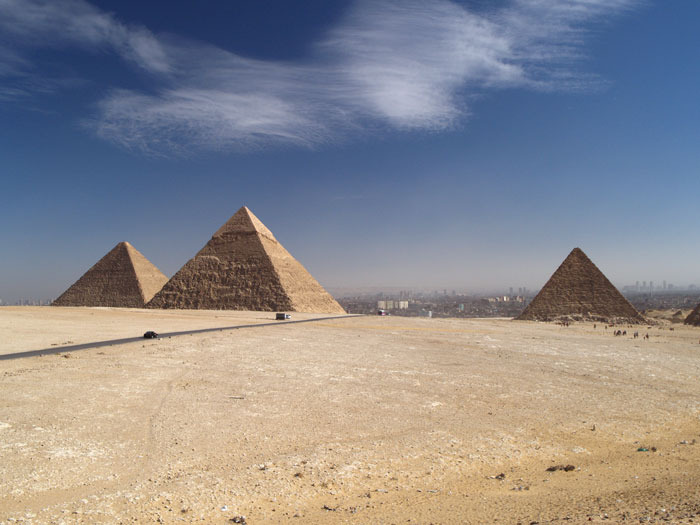
Sphinx and pyramids at Giza (Al Jizah)
Timeline of Key Events
2700 BCE
The first stone pyramid built
The first stone pyramid built.
2600 BCE
Pyramids of Giza built
Pyramids of Giza built.
1500 BCE
Hatshepsut became pharaoh
Hatshepsut became pharaoh.
1400 BCE
Tutankhamen became pharaoh
Tutankhamen became pharaoh.
1274 BCE
Ramesses II fought in Battle of Kadesh
Ramesses II fought in Battle of Kadesh.
671 BCE
Assyrians attacked Egypt
Assyrians attacked Egypt.
525 BCE
Persian conquest
Persian conquest.
Read the full history profile — narrative overview, defining eras, and the complete timeline in one place.
View expanded historyInteresting Facts
Interesting Facts
When a child loses a tooth they put their tooth in a pouch, throw it into the sun and say "The sun, the sun, the setting sun, take this awful donkey tooth and bring me a princess one". They also get money from their parents.
The Great Temple of Abu Simbel In 1257 BCE, Pharaoh Ramses II (1279-13 BCE) had two temples carved out of solid rock at a site on the west bank of the Nile south of Aswan in the land of Nubia and known today as Abu Simbel. Long before Ramses II, the site had been sacred to Hathor of Absek. The temple built by Ramses, however, was dedicated to the sun gods Amon-Re and Re-Horakhte. Because of their remote location near the Sudanese border in sourthern Egypt, the temples were unknown until their rediscovery in 1813. They were first explored in 1817 by the Egyptologist Giovanni Battista Belzoni. The sacred area, marked out as a forecourt and bounded on the north and south sides by brick walls, occupied a place between the sandstone cliffs and the river. Ramses' temple was cut into the face of the cliff, before which is a rock-cut terrace. The temple is approached across this terrace up a flight of steps with an inclined plane in the middle, and enclosed on either side by a balustrade behind which stood a row of hawks and statues of Ramses in various forms. The rock-cut fa açade of Ramses' temple represents the front of a pylon in front of which are four colossal seated figures of Ramses. This facade is one 119 feet wide, and 100 feet high, while the colossal statues are 67 feet in height. At the top of the pylon, above the cornice, is a row of baboons, who, as Watchers of the Dawn, are shown with their hands raised in adoration of the (rising) sun. The Egyptians believed baboons played a role in helping the sun god Ra defeat the darkness of night and so were believed sacred to the worship of the rising sun.
Tutankhamen was only 10 years old when he became pharaoh. When he died at 18, gold jewelry, statues, thrones, beds and a golden face mask were buried with him. Unlike the majority of other pharaohs, tomb robbers never uncovered his tomb. Archeologists unearthed it in the 1920s.
Egyptians fear the evil eye, which is believed to bring bad luck. Envy is often associated with the evil eye. It is considered rude to show open admiration for another person's possessions.
See every fact — trivia, oddities, and curious tidbits gathered from across the country.
View all interesting factsGeography and Environment
Geography and Environment
- Terrain
- vast desert plateau interrupted by Nile valley and delta
- Climate
- From November to April, temperatures range in Cairo from 40° to 65°F, and during the hot period, May to October, from 70° to 110°F. The Mediterranean coast is usually 10° cooler, while Upper Egypt is 10° to 20° warmer. Extreme temperatures during both seasons are moderated by the prevailing northerly winds. The exception is the hot, dry southerly Khamaseen, named for the number 50 because it occurs in a 50-day timeframe from April to June. With winds up to 90 miles an hour, the resulting sandstorms close down airports and roads.
- Natural Hazards
- periodic droughts; frequent earthquakes, flash floods, landslides; hot, driving windstorm called khamsin occurs in spring; dust storms, sandstorms
- Current Environmental Issues
- agricultural land being lost to urbanization and windblown sands; increasing soil salination below Aswan High Dam; desertification; oil pollution threatening coral reefs, beaches, and marine habitats; other water pollution from agricultural pesticides, raw sewage, and industrial effluents; very limited natural fresh water resources away from the Nile which is the only perennial water source; rapid growth in population overstraining the Nile and natural resources
Read the full geography and environment profile — terrain, climate, natural resources, hazards, land use, and international agreements.
View full geographyPeople & Demographics
People & Demographics
Religion
Languages Spoken
Arabic (official), English and French widely understood by educated classes
- Arabic
Population
- Population
- 80,471,869
- Population: Male/Female
- male: 57,142,484 female: 54,104,764
- Population Distribution
- approximately 95% of the population lives within 20 km of the Nile River and its delta; vast areas of the country remain sparsely populated or uninhabited
- Urban Population
- urban population: 43.1% of total population rate of urbanization: 1.9% annual rate of change
- Population in Major Urban Areas
- 22.183 million CAIRO (capital), 5.588 million Alexandria, 778,000 Bur Sa'id
- Nationality Noun
- noun: Egyptian(s) adjective: Egyptian
- Ethnic Groups
- Egyptian 99.7%, other 0.3%
- Language Note
- Arabic (official), English, and French widely understood by educated classes
Demographic Profile
Egypt is the most populous country in the Arab world and the third-most-populous country in Africa, behind Nigeria and Ethiopia. Most of the country is desert, so about 95% of the population is concentrated in a narrow strip of fertile land along the Nile River, which represents only about 5% of Egypt’s land area. Egypt’s rapid population growth – 46% between 1994 and 2014 – stresses limited natural resources, jobs, housing, sanitation, education, and health care.
Although the country’s total fertility rate (TFR) fell from roughly 5.5 children per woman in 1980 to just over 3 in the late 1990s, largely as a result of state-sponsored family planning programs, the population growth rate dropped more modestly because of decreased mortality rates and longer life expectancies. During the last decade, Egypt’s TFR decline stalled for several years and then reversed, reaching 3.6 in 2011, and is under 3 as of 2022. Contraceptive use has held steady at about 60%, while preferences for larger families and early marriage may have strengthened in the wake of the recent 2011 revolution. The large cohort of women of or nearing childbearing age will sustain high population growth for the foreseeable future (an effect called population momentum).
Nevertheless, post-MUBARAK governments have not made curbing population growth a priority. To increase contraceptive use and to prevent further overpopulation will require greater government commitment and substantial social change, including encouraging smaller families and better educating and empowering women. Currently, literacy, educational attainment, and labor force participation rates are much lower for women than men. In addition, the prevalence of violence against women, the lack of female political representation, and the perpetuation of the nearly universal practice of female genital cutting continue to keep women from playing a more significant role in Egypt’s public sphere.
Population pressure, poverty, high unemployment, and the fragmentation of inherited land holdings have historically motivated Egyptians, primarily young men, to migrate internally from rural and smaller urban areas in the Nile Delta region and the poorer rural south to Cairo, Alexandria, and other urban centers in the north, while a much smaller number migrated to the Red Sea and Sinai areas. Waves of forced internal migration also resulted from the 1967 Arab-Israeli War and the floods caused by the completion of the Aswan High Dam in 1970. Limited numbers of students and professionals emigrated temporarily prior to the early 1970s, when economic problems and high unemployment pushed the Egyptian Government to lift restrictions on labor migration. At the same time, high oil revenues enabled Saudi Arabia, Iraq, and other Gulf states, as well as Libya and Jordan, to fund development projects, creating a demand for unskilled labor (mainly in construction), which attracted tens of thousands of young Egyptian men.
Between 1970 and 1974 alone, Egyptian migrants in the Gulf countries increased from approximately 70,000 to 370,000. Egyptian officials encouraged legal labor migration both to alleviate unemployment and to generate remittance income (remittances continue to be one of Egypt’s largest sources of foreign currency and GDP). During the mid-1980s, however, depressed oil prices resulting from the Iran-Iraq War, decreased demand for low-skilled labor, competition from less costly South Asian workers, and efforts to replace foreign workers with locals significantly reduced Egyptian migration to the Gulf States. The number of Egyptian migrants dropped from a peak of almost 3.3 million in 1983 to about 2.2 million at the start of the 1990s, but numbers gradually recovered.
In the 2000s, Egypt began facilitating more labor migration through bilateral agreements, notably with Arab countries and Italy, but illegal migration to Europe through overstayed visas or maritime human smuggling via Libya also rose. The Egyptian Government estimated there were 6.5 million Egyptian migrants in 2009, with roughly 75% being temporary migrants in other Arab countries (Libya, Saudi Arabia, Jordan, Kuwait, and the United Arab Emirates) and 25% being predominantly permanent migrants in the West (US, UK, Italy, France, and Canada).
During the 2000s, Egypt became an increasingly important transit and destination country for economic migrants and asylum seekers, including Palestinians, East Africans, and South Asians and, more recently, Iraqis and Syrians. Egypt draws many refugees because of its resettlement programs with the West; Cairo has one of the largest urban refugee populations in the world. Many East African migrants are interned or live in temporary encampments along the Egypt-Israel border, and some have been shot and killed by Egyptian border guards.
Education
- Literacy Definition
- age 15 and over can read and write
In Egypt there are classic old school buildings with very high ceilings and spacious classrooms, most of these buildings used to be historical buildings occupied by royalties or government officials.
There are also modern school buildings, but public schools tend to occupy older buildings than those of private schools.
The majority of public schools do not have computer labs and audiovisual equipment. They are also crowded with minimal playing space for children. The teacher-student ratio is very high, which often results in some of the kids not getting the necessary care and sometimes becoming left out.
However, a developmental plan is being executed all over the country in an effort to create the necessary facilities needed for better education. This applies to existing schools as well as newer ones being erected.
This developmental plan will also include the rehabilitation of existing school staff by implementing proficiency exams and training sessions to improve their teaching skills as well as the level of teacher-student interaction.
Private schools have all the resources they need, from computer labs, Internet, audiovisual equipment, and vast playgrounds. Some private schools even have basketball and tennis courts, soccer fields, and swimming pools. They also maintain a reasonable teacher-to-student ratio.
Health Information
- Life Expectancy at Birth
- total population: 75 years male: 73.8 years female: 76.2 years
- Major Infectious Diseases — degree of risk
- degree of risk: intermediate food or waterborne diseases: bacterial diarrhea, hepatitis A, and typhoid fever
- Alcohol consumption per capita
- total: 0.14 liters of pure alcohol beer: 0.09 liters of pure alcohol wine: 0.01 liters of pure alcohol spirits: 0.04 liters of pure alcohol other alcohols: 0 liters of pure alcohol
- Tobacco Use
- total: 24.3% male: 48.1% female: 0.4%
- Infant Mortality Rate
- total: 16.8 deaths/1,000 live births male: 17.8 deaths/1,000 live births female: 15.9 deaths/1,000 live births
Life Expectancy
- Life Expectancy at Birth
- total population: 75 years male: 73.8 years female: 76.2 years
- Median Age
- total: 24.4 years male: 24.3 years female: 24.4 years
- Age Structure
- 0-14 years: 33.8% (male 19,349,395/female 18,243,571) 15-64 years: 60.6% (male 34,646,369/female 32,792,151) 65 years and over: 5.6% (male 3,146,720/female 3,069,042)
- Infant Mortality Rate
- total: 16.8 deaths/1,000 live births male: 17.8 deaths/1,000 live births female: 15.9 deaths/1,000 live births
Read the full people and society profile — demographics, health, education, religion, languages, and notable people.
View full people and societyGovernment & Politics
Government & Politics
Country Identity
- Country Name
- Egypt
- Full Country Name
- Arab Republic of Egypt
- Local - Long
- Jumhuriyat Misr al-Arabiyah
- Local - Short
- Misr
- Former Name
- United Arab Republic (with Syria)
Government Structure
- Government Type
- republic
- Legal System
- based on English common law, Islamic law, and Napoleonic codes; judicial review by Supreme Court and Council of State (oversees validity of administrative decisions); accepts compulsory ICJ jurisdiction, with reservations
- Executive Branch
- chief of state: Former President Mohammed Hosni MUBARAK (Resigned February 11, 2011) (led since 14 October 1981) head of government: Prime Minister Ahmed NAZIF (since 9 July 2004) cabinet: Cabinet appointed by the president elections: president elected by popular vote for six-year term; note - a national referendum in May 2005 approved a constitutional amendment that changed the presidential election to a multicandidate popular vote; previously the president was nominated by the People's Assembly and the nomination was validated by a national, popular referendum; last referendum held 26 September 1999; first election under terms of constitutional amendment held 7 September 2005; next election scheduled for 2011 election results: Hosni MUBARAK reelected president; percent of vote - Hosni MUBARAK 88.6%, Ayman NOUR 7.6%, Noman GOMAA 2.9%
- Legislative Branch
- bicameral system consists of the People's Assembly or Majlis al-Sha'b (454 seats; 444 elected by popular vote, 10 appointed by the president; members serve five-year terms) and the Advisory Council or Majlis al-Shura - which functions only in a consultative role (264 seats; 176 elected by popular vote, 88 appointed by the president; members serve six-year terms; mid-term elections for half the members) elections: People's Assembly - three-phase voting - last held 7 and 20 November, 1 December 2005;(next to be held November-December 2010); Advisory Council - last held May-June 2004 (next to be held May-June 2007) election results: People's Assembly - percent of vote by party - NA; seats by party - NDP 311, NWP 6, Tagammu 2, Tomorrow Party 1, independents 112 (12 seats to be determined by rerun elections, 10 seats appointed by President); Advisory Council - percent of vote by party - NA; seats by party - NA
- Judicial Branch
- Supreme Constitutional Court
- Suffrage
- 18 years of age; universal and compulsory
- Constitution
- 11-Sep-71
- Independence
- 28 February 1922 (from UK)
- National Holiday
- Revolution Day, 23 July (1952)
Capital City
- Capital Name
- Cairo
- Capital - geographic coordinate
- 30 03 N, 31 15 E
- Capital Time Difference
- UTC+2 (7 hours ahead of Washington, DC, during Standard Time)
from the Arabic "al-Qahira," meaning "the victorious"
Military
Branches: Army, Navy, Egyptian Air Force (Al-Quwwat al-Jawwiya il-Misriya), Egyptian Air Defense Command
Embassy / Diplomatic Mission
U.S. Embassy Cairo
Consular Section
5 Tawfik Diab Street
Garden City, Cairo
telephone: (20) 2-2797-2301
fax: (20) 2-2797-2472
email: consularcairoacs@state.gov
Website: http://egypt.usembassy.gov/index.html
Facebook: https://www.facebook.com/USEmbassyCairo
For after-hours emergencies involving U.S. citizens, call (20) 2-2797-3300.
The American Citizens Services unit uses an online appointment system for those coming to the Embassy to receive routine consular services Sunday through Wednesday, except for official holidays (U.S. and Egyptian). Phone-inquiry hours are between 9:00 a.m. and 3:00 p.m. The latest Embassy Emergency or Security Message for U.S. Citizens can be found at http://egypt.usembassy.gov
The mailing address from the United States is: Consular Section, Unit 64900, Box 15, APO AE 09839-4900. Within Egypt or from a third country, it is 8 Kamal el-Din Salah Street, Garden City, Cairo, Egypt. Consular information is available on the U.S. Embassy Cairo web site. Visa-related inquiries should be sent by e-mail.
Read the full government profile — flag symbolism, national anthem, and other national symbols.
View full government detailsEconomy
Economy
Egypt has the third-largest economy in Africa and one of the most diversified in the Middle East, with key sectors including tourism, agriculture, manufacturing, energy, and services. After years of slow growth and political turbulence following the 2011 uprising, Egypt embarked on an ambitious economic reform program in 2016, backed by a $12 billion IMF loan. Reforms included floating the Egyptian pound, cutting energy subsidies, introducing a value-added tax, and expanding social safety net programs. These measures restored macroeconomic stability and helped GDP growth reach around 5-6 percent before the COVID-19 pandemic.
However, Egypt has faced renewed economic strain since 2022, driven by the war in Ukraine, soaring import costs, capital flight, and a heavy external debt burden. The pound has been devalued multiple times, losing more than half its value against the U.S. dollar, while inflation surged above 35 percent in 2023 before gradually easing. In March 2024, Egypt secured an expanded $8 billion IMF agreement and received a landmark $35 billion investment deal with the United Arab Emirates for the development of the Ras El-Hekma coastal area, providing critical relief to foreign currency shortages.
The government continues to prioritize large-scale infrastructure projects, including the New Administrative Capital, expansion of the Suez Canal economic zone, and renewable energy development. Natural gas production, boosted by the Zohr field, remains a key growth driver, and Egypt has positioned itself as a regional energy hub. Tourism and Suez Canal revenues are vital sources of foreign currency, though Canal traffic has been significantly disrupted by Red Sea security tensions since late 2023.
Persistent challenges include high public debt, a large state and military footprint in the economy, elevated unemployment particularly among youth, and inflationary pressures that have eroded household purchasing power. Structural reforms aimed at boosting private sector participation, improving governance, and attracting sustained foreign direct investment remain central to Egypt's long-term economic outlook.
Snapshot
- Currency Name and Code
- Egyptian pounds (EGP)
- GDP — official exchange rate
- $92,600,000,000 (USD)
- GDP Real Growth Rate
- 4.9%
- Gini Index
- 34.4
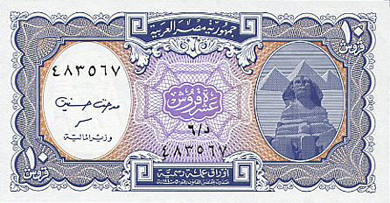
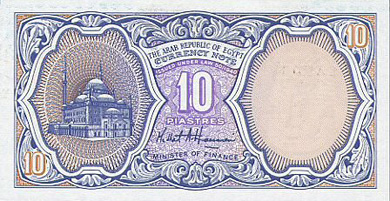
Banknotes
Budget & Public Finance
- Fiscal Year
- 1 July - 30 June
- Annual Budget
- $27,680,000,000 (USD)
- Public Debt (% of GDP)
- 93.6%
- External Debt
- $28,950,000,000 (USD)
- Investment (% of GDP)
- 17.6%
- Economic Aid
- $1,200,000,000 (USD)
- Current Account Balance
- $2,928,000,000 (USD)
- Reserves of Foreign Exchange
- $2,147,483,647 (USD)
Labor, Industry & Trade
- Labor Force by Occupation
- agriculture 32%; industry 17%; services 51%
- Household Income — highest 10%
- 25%
- Industries
- textiles, food processing, tourism, chemicals, hydrocarbons, construction, cement, metals
- Agriculture Products
- cotton, rice, corn, wheat, beans, fruits, vegetables; cattle, water buffalo, sheep, goats
- Export Commodities
- crude oil and petroleum products, cotton, textiles, metal products, chemicals
- Export Partners
- US 18.5%, Italy 13.8%, UK 8.5%, France 4%
- Import Commodities
- machinery and equipment, foodstuffs, chemicals, wood products, fuels
- Import Partners
- US 16.1%, Germany 7.5%, Italy 6.4%, France 6.2%, China 4.8%
Energy
- Oil Production
- 700,000 bbl/day
- Oil Consumption
- 566,000 bbl/day
- Oil Reserves
- 2,700,000,000 bbl/day
- Natural Gas Production
- 27,000,000,000 cu m
- Natural Gas Consumption
- 27,000,000,000 cu m
- Natural Gas Imports
- 0 cu m
- Natural Gas Exports
- 0 cu m
- Natural Gas Reserves
- 1,900,000,000,000 cu m
Communications
- Telephone System
- General assessment: underwent extensive upgrading during the 1990s; principal centers at Alexandria, Cairo, Al Mansurah, Ismailia, Suez, and Tanta are connected by coaxial cable and microwave radio relay Domestic: largest fixed-line system in the region; as of 2011 there were multiple mobile-cellular networks with a total of roughly 83 million subscribers International: country code - 20; landing point for Aletar, the SEA-ME-WE-3 and SEA-ME-WE-4 submarine cable networks, Link Around the Globe (FLAG) Falcon and FLAG FEA; satellite earth stations - 4 (2 Intelsat - Atlantic Ocean and Indian Ocean, 1 Arabsat, and 1 Inmarsat); tropospheric scatter to Sudan; microwave radio relay to Israel; a participant in Medarabtel
- Internet Country Code
- .eg
News & Weather
News & Weather
Current Weather
Latest News
Palestine football fans honour Egyptian coach Hossam Hassan - Al Jazeera
Al Jazeera · 2d ago
Turkiye and Libya’s Haftar are boosting military ties. Is Egypt worried? - Al Jazeera
Al Jazeera · 1h ago
Archaeologists in Egypt find Homer's Iliad placed on a 1,600-year-old mummy - Yahoo
Yahoo · 10h ago
How Egypt's loss to Argentina became a Zionist conspiracy theory about soccer - The Jerusalem Post
The Jerusalem Post · 6h ago
What scientists felt when approaching Egyptian mummies will truly shock you - Futura, le média qui explore le monde
Futura, le média qui explore le monde · 11h ago
Egypt’s Octagon, NATO and how Mideast nations are adapting to the Iran conflict - Breaking Defense
Breaking Defense · 12h ago
Mummies, museums and the fight over ancient Egypt - Financial Times
Financial Times · 2d ago
Were these ancient Egyptian royals actually warrior princesses? - National Geographic
National Geographic · 2d ago
News via Google News
Climate Overview
From November to April, temperatures range in Cairo from 40° to 65°F, and during the hot period, May to October, from 70° to 110°F. The Mediterranean coast is usually 10° cooler, while Upper Egypt is 10° to 20° warmer. Extreme temperatures during both seasons are moderated by the prevailing northerly winds. The exception is the hot, dry southerly Khamaseen, named for the number 50 because it occurs in a 50-day timeframe from April to June. With winds up to 90 miles an hour, the resulting sandstorms close down airports and roads.
Videos
Videos
2 curated YouTube videos.
Source: YouTube
Source: YouTube
Frequently Asked Questions
Frequently Asked Questions
What is the population of Egypt?
How do people greet each other in Egypt?
What are the dining customs in Egypt?
What etiquette should I know when visiting in Egypt?
How should I dress in Egypt?
What gestures are considered rude in Egypt?
What is family life like in Egypt?
What do Egyptians do for fun?
What is the capital of Egypt?
Where is Egypt located?
What countries border Egypt?
What is the main religion practiced in Egypt?
What currency is used in Egypt?
What language is spoken in Egypt?
What is Egypt known for?
Last reviewed 2026