
 English
 Español
 中文
中文 हिन्दी
 Français
Government and Politics
Government and Politics of Egypt
Government structure, leadership, capital, military, and national symbols of Egypt.
Government Structure
Constitutional foundations, branches, parties, and leadership.
- Government Type
- republic
- Administrative Divisions
- 26 governorates (muhafazat, singular - muhafazah); Ad Daqahliyah, Al Bahr al Ahmar, Al Buhayrah, Al Fayyum, Al Gharbiyah, Al Iskandariyah, Al Isma'iliyah, Al Jizah, Al Minufiyah, Al Minya, Al Qahirah, Al Qalyubiyah, Al Wadi al Jadid, Ash Sharqiyah, As Suways, Aswan, Asyut, Bani Suwayf, Bur Sa'id, Dumyat, Janub Sina', Kafr ash Shaykh, Matruh, Qina, Shamal Sina', Suhaj
- Legal System
- based on English common law, Islamic law, and Napoleonic codes; judicial review by Supreme Court and Council of State (oversees validity of administrative decisions); accepts compulsory ICJ jurisdiction, with reservations
- Suffrage
- 18 years of age; universal and compulsory
- Citizenship
- citizenship by birth: no citizenship by descent only: if the father was born in Egypt dual citizenship recognized: only with prior permission from the government residency requirement for naturalization: 10 years
- Executive Branch
- chief of state: President Abdel Fattah el-SISI (since 8 June 2014); el-SISI, a former military commander, led a coup that removed President Mohamed MORSI in July 2013 and subsequently won the presidential election in May 2014; reelected in March 2018 and again in December 2023 for a six-year term head of government: Prime Minister Mostafa MADBOULY (since 7 June 2018) cabinet: Cabinet appointed by the prime minister, with the approval of the president elections: president elected by popular vote for a six-year term; the 2019 constitutional amendments removed the two-term limit, allowing el-SISI to remain eligible through at least 2030; most recent election held in December 2023 election results: Abdel Fattah el-SISI reelected president in December 2023; percent of vote - Abdel Fattah el-SISI approximately 89.6%, Hazem OMAR approximately 4.5%, Farid ZAHRAN approximately 4.0%, Abdel-Sanad YAMAMA approximately 1.8%
- Legislative Branch
- Egypt's legislature has undergone significant restructuring since the 2011 revolution that ended the Mubarak era. Under the 2014 constitution, Egypt operates with a bicameral parliament consisting of the House of Representatives (Majlis al-Nowwab) and the Senate (Majlis al-Shuyukh). The House of Representatives is the primary legislative chamber, comprising 596 seats. Of these, 448 seats are filled through individual candidacy, 120 seats are elected via party lists, and 28 seats are appointed by the president. Members serve five-year terms. The most recent elections were held in October–November 2020, with the Nation's Future Party (Mostaqbal Watan) emerging as the dominant force, securing the largest bloc of seats. The House is responsible for passing legislation, approving the state budget, and overseeing the executive branch. The Senate serves in a consultative capacity and replaced the Advisory Council (Majlis al-Shura), which had been dissolved following the 2011 revolution. The Senate consists of 300 seats, with 100 seats appointed by the president, 100 filled through individual candidacy, and 100 elected via party lists. Senators serve five-year terms. Senate elections were last held in August–September 2020, with the Nation's Future Party also securing a majority of the elected seats. Both chambers were reconstituted under constitutional amendments approved in 2019, which also extended presidential term limits and formally reestablished the upper chamber after years of unicameral governance.
- Judicial Branch
- Supreme Constitutional Court
- Political Parties
- National Democratic Party or NDP [Mohammed Hosni MUBARAK (governing party)]; National Progressive Unionist Grouping or Tagammu [Rifaat EL-SAID]; New Wafd Party or NWP [No'man GOMAA]; Tomorrow Party [Ayman NOUR] note: formation of political parties must be approved by the government
- Head of State
- President Abdel Fattah el-SISI
- Head of Government
- Prime Minister Mostafa MADBOULY
- Cabinet
- Cabinet appointed by the president
- Election Results
- Egypt's political landscape has been shaped by a series of elections held under varying degrees of openness and competitive freedom. The country operates as a presidential republic, with the president serving as head of state and holding significant executive authority. In the most recent presidential election, held in December 2023, incumbent President Abdel Fattah el-Sisi secured a third six-year term in office. El-Sisi received approximately 89.6 percent of the vote, with three other candidates on the ballot. Official turnout was reported at around 66.8 percent of eligible voters. Critics and international human rights organizations noted that the political environment limited meaningful opposition, with several prominent potential candidates having withdrawn from the race or faced legal obstacles to participation prior to the election. El-Sisi first came to power following the military's removal of President Mohamed Morsi in 2013. He was formally elected president in May 2014, winning with about 96.9 percent of the vote in a two-candidate race. He was re-elected in March 2018 with approximately 97 percent of the vote, again in a contest with limited competitive opposition. Parliamentary elections were held in October and November 2020 for Egypt's House of Representatives, the lower chamber of the bicameral legislature. The Nation's Future Party, which is broadly supportive of the Sisi government, won the largest share of seats, securing over 315 of the 568 elected seats. Independent candidates aligned with the ruling establishment also performed strongly. The elections saw relatively low voter turnout, with official figures placed at around 28 percent. Egypt also holds elections for the Senate, reinstated as an advisory upper chamber following constitutional amendments approved by referendum in 2019. Those amendments also extended presidential term limits, allowing el-Sisi to potentially remain in office until 2030. International observers and civil society groups have consistently raised concerns about restrictions on political parties, freedom of the press, and civil liberties in relation to the electoral process in Egypt. The government maintains that elections are conducted in accordance with national law and constitutional frameworks.
- Constitution
- 11-Sep-71
- Independence
- 28 February 1922 (from UK)
- National Holiday
- Revolution Day, 23 July (1952)
- International Organization Participation
- ABEDA, ACC, ACCT, AfDB, AFESD, AMF, AU, BSEC (observer), CAEU, EBRD, FAO, G-15, G-24, G-77, IAEA, IBRD, ICAO, ICC, ICCt (signatory), ICRM, IDA, IDB, IFAD, IFC, IFRCS, IHO, ILO, IMF, IMO, Interpol, IOC, IOM, ISO, ITU, LAS, MINURSO, MONUC, NAM, OAPEC, OAS (observer), OIC, OSCE (partner), PCA, UN, UNAMSIL, UNCTAD, UNESCO, UNIDO, UNITAR, UNMIK, UNOMIG, UNRWA, UPU, WCO, WFTU, WHO, WIPO, WMO, WToO, WTrO
- Diplomatic Representation in the U.S.
- chief of mission: Ambassador M. Nabil FAHMY chancery: 3521 International Court NW, Washington, DC 20008 telephone: [1] (202) 895-5400 FAX: [1] (202) 244-4319 consulate(s) general: Chicago, Houston, New York, and San Francisco
- U.S. Diplomatic Representation
- chief of mission: Ambassador designate Francis J. RICCIARDONE, Jr. embassy: 8 Kamal El Din Salah St., Garden City, Cairo mailing address: Unit 64900, Box 15, APO AE 09839-4900 telephone: [20] (2) 797-3300 FAX: [20] (2) 797-3200
Capital City
Seat of government and political history.
- Capital City
- Cairo
- Location
- 30 03 N, 31 15 E
- Time Difference
- UTC+2 (7 hours ahead of Washington, DC, during Standard Time)
- History
- from the Arabic "al-Qahira," meaning "the victorious"
Embassy and Diplomatic Representation
Embassy location and contact details.
U.S. Embassy Cairo Consular Section 5 Tawfik Diab Street Garden City, Cairo telephone: (20) 2-2797-2301 fax: (20) 2-2797-2472 email: consularcairoacs@state.gov Website: http://egypt.usembassy.gov/index.html Facebook: https://www.facebook.com/USEmbassyCairo For after-hours emergencies involving U.S. citizens, call (20) 2-2797-3300. The American Citizens Services unit uses an online appointment system for those coming to the Embassy to receive routine consular services Sunday through Wednesday, except for official holidays (U.S. and Egyptian). Phone-inquiry hours are between 9:00 a.m. and 3:00 p.m. The latest Embassy Emergency or Security Message for U.S. Citizens can be found at http://egypt.usembassy.gov The mailing address from the United States is: Consular Section, Unit 64900, Box 15, APO AE 09839-4900. Within Egypt or from a third country, it is 8 Kamal el-Din Salah Street, Garden City, Cairo, Egypt. Consular information is available on the U.S. Embassy Cairo web site. Visa-related inquiries should be sent by e-mail.
Military
Branches, service obligations, expenditures, and manpower.
- Military Branches
- Army, Navy, Egyptian Air Force (Al-Quwwat al-Jawwiya il-Misriya), Egyptian Air Defense Command
- Service Age and Obligation
- 18-30 years of age for male conscript military service; service obligation - 18-36 months, followed by a 9-year reserve obligation; voluntary enlistment possible from age 16
National Symbols
Flag, anthem, and other symbols of national identity.
National Flag
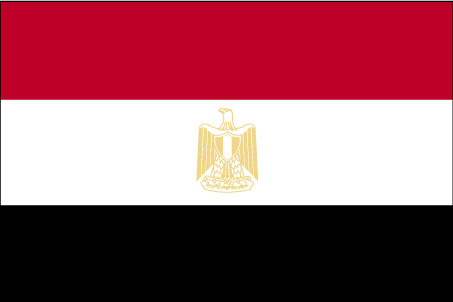
- Flag Symbolism
- three equal horizontal bands of red (top), white, and black with the national emblem (a shield superimposed on a golden eagle facing the hoist side above a scroll bearing the name of the country in Arabic) centered in the white band; similar to the flag of Yemen, which has a plain white band; also similar to the flag of Syria, which has two green stars, and to the flag of Iraq, which has three green stars (plus an Arabic inscription) in a horizontal line centered in the white band
- Date of Adoption
- 4 October 1984
National Anthem
- Anthem Lyrics (English)
- My homeland, my homeland, my hallowed land, Only to you, is my due hearty love at command, My homeland, my homeland, my hallowed land, Only to you is my due hearty love at command, Mother of the great ancient land, My sacred wish and holy demand, All should love, awe and cherish thee, Gracious is thy Nile to humanity, No evil hand can harm or do you wrong, So long as your free sons are strong, My homeland, my homeland, my hallowed land, Only to you, is my due hearty love at command
Other National Symbols
National Flower
Lotus (Nymphaea lotus)
The genus is closely related to Nuphar, differing in the petals being much larger than the sepals, whereas in Nuphar, the petals are much smaller than the 4-6 yellow-coloured sepals. The fruit maturation also differs, with Nymphaea fruit sinking below the water level immediately after the flower closes, whereas Nuphar fruit are held above water level to maturity.