
 English
 Español
 中文
中文 हिन्दी
 Français
Government and Politics
Government and Politics of Aruba
Government structure, leadership, capital, military, and national symbols of Aruba.
Government Structure
Constitutional foundations, branches, parties, and leadership.
- Government Type
- parliamentary democracy
- Administrative Divisions
- none (part of the Kingdom of the Netherlands)
- Legal System
- based on Dutch civil law system, with some English common law influence
- Suffrage
- 18 years of age; universal
- Citizenship
- see the Netherlands
- Executive Branch
- chief of state: King WILLEM-ALEXANDER of the Netherlands (since 30 April 2013), represented by Governor General Alfonso BOEKHOUDT (since 1 January 2017) head of government: Prime Minister Evelyn WEVER-CROES (since 17 November 2017) cabinet: Council of Ministers elected by the Staten (Aruban Parliament) elections: the monarch is hereditary; governor general appointed for a six-year term by the monarch; prime minister and deputy prime minister elected by the Staten for four-year terms election results: Evelyn WEVER-CROES elected prime minister following her party's victory in the 2017 parliamentary elections; she was subsequently returned to office following the 2021 elections, in which her party, Movimiento Electoral di Pueblo (MEP), secured a majority in the Staten
- Legislative Branch
- Unicameral Legislature or Staten (21 seats; members elected by direct, popular vote to serve four-year terms) Elections: last held on 25 June 2021 (next to be held in 2025) Election results: percent of vote by party - AVP 35.3%, MEP 31.3%, MAS 10.6%, Raiz 7.4%, POR 6.5%, PPT 4.5%, other 4.4%; seats by party - AVP 9, MEP 8, MAS 2, Raiz 1, POR 1
- Judicial Branch
- Common Court of Justice of Aruba (judges are appointed by the monarch)
- Political Parties
- Aliansa/Aruban Social Movement or MSA [Robert WEVER]; Aruban Liberal Organization or OLA [Glenbert CROES]; Aruban Patriotic Movement or MPA [Monica ARENDS-KOCK]; Aruban Patriotic Party or PPA [Benny NISBET]; Aruban People's Party or AVP [Mike EMAN]; People's Electoral Movement Party or MEP [Nelson O. ODUBER]; Real Democracy or PDR [Andin BIKKER]; RED [Rudy LAMPE]; Workers Political Platform or PTT [Gregorio WOLFF]
- Head of State
- King WILLEM-ALEXANDER of the Netherlands, represented by Governor General Alfonso BOEKHOUDT
- Head of Government
- Prime Minister Evelyn WEVER-CROES
- Cabinet
- Council of Ministers elected by the Staten
- Elections
- last held on 25 June 2021 (next to be held in 2025)
- Election Results
- Percent of vote by party - MEP 35.9%, AVP 27.6%, MAS 10.9%, POR 8.7%, Raiz 6.4%, PPT 4.8%, other 5.7%; seats by party - MEP 9, AVP 7, MAS 2, POR 2, Raiz 1; results reflect the most recent legislative elections held in June 2021, in which the Movimiento Electoral di Pueblo (MEP) won the most seats and party leader Evelyn Wever-Croes was reconfirmed as Prime Minister.
- Constitution
- 1-Jan-86
- Independence
- none (part of the Kingdom of the Netherlands)
- National Holiday
- Flag Day, 18 March
- International Organization Participation
- Interpol, IOC, UNESCO (associate), WCL, WToO (associate)
- Diplomatic Representation in the U.S.
- none (represented by the Kingdom of the Netherlands); note - Mr. Henry BAARH, Minister Plenipotentiary for Aruba at the Embassy of the Kingdom of the Netherlands
- U.S. Diplomatic Representation
- the US does not have an embassy in Aruba; the Consul General to Netherlands Antilles is accredited to Aruba
Capital City
Seat of government and political history.
- Capital City
- Oranjestad
- Location
- 12 31 N, 70 02 W
- Time Difference
- UTC-4 (1 hour ahead of Washington, DC, during Standard Time)
- History
- translates as "orange town" in Dutch; the city is named after William I (1533-1584), Prince of Orange, the first ruler of the Netherlands
Embassy and Diplomatic Representation
Embassy location and contact details.
United States Consulate General Curacao J.B. Gorsiraweg 1, Willemstad, Curaçao Telephone: (599-9) 461-3066 Emergency after-hours telephone: (599-9) 510-6870 Facsimile: (599-9) 461-6489
Military
Branches, service obligations, expenditures, and manpower.
- Military Branches
- No regular military forces
National Symbols
Flag, anthem, and other symbols of national identity.
National Flag
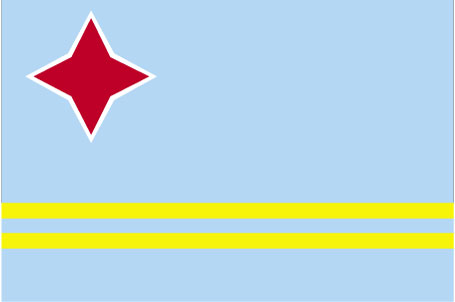
- Flag Symbolism
- has four colors: Bunting yellow, Larkspur (orU.N.) Blue, Union Jack Red and White. The flag of Aruba consists of a four-pointed red star with a white outline, in the upper hoist-side corner, set against a sea-blue background with two parallel yellow stripes. The STAR symbolizes the four points of the compass, denoting the varied source of more than 40 nationalities living on Aruba. Each of these colors is significant: the RED color of the star symbolizes love of country and the WHITE outline surrounding it represents the white sandy beaches around Aruba as well as the purity of Aruba's inhabitants who respect justice, freedom and righteousness. The BLUE color of the flag denotes the color of the surrounding sea The two yellow STRIPES on the flag denote the free position of Aruba with respect to The Netherlands and other islands while maintaining closeness with them. The YELLOW color is used to symbolize abundance - as evidenced by the sources of economic and industrial prosperity, representing the island’s past and present industries of gold, aloe, tourism, the oil refinery and so forth.
- Flag History
- In March 1976, at the suggestion of the Flag Research Institute in Winchester, Mass., I went to Aruba to review the 700 plus designs that had been entered in a competition for a new island flag. I quickly learned that many Arubans wanted a distinctive flag that would represent their history and goals as they negotiated for a "status aparte" within the Netherlands Antilles. A Flag Commission consisting of Julio Maduro, Epi Wever, and Roland Donk had met for months, going over colorful designs from the contest. They wanted no heraldic emblems, slogans, nor writing on the flag for such flags could not be read at a distance. It had to be inexpensive to manufacture, and "unlike any other flag, so it would be distinctive to Aruba." They rejected designs that did not meet their guidelines. They also wanted a design simple enough that a schoolchild could draw it, with colors contrasting well in order to be seen at a distance. Most importantly, they insisted that the flag, in its symbols and colors, represent Arubans historically and culturally. We found three designs that met their requirements. But Julio Maduro told me that the Island Council had already said those designs were not distinctive enough. On 6 March 1976, the Flag Committee decided had found two or three designs, which, with modifications, could represent Aruba. But, on my advice, the Committee decided not to limit itself to those few designs. Instead, it chose to bring together designs and colors that Arubans who entered the contest had used, and to make a new flag with those. By taking ideas from the entire competition, the flag would represent more than the ideas and inspirations of one contestant, and would reflect symbolically the feelings of most Arubans. Symbols in the competition were often discs, stars, and stripes that were said to represent the sun, which was usually yellow or gold, but sometimes red. The sun's central position in Aruba's way of life and economy meant the health and happiness of all Arubans in a comfortable, benign climate. The sun also represented economic growth and national unity. Julio Maduro and Epi Wever told me that more than 50 nationalities live in Aruba in tranquility admired throughout the world. Stripes were found in more than half of the entries. Some were simple tricolor flags recalling 19th-century European democracies. Others were narrow bands dividing fields of color in more modern color combinations, often involving blue and yellow. Another frequent symbol was a star. Stars represented the island itself, as well as liberty, unity or rebirth. But many of the stars were not the traditional five-pointed, but a bold four-pointed version. I told the commission that these special four-pointed stars were unlike any star found on any national flag. Julio and Epi said children often drew Christmas stars this way. Deciding that the Aruban flag ought to feature some combination of stars, stripes, or discs, the Commission examined the colors they found in the contest. Blue, the most popular color, represented the Aruban sky or the Caribbean Sea, in shades from aquamarine to dark blue. The other popular color was yellow, nearly always said to represent sunlight. White symbolized Aruba's unique beaches, while red stood for sunset, the island's clay soil, progress, or the blood of Arubans. The flag contest demonstrated that Arubans feel their country is unique in the world and in the Caribbean, that it enjoys an immutably beautiful sea and sunlight, and that many nationalities live in harmony. Aruba is a proud country, these flags declared, economically stable because of tourism and industry. I felt that the background color had to be blue, ideally the vivid bright blue of the sea. Because Aruba is a peaceful Mecca for people around the world, the bright blue of the United Nations flag was an ideal match. Out of the blue field, a star rises in that corner, the canton, that is highest and nearest the hoist. Placing the star there meant it would be seen even when the flag is moving in the breeze. The star has, as many Arubans wanted, four points. Suggesting a compass, its four points represent North, South, East, and West, acknowledging that Arubans came from many nations in order to live in unity and strength. The star is red because much of the soil of Aruba is red, but it is bordered in white to suggest the waves beating on its white beaches. The red soil of the interior ends with white beaches before the blue sea -- a symbol of the island itself. And the star refers also to the island's unity, diversity, vigor, and beauty. The Commission pointed out that the four points also represented the four major languages: Papiamento, Spanish, English, and Dutch. And the red in the star reminded Julio Maduro of the Indians who once lived on the island, and of blood shed by Arubans during war. White was Aruba's honesty, while blue, the color of hope, represents its future and its ties to the past. Finally, looking to the future, two narrow stripes were drawn across the blue field to suggest the movement toward "status aparte." Those stripes were very narrow because Aruba is apart, but not isolated as it embarks on its path. One stripe represents the flow of tourists to sun-drenched Aruba, enriching the island as well as vacationers. The second stripe is for industry, all the minerals (gold and phosphates in the past, petroleum in the early 20th century). The stripes announce a new, distinctive nationality with economic strength guaranteeing its independence, standing apart from the rest of the world, but working internationally. The Flag Commission was happy with the flag that it had put together, but we had to find seven variations to give the Island Council a choice. We made four designs similar to the first one, but in fewer colors, some with white and blue only, others white, blue and yellow. And the original three designs that the Commission had chosen were added as well. Betico Croes asked me to stay for another week until the Island Council selected the flag of Aruba so I could answer questions about the design. After they voted for the first design, I helped arrange to have the first flags manufactured in the United States. They were ready in time for hoisting for the first time on 18 March 1976. The flag was consistent with the Flag Commission's guidelines. The design is simple but unlike any other flag it is the only flag with a four-pointed star. It is visible at a great distance and looks good flying in the ceaseless wind of Aruba or outstretched against a wall. Its elements are large and well placed, and its colors contrast well. It is easily drawn and inexpensive to manufacture. Every color, the star, the stripes, and placements of elements are symbolic of this island. No other country could be represented by a white-bordered, four-pointed red star, and anyone who knows its symbolism will remember well the flag of Aruba.
- Date of Adoption
- 18 March 1976
National Anthem
- Anthem Lyrics
- ARUBA DUSHI TERA Padu Lampe Rufo Wever Aruba, patria aprecia nos cuna venera. Chikito y simpel bo por ta, pero si respeta! Chorus Oh! Aruba, dushi tera, nos baranca tan stima! Nos amor pa bo t'asina grandi, c'un tin nada pa kibr'e. Bo playanan tan admira cu palma tur dorna. Bo escudo y bandera ta, orgullo di nos tur. Chorus Grandeza di bo pueblo ta su gran cordialidad. Cu Dios por guia y conserva su amor pa libertad.
- Anthem Lyrics (English)
- Aruba beloved home our venerated cradle though small and simple you may be you are indeed esteemed. Refrain: Aruba our dear country our rock so well beloved our love for you is so strong that nothing can destroy it. (repeat) Your beaches so much admired with palm trees all adorned your coat of arms and flag the symbols of our pride. Refrain The greatness of our people is their great cordiality and may God guide and preserve its love for freedom. Refrain
- Anthem History
- The Dutch anthem "Wilhelmous van Nassowe" is the official anthem of this Dutch colony, however a local anthem, a waltz, has been unofficially adopted as well, and is in use in the island.