
 English
 Español
 中文
中文 हिन्दी
 Français
Government and Politics
Government and Politics of Yemen
Government structure, leadership, capital, military, and national symbols of Yemen.
Government Structure
Constitutional foundations, branches, parties, and leadership.
- Government Type
- republic
- Administrative Divisions
- 19 governorates (muhafazat, singular - muhafazah); Abyan, 'Adan, Ad Dali', Al Bayda', Al Hudaydah, Al Jawf, Al Mahrah, Al Mahwit, 'Amran, Dhamar, Hadramawt, Hajjah, Ibb, Lahij, Ma'rib, Sa'dah, San'a', Shabwah, Ta'izz
- Legal System
- based on Islamic law, Turkish law, English common law, and local tribal customary law; has not accepted compulsory ICJ jurisdiction
- Suffrage
- 18 years of age; universal
- Citizenship
- citizenship by birth: no citizenship by descent only: the father must be a citizen of Yemen; if the father is unknown, the mother must be a citizen dual citizenship recognized: no residency requirement for naturalization: 10 years
- Executive Branch
- chief of state: The presidency and governmental structure of Yemen have been in a state of significant transition and conflict since 2015. Abd al-Rab Mansur al-HADI, who served as Vice President under longtime President Ali Abdallah SALIH, assumed the presidency in February 2012 following SALIH's resignation amid the Arab Spring uprisings. Al-HADI was recognized internationally as Yemen's legitimate president; however, his government was displaced from Sanaa in 2014–2015 by Houthi forces. In April 2022, al-HADI transferred presidential authority to a newly formed Presidential Leadership Council (PLC), chaired by Rashad Muhammad al-ALIMI, effectively ending his individual tenure. The PLC serves as the internationally recognized governing authority, though its control over Yemeni territory remains contested. head of government: Prime Minister Maeen Abd al-Malik SAEED has served as head of government since October 2018, operating under the framework of the internationally recognized government. The cabinet functions in coordination with the Presidential Leadership Council following the 2022 restructuring of executive authority. cabinet: Council of Ministers appointed by the president on the advice of the prime minister. elections: Prior to the ongoing conflict, the president was elected by direct popular vote for a seven-year term. The most recent uncontested presidential transition occurred in February 2012, when al-HADI ran unopposed in an election endorsed by the Gulf Cooperation Council as part of a political transition agreement. No free national elections have been held since the outbreak of the civil war in 2015. election results: Abd al-Rab Mansur al-HADI elected president in February 2012; percent of vote — al-HADI 99.8%, with the election conducted as a single-candidate referendum under the GCC-brokered transition deal.
- Legislative Branch
- Yemen's legislature, established under a constitutional framework last significantly amended in 2001, was structured as a bicameral body consisting of a Shura Council (111 seats; members appointed by the president) and a House of Representatives (301 seats; members elected by popular vote to serve six-year terms). The last general parliamentary elections were held on 27 April 2003, in which the General People's Congress (GPC) dominated, winning 228 seats. Other results included Islah with 47 seats, the Yemeni Socialist Party (YSP) with 7 seats, the Nasserite Unionist Party with 3 seats, the National Arab Socialist Ba'th Party with 2 seats, and independents accounting for 14 seats. Elections scheduled for 2009 were postponed and never held. Since the outbreak of the civil war in 2014–2015, Yemen's formal legislative institutions have been largely non-functional. The House of Representatives has not convened in any meaningful capacity, and the country remains divided between the internationally recognized government, the Houthi movement controlling much of the north including Sanaa, and the Southern Transitional Council in the south. The Shura Council and House of Representatives nominally continue to exist under the recognized government but operate in a severely limited and fragmented manner amid ongoing conflict.
- Judicial Branch
- Supreme Court
- Political Parties
- there are more than 12 political parties active in Yemen, some of the more prominent are: General People's Congress or GPC [President Ali Abdallah SALIH]; Islamic Reform Grouping or Islah [Shaykh Abdallah bin Husayn al-AHMAR]; Nasserite Unionist Party [Abdal Malik al-MAKHLAFI]; National Arab Socialist Ba'th Party [Dr. Qasim SALAM]; Yemeni Socialist Party or YSP [Ali Salih MUQBIL]
- Head of State
- The presidency and governmental structure of Yemen have been in a state of significant transition and conflict since 2015. Abd al-Rab Mansur al-HADI, who served as Vice President under longtime President Ali Abdallah SALIH, assumed the presidency in February 2012 following SALIH's resignation amid the Arab Spring uprisings. Al-HADI was recognized internationally as Yemen's legitimate president
- Head of Government
- Prime Minister Maeen Abd al-Malik SAEED has served as head of government since October 2018, operating under the framework of the internationally recognized government. The cabinet functions in coordination with the Presidential Leadership Council following the 2022 restructuring of executive authority.
- Cabinet
- Council of Ministers appointed by the president on the advice of the prime minister
- Election Results
- Yemen's political landscape has been shaped by decades of turbulent governance, and its electoral history reflects the broader instability that has come to define the country in the modern era. The most recent presidential election took place in September 1999, when Ali Abdullah Saleh, who had ruled North Yemen since 1978 and unified Yemen since 1990, won re-election with approximately 96.3 percent of the vote. His sole challenger, Najib Qahtan al-Sha'bi, received just under 4 percent. International observers noted significant limitations in the competitiveness of the contest, as the ruling General People's Congress tightly controlled the political environment. Parliamentary elections were last held in April 2003, in which the General People's Congress secured a commanding majority, winning 238 of the 301 seats in the House of Representatives. The Yemeni Congregation for Reform, known as Islah, came in second with 46 seats, while smaller parties and independents divided the remainder. Legislative elections scheduled for 2009 were postponed and ultimately never held as the country's internal security situation deteriorated. The 2011 Arab Spring uprisings led to widespread protests against Saleh's government, eventually resulting in a Gulf Cooperation Council-brokered power transfer agreement. Under this deal, Saleh transferred power to his vice president, Abd Rabbuh Mansur Hadi, who ran unopposed in a February 2012 presidential election and received approximately 99.8 percent of the vote. This election was considered a transitional measure rather than a competitive democratic contest. Since 2014, when Houthi forces seized the capital Sanaa, Yemen has been engulfed in civil war. No further national elections have been organized. In April 2022, a Presidential Leadership Council was established, replacing Hadi's government as the internationally recognized authority, though this body was formed through political negotiation rather than popular vote. The ongoing conflict has made the conditions necessary for free and fair elections effectively impossible to achieve.
- Constitution
- 16 May 1991; amended 29 September 1994 and February 2001
- Independence
- 22 May 1990, Republic of Yemen was established with the merger of the Yemen Arab Republic [Yemen (Sanaa) or North Yemen] and the Marxist-dominated People's Democratic Republic of Yemen [Yemen (Aden) or South Yemen]; previously North Yemen had become indep
- National Holiday
- Unification Day, 22 May (1990)
- International Organization Participation
- ACC, AFESD, AMF, CAEU, FAO, G-77, IAEA, IBRD, ICAO, ICCt (signatory), ICFTU, ICRM, IDA, IDB, IFAD, IFC, IFRCS, ILO, IMF, IMO, Interpol, IOC, IOM, ISO (correspondent), ITU, LAS, NAM, OAS (observer), OIC, OPCW, UN, UNCTAD, UNESCO, UNHCR, UNIDO, UPU, WCO, WFTU, WHO, WIPO, WMO, WToO, WTrO (observer)
- Diplomatic Representation in the U.S.
- chief of mission: Ambassador Abd al-Wahab Abdallah al-HAJRI chancery: 2319 Wyoming Avenue NW, Washington, DC 20008 telephone: [1] (202) 965-4760 FAX: [1] (202) 337-2017
- U.S. Diplomatic Representation
- chief of mission: Ambassador Thomas C. KRAJESKI embassy: Sa'awan Street, Sanaa mailing address: P. O. Box 22347, Sanaa telephone: [967] (1) 755-2000 ext. 2153 or 2266 FAX: [967] (1) 303-182
Capital City
Seat of government and political history.
- Capital City
- Sanaa
- Location
- 15 21 N, 44 12 E
- Time Difference
- UTC+3 (8 hours ahead of Washington, DC, during Standard Time)
- History
- the name is reputed to mean "well-fortified" in Sabaean, the South Arabian language that went extinct in Yemen in the 6th century A.D.
Embassy and Diplomatic Representation
Embassy location and contact details.
U.S. Embassy Sana’a Dhahr Himyar Zone, Sheraton Hotel District P.O. Box 22347 Sana’a, Yemen Telephone: (967) (1) 755-2000 U.S. Citizen Emergency After-Hours Telephone: (967) (1) 755-2000 (press 0 for emergencies) or 737-789-261 (for emergencies involving U.S. citizens that cannot wait until normal business hours). Visa and routine passport questions will not be answered on this phone.
Military
Branches, service obligations, expenditures, and manpower.
- Military Branches
- Land Forces, Naval and Coastal Defense Forces (includes Marines), Air and Air Defense Force (al-Quwwat al-Jawwiya al-Yemeniya), Border Guards, Stategic Reserve Forces
- Service Age and Obligation
- 18 is the legal minimum age for voluntary military service; no conscription; 2-year service obligation
National Symbols
Flag, anthem, and other symbols of national identity.
National Flag
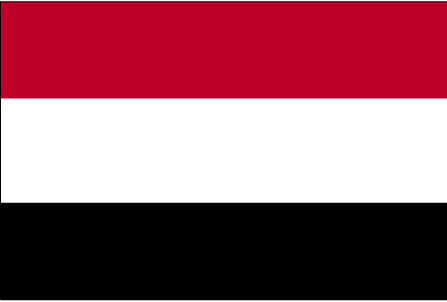
- Flag Symbolism
- three equal horizontal bands of red (top), white, and black; similar to the flag of Syria, which has two green stars and of Iraq which has three green stars (plus an Arabic inscription) in a horizontal line centered in the white band; also similar to the flag of Egypt, which has a heraldic eagle centered in the white band
- Date of Adoption
- 22 May 1990
National Anthem
- Anthem Lyrics
- Raddidi Ayyatuha 'D-dunya Nashidi Raddidihi Wa-a 'idi Wa-a idi Wa 'Dhkuri Fi Farhati Kulla Shahidi Wa'Mnahihi Hullalan Min Daw'i Idi Raddidi Ayyatuha 'D-dunya Nashidi 'Ishtu Imani Wa-hubbi Umamiyya Wa-masiri Fawqa Darbi Arabiyya Wa-sayabqa Nabdu Qalbi Yamaniyya Lan Tara 'D-dunya Ala Ardi Wasiyya.
- Anthem Lyrics (English)
- Repeat, O World, my song. Echo it over and over again. Remember, through my joy, each martyr. Clothe him with the shining mantles Of our festival. Repeat, O World, my song. In faith and love I am part of mankind. An Arab I am in all my life. My heart beats in tune with Yemen. No foreigner shall dominate over Yemen.
- Anthem History
- United Republic is the national anthem of Yemen. Written by Abdulla Abdul Wahab Noman and composed by Ayob Tarish, it was formerly the anthem of the People's Democratic Republic of Yemen (South Yemen) and became the anthem of all of Yemen when the two Yemens merged in 1990.