
 English
 Español
 中文
中文 हिन्दी
 Français
Government and Politics
Government and Politics of Turkmenistan
Government structure, leadership, capital, military, and national symbols of Turkmenistan.
Government Structure
Constitutional foundations, branches, parties, and leadership.
- Government Type
- republic
- Administrative Divisions
- 5 provinces (welayatlar, singular - welayat): Ahal Welayaty (Ashgabat), Balkan Welayaty (Balkanabat), Dashoguz Welayaty, Lebap Welayaty (Turkmenabat), Mary Welayaty
- Legal System
- based on civil law system
- Suffrage
- 18 years of age; universal
- Citizenship
- citizenship by birth: no citizenship by descent only: at least one parent must be a citizen of Turkmenistan dual citizenship recognized: yes residency requirement for naturalization: 7 years
- Executive Branch
- chief of state: President Serdar BERDIMUHAMEDOW (since 19 March 2022); note - the president is both the chief of state and head of government head of government: President Serdar BERDIMUHAMEDOW (since 19 March 2022); note - the president is both the chief of state and head of government; Raşit MEREDOW serves as Deputy Chairman of the Cabinet of Ministers cabinet: Cabinet of Ministers appointed by the president note: Serdar BERDIMUHAMEDOW, son of longtime ruler Gurbanguly BERDIMUHAMEDOW, won the February 2022 presidential election and assumed office in March 2022. Gurbanguly BERDIMUHAMEDOW, who had led the country since 2006 following the death of Saparmurat NIYAZOV, subsequently assumed the role of Chairman of the upper house of parliament (Halk Maslahaty), retaining significant political influence. The Halk Maslahaty was reconstituted as the upper chamber of a bicameral legislature in 2021, expanding the formal structures of government while power continues to remain highly centralized. elections: president elected by popular vote for a seven-year term; election last held on 12 March 2022 election results: Serdar BERDIMUHAMEDOW elected president; percent of vote - Serdar BERDIMUHAMEDOW approximately 72.97%, with several other candidates appearing on the ballot in an election widely regarded by international observers as lacking genuine political competition
- Legislative Branch
- Turkmenistan's legislative structure has undergone significant changes since the country's post-Soviet constitution was first adopted. Following a series of constitutional reforms, the parliament was reorganized into a bicameral system. The upper chamber, the Halk Maslahaty (National Council), consists of 56 seats, with 48 members elected by popular vote and 8 members appointed by the president, serving five-year terms. The lower chamber, the Mejlis (Assembly), consists of 125 seats, with members elected by popular vote to serve five-year terms. Elections: Halk Maslahaty - last held on 26 March 2021; Mejlis - last held on 26 March 2021, with the next elections due in 2026. Election results: Mejlis - seats by party - Democratic Party of Turkmenistan 55, Agrarian Party of Turkmenistan 11, Party of Industrialists and Entrepreneurs 11, independent candidates and others 48. All elected officials operate within a political environment tightly controlled by the ruling authority, and genuine political competition remains severely restricted. Note: Constitutional amendments adopted in 2021 formalized the bicameral structure, replacing the previous arrangement in which the Halk Maslahaty functioned as a supreme non-standing body above the Mejlis. Under the current system, the president retains dominant authority over both chambers. Gurbanguly Berdimuhamedov, who succeeded longtime leader Saparmurat Niyazov in 2007, ruled until 2022, when his son Serdar Berdimuhamedov assumed the presidency. Gurbanguly Berdimuhamedov subsequently became Chairman of the Halk Maslahaty, continuing to wield substantial political influence. The ruling Democratic Party of Turkmenistan remains the dominant political force, and independent political activity is not meaningfully permitted.
- Judicial Branch
- Supreme Court (judges are appointed by the president)
- Political Parties
- Democratic Party of Turkmenistan or DPT [Saparmurat NIYAZOV] note: formal opposition parties are outlawed; unofficial, small opposition movements exist underground or in foreign countries; the two most prominent opposition groups-in-exile have been National Democratic Movement of Turkmenistan (NDMT) and the United Democratic Party of Turkmenistan (UDPT); NDMT was led by former Foreign Minister Boris SHIKHMURADOV until his arrest and imprisonment in the wake of the 25 November 2002 assassination attempt on President NIYAZOV; UDPT is led by former Foreign Minister Abdy KULIEV and is based out of Moscow
- Head of State
- President Serdar BERDIMUHAMEDOW
- Head of Government
- President Serdar BERDIMUHAMEDOW
- Cabinet
- Cabinet of Ministers appointed by the president
- Elections
- Halk Maslahaty - last held on 26 March 2021; Mejlis - last held on 26 March 2021, with the next elections due in 2026.
- Election Results
- Mejlis - seats by party - Democratic Party of Turkmenistan 55, Agrarian Party of Turkmenistan 11, Party of Industrialists and Entrepreneurs 11, independent candidates and others 48. All elected officials operate within a political environment tightly controlled by the ruling authority, and genuine political competition remains severely restricted. Note: Constitutional amendments adopted in 2021 formalized the bicameral structure, establishing the Halk Maslahaty (National Council) as the upper chamber and the Mejlis as the lower chamber of the parliament. Under the current system, the president retains dominant authority over both chambers. Gurbanguly Berdimuhamedov, who succeeded longtime leader Saparmurat Niyazov in 2007, ruled until March 2022, when his son Serdar Berdimuhamedov was elected president with an officially reported 72.97 percent of the vote. Gurbanguly Berdimuhamedov subsequently assumed the role of Chairman of the Halk Maslahaty, a position formalized in 2023, through which he continues to wield substantial political influence. The ruling Democratic Party of Turkmenistan remains the dominant political force, and independent political activity is not meaningfully permitted. International observers have consistently characterized Turkmenistan's electoral processes as lacking the conditions necessary for free and fair competition.
- Constitution
- adopted 18 May 1992
- Independence
- 27 October 1991 (from the Soviet Union)
- National Holiday
- Independence Day, 27 October (1991)
- International Organization Participation
- AsDB, CIS, EAPC, EBRD, ECO, FAO, G-77, IBRD, ICAO, ICRM, IDB, IFC, IFRCS, ILO, IMF, IMO, IOC, IOM (observer), ISO (correspondent), ITU, NAM, OIC, OPCW, OSCE, PFP, UN, UNCTAD, UNESCO, UNIDO, UPU, WCO, WFTU, WHO, WIPO, WMO, WToO
- Diplomatic Representation in the U.S.
- chief of mission: Ambassador Meret Bairamovich ORAZOV chancery: 2207 Massachusetts Avenue NW, Washington, DC 20008 telephone: [1] (202) 588-1500 FAX: [1] (202) 588-0697
- U.S. Diplomatic Representation
- chief of mission: Ambassador Tracey A. JACOBSON embassy: No. 9 1984 Street (formerly Pushkin Street), Ashgabat, Turkmenistan 774000 mailing address: 7070 Ashgabat Place, Washington, D.C. 20521-7070 telephone: [9] (9312) 35-00-45 FAX: [9] (9312) 39-26-14
Capital City
Seat of government and political history.
- Capital City
- Ashgabat (Ashkhabad)
- Location
- 37 57 N, 58 23 E
- Time Difference
- UTC+5 (10 hours ahead of Washington, DC, during Standard Time)
- History
- derived from the Persian words eshq meaning "love" and abad meaning "inhabited place" or "city," and so loosely translates as "the city of love"
Embassy and Diplomatic Representation
Embassy location and contact details.
United States Embassy Ashgabat 9 1984 Street (formerly Pushkin Street) Ashgabat, Turkmenistan Telephone: (993-12) 94 00 45 Consular Information Line: (993-12) 94 00 49 Facsimile: (993-12) 94 26 14
Military
Branches, service obligations, expenditures, and manpower.
- Military Branches
- Turkmen Armed Forces: Ground Forces, Navy, Air and Air Defense Forces
- Service Age and Obligation
- 18-27 years of age for compulsory male military service; 2-year conscript service obligation, or 1 year for university students; 20 years of age for voluntary service; males may enroll in military schools from age 15
National Symbols
Flag, anthem, and other symbols of national identity.
National Flag
- Flag Symbolism
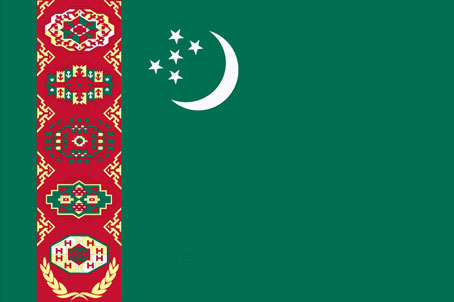
- green field with a vertical red stripe near the hoist side, containing five carpet guls (designs used in producing rugs) stacked above two crossed olive branches similar to the olive branches on the UN flag; a white crescent moon and five white stars appear in the upper corner of the field just to the fly side of the red stripe
- Flag History
- The crescent and stars represent faith in a bright future, while the white symbolizes serenity and kind-heartedness. The five stars symbolize the five velayats (regions): Ahal, Balkan, Dashhowuy, Lebap and Mary. They also stand for the 5 senses. The five points of each star symbolize the five states of matter: solid, liquid, gaseous, crystalline and plasmatic. The vertical stripe along the hoist bears 5 major guls of the Turkemenian carpets. Each gul is a symmetrical medallion, in some cases divided into four quarters in couterchanging colors. Major guls are repeated in rows or in a checkered pattern on the central field of the carpet, and minor guls appear on the border. The reflect the national idenetity of Turkmenistan where carpets were part of traditional nomadic life, used for floor-covering, furniture, sack and bags and to decorate camel an horse trappings.
- Date of Adoption
- 24 January 2001
National Anthem
- Anthem Lyrics (English)
- The great creation of Turkmenbashy, Native land, sovereign state, Turkmenistan, light and song of soul, Long live and prosper for ever and ever! I am ready to give life for native hearth, The spirit of ancestors descendants are famous for, My land is sacred. My flag flies in the world A symbol of the great neutral country flies. The great creation of Turkmenbashy, Native land, sovereign state, Turkmenistan, light and song of soul, Long live and prosper for ever and ever! My nation is united and is veins of tribes Ancestors’ blood, undying flows, Storms and misfortunes of times are not dreadful for us, Let us increase fame and honour! The great creation of Turkmenbashy, Native land, sovereign state, Turkmenistan, light and song of soul, Long live and prosper for ever and ever! Mountains, rivers and beauty of steppes, Love and destiny, revelation of mine, Let my eyes go blind for any cruel look at you, Motherland of ancestors and heirs of mine!