
 English
 Español
 中文
中文 हिन्दी
 Français
Government and Politics
Government and Politics of Tokelau
Government structure, leadership, capital, military, and national symbols of Tokelau.
Government Structure
Constitutional foundations, branches, parties, and leadership.
- Government Type
- NA
- Administrative Divisions
- none (territory of New Zealand)
- Legal System
- New Zealand and local statutes
- Suffrage
- 21 years of age; universal
- Citizenship
- see New Zealand
- Executive Branch
- chief of state: King CHARLES III (since 8 September 2022), represented by the Governor-General of New Zealand; New Zealand is represented by an Administrator appointed by the New Zealand Minister of Foreign Affairs and Trade head of government: the head of government is the Ulu o Tokelau, a position that rotates annually among the three Faipule (village leaders) of Atafu, Fakaofo, and Nukunonu cabinet: the Council for the Ongoing Government of Tokelau, consisting of three Faipule (village leaders) and three Pulenuku (village mayors), functions as a cabinet elections: none; the monarch is hereditary; the Administrator is appointed by the New Zealand Minister of Foreign Affairs and Trade; the Ulu o Tokelau is chosen from among the three Faipule and serves a one-year term, rotating among the three atolls
- Legislative Branch
- Unicameral General Fono (21 seats; members drawn from the three atolls based on proportional representation and elected by popular vote to serve three-year terms; Atafu has 8 seats, Fakaofo has 7 seats, and Nukunonu has 6 seats); note — the Tokelau Amendment Act of 1996 confers limited legislative power on the General Fono, with the body responsible for policy-making and budgetary decisions within the territory's framework of self-governance under New Zealand administration. Elections: last held in January 2023 (next to be held in January 2026)
- Judicial Branch
- Supreme Court in New Zealand exercises civil and criminal jurisdiction in Tokelau
- Political Parties
- none
- Head of State
- King CHARLES III, represented by the Governor-General of New Zealand
- Head of Government
- the head of government is the Ulu o Tokelau, a position that rotates annually among the three Faipule (village leaders) of Atafu, Fakaofo, and Nukunonu
- Cabinet
- the Council for the Ongoing Government of Tokelau, consisting of three Faipule (village leaders) and three Pulenuku (village mayors), functions as a cabinet
- Elections
- last held in January 2023 (next to be held in January 2026)
- Election Results
- Tokelau's political structure is unique among the world's territories, and its approach to governance reflects this distinctiveness. Rather than holding competitive multi-party elections in the conventional sense, Tokelau selects its leaders through a consensus-based system rooted in traditional Polynesian governance. Each of Tokelau's three atolls — Atafu, Fakaofo, and Nukunonu — is governed by its own village council, known as the Taupulega, which is composed of elders drawn from extended family groups called inati. These councils hold significant authority at the local level and serve as the foundation of political life in the territory. At the national level, Tokelau is governed by the General Fono, a national assembly that meets several times a year and functions as the territory's parliament. Each atoll sends representatives to the General Fono, with representation proportional to population. The head of government of Tokelau rotates annually among the three atolls in a position called the Ulu-o-Tokelau, meaning "Head of Tokelau." This rotating leadership is selected by the Taupulega of the atoll whose turn it is to lead, rather than through a public vote. Because leadership is determined through traditional council selection rather than competitive balloting, there are no formal election results to report in the typical sense. Candidates do not run political campaigns, and political parties do not exist in Tokelau. One significant political event that did involve formal voting was the question of Tokelau's self-determination. In February 2006 and again in October 2007, Tokelau held referendums on whether to become a self-governing territory in free association with New Zealand. Both referendums fell short of the required two-thirds majority needed to change Tokelau's status. In 2006, approximately 60 percent of voters supported self-governance. In 2007, support was again around 64 percent — close to but not reaching the threshold. As a result, Tokelau remains a non-self-governing territory administered by New Zealand under the oversight of the United Nations.
- Constitution
- administered under the Tokelau Islands Act of 1948, as amended in 1970
- Independence
- none (territory of New Zealand)
- National Holiday
- Waitangi Day (Treaty of Waitangi established British sovereignty over New Zealand), 6 February (1840)
- International Organization Participation
- UNESCO (associate), WHO (associate)
- Diplomatic Representation in the U.S.
- none (territory of New Zealand)
- U.S. Diplomatic Representation
- none (territory of New Zealand)
Capital City
Seat of government and political history.
- Capital City
- note: there is no designated, official capital for Tokelau; the location of the capital rotates among the three atolls along with the head of government or Ulu o Tokelau
- Time Difference
- UTC+13 (18 hours ahead of Washington, DC during Standard Time)
Military
Branches, service obligations, expenditures, and manpower.
- Military Branches
- defense is the responsibility of New Zealand
National Symbols
Flag, anthem, and other symbols of national identity.
National Flag
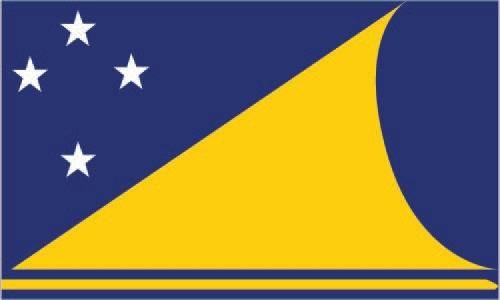
- Flag Symbolism
- the flag of New Zealand is used
- Date of Adoption
- 1989
National Anthem
- Anthem History
- territory of New Zealand