
 English
 Español
 中文
中文 हिन्दी
 Français
Government and Politics
Government and Politics of Togo
Government structure, leadership, capital, military, and national symbols of Togo.
Government Structure
Constitutional foundations, branches, parties, and leadership.
- Government Type
- republic under transition to multiparty democratic rule
- Administrative Divisions
- 5 regions (regions, singular - region); Kara, Plateaux, Savanes, Centrale, Maritime
- Legal System
- French-based court system
- Suffrage
- NA years of age; universal adult
- Citizenship
- citizenship by birth: no citizenship by descent only: at least one parent must be a citizen of Togo dual citizenship recognized: yes residency requirement for naturalization: 5 years
- Executive Branch
- chief of state: President Faure GNASSINGBE (since 6 February 2005); note - Gnassingbe EYADEMA, who had ruled Togo since 1967, died on 5 February 2005 and was succeeded by his son, Faure GNASSINGBE; popular elections subsequently validated the succession, and GNASSINGBE has since been re-elected multiple times, most recently in February 2020 head of government: Prime Minister Victoire Tomegah DOGBE (since 28 September 2020); note - DOGBE became Togo's first female prime minister upon her appointment cabinet: Council of Ministers appointed by the president and the prime minister elections: president elected by popular vote for a five-year term; election last held on 22 February 2020 (next to be held in 2025); prime minister appointed by the president election results: Faure GNASSINGBE re-elected president in 2020; percent of vote - Faure GNASSINGBE 72.4%, Agbeyome KODJO 18.4%, Jean-Pierre FABRE 4.4%, other candidates combined approximately 4.8%
- Legislative Branch
- Unicameral National Assembly (113 seats; members are elected by popular vote to serve five-year terms) Elections: last held on 29 April 2024 (next to be held in 2029) Election results: percent of vote by party - NA%; seats by party - UNIR 108, NET 1, ADDI 1, independents 3 Note: Togo transitioned to a parliamentary system under a new constitution adopted in 2024, shifting executive power away from the presidency toward a Council of Ministers led by a President of the Council. The National Assembly continues to serve as the country's sole legislative chamber, though its role has been significantly elevated under the restructured system of government.
- Judicial Branch
- Court of Appeal or Cour d'Appel; Supreme Court or Cour Supreme
- Political Parties
- Juvento [Monsilia DJATO]; Movement of the Believers of Peace and Equality or MOCEP [leader NA]; Rally for the Support for Development and Democracy or RSDD [Harry OLYMPIO]; Rally of the Togolese People or RPT [Faure GNASSINGBE]; Union for Democracy and Social Progress or UDPS [Gagou KOKOU]
- Head of State
- President Faure GNASSINGBE
- Head of Government
- Prime Minister Victoire Tomegah DOGBE
- Cabinet
- Council of Ministers appointed by the president and the prime minister
- Elections
- last held on 29 April 2024 (next to be held in 2029)
- Election Results
- Percent of vote by party - NA%; seats by party - UNIR 108, NET 1, UFC 1, independents 3 Note: Togo transitioned to a parliamentary system under a new constitution adopted in March 2024, shifting executive power away from the presidency toward a Council of Ministers led by a President of the Council. The National Assembly, whose most recent general elections were held in April 2024, continues to serve as the country's sole legislative chamber. The ruling Union for the Republic (UNIR), the party of longtime political figure Faure Gnassingbé, retained an overwhelming majority of seats. Under the restructured system of government, the role of the legislature has been significantly elevated, as the President of the Council — rather than a directly elected president — now holds primary executive authority.
- Constitution
- multiparty draft constitution approved by High Council of the Republic 1 July 1992; adopted by public referendum 27 September 1992
- Independence
- 27 April 1960 (from French-administered UN trusteeship)
- National Holiday
- Independence Day, 27 April (1960)
- International Organization Participation
- ACCT, ACP, AfDB, AU, ECOWAS, Entente, FAO, FZ, G-77, IBRD, ICAO, ICC, ICFTU, ICRM, IDA, IDB, IFAD, IFC, IFRCS, ILO, IMF, IMO, Interpol, IOC, ITU, MICAH, NAM, OIC, OPCW, UN, UNCTAD, UNESCO, UNIDO, UNMIL, UPU, WADB (regional), WAEMU, WCL, WCO, WFTU, WHO, WIPO, WMO, WToO, WTrO
- Diplomatic Representation in the U.S.
- chief of mission: Ambassador Akoussoulelou BODJONA chancery: 2208 Massachusetts Avenue NW, Washington, DC 20008 telephone: [1] (202) 234-4212 FAX: [1] (202) 232-3190
- U.S. Diplomatic Representation
- chief of mission: Ambassador Gregory ENGLE embassy: Angle Rue Kouenou and Rue 15 Beniglato, Lome mailing address: B. P. 852, Lome telephone: [228] 221 29 91 through 221 29 94 FAX: [228] 221 79 52
Capital City
Seat of government and political history.
- Capital City
- Lome
- Location
- 6 07 N, 1 13 E
- Time Difference
- UTC 0 (5 hours ahead of Washington, DC, during Standard Time)
- History
- Lome comes from "alotime" which in the native Ewe language means "among the alo plants"; alo trees dominated the city's original founding site
Embassy and Diplomatic Representation
Embassy location and contact details.
Embassy Lomé The U.S. Embassy is located on Boulevard Eyadema, Neighborhood Cité OUA, in Lomé, Togo. The local mailing address is B.P. 852, Lomé. Telephone: (228) 22 61 54 70 Facsimile: (228) 22 61 54 99 Email: consularlome@state.gov
Military
Branches, service obligations, expenditures, and manpower.
- Military Branches
- Togolese Armed Forces (Forces Armees Togolaise, FAT): Togolese Army (l'Armee de Terre), Togolese Navy (Forces Naval Togolaises), Togolese Air Force (Force Aerienne Togolaise, TAF), National Gendarmerie
- Service Age and Obligation
- 18 years of age for compulsory and voluntary military service; 2-year service obligation
National Symbols
Flag, anthem, and other symbols of national identity.
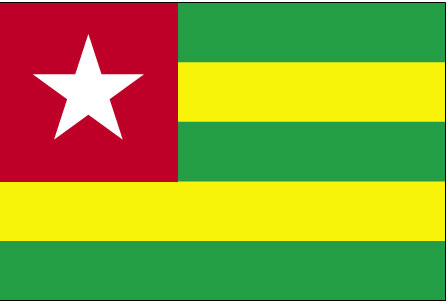
National Flag
- Flag Symbolism
- five equal horizontal bands of green (top and bottom) alternating with yellow; there is a white five-pointed star on a red square in the upper hoist-side corner; uses the popular pan-African colors of Ethiopia
- Flag History
- The green symbolizes hope and the yellow signifies faith in work as the way to achieve material, moral and spiritual well-being. The red is a symbol of charity, fidelity and love, the virtues that make people love their neighbors and sacrifice their own lives, if necessary, for the triumph of the principles of humanity and the lessening of human misery. The white is the color of purity, remindig all citizens to be worthy of their nation's independence.
- Date of Adoption
- 27 April 1960
National Anthem
- Anthem Lyrics
- Salut à toi, pays de nos aïeux" (Hail to thee, land of our forefathers) Salut à toi, pays de nos aieux! Toi qui les rendais forts, paisibles et joyeux, Cultivant vertu, vaillance Pour la postérité. Que viennent les tyrans, ton coeur soupire vers la liberté. Togo, debout! Luttons sans défaillance, Vainquons ou mourons, mais dans la dignité. Grand Dieu, Toi seul nous as exaltés Du Togo pour la prospérité, Togolais, viens! Batissons la Cité! Dans l'unité nous voulons te servir, C'est bien là de nos coeurs le plus ardent désir. Clamons fort notre devise Que rien ne peut ternir. Seuls artisans de ton bonheur ainsi que de ton avenir, Brisons partout les chaînes, la traîtrise Et nous te jurons toujours fidélité Et aimer, servir, se dépasser, Faire encore de toi sans nous lasser Togo Chéri, l'Or de l'Humanité.
- Anthem Lyrics (English)
- Hail to thee, land of our forefathers, Thou who made them strong, peaceful and happy, Men who for posterity cultivated virtue and bravery. Even if tyrants shall come, thy heart yearns towards freedom. Togo arise! Let us struggle without faltering. Victory or death, but dignity. God almighty, Thou alone hast made Togo prosper. People of Togo arise! Let us build the nation. To serve thee in unity is the most burning desire of our hearts. Let us shout aloud our motto That nothing can tarnish. We the only builders of thy happiness and of thy future, Everywhere let us break chains and treachery, And we swear to thee for ever faith, love, service, untiring zeal, To make thee yet, beloved Togo, a golden example for humanity.
- Anthem History
- Originally adopted on independence in 1960, the national anthem was replaced in 1979 and readopted in 1992.