
 English
 Español
 中文
中文 हिन्दी
 Français
Government and Politics
Government and Politics of The Bahamas
Government structure, leadership, capital, military, and national symbols of The Bahamas.
Government Structure
Constitutional foundations, branches, parties, and leadership.
- Government Type
- constitutional parliamentary democracy
- Administrative Divisions
- 21 districts; Acklins and Crooked Islands, Bimini, Cat Island, Exuma, Freeport, Fresh Creek, Governor's Harbour, Green Turtle Cay, Harbour Island, High Rock, Inagua, Kemps Bay, Long Island, Marsh Harbour, Mayaguana, New Providence, Nichollstown and Berry Islands, Ragged Island, Rock Sound, Sandy Point, San Salvador and Rum Cay
- Legal System
- based on English common law
- Suffrage
- 18 years of age; universal
- Citizenship
- citizenship by birth: no citizenship by descent only: at least one parent must be a citizen of The Bahamas dual citizenship recognized: no residency requirement for naturalization: 6-9 years
- Executive Branch
- chief of state: King CHARLES III (since 8 September 2022), represented by Governor General Cynthia A. PRATT (since 1 February 2024) head of government: Prime Minister Philip DAVIS (since 17 September 2021) and Deputy Prime Minister Chester COOPER (since 17 September 2021) cabinet: Cabinet appointed by the governor general on the prime minister's recommendation elections: none; the monarch is hereditary; governor general appointed by the monarch; following legislative elections, the leader of the majority party or the leader of the majority coalition is usually appointed prime minister by the governor general; the prime minister recommends the deputy prime minister
- Legislative Branch
- Bicameral Parliament consists of the Senate (16-member body appointed by the governor general upon the advice of the prime minister and the opposition leader for five-year terms) and the House of Assembly (39 seats; members elected by direct popular vote to serve five-year terms); the government may dissolve the Parliament and call elections at any time. Elections: last held on 16 September 2021 (next to be held by September 2026). Election results: percent of vote by party - PLP 56.3%, FNM 35.9%, other 7.8%; seats by party - PLP 32, FNM 7.
- Judicial Branch
- Supreme Court; Court of Appeal; magistrates courts
- Political Parties
- Free National Movement or FNM [Tommy TURNQUEST]; Progressive Liberal Party or PLP [Perry CHRISTIE]
- Head of State
- King CHARLES III, represented by Governor General Cynthia A. PRATT
- Head of Government
- Prime Minister Philip DAVIS and Deputy Prime Minister Chester COOPER
- Cabinet
- Cabinet appointed by the governor general on the prime minister’s recommendation
- Elections
- last held on 16 September 2021 (next to be held by September 2026).
- Election Results
- Percent of vote by party - PLP 56.3%, FNM 34.3%, other 9.4%; seats by party - PLP 32, FNM 7, independents 0. Results reflect the September 2021 general election, in which the Progressive Liberal Party, led by Philip Davis, won a decisive majority, reclaiming power from the Free National Movement.
- Constitution
- 10-Jul-73
- Independence
- 10 July 1973 (from UK)
- National Holiday
- Independence Day, 10 July (1973)
- International Organization Participation
- ACP, C, Caricom, CDB, FAO, G-77, IADB, IBRD, ICAO, ICCt (signatory), ICFTU, ICRM, IFC, IFRCS, ILO, IMF, IMO, Interpol, IOC, ITU, LAES, NAM, OAS, OPANAL, OPCW (signatory), UN, UNCTAD, UNESCO, UNIDO, UPU, WCO, WHO, WIPO, WMO, WTO (observer)
- Diplomatic Representation in the U.S.
- chief of mission: Ambassador Joshua SEARS chancery: 2220 Massachusetts Avenue NW, Washington, DC 20008 telephone: [1] (202) 319-2660 FAX: [1] (202) 319-2668 consulate(s) general: Miami, New York
- U.S. Diplomatic Representation
- chief of mission: Ambassador John D. ROOD embassy: 42 Queen Street, Nassau mailing address: local or express mail address: P. O. Box N-8197, Nassau; Department of State, 3370 Nassau Place, Washington, DC 20521-3370 telephone: [1] (242) 322-1181, 328-2206 (after hours) FAX: [1] (242) 356-0222
Capital City
Seat of government and political history.
- Capital City
- Nassau
- Location
- 25 05 N, 77 21 W
- Time Difference
- UTC-5 (same time as Washington, DC during Standard Time)
- History
- named after William III (1650-1702), king of England, Scotland, and Ireland, who was a member of the House of Nassau
Embassy and Diplomatic Representation
Embassy location and contact details.
U.S. Embassy Nassau 42 Queen Street Telephone: 242-322-1181 Emergency after-hours telephone: 242-357-7004 Facsimile: 242-356-7174
Military
Branches, service obligations, expenditures, and manpower.
- Military Branches
- Royal Bahamas Defense Force: Land Force, Navy, Air Wing
- Service Age and Obligation
- 18 years of age for voluntary male and female service; no conscription
National Symbols
Flag, anthem, and other symbols of national identity.
National Flag
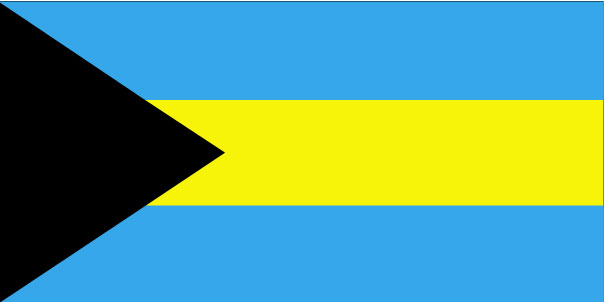
- Flag Symbolism
- has three equal horizontal bands of aquamarine or aqua blue(top), gold, and aquamarine or aqua blue, with a black equilateral triangle based on the hoist side the bands stand for the sands of the 700 bahamian islands which make up the nation and the waters that surround it. A black triangle that stands for the unity comes in from the left edge of the flag. Some people feel the golden hue symbolized the sun-warmed coasts of the islands
- Date of Adoption
- July 10, 1973.
National Anthem
- Anthem Lyrics (English)
- Lift up your head to the rising sun, Bahamaland, March on to glory, your bright banners waving high, See how the world marks the manner of your bearing; Pledge to excel thro' love and unity. Pressing onward, march together, to a common loftier goal; Steady sunward tho' the weather hide the wide and treacherous shoal. Lift up your head to the rising sun, Bahamaland, 'til the road you've trod lead unto your God, March on Bahamaland.
Other National Symbols
National Flower
Yellow Elder or Yellow Cedar (Tecoma stans
The flowers bloom in late summer/early fall. .
Coat of Arms
The Bahamas’ coat of arms is a composition of things indigenous to these islands, while the motto “Forward Upward Onward Together” heralds to the direction and manner in which the Bahamian nation should move. The crest of the arms, a light pink conch shell, symbolises the marine life of The Bahamas. The top of the crest is composed of wavy green palm fronds, symbolic of the natural vegetation. The Santa Maria, flagship of Christopher Columbus, appears on the shield of the coat of arms. Wavy barrulets of blue symbolise the waters of The Bahamas. The shield is charged with a resplendent or radiant sun to signify the world-famous balmy resort climate, and it also connotes the bright future of these islands. A flamingo, the national bird, and a silvery blue marlin support the shield. The national motto is draped across the base of the coat of arms. There was a national competition to produce the motto for the coat of arms, and the competition was won by two 11-year-old schoolchildren – Vivian F. Moultrie of Inagua Public School and Melvern B. Bowe of the Government High School in Nassau. Bahamian artist Hervis Bain prepared the preliminary design of the coat of arms.
National Fish
Blue Marlin
The blue marlin (Makaira nigricans) is the majestic fish that is found in both the Atlantic and Pacific Oceans, with reports of the largest sizes found in the latter. However, many persons first encounter the fish in Ernest Hemingway’s book “Old Man and the Sea.” Mr. Hemingway was a frequent visitor to The Bahamas, especially the island of Bimini, where the blue marlin is highly prized among the strong game-fishing community. The blue marlin, a relative of the sailfish and swordfish, is easily recognizable for the long “sword” or spike of its upper jaw, its high and pointed dorsal fin, and pointed anal fin. It is said that the fish uses its “sword” to club other fish on which it feeds. The marlin’s back is cobalt blue and its flanks and underbelly are silvery white. There may be light-blue or lavender vertical stripes on the sides as well. A powerful and aggressive fighter, the blue marlin can run hard and long, sound or dive deep, and leap high into the air in a display of strength.
National Bird
Flamingo
The scarlet, long-legged flamingoes are found in three major nesting groups in the West Indian region, Great Inagua being one of them (the others are in Yucatan, Mexico, and Bonaire Island in the Netherlands Antilles.) The more than 50,000 birds inhabiting 287 square miles of Inagua wilderness are protected by wardens employed by the Society for the Protection of the Flamingo in The Bahamas through the Bahamas National Trust, a statutory body set up in 1959. The Roseate or West Indian flamingoes (Phoenicopterus ruber) were formerly also bred in Abaco, Andros, Rum Cay, the Exuma Cays, Long Island, Ragged Cays, Acklins, Mayaguana, and the Turks and Caicos Islands. However, several factors, including action by man, led to a reduction in their number. Charles B. Cory, a curator of birds in the Boston Society of Natural History, wrote at the end of the19th century that great numbers of young birds were killed before they were able to fly, and many were carried away alive to be sold to passing vessels, on which they died from want of care. Nowadays, thanks largely to action by the government and the National Trust, the flamingo is making a comeback.
National Tree
Lignum vitae
The Lignum vitae, meaning tree of life, is from the genus Guaicum (caltrop family or Zygophyllaceae) and is the National Tree of The Bahamas. The extremely hard and heavy self-lubricating wood is especially adapted for bearings or bushings of propeller shafts on steamships, and also serves for bearings in steel mills, for bowling balls, and pulleys. For many years, dating back to World War II, shipments of the wood were made from The Bahamas to the United Kingdom and the United States by the old New Providence firm of Duncombe and Butler. Apart from its industrial uses, the bark of the tree is used for medicinal purposes, and many Bahamians throughout the islands steep the bark and drink it as a tonic for creating energy as an aphrodisiac.