
 English
 Español
 中文
中文 हिन्दी
 Français
Government and Politics
Government and Politics of Tajikistan
Government structure, leadership, capital, military, and national symbols of Tajikistan.
Government Structure
Constitutional foundations, branches, parties, and leadership.
- Government Type
- republic
- Administrative Divisions
- 2 provinces (viloyatho, singular - viloyat) and 1 autonomous province* (viloyati mukhtor); Viloyati Mukhtori Kuhistoni Badakhshon* [Gorno-Badakhshan] (Khorugh), Viloyati Khatlon (Qurghonteppa), Viloyati Sughd (Khujand)
- Legal System
- based on civil law system; no judicial review of legislative acts
- Suffrage
- 18 years of age; universal
- Citizenship
- citizenship by birth: no citizenship by descent only: at least one parent must be a citizen of Tajikistan dual citizenship recognized: no residency requirement for naturalization: 5 years or 3 years of continuous residence prior to application
- Executive Branch
- chief of state: President Emomali RAHMON (since 6 November 1994; head of state since 19 November 1992; note: the president officially dropped the Russified suffix "-ov" from his surname in 2007) head of government: Prime Minister Kokhir RASULZODA (since 23 November 2013) cabinet: Council of Ministers appointed by the president, approved by the Supreme Assembly elections: president elected by popular vote for a seven-year term; Tajikistan's constitution permits a maximum of two seven-year terms, though a 2016 constitutional amendment removed term limits for the current president; election last held on 11 October 2020 (next to be held in 2027); prime minister appointed by the president election results: Emomali RAHMON reelected president in 2020; percent of vote - Emomali RAHMON approximately 91%, with the remaining votes distributed among five other candidates; elections have been criticized by international observers as lacking genuine political competition
- Legislative Branch
- Bicameral Supreme Assembly or Majlisi Oli consists of the Assembly of Representatives (lower chamber) or Majlisi Namoyandagon (63 seats; members are elected by popular vote to serve five-year terms) and the National Assembly (upper chamber) or Majlisi Milliy (34 seats; members are indirectly elected, 25 selected by local deputies, 8 appointed by the president; 1 seat reserved for the former president; all serve five-year terms) Elections: last held on 1 March 2020 for the Assembly of Representatives (next to be held in 2025) and March 2020 for the National Assembly (next to be held in 2025) Election results: Assembly of Representatives - percent of vote by party - PDPT 50.4%, Agrarian Party of Tajikistan 16.6%, Party of Economic Reforms 16.5%, Communist Party 5.0%, Socialist Party 5.0%, Democratic Party 3.0%, other 3.5%; seats by party - PDPT 47, Agrarian Party 7, Party of Economic Reforms 5, Communist Party 2, Socialist Party 1, Democratic Party 1; National Assembly - seats by party - PDPT 27, independents and other 7
- Judicial Branch
- Supreme Court (judges are appointed by the president)
- Political Parties
- Agrarian Party of Tajikistan or APT [Amir KARAKULOV]; Democratic Party or DPT [Mahmadruzi ISKANDAROV]; Islamic Revival Party [Said Abdullo NURI]; Party of Economic Reform or PER [Olimjon BOBOYEV]; People's Democratic Party of Tajikistan or PDPT [Emomali RAHMONOV]; Social Democratic Party or SDPT [Rahmatullo ZOYIROV]; Socialist Party or SPT [Abdualim GHAFFOROV]; Tajik Communist Party or CPT [Shodi SHABDOLOV]
- Head of State
- President Emomali RAHMON (since 6 November 1994
- Head of Government
- Prime Minister Kokhir RASULZODA
- Cabinet
- Council of Ministers appointed by the president, approved by the Supreme Assembly
- Elections
- last held on 1 March 2020 for the Assembly of Representatives (next to be held in 2025) and March 2020 for the National Assembly (next to be held in 2025)
- Election Results
- Assembly of Representatives - percent of vote by party - PDPT 52.1%, Agrarian Party of Tajikistan 12.0%, Party of Economic Reforms 10.9%, Communist Party 4.1%, Socialist Party 3.4%, Democratic Party 1.7%, other 15.8%; seats by party - PDPT 47, Agrarian Party 7, Party of Economic Reforms 5, Communist Party 2, Socialist Party 1, Democratic Party 1; National Assembly - seats by party - PDPT 27, independents and other 7
- Constitution
- 6-Nov-94
- Independence
- 9 September 1991 (from Soviet Union)
- National Holiday
- Independence Day (or National Day), 9 September (1991)
- International Organization Participation
- AsDB, CIS, EAPC, EBRD, ECO, FAO, IAEA, IBRD, ICAO, ICCt, ICRM, IDA, IDB, IFAD, IFC, IFRCS, ILO, IMF, IOC, IOM, ITU, OIC, OPCW, OSCE, PFP, SCO, UN, UNCTAD, UNESCO, UNIDO, UPU, WCO, WFTU, WHO, WIPO, WMO, WTrO (observer)
- Diplomatic Representation in the U.S.
- chief of mission: Ambassador Hamrohon ZARIPOV chancery: 1005 New Hampshire Avenue NW, Washington, DC 20037 telephone: [1] (202) 223-6090 FAX: [1] (202) 223-6091
- U.S. Diplomatic Representation
- chief of mission: Ambassador Richard E. HOAGLAND embassy: 10 Pavlova Street, Dushanbe, Tajikistan 734003 mailing address: 7090 Dushanbe Place, Dulles, VA 20189 telephone: [992] (372) 21-03-48, 21-03-52, 24-15-60 FAX: [992] (372) 21-03-62, 51-00-29
Capital City
Seat of government and political history.
- Capital City
- Dushanbe
- Location
- 38 33 N, 68 46 E
- Time Difference
- UTC+5 (10 hours ahead of Washington, DC, during Standard Time)
- History
- today's city was originally at the crossroads where a large bazaar occurred on Mondays, hence the name Dushanbe, which in Persian means Monday, i.e., the second day (du) after Saturday (shambe)
Embassy and Diplomatic Representation
Embassy location and contact details.
U.S. Embassy Dushanbe 109A Ismoili Somoni Avenue Dushanbe, Tajikistan Phone: 992-37-229-2000 Consular direct line: 992-37-229-2300 email: dushanbeconsular@state.gov Emergency after hours: 992-98-580-1032 Facsimile: 992-37-229-2050
Military
Branches, service obligations, expenditures, and manpower.
- Military Branches
- Ground Forces, Air and Air Defense Forces, Mobile Forces
- Service Age and Obligation
- 18-27 years of age for compulsory or voluntary military service; 2-year conscript service obligation; males required to undergo compulsory military training between ages 16 and 55; males can enroll in military schools from at least age 15
National Symbols
Flag, anthem, and other symbols of national identity.
National Flag
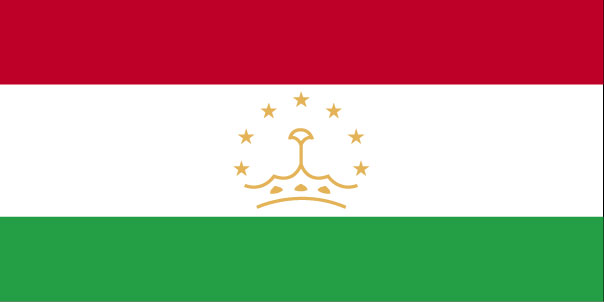
- Flag Symbolism
- three horizontal stripes of red (top), a wider stripe of white, and green; a gold crown surmounted by seven gold, five-pointed stars is located in the center of the white stripe
- Flag History
- The crown represents the Tajik people. The name is derived from tajvar, which means “crowned” In traditional Tajik culture the magic word “ seven” is a symbol of perfection, the emodiment of happiness and the provider of virtue. According to Tajik legend, heaven in composed of seven beautiful orchards, separeated by seven mountains each with a glowing star on top. THe red is a symbol of the sun and victory, the white stands for purity, cotton and the snow on the mountains, and the green represents the spiritual meaning of Islam and the generosity of nature.
National Anthem
- Anthem Lyrics
- Surudi Milli (Song of the Nation) Diori arjmandi mo Ba bakhti mo sari azizi tu baland bod, Saodati tu, davlati tu begazand bod. Zi durii zamonaho rasidaem Ba zeri parchami tu saf kashidaem, kashidaem Zinda bosh ey Vatan, Tojikistoni ozodi man! Baroi nangi nomi mo Tu az umedi raftagoni mo nishonai Tu bahri vorisoni jahon jovidonai, Khazon namerasad ba navbahori tu, Ki mazrai vafo buvad kanori tu, kanori tu Zinda bosh ey Vatan, Tojikistoni ozodi man! Tu modare yagonai, Baqoi tu buvad baqoi khonadoni mo, Maromi tu buvad maromi jismu joni mo. Zi tu saodati abad nasibi most Tu hastivu hama jahon habibi most, habibi most Zinda bosh ey Vatan, Tojikistoni ozodi man!
- Anthem History
- Surudi Milli (Song of the Nation) was officially adopted upon 1991 independence when new words were given to the old music used when Tajikistan was part of the Soviet Union.
Other National Symbols
Seal
emblem
On September 11, 1999, at the 15th Session of the first convention, Majlisi Oli of the Republic of Tajikistan ratified by its Decrees (No 891 and No 892) three Resolutions on the national symbols of the Republic of Tajikistan. Resolution on the National Emblem of the Republic of Tajikistan 1. The National Emblem of the Republic of Tajikistan is a symbol of the state sovereignty of the Republic of Tajikistan. 2. The National Emblem of the Republic of Tajikistan is a representation of a styled crown and a semi-circle of seven stars above it, in the rays of sun rising from behind mountains covered with snow. The semi-circle is nimbed by a diadem consisting, on the right, of wheat spikes, and on the left, of cotton branches with opened bolls. Above, the diadem is woven by a three-color band; the lower part occupied by an open book on a holder. Colors of the National Emblem are as follows: the crown, the sun, the mountains, the spikes, the book and the holder are golden; cotton footstalks and leaves are green; the band colors are red, white and green; the book cover is red. The National Emblem is placed on: a) the buildings of the official residence of President of the Republic of Tajikistan, the Government of the Republic of Tajikistan, ministries and state committees of the Republic of Tajikistan; buildings of the Majlises of the people's delegates of the Gorno Badakhshan Autonomous Oblast, other oblasts, the city of Dushanbe, cities and districts, local executive administration (khkumats), self-governance bodies in towns and villages (djamoats), courts, prosecution offices of the Republic of Tajikistan; on the buildings of diplomatic and consular missions, and trade representative offices of the Republic of Tajikistan abroad; b) in the convention halls of President of the Republic of Tajikistan, Majlisi Oli of the Republic of Tajikistan, Presidium of the Majlisi Oli of the Republic of Tajikistan; majlises of the people's delegates of Gorno Badakhshan Autonomous Oblast, other oblasts, the city of Dushanbe, cities and districts, local executive administration (khukumats), convention halls of the self-governance bodies in towns and villages (djamoats), and also in the offices of President of the Republic of Tajikistan, Chairman of Majlisi Oli and Prime Minister of the Republic of Tajikistan, representatives of Gorno Badakhshan Autonomous Oblast, other oblasts, the city of Dushanbe, cities and districts, and in court-rooms of the Republic of Tajikistan, in offices of the civil registration acts as well as the offices of the inaugurate registration of births and marriages; c) on the stamps and letter-heads of the documents of the President of the Republic of Tajikistan; Majlisi Oli of the Republic of Tajikistan, Presidium of the Majlisi Oli of the Republic of Tajikistan, Government of the Republic of Tajikistan, ministries and state committees of the Republic of Tajikistan; majlises of the people's delegates of Gorno Badakhshan Autonomous Oblast, other oblasts, the city of Dushanbe, cities and districts, local executive administration (khukumats), self-governance bodies of towns and villages (djamoats), courts, prosecution institutions of the Republic of Tajikistan, state notarial offices, civil registration acts offices of the Republic of Tajikistan, and also republican enterprises, institutions and organizations that by laws of the Republic of Tajikistan are entitled the right to represent the emblem on stamps and letter-heads; d) on official publications of Majlisi Oli of the Republic of Tajikistan, Presidium of Majlisi Oli of the Republic of Tajikistan and Government of the Republic of Tajkistan; e) on a passport of the citizen of the Republic of Tajikistan, and also on the diplomatic and other international passports issued to citizens of the Republic of Tajikistan; f) at the border poles established at the State border of the Republic of Tajikistan. The Law of the Republic of Tajikistan foresees other events of obligatory representation of the national Emblem of the Republic of Tajikistan. Only President of the Republic of Tajikistan can administer the right to use the National Emblem of the Republic of Tajikistan by enterprises, institutions and organizations not enlisted in the following Resolution. 3. Representation of the National Emblem of the Republic of Tajikistan, despite its size, should always strictly correspond to the standards of its colored, black and white, and dimensional depiction attached to the present Resolution. 4. The procedures of the National Emblem production and copying; use, preservation and elimination of stamps depicting the National Emblem are established by the Government of the Republic of Tajikistan. 5. Persons guilty in an insult to the National Emblem of the Republic of Tajikistan are accountable in accordance with the Law of the Republic of Tajikistan.