
 English
 Español
 中文
中文 हिन्दी
 Français
Government and Politics
Government and Politics of Taiwan
Government structure, leadership, capital, military, and national symbols of Taiwan.
Government Structure
Constitutional foundations, branches, parties, and leadership.
- Government Type
- multiparty democratic regime headed by popularly-elected president and unicameral legislature
- Administrative Divisions
- the central administrative divisions include the provinces of Fu-chien (some 20 offshore islands of Fujian Province including Quemoy and Matsu) and Taiwan (the island of Taiwan and the Pescadores islands); Taiwan is further subdivided into 16 counties (hsien, singular and plural), 5 municipalities* (shih, singular and plural), and 2 special municipalities** (chuan-shih, singular and plural); Chang-hua, Chia-i, Chia-i*, Chi-lung*, Hsin-chu, Hsin-chu*, Hua-lien, I-lan, Kao-hsiung, Kao-hsiung**, Miao-li, Nan-t'ou, P'eng-hu, P'ing-tung, T'ai-chung, T'ai-chung*, T'ai-nan, T'ai-nan*, T'ai-pei, T'ai-pei**, T'ai-tung, T'ao-yuan, and Yun-lin; the provincial capital is at Chung-hsing-hsin-ts'un
- Legal System
- based on civil law system; accepts compulsory ICJ jurisdiction, with reservations
- Suffrage
- 20 years of age; universal
- Citizenship
- citizenship by birth: no citizenship by descent only: at least one parent must be a citizen of Taiwan dual citizenship recognized: yes, except that citizens of Taiwan are not recognized as dual citizens of the People's Republic of China residency requirement for naturalization: 5 years
- Executive Branch
- chief of state: President LAI Ching-te (since 20 May 2024) and Vice President HSIAO Bi-khim (since 20 May 2024) head of government: Premier (President of the Executive Yuan) CHO Jung-tai (since 20 May 2024) and Vice Premier (Vice President of the Executive Yuan) CHENG Li-chiun (since 20 May 2024) cabinet: Executive Yuan appointed by the president elections: president and vice president elected on the same ticket by popular vote for four-year terms; election last held 13 January 2024 (next to be held in January 2028); premier appointed by the president; vice premiers appointed by the president on the recommendation of the premier election results: LAI Ching-te elected president; percent of vote - LAI Ching-te (DPP) 40.1%, HOU Yu-ih (KMT) 33.5%, KO Wen-je (TPP) 26.5%
- Legislative Branch
- Taiwan's legislature is unicameral, consisting of the Legislative Yuan with 113 seats. Of these, 73 members are elected by popular vote from single-member districts, 34 are elected based on the proportion of island-wide votes received by participating political parties, and six are elected by popular vote among indigenous (aboriginal) populations. Members serve four-year terms. The National Assembly, which was formerly a standing body, was abolished following constitutional amendments ratified in June 2005, leaving Taiwan with a unicameral legislature. Elections: Legislative Yuan - last held on 13 January 2024 (next to be held in January 2028). Election results: Legislative Yuan - percent of vote by party - Kuomintang (KMT) approximately 35.2%, Democratic Progressive Party (DPP) approximately 34.3%, Taiwan People's Party (TPP) approximately 22.1%, others approximately 8.4%; seats by party - KMT 52, DPP 51, TPP 8, independents and others 2. No single party holds an outright majority, resulting in a hung legislature in which the KMT and TPP have at times coordinated to check the DPP-led executive branch.
- Judicial Branch
- Judicial Yuan (justices appointed by the president with consent of the Legislative Yuan)
- Political Parties
- Democratic Progressive Party or DPP [YU Shyi-kun, chairman]; Kuomintang or KMT (Nationalist Party) [MA Ying-jeou, chairman]; People First Party or PFP [James SOONG (SOONG Chu-yu), chairman]; Taiwan Solidarity Union or TSU [SU Chin-chiang, chairman]; other minor parties including the Chinese New Party or NP
- Head of State
- President LAI Ching-te and Vice President HSIAO Bi-khim
- Head of Government
- Premier (President of the Executive Yuan) CHO Jung-tai and Vice Premier (Vice President of the Executive Yuan) CHENG Li-chiun
- Cabinet
- Executive Yuan - (ministers appointed by president on recommendation of premier)
- Elections
- Legislative Yuan - last held on 13 January 2024 (next to be held in January 2028).
- Election Results
- Legislative Yuan — percent of vote by party: Kuomintang (KMT) approximately 35.2%, Democratic Progressive Party (DPP) approximately 34.3%, Taiwan People's Party (TPP) approximately 22.1%, others approximately 8.4%; seats by party: KMT 52, DPP 51, TPP 8, independents and others 2. The January 2024 legislative elections produced a hung legislature in which no single party holds an outright majority. While DPP candidate Lai Ching-te won the presidential race, his party lost its legislative majority, creating a divided government. The KMT and TPP have at times coordinated legislative efforts to check the DPP-led executive branch, leading to significant procedural disputes and standoffs over proposed reforms, including contentious debates around legislative oversight powers and budget cuts affecting key government agencies.
- Constitution
- 25 December 1946, amended in 1992, 1994, 1997, 1999, and 2000
- National Holiday
- Republic Day (Anniversary of the Chinese Revolution), 10 October (1911)
- International Organization Participation
- APEC, AsDB, BCIE, ICC, ICFTU, IOC, WCL, WTrO
- Diplomatic Representation in the U.S.
- none; unofficial commercial and cultural relations with the people of the US are maintained through an unofficial instrumentality, the Taipei Economic and Cultural Representative Office (TECRO) in the US with headquarters in Taipei and field offices in Washington and 12 other US cities
- U.S. Diplomatic Representation
- none; unofficial commercial and cultural relations with the people on Taiwan are maintained through an unofficial instrumentality - the American Institute in Taiwan (AIT) - which has offices in the US and Taiwan; US office at 1700 N. Moore St., Suite 1700, Arlington, VA 22209-1996, telephone: [1] (703) 525-8474, FAX: [1] (703) 841-1385); Taiwan offices at #7 Lane 134, Hsin Yi Road, Section 3, Taipei, Taiwan, telephone: [886] (2) 2162-2000, FAX: [886] (2) 2162-2251; #2 Chung Cheng 3rd Road, 5th Floor, Kao-hsiung, Taiwan, telephone: [886] (7) 238-7744, FAX: [886] (7) 238-5237; and the American Trade Center, Room 3208 International Trade Building, Taipei World Trade Center, 333 Keelung Road Section 1, Taipei, Taiwan 10548, telephone: [886] (2) 2720-1550, FAX: [886] (2) 2757-7162
Capital City
Seat of government and political history.
- Capital City
- Taipei
- Location
- 25 02 N, 121 31 E
- Time Difference
- UTC+8 (13 hours ahead of Washington, DC, during Standard Time)
- History
- the Chinese meaning is "Northern Taiwan," reflecting the city's position in the far north of the island
Embassy and Diplomatic Representation
Embassy location and contact details.
The American Institute in Taiwan No.7 Lane 134 Xinyi Road Section 3 Taipei, Taiwan Telephone: (886) 2-2162-2000 Facsimile: (886) 2-2162-2239 The American Institute in Taiwan (Kaohsiung Branch Office) No. 2 Chung Cheng 3rd Road, 5th Floor Kaohsiung, Taiwan Telephone: (886) 7-238-7744 Facsimile: (886) 7-238-5237 Email: amcit-ait-t@state.gov Duty Officer After-Hours Emergency Telephone: (886) 2-2162-2000. Press “0” or “*”.
Military
Branches, service obligations, expenditures, and manpower.
- Military Branches
- Army, Navy (includes Marine Corps), Air Force, Coast Guard Administration, Armed Forces Reserve Command, Combined Service Forces Command, Armed Forces Police Command
- Service Age and Obligation
- 18-35 years of age for compulsory and voluntary military service; service obligation is 2 years; women may enlist; women in Air Force service are restricted to noncombat roles; reserve obligation to age 30 (Army); the Ministry of Defense is in the process of implementing a voluntary enlistment system over the period 2010-2015, although nonvolunteers will still be required to perform alternative service or go through 4 months of military training
National Symbols
Flag, anthem, and other symbols of national identity.
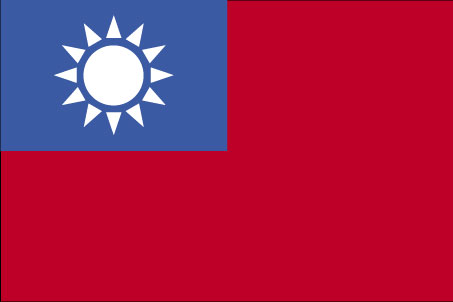
National Flag
- Flag Symbolism
- red with a dark blue rectangle in the upper hoist-side corner bearing a white sun with 12 triangular rays. the sun and rays represent the 12 two-hour periods of the day, and together they symbolize the spirit of unceasing progress. The colors stand for the three pricipals of the people but also have dual meaning. Blue is for democracy, white for the people's livelihood and red for nationalism. The other meanings are blue - equality and justice, white 0 fraternity and frankness, and red - liberty and sacrifice.
- Flag History
- The flag, adopted as the national flag and war ensign of China, was retained by the nationalist forces, which were defeated by the communists and n 1949 found refuge on the island of Taiwan.
- Date of Adoption
- 8 October 1928
National Anthem
- Anthem Lyrics
- Taiwan National Anthem Text (Native in Wade-Gile): San-min-chu-i, Wu-tang so tsung; i-chien min-kuo, i-chin ta-t'ung. Tzu erh to-shih, wei min ch'ien-feng; su-yeh fei-hsieh, chu-i shih ts'ung. Shih ch'in shih yung, pi hsin pi chung; i-hsin i-te, kuan-ch'e shih-chung.
- Anthem Lyrics (English)
- Our aim shall be to found a free land. World peace be our stand. Lead on, comrades, vanguards ye are. Hold fast your aim, by sun and star. Be earnest and brave, your country to save. One heart, one soul, one mind, one goal! Taiwan National Anthem Text (Native in Wade-Gile): San-min-chu-i, Wu-tang so tsung; i-chien min-kuo, i-chin ta-t'ung. Tzu erh to-shih, wei min ch'ien-feng; su-yeh fei-hsieh, chu-i shih ts'ung. Shih ch'in shih yung, pi hsin pi chung; i-hsin i-te, kuan-ch'e shih-chung.