
 English
 Español
 中文
中文 हिन्दी
 Français
Government and Politics
Government and Politics of South Africa
Government structure, leadership, capital, military, and national symbols of South Africa.
Government Structure
Constitutional foundations, branches, parties, and leadership.
- Government Type
- republic
- Administrative Divisions
- 9 provinces; Eastern Cape, Free State, Gauteng, KwaZulu-Natal, Limpopo, Mpumalanga, North-West, Northern Cape, Western Cape
- Legal System
- based on Roman-Dutch law and English common law; accepts compulsory ICJ jurisdiction, with reservations
- Suffrage
- 18 years of age; universal
- Citizenship
- citizenship by birth: no citizenship by descent only: at least one parent must be a citizen of South Africa dual citizenship recognized: yes, but requires prior permission of the government residency requirement for naturalization: 5 year
- Executive Branch
- chief of state: President Cyril RAMAPHOSA (since 15 February 2018); note - the president is both the chief of state and head of government head of government: President Cyril RAMAPHOSA (since 15 February 2018); note - the president is both the chief of state and head of government cabinet: Cabinet appointed by the president elections: president elected by the National Assembly for a five-year term; election last held 29 May 2024 (next to be held in 2029) election results: Cyril RAMAPHOSA reelected president by the National Assembly on 14 June 2024 following general elections in which the African National Congress (ANC) lost its parliamentary majority for the first time since the end of apartheid; RAMAPHOSA secured sufficient support through a coalition government arrangement
- Legislative Branch
- Bicameral Parliament consisting of the National Assembly (400 seats; members are elected by popular vote under a system of proportional representation to serve five-year terms) and the National Council of Provinces (90 seats, 10 members elected by each of the nine provincial legislatures for five-year terms; has special powers to protect regional interests, including the safeguarding of cultural and linguistic traditions among ethnic minorities). Elections: National Assembly and National Council of Provinces - last held 29 May 2024 (next to be held in 2029). Election results: National Assembly - percent of vote by party - ANC 40.2%, DA 21.8%, uMkhonto we Sizwe (MK) 14.6%, EFF 9.5%, IFP 3.9%, PA 2.1%, other 7.9%; seats by party - ANC 159, DA 87, MK 58, EFF 39, IFP 17, PA 9, other 31. The 2024 election marked a historic turning point, as the ANC lost its outright parliamentary majority for the first time since the end of apartheid in 1994, resulting in the formation of a Government of National Unity. National Council of Provinces - percent of vote by party - NA%; seats by party - NA.
- Judicial Branch
- Constitutional Court; Supreme Court of Appeals; High Courts; Magistrate Courts
- Political Parties
- African Christian Democratic Party or ACDP [Kenneth MESHOE, president]; African National Congress or ANC [Thabo MBEKI, president]; Democratic Alliance or DA (formed from the merger of the Democratic Party or DP and the Freedom Alliance or FA) [Anthony LEON]; Inkatha Freedom Party or IFP [Mangosuthu BUTHELEZI, president]; Pan-Africanist Congress or PAC [Stanley MOGOBA, president]; New National Party or NNP [leader NA]; United Democratic Movement or UDM [Bantu HOLOMISA]
- Head of State
- President Cyril RAMAPHOSA
- Head of Government
- President Cyril RAMAPHOSA
- Cabinet
- Cabinet appointed by the president
- Elections
- National Assembly and National Council of Provinces - last held 29 May 2024 (next to be held in 2029).
- Election Results
- National Assembly - percent of vote by party - ANC 40.2%, DA 21.8%, uMkhonto we Sizwe (MK) 14.6%, EFF 9.5%, IFP 3.9%, PA 2.1%, other 7.9%; seats by party - ANC 159, DA 87, MK 58, EFF 39, IFP 17, PA 9, other 31. The May 2024 general election marked a historic turning point, as the ANC lost its outright parliamentary majority for the first time since the end of apartheid in 1994. With no single party securing more than 50% of the vote, the ANC entered into a broad coalition known as the Government of National Unity (GNU), bringing together multiple parties including the DA and IFP, among others, to form a stable governing arrangement. Cyril Ramaphosa was subsequently re-elected as President by the National Assembly. National Council of Provinces - percent of vote by party - NA; seats by party - NA.
- Constitution
- 10 December 1996; this new constitution was certified by the Constitutional Court on 4 December 1996, was signed by then President MANDELA on 10 December 1996, and entered into effect on 3 February 1997; it is being implemented in phases
- Independence
- 31 May 1910 (from UK); note - South Africa became a republic in 1961 following an October 1960 referendum
- National Holiday
- Freedom Day, 27 April (1994)
- International Organization Participation
- ACP, AfDB, AU, BIS, C, FAO, G-24, G-77, IAEA, IBRD, ICAO, ICC, ICCt, ICFTU, ICRM, IDA, IFAD, IFC, IFRCS, IHO, ILO, IMF, IMO, Interpol, IOC, IOM, ISO, ITU, MONUC, NAM, NSG, OPCW, PCA, SACU, SADC, UN, UNCTAD, UNESCO, UNHCR, UNIDO, UNITAR, UNMEE, UNMIL, UPU, WCL, WCO, WFTU, WHO, WIPO, WMO, WToO, WTrO, ZC
- Diplomatic Representation in the U.S.
- chief of mission: Ambassador Barbara Joyce Mosima MASEKELA chancery: 3051 Massachusetts Avenue NW, Washington, DC 20008 telephone: [1] (202) 232-4400 FAX: [1] (202) 265-1607 consulate(s) general: Chicago, Los Angeles, New York
- U.S. Diplomatic Representation
- chief of mission: Ambassador Jendayi E. FRAZER embassy: 877 Pretorius Street, Pretoria mailing address: P. O. Box 9536, Pretoria 0001 telephone: [27] (12) 342-1048 FAX: [27] (12) 342-2244 consulate(s) general: Cape Town, Durban, Johannesburg
Capital City
Seat of government and political history.
- Capital City
- Pretoria (administrative capital); Cape Town (legislative capital); Bloemfontein (judicial capital)
- Location
- 25 42 S, 28 13 E
- Time Difference
- UTC+2 (7 hours ahead of Washington, DC, during Standard Time)
- History
- Pretoria is named in honor of Andries PRETORIUS, the father of voortrekker (pioneer) leader Marthinus PRETORIUS; Cape Town reflects its location on the Cape of Good Hope; Bloemfontein is a combination of the Dutch words bloem (flower) and fontein (fountain) meaning "fountain of flowers"
Embassy and Diplomatic Representation
Embassy location and contact details.
U.S. Embassy Pretoria 877 Pretorius Street, Arcadia, Pretoria Telephone: (27-12) 431-4000 (from within South Africa 012-431-4000) Fax: (27-12) 431-5504 (from within South Africa 012-431-5504) U.S. Consulate General Johannesburg 1 Sandton Drive (opposite Sandton City Mall just west of the intersection of Sandton Drive and Rivonia Road), Johannesburg Telephone: (27-11) 290-3000 (from South Africa 011-290-3000) Emergency after-hours telephone: 079-111-1684 (from outside South Africa: 27 79-111-1684) Fax: (27-11) 884-0396 (from within South Africa 011-884-0396) Consular jurisdiction: Pretoria area and Gauteng, Mpumalanga, Limpopo, North West, and Free State provinces. U.S. Consulate General Cape Town 2 Reddam Avenue, West Lake 7945, Cape Town Telephone: (27-21) 702-7300 (from South Africa 021-702-7300) Emergency after-hours telephone: 021-702-7411(from outside of Africa 27 21-702-7411) Fax (27-21) 702-7493 (from within South Africa 021-702-7493) Consular jurisdiction: Western Cape, Eastern Cape, and Northern Cape provinces. U.S. Consulate General Durban Located at: The Old Mutual Building, 31st floor, 303 Dr. Pixley KaSeme Street, Durban 4001 Telephone: (27-31) 305-7600 (from within South Africa 031-305-7600) Emergency after-hours telephone: 079-111-1445 (from outside South Africa: 27 79-111-1445) Fax: (27-31) 305-7691 (from within South Africa 031-305-7691) Consular jurisdiction: KwaZulu-Natal Province.
Military
Branches, service obligations, expenditures, and manpower.
- Military Branches
- South African National Defense Force (SANDF): South African Army, South African Navy (SAN), South African Air Force (SAAF), South African Military Health Services
- Service Age and Obligation
- 18 years of age for voluntary military service; women are eligible to serve in noncombat roles; 2-year service obligation
National Symbols
Flag, anthem, and other symbols of national identity.
National Flag
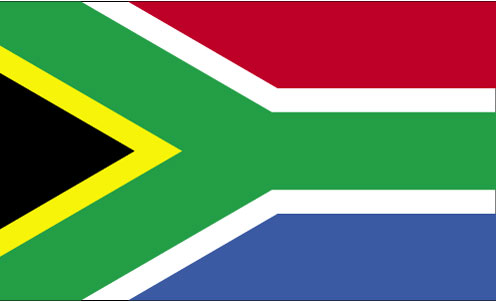
- Flag Symbolism
- two equal width horizontal bands of red (top) and blue separated by a central green band which splits into a horizontal Y, the arms of which end at the corners of the hoist side; the Y embraces a black isosceles triangle from which the arms are separated by narrow yellow bands; the red and blue bands are separated from the green band and its arms by narrow white stripes
- Flag History
- The flag combines the colors of the Boer reppublics (red, white, blue) with the colors of the African National Congress (black, green, yellow), which came to power in 1994. The ANC is shown as a driving force behind the country's convergence and unification which is symbolized by the “Y” shape.
- Date of Adoption
- 27 April 1994
National Anthem
- Anthem Lyrics
- Nkosi sikelel' iAfrika and Die Stem / The Call of South Africa Nkosi sikelel' iAfrika Maluphakanyisw' uphondo lwayo, Yizwa imithandazo yethu, Nkosi sikelela, thina lusapho lwayo. Morena boloka setjhaba sa heso, O fedise dintwa la matshwenyeho, O se boloke, O se boloke setjhaba sa heso, Setjhaba sa South Afrika - South Afrika. Uit die blou van onse hemel, Uit die diepte van ons see, Oor ons ewige gebergtes, Waar die kranse antwoord gee, Sounds the call to come together, And united we shall stand, Let us live and strive for freedom, In South Africa our land.
Other National Symbols
National Flower
king protea
National Tree
real yellowwood
National Fish
GALJOEN
National Animal
Springbok
National Bird
blue crane
Coat of Arms
The role of a Coat of Arms A national Coat of Arms, or state emblem, is the highest visual symbol of the State. The Coat of Arms is also a central part of the Great Seal, traditionally considered to be the highest emblem of the State. Absolute authority is given to every document with an impression of the Great Seal on it, as this means that it has been approved by the President of South Africa. South Africa’s Coat of Arms was launched on Freedom Day, 27 April 2000. The change reflected government's aim to highlight the democratic change in South Africa and a new sense of patriotism. The design of the Coat of Arms The Coat of Arms is a series of elements organised in distinct symmetric egg-like or oval shapes placed on top of one another. [ Top ] The lower oval shape represents the elements of foundation The first element is the motto, in a green semicircle. Completing the semicircle are two symmetrically placed pairs of elephant tusks pointing upwards. Within the oval shape formed by the tusks are two symmetrical ears of wheat, that in turn frame a centrally placed gold shield. The shape of the shield makes reference to the drum, and contains two human figures from Khoisan rock art. The figures are depicted facing one another in greeting and in unity. Above the shield are a spear and a knobkierie, crossed in a single unit. These elements are arranged harmoniously to give focus to the shield and complete the lower oval shape of foundation. [ Top ] The oval shape of ascendance Immediately above the oval shape of foundation, is the visual centre of the Coat of Arms, a protea. The petals of the protea are rendered in a triangular pattern reminiscent of the crafts of Africa. The secretary bird is placed above the protea and the flower forms the chest of the bird. The secretary bird stands with its wings uplifted in a regal and uprising gesture. The distinctive head feathers of the secretary bird crown a strong and vigilant head. The rising sun above the horizon is placed between the wings of the secretary bird and completes the oval shape of ascendance. The combination of the upper and lower oval shapes intersect to form an unbroken infinite course, and the great harmony between the basic elements result in a dynamic, elegant and thoroughly distinctive design. Yet it clearly retains the stability, gravity and immediacy that a Coat of Arms demands.
Motto
The motto The motto is: !ke e: /xarra //ke, written in the Khoisan language of the /Xam people, literally meaningdiverse people unite. It addresses each individual effort to harness the unity between thought and action. On a collective scale it calls for the nation to unite in a common sense of belonging and national pride - unity in diversity. Pronunciation of !ke e: /xarra //ke:
Coat of Arms
The ears of wheat An emblem of fertility, it also symbolises the idea of germination, growth and the feasible development of any potential. It relates to the nourishment of the people and signifies the agricultural aspects of the Earth. Elephant tusks Elephants symbolise wisdom, strength, moderation and eternity. The shield It has a dual function as a vehicle for the display of identity and of spiritual defence. It contains the primary symbol of our nation. The human figures The figures are derived from images on the Linton stone, a world-famous example of South African rock art, now housed and displayed in the South African Museum in Cape Town. The Khoisan, the oldest known inhabitants of our land and most probably of the Earth, testify to our common humanity and heritage as South Africans and as humanity in general. The figures are depicted in an attitude of greeting, symbolising unity. This also represents the beginning of the individual’s transformation into the greater sense of belonging to the nation and by extension, collective humanity. The spear and knobkierie Dual symbols of defence and authority, they in turn represent the powerful legs of the secretary bird. The spear and knobkierie are lying down, symbolising peace.
National Tree
Real yellowwood
The yellowwood family is primeval and has been present in this part of Africa for more than 100 million years. The species is widespread and is found from Table Mountain, along the southern and eastern Cape coast, in the ravines of the Drakensberg up to the Soutpansberg and the Blouberg in Limpopo. In forests, they can grow up to 40 metres in height with the base of the trunk sometimes up to 3 metres in diameter. In contrast, trees that grow in unsheltered places like mountain-slopes, are often short, bushy and gnarled. The bark of the real yellowwood is khaki-coloured to grey when it is old, deeply split and peels off in strips. The crown is relatively small in relation to its height and is often covered with grey lichen. Male and female cones resemble pine cones and are white, light green or pink. The female cone has a fleshy podocarpium on which the seed, which takes on the shape and colour of a cherry, develops.
National Bird
Blue crane
This elegant crane, that stands about one meter high, is almost entirely restricted to South Africa in its distribution. The blue crane is a light blue-grey, has a long neck supporting a rather bulbous head, long legs and elegant wing plumes which sweep to the ground. It eats seeds, insects and reptiles. Blue cranes lay their eggs in the bare veld, often close to water. They are quite common in the Karoo, but are also seen in the grasslands of KwaZulu-Natal and the highveld, usually in pairs or small family parties. The blue crane has a distinctive rattling croak, fairly high-pitched at call, which can be heard from far away. It is, however, usually quiet. The habitat of the blue crane is open grass fields or Karoo-like plains with low shrubby bushes. It likes wet parts and lays its eggs on the ground. It grazes in the field and eats seeds, insects and small reptiles.
National Fish
Galjoen
The galjoen is found only along the South African coast. It keeps to mostly shallow water, is often found in rough surf and sometimes right next to the shore and is known to every angler. Near rocks, the colour of the galjoen is almost completely black, while in sandy areas the colour is silver-bronze. It is also known in KwaZulu-Natal as blackfish or black bream. The record size is over 55 cm and 7 kg, however the average is much smaller. The galjoen is a game fighter. The diet of the galjoen consists mainly of red bait (ascidians), small mussels and barnacles. The scales are very firmly attached. The fins are well-developed with prominent spines.
National Flower
Giant or king protea
The giant or king protea is widely distributed in the south-western and southern areas of the Western Cape, from the Cedarberg up to just east of Grahamstown. The artichoke-like appearance of the flower-heads of the king protea lead to the specific name ‘cynaroides’, which means ‘like cynara’ (the artichoke). The name does not do justice to the beautiful flower-heads of this protea, which is the largest in the genus. A number of varieties in colour and leaf shapes are found, but the most beautiful is the pink coloured flower.
National Animal
Springbuck/springbok
Typical of this species is the pronk (jumping display), which led to its common name. Both sexes have horns but those of the ram are thicker and rougher. This species has adapted to the dry, barren areas and open grass plains and is thus found especially in the Free State, North West province and in the Karoo up to the west coast. They are herd animals and move in small herds during winter, but often crowd together in bigger herds in summer. They eat both grass and leaves and can go without drinking-water, because they get enough moisture from the succulent leaves. Where drinking-water is available they will use it. Springbuck stand 75 cm high and weigh about 40 kg. They breed throughout the year and lambs are born after a 6-month gestation period.