
 English
 Español
 中文
中文 हिन्दी
 Français
Government and Politics
Government and Politics of Somalia
Government structure, leadership, capital, military, and national symbols of Somalia.
Government Structure
Constitutional foundations, branches, parties, and leadership.
- Government Type
- no permanent national government; transitional, parliamentary national government
- Administrative Divisions
- 18 regions (plural - NA, singular - gobolka); Awdal, Bakool, Banaadir, Bari, Bay, Galguduud, Gedo, Hiiraan, Jubbada Dhexe, Jubbada Hoose, Mudug, Nugaal, Sanaag, Shabeellaha Dhexe, Shabeellaha Hoose, Sool, Togdheer, Woqooyi Galbeed
- Legal System
- no national system; Shari'a and secular courts are in some localities
- Suffrage
- 18 years of age; universal
- Citizenship
- citizenship by birth: no citizenship by descent only: the father must be a citizen of Somalia dual citizenship recognized: no residency requirement for naturalization: 7 years
- Executive Branch
- chief of state: President Hassan Sheikh MOHAMUD (since 23 May 2022); note - Hassan Sheikh Mohamud previously served as president from 2012 to 2017 and was re-elected by the Federal Parliament in May 2022 following a prolonged electoral process delayed by political disputes and security challenges head of government: Prime Minister Hamza Abdi BARRE (since 25 June 2022); appointed by President Hassan Sheikh Mohamud following his election victory cabinet: Cabinet appointed by the prime minister, subject to approval by the House of the People of the Federal Parliament election results: Hassan Sheikh MOHAMUD was elected president by members of the upper and lower houses of the Federal Parliament, defeating incumbent President Mohamed Abdullahi Mohamed (also known as Farmaajo) in the third round of voting; Hamza Abdi Barre was subsequently nominated as prime minister and confirmed by the Federal Parliament
- Legislative Branch
- Bicameral Federal Parliament, consisting of the Upper House (Senate) and the House of the People (Lower House). The Senate comprises 54 seats, with members representing the country's 18 regional states. The House of the People consists of 275 seats, with members selected through a clan-based electoral system. Seats in the lower house are distributed among Somalia's major clan families — Darod, Digil-Mirifle, Dir, and Hawiye — each receiving 61 seats, with the remaining 31 seats allocated to minority clans. Members of both chambers serve four-year terms. Somalia continues to work toward a universal suffrage voting system, with ongoing efforts to transition away from the indirect clan-delegate model that has governed elections in recent electoral cycles.
- Judicial Branch
- following the breakdown of the central government, most regions have reverted to local forms of conflict resolution, either secular, traditional Somali customary law, or Shari'a (Islamic) law with a provision for appeal of all sentences
- Political Parties
- none
- Head of State
- President Hassan Sheikh MOHAMUD
- Head of Government
- Prime Minister Hamza Abdi BARRE
- Cabinet
- Cabinet appointed by the prime minister and approved by the Transitional Federal Assembly
- Election Results
- Hassan Sheikh Mohamud was elected president of Somalia by the Federal Parliament on May 15, 2022, defeating incumbent President Mohamed Abdullahi Mohamed (also known as Farmaajo) in a runoff vote. The election, held in Mogadishu, concluded a prolonged electoral process that had been delayed by political disputes and security concerns. Hassan Sheikh Mohamud, who had previously served as president from 2012 to 2017, secured 214 votes out of 328 ballots cast in the third round of voting, marking a return to office for the experienced political figure.
- Constitution
- 25 August 1979, presidential approval 23 September 1979
- Independence
- 1 July 1960 (from a merger of British Somaliland, which became independent from the UK on 26 June 1960, and Italian Somaliland, which became independent from the Italian-administered UN trusteeship on 1 July 1960, to form the Somali Republic)
- National Holiday
- Foundation of the Somali Republic, 1 July (1960); note - 26 June (1960) in Somaliland
- International Organization Participation
- ACP, AfDB, AFESD, AMF, AU, CAEU, FAO, G-77, IBRD, ICAO, ICRM, IDA, IDB, IFAD, IFC, IFRCS, IGAD, ILO, IMF, IMO, Interpol, IOC, IOM (observer), ITU, LAS, NAM, OIC, UN, UNCTAD, UNESCO, UNHCR, UNIDO, UPU, WFTU, WHO, WIPO, WMO
- Diplomatic Representation in the U.S.
- Somalia does not have an embassy in the US (ceased operations on 8 May 1991); note - the TFG and other factions have representatives in Washington and at the United Nations
- U.S. Diplomatic Representation
- the US does not have an embassy in Somalia; US interests are represented by the US Embassy in Nairobi, Kenya at United Nations Avenue, Gigiri, Nairobi; mailing address: Unit 64100, Nairobi; APO AE 09831; telephone: [254] (20) 363-6000; FAX [254] (20) 363-6157
Capital City
Seat of government and political history.
- Capital City
- Mogadishu
- Location
- 2 04 N, 45 20 E
- Time Difference
- UTC+3 (8 hours ahead of Washington, DC, during Standard Time)
- History
- several theories attempt to explain the city's name; one of the more plausible is that it derives from "maq'ad-i-shah" meaning "the seat of the shah," reflecting the city's links with Persia
Embassy and Diplomatic Representation
Embassy location and contact details.
There is no U.S. Embassy in Somalia. If you are going to live in or visit Somalia, please take the time to tell our Embassy in Kenya about your trip. If you enroll your trip, we can keep you up to date with important safety and security announcements. It will also help your friends and family get in touch with you in an emergency. Here’s the link to the Smart Traveler Enrollment Program. Travelers to Somalia should register with the U.S. Embassy in Nairobi, Kenya. U.S. Embassy Kenya United Nations Avenue, Gigiri, Nairobi, Kenya Telephone: (254) (20) 363-6000 After-hours emergency: (254) (20) 363-6170 Fax: (254) (20) 363-6410 Email: kenya_acs@state.gov
Military
Branches, service obligations, expenditures, and manpower.
- Military Branches
- National Security Force (NSF): Somali Army
- Service Age and Obligation
- 18 is the legal minimum age for compulsory and voluntary military service
National Symbols
Flag, anthem, and other symbols of national identity.
National Flag
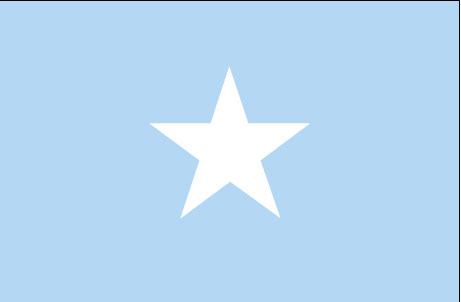
- Flag Symbolism
- light blue with a large white five-pointed star in the center; blue field influenced by the flag of the UN
- Flag History
- The adoption of the blue was influenced by the blue field of the United Nations flag. The five points of the star represent the five counties in which the Somalis live: Somali (Italian colony), British Somali, Ethiopia, Kenya and Djibouti.
- Date of Adoption
- 12 October 1954
National Anthem
- Anthem Lyrics
- Somaliyaay toosoo Toosoo isku tiirsada ee Hadba kiina taag daranee Taageera waligiinee
- Anthem History
- After its independence from Italy and the United Kingdom in 1960, the Somali Republic adopted a new national anthem, written by Giuseppe Blanc (1886-1969). This anthem, which had neither lyrics nor a title, remained in use until 2000 when it was replaced with a new version. The newly adopted version has a new melody, and has lyrics.