
 English
 Español
 中文
中文 हिन्दी
 Français
Government and Politics
Government and Politics of Slovenia
Government structure, leadership, capital, military, and national symbols of Slovenia.
Government Structure
Constitutional foundations, branches, parties, and leadership.
- Government Type
- parliamentary democratic republic
- Administrative Divisions
- 182 municipalities (obcine, singular - obcina) and 11 urban municipalities* (mestne obcine , singular - mestna obcina ) Ajdovscina, Beltinci, Benedikt, Bistrica ob Sotli, Bled, Bloke, Bohinj, Borovnica, Bovec, Braslovce, Brda, Brezice, Brezovica, Cankova, Celje*, Cerklje na Gorenjskem, Cerknica, Cerkno, Cerkvenjak, Crensovci, Crna na Koroskem, Crnomelj, Destrnik, Divaca, Dobje, Dobrepolje, Dobrna, Dobrova-Horjul-Polhov Gradec, Dobrovnik-Dobronak, Dolenjske Toplice, Dol pri Ljubljani, Domzale, Dornava, Dravograd, Duplek, Gorenja Vas-Poljane, Gorisnica, Gornja Radgona, Gornji Grad, Gornji Petrovci, Grad, Grosuplje, Hajdina, Hoce-Slivnica, Hodos-Hodos, Horjul, Hrastnik, Hrpelje-Kozina, Idrija, Ig, Ilirska Bistrica, Ivancna Gorica, Izola-Isola, Jesenice, Jezersko, Jursinci, Kamnik, Kanal, Kidricevo, Kobarid, Kobilje, Kocevje, Komen, Komenda, Koper-Capodistria*, Kostel, Kozje, Kranj*, Kranjska Gora, Krizevci, Krsko, Kungota, Kuzma, Lasko, Lenart, Lendava-Lendva, Litija, Ljubljana*, Ljubno, Ljutomer, Logatec, Loska Dolina, Loski Potok, Lovrenc na Pohorju, Luce, Lukovica, Majsperk, Maribor*, Markovci, Medvode, Menges, Metlika, Mezica, Miklavz na Dravskem Polju, Miren-Kostanjevica, Mirna Pec, Mislinja, Moravce, Moravske Toplice, Mozirje, Murska Sobota*, Muta, Naklo, Nazarje, Nova Gorica*, Novo Mesto*, Odranci, Oplotnica, Ormoz, Osilnica, Pesnica, Piran-Pirano, Pivka, Podcetrtek, Podlehnik, Podvelka, Polzela, Postojna, Prebold, Preddvor, Prevalje, Ptuj*, Puconci, Race-Fram, Radece, Radenci, Radlje ob Dravi, Radovljica, Ravne na Koroskem, Razkrizje, Ribnica, Ribnica na Pohorju, Rogasovci, Rogaska Slatina, Rogatec, Ruse, Salovci, Selnica ob Dravi, Semic, Sempeter-Vrtojba, Sencur, Sentilj, Sentjernej, Sentjur pri Celju, Sevnica, Sezana, Skocjan, Skofja Loka, Skofljica, Slovenj Gradec*, Slovenska Bistrica, Slovenske Konjice, Smarje pri Jelsah, Smartno ob Paki, Smartno pri Litiji, Sodrazica, Solcava, Sostanj, Starse, Store, Sveta Ana, Sveti Andraz v Slovenskih Goricah, Sveti Jurij, Tabor, Tisina, Tolmin, Trbovlje, Trebnje, Trnovska Vas, Trzic, Trzin, Turnisce, Velenje*, Velika Polana, Velike Lasce, Verzej, Videm, Vipava, Vitanje, Vodice, Vojnik, Vransko, Vrhnika, Vuzenica, Zagorje ob Savi, Zalec, Zavrc, Zelezniki, Zetale, Ziri, Zirovnica, Zuzemberk, Zrece
- Legal System
- based on civil law system
- Suffrage
- 18 years of age; universal (16 years of age, if employed)
- Citizenship
- citizenship by birth: no citizenship by descent only: at least one parent must be a citizen of Slovenia; both parents if the child is born outside of Slovenia dual citizenship recognized: yes, for select cases residency requirement for naturalization: 10 years, the last 5 of which have been continuous
- Executive Branch
- chief of state: President Nataša PIRC MUSAR (since 23 December 2022) head of government: Prime Minister Robert GOLOB (since 1 June 2022) cabinet: Council of Ministers nominated by the prime minister and elected by the National Assembly elections: president elected by popular vote for a five-year term; election last held 23 October and 13 November 2022 (next to be held in fall 2027); following National Assembly elections, the leader of the majority party or the leader of a majority coalition is usually nominated to become prime minister by the president and elected by the National Assembly; election last held 24 April 2022 (next National Assembly elections to be held in 2026) election results: Nataša PIRC MUSAR elected president in second round; percent of vote in second round - Nataša PIRC MUSAR 53.9%, Anže LOGAR 46.1%; Robert GOLOB elected prime minister; National Assembly vote - 54 to 30
- Legislative Branch
- Bicameral Parliament consisting of a National Assembly or Državni Zbor (90 seats; members are elected by popular vote through a proportional representation system with single-member constituency and party list components; members serve four-year terms) and the National Council or Državni Svet (40 seats; this is primarily an advisory body with limited legislative powers; it may propose laws, request review of any National Assembly decisions, and call national referenda; members representing social, economic, professional, and local interests are indirectly elected to five-year terms by an electoral college). Elections: National Assembly - last held on 24 April 2022 (next to be held in 2026). Election results: percent of vote by party - Gibanje Svoboda (Freedom Movement) 34.5%, SDS 23.5%, Nova Slovenija (NSi) 6.9%, SD 6.7%, Levica 4.4%, SLS 4.0%, SNS 3.5%, other 16.5%; seats by party - Gibanje Svoboda 41, SDS 27, NSi 8, SD 7, Levica 5, and one seat each reserved for the Hungarian and Italian national minorities. Following the election, Gibanje Svoboda leader Robert Golob was appointed Prime Minister, ending the tenure of Janez Janša and marking a significant shift in Slovenia's political landscape.
- Judicial Branch
- Supreme Court (judges are elected by the National Assembly on the recommendation of the Judicial Council); Constitutional Court (judges elected for nine-year terms by the National Assembly and nominated by the president)
- Political Parties
- Democratic Party of Retired (Persons) of Slovenia or DeSUS [Karl ERJAVEC]; Liberal Democratic Party or LDS [Jelko KACIN]; New Slovenia or NSi [Andrej BAJUK]; Slovene Democratic Party or SDS [Janez JANSA]; Slovene National Party or SNS [Zmago JELINCIC]; Slovene People's Party or SLS [Janez PODOBNIK]; Slovene Youth Party or SMS [Darko KRANJC]; United List of Social Democrats or ZLSD [Borut PAHOR]
- Head of State
- President Nataša PIRC MUSAR
- Head of Government
- Prime Minister Robert GOLOB
- Cabinet
- Council of Ministers nominated by the prime minister and elected by the National Assembly
- Elections
- National Assembly - last held on 24 April 2022 (next to be held in 2026).
- Election Results
- percent of vote by party - Gibanje Svoboda (Freedom Movement) 34.5%, SDS 23.5%, Nova Slovenija (NSi) 6.9%, SD 6.7%, Levica 4.4%, SLS 4.0%, SNS 3.5%, other 16.5%; seats by party - Gibanje Svoboda 41, SDS 27, NSi 8, SD 7, Levica 5, and one seat each reserved for the Hungarian and Italian national minorities. Following the election, Gibanje Svoboda leader Robert Golob was appointed Prime Minister, ending the tenure of Janez Janša and marking a significant shift in Slovenia's political landscape.
- Constitution
- adopted 23 December 1991, effective 23 December 1991
- Independence
- 25 June 1991 (from Yugoslavia)
- National Holiday
- Independence Day/Statehood Day, 25 June (1991)
- International Organization Participation
- ACCT (observer), BIS, CE, CEI, EAPC, EBRD, EU (new member), FAO, IADB, IAEA, IBRD, ICAO, ICC, ICCt, ICRM, IDA, IFC, IFRCS, IHO, ILO, IMF, IMO, Interpol, IOC, IOM, ISO, ITU, NAM (guest), NSG, OPCW, OSCE, PCA, PFP, UN, UNCTAD, UNESCO, UNIDO, UNMIK, UNTSO, UPU, WCO, WEU (associate partner), WHO, WIPO, WMO, WToO, WTrO, ZC
- Diplomatic Representation in the U.S.
- chief of mission: Ambassador Davorin KRACUN chancery: 1525 New Hampshire Avenue NW, Washington, DC 20036 telephone: [1] (202) 667-5363 FAX: [1] (202) 667-4563 consulate(s) general: Cleveland, New York
- U.S. Diplomatic Representation
- chief of mission: Ambassador Thomas B. ROBERTSON embassy: Presernova 31, 1000 Ljubljana mailing address: American Embassy Ljubljana, Department of State, 7140 Ljubljana Place, Washington, DC 20521-7140 telephone: [386] (1) 200-5500 FAX: [386] (1) 200-5555
Capital City
Seat of government and political history.
- Capital City
- Ljubljana
- Location
- 46 03 N, 14 31 E
- Time Difference
- UTC+1 (6 hours ahead of Washington, DC, during Standard Time)
- History
- likely related to the Slavic root "ljub", meaning "to like" or "to love"; by tradition, the name is related to the Slovene word "ljubljena" meaning "beloved"
Embassy and Diplomatic Representation
Embassy location and contact details.
U.S. Embassy Ljubljana, Consular Section Prešernova 31 1000 Ljubljana Telephone: (386) (1) 200-5595 Emergency after-hours telephone: (386) (1) 200-5556 Facsimile: (386) (1) 200-5535 E-mail: ACSLjubljana@state.gov
Military
Branches, service obligations, expenditures, and manpower.
- Military Branches
- Slovenian Armed Forces (Slovenska Vojska, SV): Forces Command (with ground units, naval element, air and air defense brigade); Administration for Civil Protection and Disaster Relief (ACPDR
- Service Age and Obligation
- 18-25 years of age for voluntary military service; conscription abolished in 2003
National Symbols
Flag, anthem, and other symbols of national identity.
National Flag
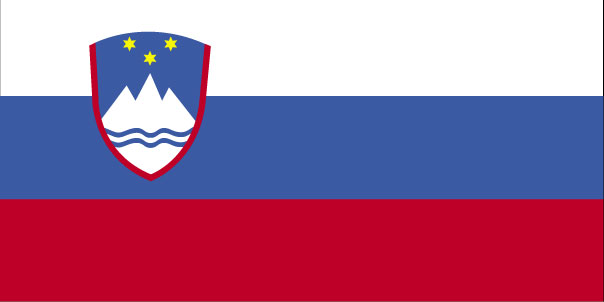
- Flag Symbolism
- three equal horizontal bands of white (top), blue, and red, with the Slovenian seal (a shield with the image of Triglav, Slovenia's highest peak, in white against a blue background at the center; beneath it are two wavy blue lines depicting seas and rivers, and above it are three six-pointed stars arranged in an inverted triangle, which are taken from the coat of arms of the Counts of Celje, the great Slovene dynastic house of the late 14th and early 15th centuries); the seal is located in the upper hoist side of the flag centered in the white and blue bands
- Date of Adoption
- 27 June 1991
National Anthem
- Anthem Lyrics
- "Zivé naj vsi naródi, ki hrepené do"cakat' dan, da, koder sonce hodi, prepir iz svéta bo pregnan; da rojak prost bo vsak, ne vrag, le sosed bo mejak!
- Anthem Lyrics (English)
- God's blessing on all nations, Who long and work for that bright day, When o'er earth's habitation No war, no strife shall hold its sway; Who long to see That all man free No more shall foes, but neighbours be.
Other National Symbols
National Flower
carnation
National Flower
carnation
National Tree
tilia (linden)
Coat of Arms
Counts of Celje The coat of arms with three golden six-pointed stars belonged to the noble house of Celje, which hailed from Žovnek and was first mentioned in the medieval annals around 1130. In the succeeding centuries, it went on to create an influential realm, establishing control over most of the Slovenian territories by 1436. At that time, the family's court in the city of Celje was the focal point of humanist thought and renaissance on Slovenian soil. The assassination of the last male descendant of the Celje dynasty in 1456 brought to an end the period of native rule in the Slovenian lands. From then on and until the 20th century, Slovenians were ruled from abroad by foreigners, most notably by the Habsburgs.
Coat of Arms
The coat of arms of Slovenia has the form of a shield. In the middle of the shield, on a blue background, is a representation of Mount Triglav in white, under which there are two undulating blue lines symbolising the sea and rivers and above which there are three golden, six-pointed stars forming a downward-pointing triangle. The shield is bordered in red. The coat-of-arms was designed in accordance with a set standard of geometry and colour by the academy sculptor Marko Pogaènik. The shield has a red border at the sides and so features all three colours of the Slovenian tricolour: white, blue and red (the mountain is in white, the waves in blue). The gold stars recall one of the colours of the historical flag of the province of Carniola, regarded as the forerunner of the tricolour.
Coat of Arms
Form and colours The coat of arms of Slovenia has the form of a shield. In the middle of the shield, on a blue background, is a representation of Mount Triglav in white, under which there are two undulating blue lines symbolising the sea and rivers and above which there are three golden, six-pointed stars forming a downward-pointing triangle. The shield is bordered in red. The coat-of-arms was designed in accordance with a set standard of geometry and colour by the academy sculptor Marko Pogaènik. The shield has a red border at the sides and so features all three colours of the Slovenian tricolour: white, blue and red (the mountain is in white, the waves in blue). The gold stars recall one of the colours of the historical flag of the province of Carniola, regarded as the forerunner of the tricolour. The lower part of the coat of arms symbolises the Slovenian landscape, which comprises Alpine peaks in the northwest, the Adriatic sea in the south, and the plain of the ancient Pannonian Sea in the east. The verticality of the Alps is represented by the highest mountain, Triglav, while the level expansiveness of the maritime and lowland areas is expressed in the two horizontal waves. The mountain and the water at its foot can equally be understood as a universal symbol which does not refer uniquely to the Slovenian landscape. It symbolises the fundamental inner balance of the human individual, the balance between the masculine and feminine principles. The vertical extensions of the mountain denotes will and masculine power within the human being, while the horizontality and suppleness of the water symbolises attributes of femininity, all-encompassing and entire. The balance water between the feminine and masculine principles touches the very essence of humanity, and can at the same time be constructed on the global level as a symbol of the balance between nature and civilisation. In this way the coat-of-arms addresses an age which once more observes and cherishes balance in all things. The balance between the mountain and the water-levels is a token of Slovenian identity in terms of landscape. Slovenian identity on the spiritual and ethnical level is symbolised by the three six-pointed gold stars placed above in the form of a triangle pointing from the sky to the earth. The stars are aligned with the triangle formed by the three peaks of Triglav (whose name means “three- headed”), symbolising the terrestrial world. The coat-of-arms thus symbolically conjures the realm of the spiritual and ethereal principle and the world of earth and landscape, whereby the two are coextensive, interdependent and complementary. The three six-pointed golden stars are taken from the coat of arms of the Counts of Celje, whose rule in the late Middle Ages united almost the entire Slovenian territory that is known today. The stars of the Counts of Celje thus symbolise the cultural and administrative tradition of Slovenian lands in the context of their involvement in the currents of European history. The design of the coat of arms The primeval pattern of the Slovenian coat of arms can be traced back to the poem “Krst pri Savici” (The Baptism on the Savica) by France Prešeren who is considered one of the founders of modern Slovenian nationhood. The poem deals with the question of Slovenian identity in the context of the conversion to Christianity. In the first stanza, the poet presents Mount Triglav, the lake beneath it, and the golden light above it. These same elements are represented in the coat of arms. The image of the Slovenian coat of arms was first encountered on Mary's column standing in front of the parish church at Bled, which was created by the architect Jože Pleènik in 1934. The reverse side of Mary's coat features a chiselled out coat of arms of the then Kingdom of Serbs, Croats and Slovenes. Instead of the official coat of arms, the artist created a coat of arms composed of the shape of Triglav and a six-pointed star above it. Geometric design The Slovenian coat-of-arms is composed according to a precise geometric design based on the two equilateral triangles: the “celestial” and the “terrestrial” triangles whose tips meet at the lower of the three stars. The “terrestrial” part of the shield has two internal poles. One is the meandering of the two waves, while the other is Triglav, which is made up of three equilateral triangles. Together, they form the “terrestrial” triangle.