
 English
 Español
 中文
中文 हिन्दी
 Français
Government and Politics
Government and Politics of Serbia
Government structure, leadership, capital, military, and national symbols of Serbia.
Government Structure
Constitutional foundations, branches, parties, and leadership.
- Government Type
- republic
- Administrative Divisions
- 2 republics (republike, singular - republika); and 2 nominally autonomous provinces* (autonomn pokrajine, singular - autonomna pokrajina); Kosovo*, Montenegro, Serbia, Vojvodina*
- Legal System
- based on civil law system
- Suffrage
- 16 years of age, if employed; 18 years of age, universal
- Citizenship
- citizenship by birth: no citizenship by descent only: at least one parent must be a citizen of Serbia dual citizenship recognized: yes residency requirement for naturalization: 3 years
- Executive Branch
- chief of state: President Aleksandar VUCIC (since 31 May 2017); note - the president serves as chief of state head of government: Prime Minister Milos VUCEVIC (since 2 May 2024); note - the prime minister serves as head of government cabinet: Government (cabinet) elected by the National Assembly elections: president elected by direct popular vote for a five-year term, eligible for a second term; election last held on 3 April 2022 (next to be held in 2027); prime minister elected by the National Assembly election results: Aleksandar VUCIC reelected president in the first round; percent of vote - Aleksandar VUCIC (SNS) 59.8%, Zdravko PONOS (NADA coalition) 18.9%, Milos JOVANOVIC (NADA) 6.1%, other 15.2%
- Legislative Branch
- Unicameral National Assembly (Narodna skupština) with 250 seats. Members are elected by proportional representation from a single nationwide constituency, with a 3 percent electoral threshold required for parties representing national minorities and a 5 percent threshold for all other parties. Members serve four-year terms. Elections: The most recent parliamentary elections were held on June 2, 2024. Early elections have been called periodically, reflecting the fluid nature of Serbian coalition politics. Election results: The ruling Serbian Progressive Party (SNS)-led coalition "Serbia Must Not Stop" won the largest share of seats, maintaining its dominant position in the legislature. Opposition coalitions, including the Serbia Against Violence bloc, also secured representation. The Assembly is presided over by a Speaker elected from among its members. The National Assembly holds legislative authority, ratifies international treaties, adopts the state budget, and oversees the work of the government. Serbia transitioned to its current unicameral parliamentary system following the dissolution of the State Union of Serbia and Montenegro in 2006, when Montenegro declared independence and Serbia became a fully independent republic under its own constitutional framework, formalized by the 2006 Constitution.
- Judicial Branch
- The Court of Serbia and Montenegro; judges are elected by the Serbia and Montenegro Parliament for six-year terms note: since the promulgation of the 2003 Constitution, the Federal Court has constitutional and administrative functions; it has an equal number of judges from each republic
- Political Parties
- Democratic Party or DS [Boris TADIC]; Democratic Party of Serbia or DSS [Vojislav KOSTUNICA]; Democratic Party of Socialists of Montenegro or DPS [Milo DJUKANOVIC]; Democratic Serbian Party of Montenegro or DSS [Bozidar BOJOVIC]; G17 Plus [Miroljub LABUS]; New Serbia or NS [Velimir ILIC]; Liberal Party of Montenegro or LSCG [Miodrag ZIVKOVIC]; People's Party of Montenegro or NS [Predrag POPOVIC]; Power of Serbia Movement or PSS [Bogoljub KARIC]; Serbian Peoples' Party of Montenegro or SNS [Andrija MANDIC]; Serbian Radical Party or SRS [Tomislav NIKOLIC]; Serbian Renewal Movement or SPO [Vuk DRASKOVIC]; Serbian Socialist Party or SPS (former Communist Party and party of Slobodan MILOSEVIC) [Ivica DACIC, president of Main Board]; Social Democratic Party of Montenegro or SDP [Ranko KRIVOKAPIC]; Socialist People's Party of Montenegro or SNP [Predrag BULATOVIC] note: the following political parties participate in elections and institutions only in Kosovo, which has been governed by the UN under UNSCR 1244 since 1999: Albanian Christian Democratic Party or PSHDK [Mark KRASNIQI]; Alliance for the Future of Kosovo or AAK [Ramush HARADINAJ]; Citizens' Initiative of Gora or GIG [leader NA]; Democratic Ashkali Party of Kosovo or PDAK [Sabit RRAHMANI]; Democratic League of Kosovo or LDK [Ibrahim RUGOVA]; Democratic Party of Kosovo or PDK [Hashim THACI]; Justice Party or PD [Sylejman CERKEZI]; Kosovo Democratic Turkish Party of KDTP [Mahir YAGCILAR]; Liberal Party of Kosovo or PLK [Gjergj DEDAJ]; Ora [Veton SURROI]; New Democratic Initiative of Kosovo or IRDK [Bislim HOTI]; Party of Democratic Action or SDA [Numan BALIC]; Popular Movement of Kosovo or LPK [Emrush XHEMAJLI]; Prizren-Dragas Initiative or PDI [Ismajl KARADOLAMI]; Serb Democratic Party or SDS [Slavisa PETKOVIC]; Serb List for Kosovo and Metohija or SLKM [Oliver IVANOVIC]; United Roma Party of Kosovo or PREBK [Haxhi Zylfi MERXHA]; Vakat [leader NA]
- Head of State
- President Aleksandar VUCIC
- Head of Government
- Prime Minister Milos VUCEVIC
- Cabinet
- Council of Ministers appointed by the president
- Elections
- The most recent parliamentary elections were held on June 2, 2024. Early elections have been called periodically, reflecting the fluid nature of Serbian coalition politics.
- Election Results
- The ruling Serbian Progressive Party (SNS)-led coalition won the largest share of seats in the most recent parliamentary elections held in June 2024, maintaining its dominant position in the National Assembly. The SNS-led list secured approximately 46 percent of the vote, translating into a commanding bloc of seats. Opposition coalitions, including the Serbia Against Violence grouping and other centrist and pro-European parties, also secured representation, though they remain a minority in the chamber. Ana Brnabić was elected Speaker of the National Assembly following the formation of the new parliament, becoming the presiding officer of the legislature. The National Assembly holds legislative authority, ratifies international treaties, adopts the state budget, and oversees the work of the government. Serbia transitioned to its current unicameral parliamentary system following the dissolution of the State Union of Serbia and Montenegro in 2006, when Montenegro declared independence and Serbia became a fully independent republic under its own constitutional framework, formalized by the 2006 Constitution. The 250-seat assembly operates on a proportional representation basis, with a five percent electoral threshold required for parties and coalitions to enter parliament.
- Constitution
- 4-Feb-03
- Independence
- 27 April 1992 (Federal Republic of Yugoslavia or FRY - now Serbia and Montenegro - formed as self-proclaimed successor to the Socialist Federal Republic of Yugoslavia or SFRY)
- National Holiday
- National Day, 27 April
- International Organization Participation
- CE, CEI, EBRD, FAO, G- 9, G-77, IAEA, IBRD, ICAO, ICC, ICCt, ICFTU, ICRM, IDA, IFAD, IFC, IFRCS, IHO, ILO, IMF, IMO, Interpol, IOC, IOM, ISO, ITU, MONUC, NAM, OAS (observer), OPCW, OSCE, PCA, UN, UNCTAD, UNESCO, UNHCR, UNIDO, UNMISET, UPU, WCL, WCO, WHO, WIPO, WMO, WToO, WTrO (observer)
- Diplomatic Representation in the U.S.
- chief of mission: Ambassador Ivan VUJACIC chancery: 2134 Kalorama Road NW, Washington, DC 20008 telephone: [1] (202) 332-0333 FAX: [1] (202) 332-3933 consulate(s) general: Chicago
- U.S. Diplomatic Representation
- chief of mission: Ambassador Michael C. POLT embassy: Kneza Milosa 50, 11000 Belgrade mailing address: 5070 Belgrade Place, Washington, DC 20521-5070 telephone: [381] (11) 361-9344 FAX: [381] (11) 361-8230 consulate(s): Podgorica note: there is a branch office in Pristina at 30 Nazim Hikmet 38000 Pristina, Kosovo; telephone: [381](38)549-516; FAX: [381](38)549-890
Capital City
Seat of government and political history.
- Capital City
- Belgrade (Beograd)
- Location
- 44 50 N, 20 30 E
- Time Difference
- UTC+1 (6 hours ahead of Washington, DC, during Standard Time)
- History
- the Serbian "Beograd" means "white fortress" or "white city" and dates back to the 9th century; the name derives from the white fortress wall that once enclosed the city
Embassy and Diplomatic Representation
Embassy location and contact details.
U.S. Embassy Belgrade Bulevar kneza Aleksandra Karadordevica 92 11040 Belgrade Serbia Telephone: 381-11-7064-000 Email: belgradeacs@state.gov
Military
Branches, service obligations, expenditures, and manpower.
- Military Branches
- Serbian Armed Forces (Vojska Srbije, VS): Land Forces Command (includes Riverine Component, consisting of a river flotilla on the Danube), Air and Air Defense Forces Command
- Service Age and Obligation
- 18 years of age for voluntary military service; conscription abolished December 2010; reserve obligation to age 60 for men and age 50 for women
National Symbols
Flag, anthem, and other symbols of national identity.
National Flag
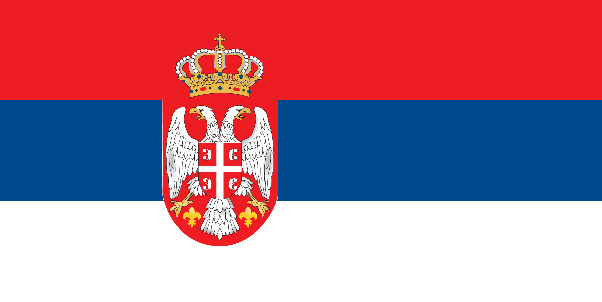
- Flag Symbolism
- three equal horizontal bands of blue (top), white, and red
- Date of Adoption
- 27 April 1992
National Anthem
- Anthem Lyrics
- Hej Sloveni Hej Sloveni, još 'te živi duh naših dedova, dok za narod srce bije njihovih sinova. Živi, živi duh slovenski živet ce vekov'ma zalud preti ponor pakla zalud vatra groma. Nek se sada i nad nama burom sve raznese stena puca, dub se lama, zemlja nek se trese. Mi stojimo postojano kano klisurine proklet bio izdajica svoje domovine.
- Anthem Lyrics (English)
- O, Slavs, there still lives Word of our grandfathers While for the people heart strikes Of their sons Live, live, spirit Slavic You will live for centuries Futile is the Hell's abyss Futile is the fire of thunder Even if now there above us Storm shatters everything Stone breaks, tree shatters Earth quakes We stand steadily As river gorges Damned be the traitor Of his homeland!
Other National Symbols
National Flower
plum
Coat of Arms
Adopted: August 17, 2004
On August 17, 2004, the Parliament of Serbia voted unanimously to adopt a recommendation for the use of the coat-of-arms, flag, and national anthem of Serbia. Coat-of-arms of the Republic of Serbia According to the recommendation, the coat-of-arms is a double-headed white eagle with a shield, a cross, four firesteels, and the crown of the Nemanjic dynasty. The national anthem of Serbia is a 19th century song, “Boze Pravde” (God of Justice), written by Davorin Jenko and with lyrics by Jovan Djordjevic. The recommendation defines two flags – the national flag and the state flag. The national flag is a tricolour (red, blue, and white) with horizontal stripes, while the state flag of Serbia is the same tricolour but with a small coat-of-arms located left of centre by one-seventh of the length of the flag.