
 English
 Español
 中文
中文 हिन्दी
 Français
Government and Politics
Government and Politics of Qatar
Government structure, leadership, capital, military, and national symbols of Qatar.
Government Structure
Constitutional foundations, branches, parties, and leadership.
- Government Type
- traditional monarchy
- Administrative Divisions
- 10 municipalities (baladiyat, singular - baladiyah); Ad Dawhah, Al Ghuwayriyah, Al Jumayliyah, Al Khawr, Al Wakrah, Ar Rayyan, Jarayan al Batinah, Madinat ash Shamal, Umm Sa'id, Umm Salal
- Legal System
- discretionary system of law controlled by the amir, although civil codes are being implemented; Islamic law dominates family and personal matters
- Suffrage
- 18 years of age; universal
- Citizenship
- citizenship by birth: no citizenship by descent only: the father must be a citizen of Qatar dual citizenship recognized: no residency requirement for naturalization: 20 years; 15 years if an Arab national Suffrage:
- Executive Branch
- chief of state: Amir TAMIM bin Hamad al-Thani (since 25 June 2013, when his father, Amir HAMAD bin Khalifa al-Thani, abdicated in his favor); note - Amir TAMIM also serves as Supreme Commander of the Armed Forces head of government: Prime Minister and Minister of Foreign Affairs MUHAMMAD bin Abd al-Rahman bin Jassim al-Thani (since 7 March 2023); Deputy Prime Minister KHALID bin Khalifa bin Abdul Aziz al-Thani served in the role previously (2020–2023) cabinet: Council of Ministers appointed by the Amir elections: none; the monarch is hereditary note: Qatar held elections for its 45-member Advisory Council (Majlis al-Shura) on 2 October 2021, marking the first time citizens directly elected members to the body. The Advisory Council holds legislative powers, including the ability to propose and review legislation, approve the state budget, and question ministers. Previously, all members had been appointed by the Amir. Qatar also continues to hold periodic elections for the 29-member Central Municipal Council (CMC), which exercises consultative powers focused on improving the delivery of municipal services.
- Legislative Branch
- Unicameral Consultative Council or Majlis al-Shura (45 seats; 30 members directly elected by popular vote and 15 members appointed by the Amir; members serve 4-year terms) Note: Qatar held its first-ever legislative elections in October 2021, marking a historic milestone after decades of delays. The 2005 constitution had long provided for a 45-member Majlis al-Shura with two-thirds of seats to be filled by direct election and the remaining one-third to be appointed by the Amir. Planned elections were repeatedly postponed, and the council continued to operate with fully appointed membership for many years. The October 2021 elections saw Qatari citizens vote for 30 of the 45 council seats for the first time, with the Amir appointing the remaining 15 members, including women and representatives of various constituencies. The council holds legislative authority, approves the state's general budget, and can propose legislation, though executive power remains firmly with the Amir.
- Judicial Branch
- Court of Appeal note: under a judiciary law issued in 2003, the former two court systems, civil and Islamic law, were merged under a higher court, the Court of Cassation, established for appeals
- Political Parties
- none
- Head of State
- Amir TAMIM bin Hamad al-Thani (since 25 June 2013, when his father, Amir HAMAD bin Khalifa al-Thani, abdicated in his favor)
- Head of Government
- Prime Minister and Minister of Foreign Affairs MUHAMMAD bin Abd al-Rahman bin Jassim al-Thani
- Cabinet
- Council of Ministers appointed by the monarch
- Elections
- the monarch is hereditary
- Election Results
- Qatar is a constitutional monarchy governed by the Al Thani royal family, and as such, it does not hold national elections for a head of state or a directly elected national legislature in the conventional sense. The Emir holds supreme executive authority, and political parties are prohibited under Qatari law. The most significant electoral development in Qatar's modern history took place on October 2, 2021, when the country held its first-ever elections for the Shura Council, Qatar's legislative advisory body. Of the 45 seats on the Shura Council, 30 were made available for direct election by Qatari citizens, while the remaining 15 seats continued to be appointed by the Emir. Voter turnout for this historic election was reported at approximately 63.5 percent of eligible voters. Women were permitted both to vote and to stand as candidates; however, none of the six female candidates who ran were elected to the 30 contested seats. Prior to 2021, all 45 Shura Council members had been appointed directly by the Emir, meaning the 2021 vote represented a meaningful, if limited, step toward participatory governance. The Shura Council's role remains advisory rather than fully legislative, as it does not have the authority to form or dissolve governments, and the Emir retains final decision-making power on all major affairs of state. At the municipal level, Qatar has held elections for the Central Municipal Council since 1999. These elections allow Qatari citizens to vote for representatives in 29 municipal districts. The Central Municipal Council serves in an advisory capacity to the Ministry of Municipality and Environment and addresses local governance issues such as urban planning and public services. Suffrage in Qatar is restricted to Qatari nationals who are at least 18 years of age and meet specific residency and lineage requirements, which significantly limits the eligible voter pool given that expatriates make up the large majority of the country's total population.
- Constitution
- provisional constitution enacted 19 April 1972; in July 1999 Amir HAMAD issued a decree forming a committee to draft a permanent constitution; in the 29 April 2003 referendum, 96.6% of Qatari voters approved the new constitution
- Independence
- 3 September 1971 (from UK)
- National Holiday
- Independence Day, 3 September (1971)
- International Organization Participation
- ABEDA, AFESD, AMF, FAO, G-77, GCC, IAEA, IBRD, ICAO, ICC, ICRM, IDB, IFAD, IFRCS, IHO (pending member), ILO, IMF, IMO, Interpol, IOC, ISO (correspondent), ITU, LAS, NAM, OAPEC, OAS (observer), OIC, OPCW, OPEC, UN, UNCTAD, UNESCO, UNIDO, UPU, WCO, WHO, WIPO, WMO, WToO, WTrO
- Diplomatic Representation in the U.S.
- chief of mission: Ambassador Nasir bin Hamad bin Mubarak al-KHALIFA chancery: 2555 M Street NW, Washington, DC 20037 telephone: [1] (202) 274-1600 and 274-1603 FAX: [1] (202) 237-0059 consulate(s) general: Houston
- U.S. Diplomatic Representation
- chief of mission: Ambassador Chase UNTERMEYER embassy: Al-Luqta District, 22 February Road, Doha mailing address: P. O. Box 2399, Doha telephone: [974] 488 4101 FAX: [974] 488 4176
Capital City
Seat of government and political history.
- Capital City
- Doha
- Location
- 25 17 N, 51 32 E
- Time Difference
- UTC+3 (8 hours ahead of Washington, DC, during Standard Time)
- History
- derives from the Arabic term "dohat," meaning "roundness," and refers to the small rounded bays along the area's coastline
Embassy and Diplomatic Representation
Embassy location and contact details.
U.S. Embassy Doha Al-Luqta District, 22nd February Street, PO Box 2399, Doha Telephone: (974) 4496-6000, extension 0 or 6600 Emergency after-hours telephone: (974) 4496-6000, extension 0 or 6600, Facsimile: (974) 4488-4298 E-mail: acsconsulardoha@state.gov The Embassy observes a Sunday through Thursday workweek. Government offices and most businesses in Qatar also observe a Sunday through Thursday
Military
Branches, service obligations, expenditures, and manpower.
- Military Branches
- Qatari Emiri Land Force (QELF), Qatari Emiri Navy (QEN), Qatari Emiri Air Force (QEAF)
- Service Age and Obligation
- conscription for males aged 18-35
National Symbols
Flag, anthem, and other symbols of national identity.
National Flag
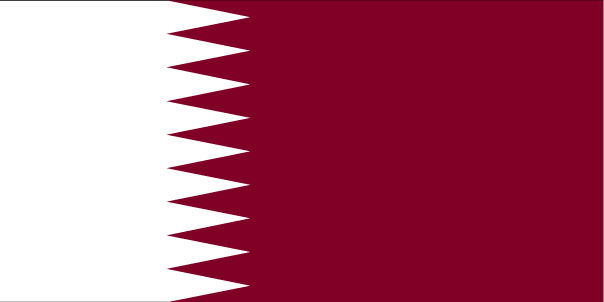
- Flag Symbolism
- maroon with a broad white serrated band (nine white points) on the hoist side
- Flag History
- The local red dyes used in making flags darken when exposed to the sun, so the red was officially changed to maroon in 1948.
- Date of Adoption
- 9 July 1971
National Anthem
- Anthem Lyrics (English)
- Swearing by God who erected the sky Swearing by God who spread the light Qatar will always be free Sublimed by the souls of the sinceres Procede thou on the manners of the ascendants And advance on Prophet's guidance In my heart, Qatar is an epic of glory and dignity Qatar is land of the early men Who protect us at time of distress, Doves they can be at times of peace, Warriors they are at times of sacrifice
- Anthem History
- The national Anthem of the State of Qatar was adopted with dawning of a new era when H.H. the Emir Sheikh Hamad Bin Khalifa Al-Thani assumed the reign of power. It was performed for the first time on Saturday 7th 1996 during the reception of GCC leaders on the occasion of the 17th GCC summit held in Doha. The Anthem starts by an oath: In the name of Allah, who elevated the sky and spread the light, Qatar shall always remain free, honorable and dignified with its glories hovering high by the spirit of the sincere and faithful. The first part of the Anthem urges citizens of Qatar to remain committed to tread the path of their forefathers, who were honorable, respectable, knowledgeable, religious, empowered by wisdom and vision, and to follow the guidance of the prophets and their preaching about righteousness, good deads and beauty. In the hearts of Qataris, Qatar is a story of nobility and glory that no one can deny and deface. In the second and last part, the Anthem affirms that the Qatari men of today are defenders of its land and dignity, they are descendents of the ancestors who defended it in the past and registered glorious annals of history in words that shine. Like their forefathers, they are pioneers in all fields, they are doves in peace times, and hawks of the day of combat. The Anthem closes by reaffirming that Qatar will remain free, dignified, glorious and noble hovering high by the souls of the faithful and sincere.