
 English
 Español
 中文
中文 हिन्दी
 Français
Government and Politics
Government and Politics of Papua New Guinea
Government structure, leadership, capital, military, and national symbols of Papua New Guinea.
Government Structure
Constitutional foundations, branches, parties, and leadership.
- Government Type
- constitutional monarchy with parliamentary democracy
- Administrative Divisions
- 20 provinces; Bougainville, Central, Chimbu, Eastern Highlands, East New Britain, East Sepik, Enga, Gulf, Madang, Manus, Milne Bay, Morobe, National Capital, New Ireland, Northern, Sandaun, Southern Highlands, Western, Western Highlands, West New Britain
- Legal System
- based on English common law
- Suffrage
- 18 years of age; universal
- Citizenship
- citizenship by birth: no citizenship by descent only: at least one parent must be a citizen of Papua New Guinea dual citizenship recognized: no residency requirement for naturalization: 8 years
- Executive Branch
- chief of state: King CHARLES III (since 8 September 2022), represented by Governor General Sir Bob DADAE (since 28 February 2017) head of government: Prime Minister James MARAPE (since 30 May 2019); Deputy Prime Minister John ROSSO (since 2023) cabinet: National Executive Council appointed by the governor general on the recommendation of the prime minister elections: none; the monarch is hereditary; governor general appointed by the National Executive Council; following legislative elections, the leader of the majority party or the leader of the majority coalition is typically appointed prime minister by the governor general
- Legislative Branch
- unicameral National Parliament — sometimes referred to as the House of Assembly (118 seats; 89 members elected from open electorates and 22 from provincial electorates, plus 1 from the Autonomous Region of Bougainville and 6 from regional electorates; members elected by popular vote to serve five-year terms) elections: last held 4–22 July 2022 (next to be held in 2027) election results: percent of vote by party — Pangu Party 22%, People's National Congress 8%, United Resources Party 7%, National Alliance 6%, People's Movement for Change 5%, others and independents 52%; seats by party — Pangu Party 39, People's National Congress 12, United Resources Party 11, National Alliance 9, People's Movement for Change 7, others and independents 40; James Marape of the Pangu Party retained the position of Prime Minister following the election note: affiliation with political parties remains fluid, and coalition arrangements frequently shift following elections
- Judicial Branch
- Supreme Court (the chief justice is appointed by the governor general on the proposal of the National Executive Council after consultation with the minister responsible for justice; other judges are appointed by the Judicial and Legal Services Commission)
- Political Parties
- Christian Democratic Party [Dr. Banare BUN]; Melanesian Alliance Party or MAP [Sir Moi AVEL]; National Alliance Party or NA [Michael SOMARE]; National Party [Melcher PEP]; Papua and Niugini Union Party or PANGU [Chris HAIVETA]; Papua New Guinea First Party [Cecilking DORUBA]; Papua New Guinea Labor Party [Bob DANAYA]; Papua New Guinea Party or PNGP (was People's Democratic Movement or PDM) [Sir Mekere MORAUTA]; People's Action Party or PAP [Moses MALADINA]; People's Labor Party or PLP [Ekis ROPENU]; People's National Congress or PNC [Peter O'NEILL]; People's Progressive Party or PPP [Andrew BAING]; Pipol First Party [Luther WENGE]; United Party [Bire KIMASOPA]; United Resources Party or URP [Tim NEVILLE] (2005)
- Head of State
- King CHARLES III, represented by Governor General Sir Bob DADAE
- Head of Government
- Prime Minister James MARAPE
- Cabinet
- National Executive Council appointed by the governor general on the recommendation of the prime minister
- Elections
- last held 4–22 July 2022 (next to be held in 2027)
- Election Results
- Papua New Guinea held general elections in July 2022. Percent of vote by party — Pangu Party approximately 22%, People's National Congress 8%, United Resources Party 7%, National Alliance 6%, People's Movement for Change 5%, others and independents 52%; seats by party — Pangu Party 39, People's National Congress 12, United Resources Party 11, National Alliance 9, People's Movement for Change 7, others and independents 40. Following the election, James Marape of the Pangu Party was returned as Prime Minister, securing enough parliamentary support to continue leading the government. Note: affiliation with political parties remains fluid, and coalition arrangements frequently shift following elections in Papua New Guinea, making post-election seat distributions subject to change as alliances are negotiated.
- Constitution
- 16-Sep-75
- Independence
- 16 September 1975 (from the Australian-administered UN trusteeship)
- National Holiday
- Independence Day, 16 September (1975)
- International Organization Participation
- ACP, APEC, ARF, AsDB, C, CP, FAO, G-77, IBRD, ICAO, ICFTU, ICRM, IDA, IFAD, IFC, IFRCS, IHO, ILO, IMF, IMO, Interpol, IOC, IOM (observer), ISO (correspondent), ITU, NAM, OPCW, PIF, Sparteca, UN, UNCTAD, UNESCO, UNIDO, UPU, WCO, WFTU, WHO, WIPO, WMO, WTrO
- Diplomatic Representation in the U.S.
- chief of mission: Ambassador Evan Jeremy PAKI chancery: 1779 Massachusetts Avenue NW, Suite 805, Washington, DC 20036 telephone: [1] (202) 745-3680 FAX: [1] (202) 745-3679
- U.S. Diplomatic Representation
- chief of mission: Ambassador Robert W. FITTS embassy: Douglas Street, Port Moresby mailing address: 4240 Port Moresby PI, US Department of State, Washington DC 20521-4240 telephone: [675] 321-1455 FAX: [675] 321-3423
Capital City
Seat of government and political history.
- Capital City
- Port Moresby
- Location
- 9 27 S, 147 11 E
- Time Difference
- UTC+10 (15 hours ahead of Washington, DC, during Standard Time) time zone note: Papua New Guinea has two time zones, including Bougainville (UTC+11)
- History
- named in 1873 by Captain John MORESBY (1830-1922) in honor of his father, British Admiral Sir Fairfax MORESBY (1786-1877)
Embassy and Diplomatic Representation
Embassy location and contact details.
U.S. EmbassyPort Moresby Douglas Street, adjacent to the Bank of Papua New Guinea Port Moresby, Papua New Guinea, P.O. Box 1492, Port Moresby, NCD 121, Papua New Guinea. Telephone: 675 321-1455 After-hours duty-officer telephone: 675 7200-9439 E-mail: ConsularPortMoresby@state.gov
Military
Branches, service obligations, expenditures, and manpower.
- Military Branches
- Papua New Guinea Defense Force (PNGDF; includes Maritime Operations Element, Air Operations Element)
- Service Age and Obligation
- 16 years of age for voluntary military service (with parental consent); no conscription; graduation from grade 12 required
National Symbols
Flag, anthem, and other symbols of national identity.
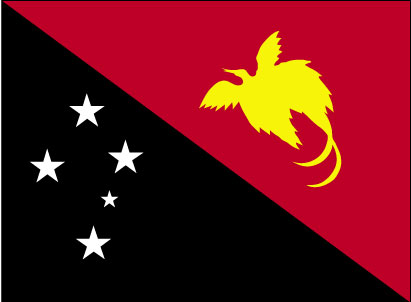
National Flag
- Flag Symbolism
- divided diagonally from upper hoist-side corner; the upper triangle is red with a soaring yellow bird of paradise centered; the lower triangle is black with five, white, five-pointed stars of the Southern Cross constellation centered
- Flag History
- Student, Susan Hareho Karike designed the flag. Chose red and black because of the wide spread use of these colors in traditional native art. The stars form the costellation of the Southern Cross, symbolizing the relationship with Australia and also referring to a local legend about five sisters.
- Date of Adoption
- 1 July 1971
National Anthem
- Anthem Lyrics (English)
- O arise all you sons of this land, Let us sing of our joy to be free, Praising God and rejoicing to be Papua New Guinea. Chorus: Shout our name from the mountains to seas Papua New Guinea; Let us raise our voices and proclaim Papua New Guinea. Now give thanks to the good Lord above For His kindness, His wisdom and love For this land of our fathers so free, Papua New Guinea. Chorus: Shout again for the whole world to hear Papua New Guinea; We're independent and we're free, Papua New Guinea.