
 English
 Español
 中文
中文 हिन्दी
 Français
Government and Politics
Government and Politics of New Zealand
Government structure, leadership, capital, military, and national symbols of New Zealand.
Government Structure
Constitutional foundations, branches, parties, and leadership.
- Government Type
- parliamentary democracy
- Administrative Divisions
- 13 regions; Auckland, Bay of Plenty, Canterbury, Gisborne-Hawke's Bay, Manawatu-Wanganui, Nelson-Marlborough, Northland, Otago, Southland, Taranaki, Waikato, Wellington, West Coast
- Legal System
- based on English law, with special land legislation and land courts for the Maori; accepts compulsory ICJ jurisdiction, with reservations
- Suffrage
- 18 years of age; universal
- Citizenship
- citizenship by birth: no citizenship by descent only: at least one parent must be a citizen of New Zealand dual citizenship recognized: yes residency requirement for naturalization: 3 years
- Executive Branch
- chief of state: King CHARLES III (since 8 September 2022), represented by Governor General Dame Cindy KIRO (since 21 October 2021) head of government: Prime Minister Christopher LUXON (since 27 November 2023) and Deputy Prime Minister Winston PETERS (since 27 November 2023) cabinet: Executive Council appointed by the governor general on the recommendation of the prime minister elections: none; the monarch is hereditary; governor general appointed by the monarch on the advice of the prime minister; following legislative elections, the leader of the majority party or the leader of a majority coalition is usually appointed prime minister by the governor general; deputy prime minister appointed by the governor general
- Legislative Branch
- Unicameral House of Representatives - commonly called Parliament (122 seats; 72 members elected by popular vote in single-member constituencies including seven Maori constituencies, and 50 proportional seats chosen from party lists; all members serve three-year terms) Elections: last held on 14 October 2023 (next to be held no later than November 2026) Election results: percent of vote by party - National Party 38.1%, Labour Party 26.9%, Green Party 11.6%, ACT New Zealand 8.6%, New Zealand First 6.1%, Maori Party 3.1%, other 5.6%; seats by party - National Party 48, Labour Party 34, Green Party 15, ACT New Zealand 11, New Zealand First 8, Maori Party 6 Note: New Zealand uses a mixed-member proportional (MMP) representation system, which can result in overhang seats when a party wins more electorate seats than its party vote entitlement would otherwise allocate, occasionally causing the total number of seats to exceed the nominal base of 120. Following the 2023 election, a three-party coalition government was formed by the National Party, ACT New Zealand, and New Zealand First.
- Judicial Branch
- Supreme Court; Court of Appeal; High Court; note - Judges appointed by the Governor-General
- Political Parties
- ACT New Zealand [Rodney HIDE]; Green Party [Jeanette FITZSIMONS]; Maori Party [Whatarangi WINIATA]; National Party or NP [Don BRASH]; New Zealand First Party or NZFP [Winston PETERS]; New Zealand Labor Party or NZLP [Helen CLARK]; Progressive Party [James (Jim) ANDERTON]; United Future or UF [Peter DUNNE]
- Head of State
- King CHARLES III, represented by Governor General Dame Cindy KIRO
- Head of Government
- Prime Minister Christopher LUXON and Deputy Prime Minister Winston PETERS
- Cabinet
- Executive Council appointed by the governor general on the recommendation of the prime minister
- Elections
- last held on 14 October 2023 (next to be held no later than November 2026)
- Election Results
- percent of vote by party - National Party 38.1%, Labour Party 26.9%, Green Party 11.6%, ACT New Zealand 8.6%, New Zealand First 6.1%, Maori Party 3.1%, other 5.6%; seats by party - National Party 48, Labour Party 34, Green Party 15, ACT New Zealand 11, New Zealand First 8, Maori Party 6, other 1 Note: New Zealand uses a mixed-member proportional (MMP) representation system, which can result in overhang seats when a party wins more electorate seats than its party vote entitlement would otherwise allocate, occasionally causing the total number of seats to exceed the nominal base of 120. The 2023 general election produced a total of 123 seats due to two overhang seats. Following the election, a three-party coalition government was formed by the National Party, ACT New Zealand, and New Zealand First, with National Party leader Christopher Luxon becoming Prime Minister.
- Constitution
- consists of a series of legal documents, including certain acts of the UK and New Zealand Parliaments and The Constitution Act 1986 which is the principal formal charter
- Independence
- 26 September 1907 (from UK)
- National Holiday
- Waitangi Day (Treaty of Waitangi established British sovereignty over New Zealand), 6 February (1840)
- International Organization Participation
- ANZUS (US suspended security obligations to NZ on 11 August 1986), APEC, ARF, AsDB, ASEAN (dialogue partner), Australia Group, BIS, C, CP, EBRD, FAO, IAEA, IBRD, ICAO, ICC, ICCt, ICFTU, ICRM, IDA, IEA, IFAD, IFC, IFRCS, IHO, ILO, IMF, IMO, Interpol, IOC, IOM, ISO, ITU, NAM (guest), NSG, OECD, OPCW, PCA, PIF, Sparteca, SPC, UN, UNAMSIL, UNCTAD, UNESCO, UNHCR, UNIDO, UNMISET, UNTSO, UPU, WCO, WFTU, WHO, WIPO, WMO, WTrO
- Diplomatic Representation in the U.S.
- chief of mission: Ambassador L. John WOOD chancery: 37 Observatory Circle NW, Washington, DC 20008 telephone: [1] (202) 328-4800 FAX: [1] (202) 667-5227 consulate(s) general: Los Angeles, New York
- U.S. Diplomatic Representation
- chief of mission: Ambassador William P. McCORMICK embassy: 29 Fitzherbert Terrace, Thorndon, Wellington mailing address: P. O. Box 1190, Wellington; PSC 467, Box 1, APO AP 96531-1034 telephone: [64] (4) 462-6000 FAX: [64] (4) 499-0490 consulate(s) general: Auckland
Capital City
Seat of government and political history.
- Capital City
- Wellington
- Location
- 41 18 S, 174 47 E
- Time Difference
- UTC+12 (17 hours ahead of Washington, DC, during Standard Time) time zone note: New Zealand has two time zones: New Zealand standard time (UTC+12) and Chatham Islands time (45 minutes in advance of New Zealand standard time; UTC+12:45)
- History
- named in 1840 after Arthur WELLESLEY, the first Duke of Wellington and victorious general at the Battle of Waterloo
Embassy and Diplomatic Representation
Embassy location and contact details.
The U.S. Consulate General in Auckland Third floor of the Citigroup Centre, 23 Customs Street East (between Commerce and Queen Streets), Telephone: (64) (9) 303-2724 Emergency after-hours telephone: (64) (4) 462-6000 Facsimile: (64) (9) 366-0870 The U.S. Embassy in Wellington 29 Fitzherbert Terrace, Thorndon, Wellington Telephone: (64) (4) 462-6000 Emergency after-hours telephone: (64) (4) 462-6000 Facsimile: (64) (4) 471-2380
Military
Branches, service obligations, expenditures, and manpower.
- Military Branches
- New Zealand Defense Force (NZDF): New Zealand Army; Royal New Zealand Navy; Royal New Zealand Air Force (Te Hokowhitu o Kahurangi, RNZAF)
- Service Age and Obligation
- 17 years of age for voluntary military service; soldiers cannot be deployed until the age of 18; no conscription; 3 years of secondary education required; must be a citizen of NZ, the UK, Australia, Canada, or the US, and resident of NZ for the previous 5 years
National Symbols
Flag, anthem, and other symbols of national identity.
National Flag
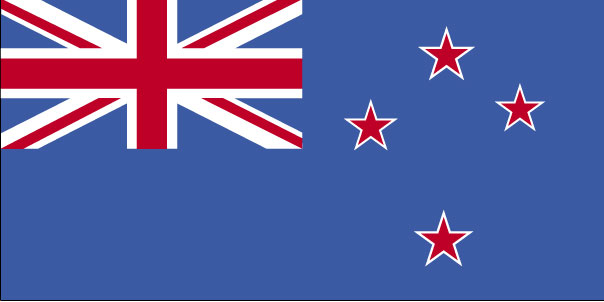
- Flag Symbolism
- blue with the flag of the UK in the upper hoist-side quadrant with four red five-pointed stars edged in white centered in the outer half of the flag; the stars represent the Southern Cross constellation
- Date of Adoption
- 12 June 1902
National Anthem
- Anthem Lyrics
- E Ihoa Atua O nga Iwi Matoura, Ata whaka rongona; Me aroha noa. Kia hua ko te pai; Kia tau to atawhai; Manaakitia mai Aotearoa Ona mano tangata Kiri whero, kiri ma, Iwi Maori Pakeha Repeke katoa, Nei ka tono ko nga he Mau e whakaahu ke, Kia ora marire Aotearoa Waiho tona takiwa Ko te ao marama; Kia whiti tona ra Taiawhio noa. Ko te hae me te ngangau Meinga kia kore kau; Waiho i te rongo mau Aotearoa Tona pai me toitu; Tika rawa, pono pu; Tona noho, tana tu; Iwi no Ihoa. Kaua mona whakama; Kia hau te ingoa; Kia tu hei tauira; Aotearoa
- Anthem Lyrics (English)
- God Defend New Zealand God of nations! at Thy feet In the bonds of love we meet, Hear our voices, we entreat, God defend our Free Land. Guard Pacific's triple star, From the shafts of strife and war, Make her praises heard afar, God defend New Zealand Men of ev'ry creed and race Gather here before Thy face, Asking Thee to bless this place, God defend our Free Land. From dissension, envy, hate, And corruption guard our State, Make our country good and great, God defend New Zealand. Peace, not war, shall be our boast, But, should foes assail our coast, Make us then a mighty host, God defend our Free Land. Lord of battles in thy might, Put our enemies to flight, Let our cause be just and right, God defend New Zealand. Let our love for Thee increase, May Thy blessings never cease, Give us plenty, give us peace, God defend our Free Land. From dishonour and from shame Guard our country's spotless name Crown her with immortal fame, God defend New Zealand. May our mountains ever be Freedom's ramparts on the sea, Make us faithful unto Thee, God defend our Free Land. Guide her in the nations' van, Preaching love and truth to man, Working out Thy Glorious plan, God defend New Zealand. God Save the Queen God save our gracious Queen, Long live our noble Queen, God save The Queen. Send her victorious, Happy and glorious, Long to reign over us: God save The Queen. O Lord our God, arise, Scatter our enemies, And make them fall; Confound their politics, Frustrate their knavish tricks; On thee our hopes we fix: God save us all. Thy choicest gifts in store On her be pleased to pour, Long may she reign. May she defend our laws, And ever give us cause To sing with heart and voice, God save The Queen. Note: The second verse of 'God Save The Queen' is commonly omitted
- Anthem History
- New Zealand holds a rare position in the world in that it has two national anthems of equal standing - 'God Defend New Zealand' and 'God Save The Queen'. Both of these anthems have origins which have been inspired by the fire of patriotism yet were written under markedly different situations.
Other National Symbols
National Flower
silver fern (foliage), koru, and kowhai (flower)
Coat of Arms
The first quarter of the shield depicts four stars as representative of the Southern Cross, then three ships symbolising the importance of New Zealand's sea trade; in the second quarter is a fleece representing the farming industry. The wheat sheaf in the third quarter represents the agricultural industry, whilst the crossed hammers in the fourth quarter represent the mining industry. The supporters on either side of the shield consist of a Maori Chieftain holding a taiaha (a Maori war weapon) and a European woman holding the New Zealand Ensign. Surmounting the Arms is the St Edward's Crown which was used in the Coronation ceremony of Her Majesty Queen Elizabeth II. The crown symbolises the fact that Her Majesty is Queen of New Zealand under the New Zealand Royal Titles Act 1953.