
 English
 Español
 中文
中文 हिन्दी
 Français
Government and Politics
Government and Politics of Curacao
Government structure, leadership, capital, military, and national symbols of Curacao.
Government Structure
Constitutional foundations, branches, parties, and leadership.
- Government Type
- parliamentary
- Administrative Divisions
- none (part of the Kingdom of the Netherlands)
- Legal System
- based on Dutch civil law system with some English common law influence
- Suffrage
- 18 years of age; universal
- Citizenship
- See the Netherlands
- Executive Branch
- chief of state: King WILLEM-ALEXANDER of the Netherlands (since 30 April 2013), represented by Governor Lucille A. GEORGE-WOUT (since 4 November 2013) head of government: Prime Minister Gilmar PISAS (since 14 June 2021) cabinet: Cabinet of Ministers appointed by the Governor elections: the monarch is hereditary; governor appointed by the monarch for a six-year term; following legislative elections, the leader of the majority coalition is typically appointed prime minister by the Governor; election last held on 19 March 2021 (next to be held in 2025) note: Curaçao became an autonomous country within the Kingdom of the Netherlands on 10 October 2010, following the dissolution of the Netherlands Antilles; current governing coalition is led by the Movementu Futuro Kòrsou (MFK)
- Legislative Branch
- Curacao has a unicameral legislature known as the Staten (Parliament), consisting of 21 seats. Members are elected by popular vote to serve four-year terms. Following Curacao's dissolution of the Netherlands Antilles and its establishment as a constituent country within the Kingdom of the Netherlands on October 10, 2010, the Staten became the sole legislative body representing Curacao as an autonomous territory, separate from the former multi-island arrangement. Elections: The most recent parliamentary elections were held on March 19, 2021. The next elections are scheduled to be held in 2025. Election results: The 2021 elections produced a fragmented result across multiple parties. The Movimentu Futuro Korsou (MFK), led by Gilmar Pisas, emerged as the leading party and subsequently formed a governing coalition. Other parties winning seats included the Partido Alternativa Real (PAR), Democratische Partij (DP), Pueblo Soberano (PS), and several smaller parties. Note: Following the 2021 elections, Gilmar Pisas of the MFK was sworn in as Prime Minister and formed a coalition government. Curacao's political landscape remains characterized by multi-party coalitions, given the proportional representation system and the relatively fragmented nature of its electorate.
- Judicial Branch
- Joint High Court of Justice (judges appointed by the monarch)
- Political Parties
- Antillean Restructuring Party or PAR [Etienne YS]; C 93 [Stanley BROWN]; Democratic Party of Bonaire or PDB [Jopi ABRAHAM]; Democratic Party of Curacao or DP [Errol HERNANDEZ]; Democratic Party of Sint Eustatius or DP-St. E [Julian WOODLEY]; Democratic Party of Sint Maarten or DP-St. M [Sarah WESCOTT-WILLIAMS]; Foundation Energetic Management Anti-Narcotics or FAME [Eric LODEWIJKS]; Labor Party People's Crusade or PLKP [Errol COVA]; National Alliance [William MARLIN]; National People's Party or PNP [Susanne F. C. CAMELIA-ROMER]; New Antilles Movement or MAN [Kenneth GIJSBERTHA]; Patriotic Union of Bonaire or UP Bonaire [Ramonsito BOOI]; Patriotic Movement of Sint Maarten or SPA [Vance JAMES, Jr.]; People's Party or PAPU [Richard HODI]; Pro Curacao Party or PPK [Winston LOURENS]; Saba Democratic Labor Movement [Steve HASSELL]; Saba Unity Party [Carmen SIMMONDS]; St. Eustatius Alliance or SEA [Kenneth VAN PUTTEN]; Serious Alternative People's Party or Sapp [Julian ROLLOCKS]; Social Action Cause or KAS [Benny DEMEI]; Windward Islands People's Movement or WIPM [Will JOHNSTON]; Workers' Liberation Front or FOL [Anthony GODETT, Rignald LAK, Editha WRIGHT] note: political parties are indigenous to each island
- Head of State
- King WILLEM-ALEXANDER of the Netherlands, represented by Governor Lucille A. GEORGE-WOUT
- Head of Government
- Prime Minister Gilmar PISAS
- Cabinet
- Council of Ministers elected by the Staten (legislature)
- Elections
- The most recent parliamentary elections were held on March 19, 2021. The next elections are scheduled to be held in 2025.
- Election Results
- The 2021 elections produced a fragmented result across multiple parties. The Movimentu Futuro Korsou (MFK), led by Gilmar Pisas, emerged as the leading party with eight seats in the 21-seat Staten (parliament), and subsequently formed a governing coalition. Other parties winning seats included the Partido Alternativa Real (PAR), Democratische Partij (DP), Pueblo Soberano (PS), and Movishon Progresivo (MP), among others. Following the 2021 elections, Gilmar Pisas of the MFK was sworn in as Prime Minister in June 2021 and formed a coalition government with PAR and MP. However, coalition dynamics shifted in subsequent years, as is common in Curaçao's multi-party system. The next scheduled elections are set to take place in 2025, continuing the island's regular electoral cycle under its proportional representation framework. Curaçao's political landscape remains characterized by multi-party coalitions, given the proportional representation system and the relatively fragmented nature of its electorate, which frequently results in no single party securing an outright majority.
- Constitution
- 29 December 1954, Statute of the Realm of the Netherlands, as amended
- Independence
- none (part of the Kingdom of the Netherlands)
- National Holiday
- Queen's Day (Birthday of Queen-Mother JULIANA in 1909 and accession to the throne of her oldest daughter BEATRIX in 1980), 30 April
- International Organization Participation
- Caricom (observer), Interpol, IOC, UNESCO (associate), WCL, WCO, WMO, WToO (associate)
- Diplomatic Representation in the U.S.
- none (represented by the Kingdom of the Netherlands); note - Mr. Jeffrey CORRION, Minister Plenipotentiary for Aruba at the Embassy of the Kingdom of the Netherlands
- U.S. Diplomatic Representation
- chief of mission: Consul General Robert E. SORENSON consulate(s) general: J. B. Gorsiraweg #1, Willemstad AN, Curacao mailing address: P. O. Box 158, Willemstad, Curacao telephone: [599] (9) 4613066 FAX: [599] (9) 4616489
Capital City
Seat of government and political history.
- Capital City
- Willemstad
- Location
- 12 06 N, 68 55 W
- Time Difference
- UTC-4 (1 hour ahead of Washington, DC, during Standard Time)
- History
- Named after Prince WILLIAM II of Orange (1626-1650), who served as stadtholder (Dutch head of state) from 1647 to 1650, shortly after the the Dutch captured Curacao from the Spanish in 1634
Military
Branches, service obligations, expenditures, and manpower.
- Military Branches
- No regular military forces; the Dutch Government controls foreign and defense policy
- Service Age and Obligation
- No conscription
National Symbols
Flag, anthem, and other symbols of national identity.
National Flag
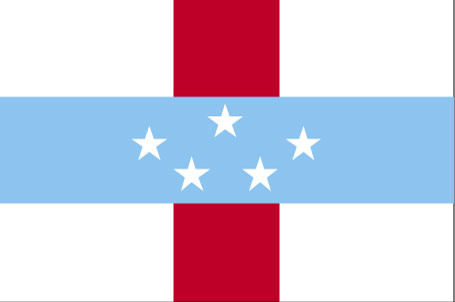
- Flag Symbolism
- white, with a horizontal blue stripe in the center superimposed on a vertical red band, also centered; five white, five-pointed stars are arranged in an oval pattern in the center of the blue band; the five stars represent the five main islands of Bonaire, Curacao, Saba, Sint Eustatius, and Sint Maarten
- Flag History
- The colors are based on those of the Netherlands flag. The blue represents the Caribbean and the stars stand for the five constituent parts of the Netherlands Antilles: Caracao and Bonaire off the coast of Venezuela, St. marten, St. Eustatius and Saba in the leeward Islands.
- Date of Adoption
- 1 January 1986
National Anthem
- Anthem History
- part of the Kingdom of the Netherlands