
 English
 Español
 中文
中文 हिन्दी
 Français
Government and Politics
Government and Politics of Nauru
Government structure, leadership, capital, military, and national symbols of Nauru.
Government Structure
Constitutional foundations, branches, parties, and leadership.
- Government Type
- republic
- Administrative Divisions
- 14 districts; Aiwo, Anabar, Anetan, Anibare, Baiti, Boe, Buada, Denigomodu, Ewa, Ijuw, Meneng, Nibok, Uaboe, Yaren
- Legal System
- acts of the Nauru Parliament and British common law
- Suffrage
- 20 years of age; universal and compulsory
- Executive Branch
- chief of state: President David ADEANG (since 30 October 2023); note - the president is both the chief of state and head of government head of government: President David ADEANG (since 30 October 2023); note - the president is both the chief of state and head of government cabinet: Cabinet appointed by the president from among the members of Parliament elections: president elected by Parliament for a three-year term; election last held 24 September 2022 (next to be held in 2025) election results: David ADEANG was elected president by Parliament following the resignation of Russ KUN in October 2023
- Legislative Branch
- Unicameral Parliament (19 seats; members elected by popular vote to serve three-year terms) Elections: last held on 24 September 2022 (next to be held in 2025) Election results: percent of vote - NA%; seats - independents 19 (no formal party representation currently holds seats)
- Judicial Branch
- Supreme Court
- Political Parties
- loose multiparty system; Democratic Party [Kennan ADEANG]; Nauru Party (informal) [leader NA]; Nauru First (Naoero Amo) Party [leader NA]
- Head of State
- President David ADEANG
- Head of Government
- President David ADEANG
- Cabinet
- Cabinet appointed by the president from among the members of Parliament
- Elections
- last held on 24 September 2022 (next to be held in 2025)
- Election Results
- Percent of vote - NA%; seats by party - independents 19. Nauru's Parliament consists of 19 seats, all held by independent members, as the country has no formal political parties. Candidates run on the basis of personal and clan affiliations rather than party platforms. Following the most recent legislative elections, David Adeang was elected President by Parliament, continuing the nation's tradition of consensus-based governance among independently elected representatives.
- Constitution
- 29-Jan-68
- Independence
- 31 January 1968 (from the Australia-, NZ-, and UK-administered UN trusteeship)
- National Holiday
- Independence Day, 31 January (1968)
- International Organization Participation
- ACP, AsDB, C, FAO, ICAO, ICCt, Interpol, IOC, ITU, OPCW, PIF, Sparteca, SPC, UN, UNCTAD, UNESCO, UPU, WHO
- Diplomatic Representation in the U.S.
- chief of mission: Ambassador Vinci Niel CLODUMAR chancery: 800 2nd Avenue, Suite 400 D, New York, NY 10017 telephone: [1] (212) 937-0074 FAX: [1] (212) 937-0079 consulate(s): Agana (Guam)
- U.S. Diplomatic Representation
- the US does not have an embassy in Nauru; the US Ambassador to Fiji is accredited to Nauru
Capital City
Seat of government and political history.
- Capital City
- no official capital; government offices in the Yaren District
- Time Difference
- UTC+12 (17 hours ahead of Washington, DC, during Standard Time)
Embassy and Diplomatic Representation
Embassy location and contact details.
There is no U.S. Embassy or diplomatic post in Nauru. The U.S. Embassy in Fiji provides assistance for U.S. citizens in Nauru. U.S. Embassy Suva 158 Princes Road, Suva, Fiji (679) 331-4466 Emergency after-hours telephone: (679) 772-8049 Facsimile: (679) 330-2267
Military
Branches, service obligations, expenditures, and manpower.
- Military Branches
- no regular military forces
National Symbols
Flag, anthem, and other symbols of national identity.
National Flag
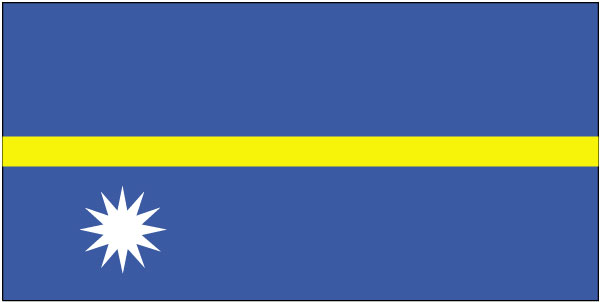
- Flag Symbolism
- blue with a narrow, horizontal, yellow stripe across the center and a large white 12-pointed star below the stripe on the hoist side; the star indicates the country's location in relation to the Equator (the yellow stripe) and the 12 points symbolize the 12 original tribes of Nauru the blue stands for the Pacific Ocean and blue skies. The yellow stands for the Equator and immediately below it lies the island, represented by a white star. Its 12 points symbolize the 12 original tribes of Nauru.
- Date of Adoption
- 31 January 1968
National Anthem
- Anthem Lyrics
- Nauru bwiema, ngabena ma auwe. Ma dedaro bwe dogum, mo otata bet egom. Atsin ngago bwien okor, ama bagadugu Epoa ngabuna ri nan orre bet imur. Ama memag ma nan epodan eredu won engiden, Miyan aema ngeiyin ouge, Nauru eko dogin!
- Anthem Lyrics (English)
- Nauru our homeland, the land we dearly love, We all pray for you and we also praise your name. Since long ago you have been the home of our great forefathers And will be for generations yet to come. We all join in together and say; Nauru for evermore!