
 English
 Español
 中文
中文 हिन्दी
 Français
Government and Politics
Government and Politics of Korea, North
Government structure, leadership, capital, military, and national symbols of Korea, North.
Government Structure
Constitutional foundations, branches, parties, and leadership.
- Government Type
- Communist state one-man dictatorship
- Administrative Divisions
- 9 provinces (do, singular and plural) and 4 special cities* (si, singular and plural); Chagang-do (Chagang Province), Hamgyong-bukto (North Hamgyong Province), Hamgyong-namdo (South Hamgyong Province), Hwanghae-bukto (North Hwanghae Province), Hwanghae-namdo (South Hwanghae Province), Kaesong-si* (Kaesong City), Kangwon-do (Kangwon Province), Najin Sonbong-si*, Namp'o-si* (Namp'o City), P'yongan-bukto (North P'yongan Province), P'yongan-namdo (South P'yongan Province), P'yongyang-si* (Pyongyang City), Yanggang-do (Yanggang Province)
- Legal System
- based on German civil law system with Japanese influences and Communist legal theory; no judicial review of legislative acts; has not accepted compulsory ICJ jurisdiction
- Suffrage
- 17 years of age; universal
- Citizenship
- citizenship by birth: no citizenship by descent only: at least one parent must be a citizen of North Korea dual citizenship recognized: no residency requirement for naturalization: unknown
- Executive Branch
- chief of state: KIM Jong Un (since December 2011); KIM Jong Un serves as General Secretary of the Korean Workers' Party and President of the State Affairs Commission, the position recognized as the nation's highest office; KIM Jong Un assumed full control following the death of his father, KIM Jong Il, in December 2011 and has consolidated authority across party, state, and military structures; CHOE Ryong Hae serves as President of the Presidium of the Supreme People's Assembly, nominally responsible for representing the state and receiving diplomatic credentials head of government: Premier KIM Tok Hun (since August 2020); multiple Vice Premiers assist in overseeing state administrative functions under the Cabinet cabinet: Naegak (cabinet) members, except for the Minister of National Defense, are appointed by the Supreme People's Assembly (SPA) elections: KIM Jong Un faces no electoral competition; SPA deputies are elected every five years in single-candidate elections; last SPA elections held in March 2019 (next scheduled for 2024) election results: all candidates for the SPA ran unopposed with officially reported approval rates near 100 percent; leadership positions within the state and party are determined through party processes rather than competitive elections
- Legislative Branch
- Unicameral Supreme People's Assembly or Ch'oego Inmin Hoeui (687 seats; members elected by popular vote to serve five-year terms) Elections: Last held on March 10, 2019 (next to be held in 2024) Election results: Percent of vote by party — NA; seats by party — NA; the ruling Korean Workers' Party approves a single list of candidates who are elected without opposition and with an officially reported 100% turnout; some seats are held by minor parties including the Korean Social Democratic Party and the Chondoist Chongu Party
- Judicial Branch
- Central Court (judges are elected by the Supreme People's Assembly)
- Political Parties
- major party - Korean Workers' Party or KWP [KIM Jong Il, general secretary]; minor parties - Chondoist Chongu Party [RYU Mi Yong, chairwoman] (under KWP control); Social Democratic Party [KIM Yong Dae, chairman] (under KWP control)
- Head of State
- KIM Jong Un (since December 2011)
- Head of Government
- Premier KIM Tok Hun (since August 2020)
- Cabinet
- Naegak (cabinet) members, except for Minister of People’s Armed Forces, are appointed by SPA
- Elections
- Last held on March 10, 2019 (next to be held in 2024)
- Election Results
- Percent of vote by party — NA; seats by party — NA; the ruling Korean Workers' Party controls all meaningful political activity and approves a single list of candidates who run unopposed, with officially reported 100% voter turnout and unanimous approval. Elections to the Supreme People's Assembly are held every five years and serve as a ceremonial affirmation of state authority rather than a competitive democratic process. A limited number of seats are nominally held by minor parties, including the Korean Social Democratic Party and the Chondoist Chongu Party, both of which operate under the umbrella of the Democratic Front for the Reunification of the Fatherland and pose no political challenge to the Korean Workers' Party.
- Constitution
- adopted 1948, completely revised 27 December 1972, revised again in April 1992 and September 1998
- Independence
- 15 August 1945 (from Japan)
- National Holiday
- Founding of the Democratic People's Republic of Korea (DPRK), 9 September (1948)
- International Organization Participation
- ARF, FAO, G-77, ICAO, ICRM, IFAD, IFRCS, IHO, IMO, IOC, ISO, ITU, NAM, UN, UNCTAD, UNESCO, UNIDO, UPU, WFTU, WHO, WIPO, WMO, WToO
- Diplomatic Representation in the U.S.
- none; North Korea has a Permanent Mission to the UN in New York
- U.S. Diplomatic Representation
- none; note - Swedish Embassy in Pyongyang represents the US as consular protecting power
Capital City
Seat of government and political history.
- Capital City
- Pyongyang
- Location
- 39 01 N, 125 45 E
- Time Difference
- UTC+9 (14 hours ahead of Washington, DC, during Standard Time) time zone note: on 5 May 2018, North Korea reverted to UTC+9, the same time zone as South Korea
- History
- the name translates as "flat land" in Korean
Embassy and Diplomatic Representation
Embassy location and contact details.
North Korea does not have an embassy in the United States. U.S. citizens and residents planning to travel to North Korea may obtain DPRK visas at the DPRK Embassy in Beijing, China, which will issue visas only upon authorization from the DPRK Foreign Ministry in Pyongyang. Before departing for China, you may wish to contact the DPRK Embassy in Beijing to confirm it has received authorization from Pyongyang to issue you a visa. The Embassy of the Democratic People's Republic of Korea in Beijing No. 11, Ritan Bei Lu, Jianguomen Wai, Chaoyang District Beijing, China 100600 Telephone: (86-10) 6532-6639 (Visa Office) Telephone: (86-10) 65312-1186 Facsimile: (86-10) 6532-6056 If you wish to ask the DPRK whether your application for a visa would be approved, you may address your inquiry to the Permanent Representative of the Democratic People's Republic of Korea to the United Nations in New York. The Permanent Representative of the Democratic People’s Republic of Korea to the United Nations 820 Second Avenue New York, NY 10017 Telephone: (212) 972-3105 Facsimile: (212) 972-3154 If you live abroad in a country with diplomatic relations with the DPRK, you could ask the DPRK embassy in that country for visa advice. The Embassy of Sweden (U.S. Protecting Power): Swedish Embassy (U.S. Protecting Power) Munsu-Dong District Pyongyang, DPRK Telephone: (850-2) 3817 485 (reception) Telephone: (850-2) 3817 904, (850-2) 3817 907 (Deputy) Telephone: (850-2) 3817 908, (850-2) 3817 905 (Ambassador) Facsimile: (850-2) 3817 663 Email: ambassaden.pyongyang@gov.se U.S. Embassy Beijing: The Embassy is located near the Ladies' Street (Nuren Jie) and Laitai Flower Market, opposite the Kempinski Hotel and Lufthansa shopping Center. U.S. Embassy Beijing American Citizens Services Unit No. 55 An Jia Lou Road Chaoyang District Beijing, China 100600 Telephone: (86-10) 8531-4000 Facsimile: (86-10) 8531-3300 Email: beijingacs@state.gov Emergency after-hours telephone: (86-10) 8531-4000 U.S. Embassy Seoul: The Embassy is located across the street from Sejong Cultural Center and next to the Ministry of Information and Communication/KT Building. U. S. Embassy Seoul American Citizen Services Unit 188 Sejong Daero, Jongno-gu Seoul, Republic of Korea Telephone: (82-2) 397-4114 Facsimile: (82-2) 2-397-4101 E-mail: seoulinfo@state.gov Emergency after-hours telephone: (82-2) 397-4114
Military
Branches, service obligations, expenditures, and manpower.
- Military Branches
- North Korean People's Army: Ground Forces, Navy, Air Force; civil security forces
- Service Age and Obligation
- 18 is presumed to be the legal minimum age for compulsory military service; 16-17 is the presumed legal minimum age for voluntary service
National Symbols
Flag, anthem, and other symbols of national identity.
National Flag
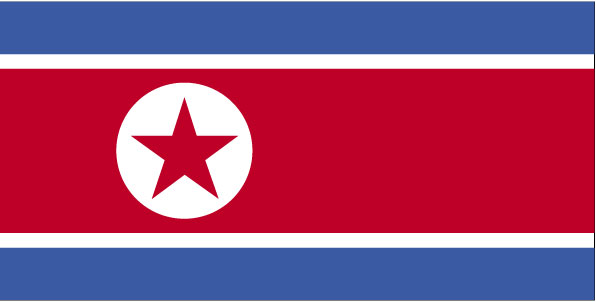
- Flag Symbolism
- three horizontal bands of blue (top), red (triple width), and blue; the red band is edged in white; on the hoist side of the red band is a white disk with a red five-pointed star the red symbolizes revolutionary patriotism and the fighting spirit. The star symbolizes the reolutionary traditions established by President Kim Il Sung. The white stands for the Korean nation and its culture. The blue stripes symbolize “the aspiration of the Korean people to unite with the revolutionary people of the whole world and fight for the victory of the idea of independence, friendship and peace”.
- Date of Adoption
- 8 September 1948
National Anthem
- Anthem Lyrics
- Patriotic Song A ch'im un pinnara i kangsan Ungum e, chawon do kaduk han Samch'olli, arumdaun nae choguk, Panmannyon oraen ryoksa e. Ch'allan han munhwa ro charanan Sulgiroun inmin ui i yonggwang: Momgwa mam ta pach'yo, i, choson Kiri pattuse. Ch'alse. Paektusan Kisang ul ta anko. Kullo ui chongsin un kitturo. Chilli ro mungch 'yo jin oksen ttut On segye apso nagari. Sonnun him nodo do naemiro, Inmin ui ttus uro son nara. Han opsi pugang hanun I choson kiri pinnaese.
- Anthem Lyrics (English)
- Let morning shine on the silver and gold of this land, Three thousand leagues packed with natural wealth. My beautiful fatherland. The glory of a wise people Brought up in a culture brilliant With a history five millennia long. Let us devote our bodies and minds To supporting this Korea for ever. The firm will, bonded with truth, Nest for the spirit of labour, Embracing the atmosphere of Mount Paektu, Will go forth to all the world. The country established by the will of the people, Breasting the raging waves with soaring strength. Let us glorify for ever this Korea, Limitlessly rich and strong.
- Anthem History
- This Communist nation adopted a new anthem upon its creation at the start of the cold war in 1947, simply titled "Patriotic Song". The words are by Pak Se Yong It has been in use since 1947 The music is by Kim Won Gyun
Other National Symbols
National Flower
Kimjongilia