
 English
 Español
 中文
中文 हिन्दी
 Français
Government and Politics
Government and Politics of Japan
Government structure, leadership, capital, military, and national symbols of Japan.
Government Structure
Constitutional foundations, branches, parties, and leadership.
- Government Type
- constitutional monarchy with a parliamentary government
- Administrative Divisions
- 47 prefectures; Aichi, Akita, Aomori, Chiba, Ehime, Fukui, Fukuoka, Fukushima, Gifu, Gumma, Hiroshima, Hokkaido, Hyogo, Ibaraki, Ishikawa, Iwate, Kagawa, Kagoshima, Kanagawa, Kochi, Kumamoto, Kyoto, Mie, Miyagi, Miyazaki, Nagano, Nagasaki, Nara, Niigata, Oita, Okayama, Okinawa, Osaka, Saga, Saitama, Shiga, Shimane, Shizuoka, Tochigi, Tokushima, Tokyo, Tottori, Toyama, Wakayama, Yamagata, Yamaguchi, Yamanashi
- Legal System
- modeled after European civil law system with English-American influence; judicial review of legislative acts in the Supreme Court; accepts compulsory ICJ jurisdiction with reservations
- Suffrage
- 20 years of age; universal
- Citizenship
- citizenship by birth: no citizenship by descent only: at least one parent must be a citizen of Japan dual citizenship recognized: no residency requirement for naturalization: 5 years
- Executive Branch
- chief of state: Emperor NARUHITO (since 1 May 2019); note: Emperor NARUHITO ascended to the Chrysanthemum Throne following the abdication of his father, Emperor AKIHITO, who became the first Japanese emperor to abdicate in roughly 200 years head of government: Prime Minister ISHIBA Shigeru (since 1 October 2024) cabinet: Cabinet appointed by the prime minister elections: Diet designates prime minister; constitution requires that the prime minister command a parliamentary majority; following legislative elections, the leader of the majority party or majority coalition in the House of Representatives usually becomes prime minister; monarch is hereditary
- Legislative Branch
- bicameral Diet or Kokkai consists of the House of Councillors or Sangi-in (248 seats - members elected for six-year terms; half reelected every three years; 148 members in multi-seat constituencies and 100 by proportional representation) and the House of Representatives or Shugi-in (465 seats - members elected for four-year terms; 289 in single-seat constituencies; 176 members by proportional representation in 11 regional blocs) elections: House of Councillors - last held 10 July 2022 (next to be held in July 2025); House of Representatives - last held 27 October 2024 (next election by October 2028) election results: House of Councillors - percent of vote by party - NA; seats by party following 2022 election - LDP 119, CDP 39, Ishin 21, Komeito 18, DPP 11, JCP 11, Reiwa 5, SDP 1, others 23 : House of Representatives - percent of vote by party - LDP 26.7%, CDP 21.9%, Ishin 9.2%, DPP 11.3%, Komeito 5.2%, others 25.7%; seats by party following 2024 election - LDP 191, CDP 148, Ishin 38, DPP 28, Komeito 24, Yuishikai 12, Reiwa 9, JCP 8, SDP 1, others 6 (2024)
- Judicial Branch
- Supreme Court (chief justice is appointed by the monarch after designation by the cabinet; all other justices are appointed by the cabinet) )
- Political Parties
- Democratic Party of Japan or DPJ [Seiji MAEHARA, president; Yukio HATOYAMA, secretary general]; Japan Communist Party or JCP [Kazuo SHII, chairman; Tadayoshi ICHIDA, head of secretariat]; Komeito [Takenori KANZAKI, chief representative; Tetsuzo FUYUSHIBA, secretary general]; Liberal Democratic Party or LDP [Junichiro KOIZUMI, president; Tsutomu TAKEBE, secretary general]; Social Democratic Party or SDP [Mizuho FUKUSHIMA, chairperson; Seiji MATAICHI, secretary general]
- Head of State
- Emperor NARUHITO
- Head of Government
- Prime Minister ISHIBA Shigeru
- Cabinet
- Cabinet appointed by the prime minister
- Elections
- House of Councillors - last held 10 July 2022 (next to be held in July 2025); House of Representatives - last held 27 October 2024 (next election by October 2028)
- Election Results
- House of Councillors - percent of vote by party - NA; seats by party following 2022 election - LDP 119, CDP 39, Ishin 21, Komeito 18, DPP 11, JCP 11, Reiwa 5, SDP 1, others 23 House of Representatives - percent of vote by party - LDP 26.7%, CDP 21.9%, Ishin 9.2%, DPP 11.3%, Komeito 5.2%, others 25.7%; seats by party following October 2024 election - LDP 191, CDP 148, Ishin 38, DPP 28, Komeito 24, Yuishikai 12, Reiwa 9, JCP 8, SDP 1, others 6 (2024)
- Constitution
- Enacted May 3, 1947
- Independence
- 660 BC (traditional founding by Emperor Jimmu)
- National Holiday
- Birthday of Emperor AKIHITO, 23 December (1933)
- International Organization Participation
- AfDB, APEC, ARF, AsDB, ASEAN (dialogue partner), Australia Group, BIS, CE (observer), CERN (observer), CP, EBRD, FAO, G-5, G-7, G-8, G-10, IADB, IAEA, IBRD, ICAO, ICC, ICFTU, ICRM, IDA, IEA, IFAD, IFC, IFRCS, IHO, ILO, IMF, IMO, Interpol, IOC, IOM, ISO, ITU, NAM (guest), NEA, NSG, OAS (observer), OECD, OPCW, OSCE (partner), Paris Club, PCA, UN, UNCTAD, UNDOF, UNESCO, UNHCR, UNIDO, UNITAR, UNMISET, UNMOVIC, UNRWA, UPU, WCL, WCO, WFTU, WHO, WIPO, WMO, WToO, WTrO, ZC
- Diplomatic Representation in the U.S.
- chief of mission: Ambassador Ryozo KATO chancery: 2520 Massachusetts Avenue NW, Washington, DC 20008 telephone: [1] (202) 238-6700 FAX: [1] (202) 328-2187 consulate(s) general: Atlanta, Boston, Chicago, Denver, Detroit, Agana (Guam), Honolulu, Houston, Los Angeles, Miami, New Orleans, New York, Portland (Oregon), San Francisco, Seattle consulate(s): Anchorage, Saipan (Northern Mariana Islands)
- U.S. Diplomatic Representation
- chief of mission: Ambassador J. Thomas SCHIEFFER embassy: 1-10-5 Akasaka, Minato-ku, Tokyo 107-8420 mailing address: Unit 45004, Box 258, APO AP 96337-5004 telephone: [81] (03) 3224-5000 FAX: [81] (03) 3505-1862 consulate(s) general: Naha (Okinawa), Osaka-Kobe, Sapporo consulate(s): Fukuoka, Nagoya
Capital City
Seat of government and political history.
- Capital City
- Tokyo
- Location
- 35 41 N, 139 45 E
- Time Difference
- UTC+9 (14 hours ahead of Washington, DC, during Standard Time)
- History
- originally known as Edo, meaning "estuary" in Japanese, the name was changed to Tokyo, meaning "eastern capital," in 1868
Embassy and Diplomatic Representation
Embassy location and contact details.
U.S. Embassy in Tokyo 1-10-5 Akasaka, Minato-ku, Tokyo 107-8420 Japan Telephone: 81-3-3224-5000 Emergency after-hours telephone: 81-3-3224-5000 Facsimile: 81-3-3224-5856 U.S. Consulate General in Osaka-Kobe 2-11-5 Nishitenma, Kita-ku, Osaka 530-8543 Telephone: 81-6-6315-5900 Emergency after-hours telephone: 81-6-6315-5900 Facsimile: 81-6-6315-5914 U.S. Consulate General in Naha 2-1-1 Toyama, Urasoe, Okinawa 901-2104 Telephone: 81-98-876-4211 Emergency after-hours telephone: 81-3-3224-5000 (Emergency calls are routed through the Embassy switchboard after hours) Facsimile: 81-98-876-4243 U.S. Consulate General in Sapporo Kita 1-Jo Nishi 28-chome, Chuo-ku, Sapporo 064-0821 Telephone: 81-11-641-1115 Emergency after-hours telephone: 81-11-641-1115 Facsimile: 81-11-643-1283. U.S. Consulate in Fukuoka 2-5-26 Ohori, Chuo-ku, Fukuoka 810-0052 Telephone: 81-92-751-9331 Emergency after-hours telephone: 81-3-3224-5000 (Emergency calls are routed through the Embassy switchboard after hours) Facsimile: 81-92-713-9222 U.S. Consulate in Nagoya Nagoya International Center Bldg. 6th floor, 1-47-1 Nagono, Nakamura-ku, Nagoya 450-0001 Telephone: 81-52-581-4501 Emergency after-hours telephone: 81-52-581-4501 Facsimile: 81-52-581-3190.
Military
Branches, service obligations, expenditures, and manpower.
- Military Branches
- Japanese Ministry of Defense (MOD): Ground Self-Defense Force (Rikujou Jieitai, GSDF); Maritime Self-Defense Force (Kaijou Jieitai, MSDF); Air Self-Defense Force (Koukuu Jieitai, ASDF)
- Service Age and Obligation
- 18 years of age for voluntary military service; no conscription; mandatory retirement at age 53 for senior enlisted personnel and at 62 years for senior service officers
National Symbols
Flag, anthem, and other symbols of national identity.
National Flag
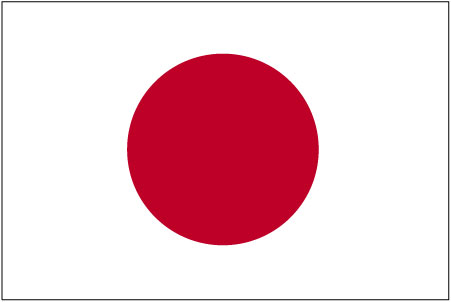
- Flag Symbolism
- white with a large red disk (representing the sun without rays) in the center
- Flag History
- The flag is called Hinomary (disk of the sun). The sun recalls the name of Japan (the Land of the Rising Sun) and worship of Amaterasu Omikami (the Sun Goddess), the most venerated goddess in the Shinto religion. The colors also reflect the spirit of Shinto ethis bast on a bright, pure, and just gentle heart. White is for purity and integrity, red for sincerity, brightness and warmth.
- Date of Adoption
- 13 August 1999
National Anthem
- Anthem Lyrics (English)
- Thousands of years of happy reign be thine; Rule on, my lord, till what are pebbles now By age united to mighty rocks shall grow Who's venerable sides the moss doth line.
Other National Symbols
National Flower
cherry blossom, chrysanthemum
cherry blossom - Its flowers are nearly pure white, tinged with the palest pink, especially near the stem. <br> chrysanthemum -growing to 50-150 cm tall, with deeply lobed leaves and large flowerheads, white, yellow or pink in the wild species.
National Tree
Cherry blossom