
 English
 Español
 中文
中文 हिन्दी
 Français
Government and Politics
Government and Politics of Ireland
Government structure, leadership, capital, military, and national symbols of Ireland.
Government Structure
Constitutional foundations, branches, parties, and leadership.
- Government Type
- republic
- Administrative Divisions
- 26 counties; Carlow, Cavan, Clare, Cork, Donegal, Dublin, Galway, Kerry, Kildare, Kilkenny, Laois, Leitrim, Limerick, Longford, Louth, Mayo, Meath, Monaghan, Offaly, Roscommon, Sligo, Tipperary, Waterford, Westmeath, Wexford, Wicklow
- Legal System
- based on English common law, substantially modified by indigenous concepts; judicial review of legislative acts in Supreme Court; has not accepted compulsory ICJ jurisdiction
- Suffrage
- 18 years of age; universal
- Citizenship
- citizenship by birth: no, unless a parent of a child born in Ireland has been legally resident in Ireland for at least three of the four years prior to the birth of the child citizenship by descent only: yes dual citizenship recognized: yes residency requirement for naturalization: 4 of the previous 8 years
- Executive Branch
- chief of state: President Michael D. HIGGINS (since 11 November 2011; reelected for a second term on 26 October 2018) head of government: Prime Minister (Taoiseach) Micheál MARTIN (since 9 April 2025); note - Simon HARRIS served as Taoiseach from April 2024 until April 2025 following the formation of a new coalition government after the November 2024 general election cabinet: Cabinet appointed by the president with previous nomination by the prime minister and approval of the House of Representatives (Dáil Éireann) elections: president elected by popular vote for a seven-year term; election last held on 26 October 2018 (next scheduled for October 2025); prime minister nominated by the House of Representatives and appointed by the president election results: Michael D. HIGGINS reelected president in 2018; percent of vote - Michael D. HIGGINS 55.8%, Peter CASEY 23.3%, Seán GALLAGHER 6.4%, Liadh NÍ RIADA 6.4%, Joan FREEMAN 6.0%, Gavin DUFFY 2.2% note: current government coalition consists of Fianna Fáil, Fine Gael, and the Green Party, formed following the 2020 general election; a new coalition of Fianna Fáil, Fine Gael, and independent members was formed in 2025 following the November 2024 general election
- Legislative Branch
- Bicameral Parliament or Oireachtas consists of the Senate or Seanad Éireann (60 seats — 43 elected by vocational panels, 6 elected by university graduates, and 11 nominated by the Taoiseach; members serve five-year terms) and the House of Representatives or Dáil Éireann (160 seats; members are elected by popular vote on the basis of proportional representation using the single transferable vote to serve five-year terms). Elections: Senate — last held in April 2020 (next to be held by 2025); House of Representatives — last held on 29 November 2024 (next to be held by 2029). Election results: Senate — percent of vote by party — NA; seats by party — Fianna Fáil 16, Fine Gael 12, Sinn Féin 7, Green Party 4, Labour Party 4, independents and others 17; House of Representatives — percent of vote by party — Fianna Fáil 21.9%, Fine Gael 20.9%, Sinn Féin 24.1%, Labour Party 4.3%, Social Democrats 4.8%, Green Party 1.9%, others and independents 22.1%; seats by party — Fianna Fáil 48, Fine Gael 38, Sinn Féin 39, Labour Party 9, Social Democrats 11, Green Party 1, Independents and others 14.
- Judicial Branch
- Supreme Court (judges appointed by the president on the advice of the prime minister and cabinet)
- Political Parties
- Fianna Fail [Bertie AHERN]; Fine Gael [Enda KENNY]; Green Party [Trevor SARGENT]; Labor Party [Pat RABITTE]; Progressive Democrats [Mary HARNEY]; Sinn Fein [Gerry ADAMS]; Socialist Party [Joe HIGGINS]; The Workers' Party [Sean GARLAND]
- Head of State
- President Michael D. HIGGINS (since 11 November 2011
- Head of Government
- Prime Minister (Taoiseach) Micheál MARTIN
- Cabinet
- Cabinet appointed by the president with previous nomination by the prime minister and approval of the House of Representatives
- Elections
- Senate — last held in April 2020 (next to be held by 2025); House of Representatives — last held on 29 November 2024 (next to be held by 2029).
- Election Results
- Senate — percent of vote by party — NA; seats by party — Fianna Fáil 21, Fine Gael 17, Sinn Féin 9, Labour Party 5, Green Party 1, independents and others 7; House of Representatives — percent of vote by party — Fianna Fáil 21.9%, Fine Gael 20.9%, Sinn Féin 24.1%, Labour Party 4.3%, Social Democrats 4.8%, Green Party 1.9%, others and independents 22.1%; seats by party — Fianna Fáil 48, Fine Gael 38, Sinn Féin 39, Labour Party 9, Social Democrats 11, Green Party 1, Independents and others 14. Note: Following the November 2024 general election, updated seat allocations are pending final government formation; Fianna Fáil and Fine Gael are projected to form a coalition government, with Fianna Fáil winning approximately 48 seats and Fine Gael approximately 38 seats, while Sinn Féin saw a reduced return compared to its strong showing in 2020.
- Constitution
- 29 December 1937; adopted 1 July 1937 by plebiscite
- Independence
- 6 December 1921 (from UK by treaty)
- National Holiday
- Saint Patrick's Day, 17 March
- International Organization Participation
- Australia Group, BIS, CE, EAPC, EBRD, EIB, EMU, ESA, EU, FAO, IAEA, IBRD, ICAO, ICC, ICCt, ICFTU, ICRM, IDA, IEA, IFAD, IFC, IFRCS, ILO, IMF, IMO, Interpol, IOC, IOM, ISO, ITU, MINURSO, MONUC, NAM (guest), NEA, NSG, OAS (observer), OECD, OPCW, OSCE, Paris Club, PCA, PFP, UN, UNCTAD, UNESCO, UNFICYP, UNHCR, UNIDO, UNIFIL, UNMIL, UNMISET, UNTSO, UPU, WCO, WEU (observer), WHO, WIPO, WMO, WTrO, ZC
- Diplomatic Representation in the U.S.
- chief of mission: Ambassador Noel FAHEY chancery: 2234 Massachusetts Avenue NW, Washington, DC 20008 telephone: [1] (202) 462-3939 FAX: [1] (202) 232-5993 consulate(s) general: Boston, Chicago, New York, San Francisco
- U.S. Diplomatic Representation
- chief of mission: Ambassador James C. KENNY embassy: 42 Elgin Road, Ballsbridge, Dublin 4 mailing address: use embassy street address telephone: [353] (1) 668-8777 FAX: [353] (1) 668-9946
Capital City
Seat of government and political history.
- Capital City
- Dublin
- Location
- 53 19 N, 6 14 W
- Time Difference
- UTC 0 (5 hours ahead of Washington, DC, during Standard Time)
- History
- derived from Irish dubh and lind meaning respectively "black, dark" and "pool" and which referred to the dark tidal pool where the River Poddle entered the River Liffey; today the area is the site of the castle gardens behind Dublin Castle
Embassy and Diplomatic Representation
Embassy location and contact details.
U.S. Embassy Dublin 42 Elgin Road Ballsbridge Dublin 4 Telephone: 353-1-668-8777 Emergency after-hours telephone: 353-1-630-6200 Facsimile: 353-1-668-8056
Military
Branches, service obligations, expenditures, and manpower.
- Military Branches
- Irish Defense Forces (Oglaigh na h-Eireannn), Permanent Defence Force: Army, Naval Service, Air Corps
- Service Age and Obligation
- 18-25 years of age for male and female voluntary military service recruits to the Permanent Defence Forces (PDF; 18-27 years of age for the Naval Service); 18-28 for cadetship (officer) applicants; 18-35 years of age for the Reserve Defence Forces (RDF); maximum obligation 12 years (PDF officers), 5 years (PDF enlisted), 3 years RDF (4 years for Naval Service Reserves); EU citizenship, refugee status, or 5-year residence in Ireland required
National Symbols
Flag, anthem, and other symbols of national identity.
National Flag
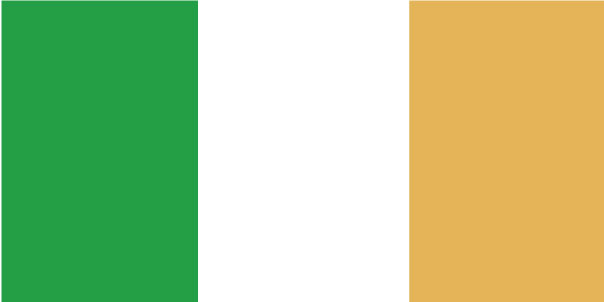
- Flag Symbolism
- three equal vertical bands of green (hoist side), white, and orange; similar to the flag of Cote d'Ivoire, which is shorter and has the colors reversed - orange (hoist side), white, and green; also similar to the flag of Italy, which is shorter and has colors of green (hoist side), white, and red. It is used as the civil and state flag and as the civil and naval ensign.
- Flag History
- The green stripe represents those of native Irish descent (see under the Green Flag below), the orange stripe represents the descendants of 17th-century British colonists (a group which supported William of Orange in the War of the Two Kings), and the white stripe represents the hope for peace between the two groups. Thomas Francis Meagher spoke as follows when presenting the flag to the public for the first time at a meeting organised by the Young Ireland movement in Dublin on 15 April 1848: The white in the centre signifies a lasting truce between the 'Orange' and the 'Green', and I trust that beneath its folds the hands of the Irish Protestant and the Irish Catholic may be clasped in generous and heroic brotherhood. The Green Flag was used by the contemporary supporters of Daniel O'Connell, but the Young Irelanders were republicans and required a distinctive emblem which would clearly express their republicanism: the design of the new flag was modelled on that of the French Republic: The original tricolour (in which orange was placed next to the staff) was virtually forgotten after the collapse of the 1848 rebellion but it was revived by the Irish Volunteers in the Easter rising of 1916 when the colours were arranged in their modern order. Although the Volunteers used the Tricolour and the Green Flag side by side, the two flags came to be associated with the supporters of Sinn Féin and of the Irish Parliamentary Party respectively during the turbulent period following the rising. The landslide victory of the republicans in the general election of 1918 ensured that the Tricolour would be the future national flag.
- Date of Adoption
- 29 December 1937
National Anthem
- Anthem Lyrics
- Amhra/n na bhFiann Seo dhibh a cháirde duan Óglaigh, Cathréimeach briomhar ceolmhar, Ár dtinte cnámh go buacach táid, 'S an spéir go min réaltogach Is fonnmhar faobhrach sinn chun gleo 'S go tiúnmhar glé roimh thíocht do'n ló Fé chiúnas chaomh na hoiche ar seol: Seo libh canaídh Amhrán na bhFiann. Curfá: Sinne Fianna Fáil A tá fé gheall ag Éirinn, buion dár slua Thar toinn do ráinig chugainn, Fé mhóid bheith saor. Sean tír ár sinsir feasta Ní fhagfar fé'n tiorán ná fé'n tráil Anocht a théam sa bhearna bhaoil, Le gean ar Ghaeil chun báis nó saoil Le guna screach fé lámhach na bpiléar Seo libh canaídh Amhrán na bhFiann. Cois bánta réidhe, ar árdaibh sléibhe, Ba bhuachach ár sinsir romhainn, Ag lámhach go tréan fé'n sár-bhrat séin Tá thuas sa ghaoith go seolta Ba dhúchas riamh d'ár gcine cháidh Gan iompáil siar ó imirt áir, 'S ag siúl mar iad i gcoinne námhad Seo libh, canaídh Amhrán na bhFiann. Curfá A bhuíon nách fann d'fhuil Ghaeil is Gall, Sin breacadh lae na saoirse, Ta scéimhle 's scanradh i gcroíthe namhad, Roimh ranna laochra ár dtire. Ár dtinte is tréith gan spréach anois, Sin luisne ghlé san spéir anoir, 'S an bíobha i raon na bpiléar agaibh: Seo libh, canaídh Amhrán na bhFiann. Curfá
- Anthem Lyrics (English)
- Soldier's Song We'll sing song, a soldier's song, With cheering rousing chorus, As round our blazing fires we throng, The starry heavens o'er us; Impatient for the coming fight, And as we wait the morning's light, Here in the silence of the night, We'll chant a soldier's song. Chorus: Soldiers are we whose lives are pledged to Ireland; Some have come from a land beyond the wave. Sworn to be free, No more our ancient sire land Shall shelter the despot or the slave. Tonight we man the gap of danger In Erin's cause, come woe or weal 'Mid cannons' roar and rifles peal, We'll chant a soldier's song In valley green, on towering crag, Our fathers fought before us, And conquered 'neath the same old flag That's proudly floating o'er us. We're children of a fighting race, That never yet has known disgrace, And as we march, the foe to face, We'll chant a soldier's song Chorus Sons of the Gael! Men of the Pale! The long watched day is breaking; The serried ranks of Inisfail Shall set the Tyrant quaking. Our camp fires now are burning low; See in the east a silv'ry glow, Out yonder waits the Saxon foe, So chant a soldier's song. Chorus
Other National Symbols
National Flower
shamrock (or trefoil)
a three-leaved young white clover, sometimes (rarely nowadays) Trifolium repens (white clover, known in Irish as seamair bhán) but more usually today Trifolium dubium (lesser clover, Irish: seamair bhuí). However, other three leafed plants such as Black medick (Medicago lupulina), Red clover (Trifolium pratense) or Wood Sorrel (Oxalis acetosella) are sometimes designated as shamrocks. The shamrock was traditionally used for its medical properties and was a popular motif in Victorian times.