
 English
 Español
 中文
中文 हिन्दी
 Français
Government and Politics
Government and Politics of Equatorial Guinea
Government structure, leadership, capital, military, and national symbols of Equatorial Guinea.
Government Structure
Constitutional foundations, branches, parties, and leadership.
- Government Type
- republic
- Administrative Divisions
- 7 provinces (provincias, singular - provincia); Annobon, Bioko Norte, Bioko Sur, Centro Sur, Kie-Ntem, Litoral, Wele-Nzas
- Legal System
- partly based on Spanish civil law and tribal custom
- Suffrage
- 18 years of age; universal adult
- Citizenship
- Citizenship by birth: No Citizenship by descent only: At least one parent must be a citizen of Equatorial Guinea Dual citizenship recognized: No Residency requirement for naturalization: 10 years
- Executive Branch
- chief of state: President Teodoro OBIANG NGUEMA MBASOGO (since 3 August 1979, when he seized power in a military coup ousting his uncle, Francisco Macías Nguema) head of government: Prime Minister Manuela ROKA BOTEY (since 1 February 2023), the first woman to hold the position; First Deputy Prime Minister Clemente ENGONGA NGUEMA ONGUENE (since 2023) cabinet: Council of Ministers appointed by the president elections: president elected by popular vote for a seven-year term; election last held on 20 November 2022 (next to be held in 2029); prime minister and deputy prime ministers appointed by the president election results: Teodoro OBIANG NGUEMA MBASOGO reelected president; percent of vote - Teodoro OBIANG NGUEMA MBASOGO 94.9%; the election, like previous contests, was criticized by international observers for lacking genuine political competition and transparency
- Legislative Branch
- Equatorial Guinea has a bicameral parliament consisting of the Senate (Senate or Senado) and the House of People's Representatives (Cámara de Representantes del Pueblo). The House of People's Representatives has 100 seats, with members directly elected by popular vote to serve five-year terms. The Senate, established under the 2012 constitutional reforms, has 70 seats, of which 55 are directly elected and 15 are appointed by the president. Elections: The most recent legislative elections were held in November 2022, in which the ruling Democratic Party of Equatorial Guinea (PDGE) and its allied coalition maintained their overwhelming dominance of the legislature. The PDGE and allied parties secured nearly all seats in both chambers, with the Convergence for Social Democracy (CPDS) retaining minimal representation. Note: Despite its bicameral structure, parliament exercises limited independent authority, as the constitution concentrates executive power heavily in the presidency. Political pluralism remains restricted in practice, and opposition parties face significant barriers to meaningful participation in the electoral process.
- Judicial Branch
- Supreme Tribunal
- Political Parties
- Convergence Party for Social Democracy or CPDS [Placido MIKO Abogo]; Democratic Party for Equatorial Guinea or PDGE (ruling party) [Teodoro OBIANG NGUEMA MBASOGO]; Party for Progress of Equatorial Guinea or PPGE [Severo MOTO]; Popular Action of Equatorial Guinea or APGE [Miguel Esono EMAN]; Popular Union or UP [Andres Moises Bda ADA]; Progressive Democratic Alliance or ADP [Victorino Bolekia BONAY]; Union of Independent Democrats of UDI [Daniel OYONO]
- Head of State
- President Teodoro OBIANG NGUEMA MBASOGO (since 3 August 1979, when he seized power in a military coup ousting his uncle, Francisco Macías Nguema)
- Head of Government
- Prime Minister Manuela ROKA BOTEY, the first woman to hold the position
- Cabinet
- Council of Ministers appointed by the president
- Elections
- The most recent legislative elections were held in November 2022, in which the ruling Democratic Party of Equatorial Guinea (PDGE) and its allied coalition maintained their overwhelming dominance of the legislature. The PDGE and allied parties secured nearly all seats in both chambers, with the Convergence for Social Democracy (CPDS) retaining minimal representation. Note: Despite its bicameral structure, parliament exercises limited independent authority, as the constitution concentrates executive power heavily in the presidency. Political pluralism remains restricted in practice, and opposition parties face significant barriers to meaningful participation in the electoral process.
- Election Results
- Equatorial Guinea is a one-party dominant state in which the Democratic Party of Equatorial Guinea (Partido Democrático de Guinea Ecuatorial, or PDGE) has maintained an unbroken grip on political power since 1987. President Teodoro Obiang Nguema Mbasogo, who came to power through a military coup in 1979, has been routinely reelected with margins that international observers have widely characterized as neither free nor fair. In the November 2022 general elections, Obiang was reelected to a seventh term as president, officially receiving approximately 94.9 percent of the vote. His party simultaneously swept the legislative elections, securing an overwhelming majority of seats in both the Chamber of Deputies and the Senate. Opposition parties, which are permitted to exist on paper, are effectively marginalized through legal restrictions, limited access to media, and an environment that discourages genuine political competition. The 2022 elections were conducted without independent international monitoring from major organizations such as the African Union or the European Union, both of which have in prior election cycles raised concerns about the integrity of the electoral process. Domestic civil society organizations face significant constraints on their ability to observe or report on voting procedures. Prior to 2022, Obiang won the 2016 presidential election with an officially reported 93.7 percent of the vote, continuing a pattern of results that analysts and human rights organizations have described as reflecting institutional authoritarianism rather than genuine democratic competition. The PDGE and aligned coalition parties have consistently held near-total control of the national legislature since multiparty elections were formally introduced in 1993. Equatorial Guinea is ranked among the least democratic countries in the world by political freedom indices. While constitutional provisions exist for regular elections and term limits have been formally abolished, the political system functions in practice as a personalist autocracy centered on the Obiang family. Teodoro Obiang's son, Teodorin Obiang, serves as Vice President and is widely regarded as his father's designated successor.
- Constitution
- approved by national referendum 17 November 1991; amended January 1995
- Independence
- 12 October 1968 (from Spain)
- National Holiday
- Independence Day, 12 October (1968)
- International Organization Participation
- ACCT, ACP, AfDB, AU, BDEAC, CEMAC, FAO, FZ, G-77, IBRD, ICAO, ICRM, IDA, IFAD, IFC, IFRCS, ILO, IMF, IMO, Interpol, IOC, ITU, NAM, OAS (observer), OPCW, UN, UNCTAD, UNESCO, UNIDO, UPU, WHO, WIPO, WToO, WTrO (observer)
- Diplomatic Representation in the U.S.
- chief of mission: Ambassador Purificacion ANGUE ONDO chancery: 2020 16th Street NW, Washington, DC 20009 telephone: [1] (202) 518-5700 FAX: [1] (202) 518-5252
- U.S. Diplomatic Representation
- chief of mission: the US ambassador to Cameroon is accredited to Equatorial Guinea embassy: adjacent to the golf course at the base of Mont Febe; note - relocated embassy is opened for limited functions; inquiries should continue to be directed to the US Embassy in Yaounde, Cameroon mailing address: B.P. 817, Yaounde, Cameroon; US Embassy Yaounde, Department of State, Washington, DC 20521-2520 telephone: [237] 220 15 00 FAX: [237] 220 16 20
Capital City
Seat of government and political history.
- Capital City
- Malabo; note - Malabo is on the island of Bioko; some months of the year, the government operates out of Bata on the mainland region.
- Location
- 3 45 N, 8 47 E
- Time Difference
- UTC+1 (6 hours ahead of Washington, DC, during Standard Time)
- History
- Named after King MALABO (Malabo Lopelo Melaka) (1837–1937), the last king of the Bubi, the ethnic group indigenous to the island of Bioko
Embassy and Diplomatic Representation
Embassy location and contact details.
U.S. Embassy Malabo Carretera de Aeropuerto KM-3 (El Paraiso) Apartado 95 Malabo Telephone: 240-333-098-895 Immigrant visa services are provided through the U.S. Embassy in Yaoundé, Cameroon, Avenue Rosa Parks in the Mbankolo Quartier, adjacent to the Mount Febe Golf Club. Mailing Address: P.O. Box 817, Yaounde, Cameroon Telephone: 237-2220-1500 Emergency after-hours telephone: 237-2220-1500 Facsimile: 237-2220-1572
Military
Branches, service obligations, expenditures, and manpower.
- Military Branches
- Equatorial Guinea Armed Forces (FAGE): Equatorial Guinea National Guard (Guardia Nacional de Guinea Ecuatoria, GNGE (Army), with Navy and Air Force
- Service Age and Obligation
- 18 years of age for selective compulsory military service, although conscription is rare in practice; 2-year service obligation; women hold only administrative positions in the Navy
National Symbols
Flag, anthem, and other symbols of national identity.
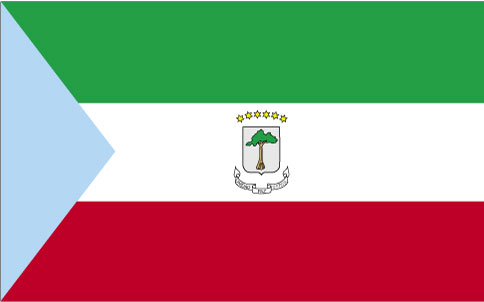
National Flag
- Flag Symbolism
- three equal horizontal bands of green (top), white, and red with a blue isosceles triangle based on the hoist side and the coat of arms centered in the white band; the coat of arms has six yellow six-pointed stars (representing the mainland and five offshore islands) above a gray shield bearing a silk-cotton tree and below which is a scroll with the motto UNIDAD, PAZ, JUSTICIA (Unity, Peace, Justice)
- Flag History
- The blue represents the sea linking the mainland of the country with Bioko and other islands. The color green symbolizes its tropical forests and natural riches, the white stands for peace and the red commemorates the blood shed in the struggle for independence. Then main device of the arms is the tree under which King Bonkoro signed the treaty with Spain in 1843. The six stars represent the six districts of the state.
- Date of Adoption
- 21 August 1979
National Anthem
- Anthem Lyrics
- CORO Salve oh Patria, mil veces! Oh Patria! gloria a ti! Y a tu pecho rebosa gozo y paz, y tu frente radiosa más que el sol contemplamos lucir. ESTROFAS Indignados tus hijos del yugo Cedió al fin la fierezaespañola, que te impuso la ibérica audacia, y hoy, oh Patria, tu libre existencia de la injusta y horrenda desgracia es la noble y magn¡fica herencia que pesaba fatal sobre ti, que nos dio, el heroísmo feliz; santa voz a los cielos alzaron, de las manos paternas la hubimos, voz de noble y sin par juramento, nadie intente arrancárnosla ahora, de vengarte del monstruo sangriento, ni nuestra ira excitar vengadora de romper ese yugo servil. quiera, necio o audaz, contra sí. Los primeros los hijos del suelo Nadie, oh Patria, lo intente. Las sombras que, soberbio; el Pichincha decora de tus héroes gloriosos nos miran, te aclamaron por siempre señora y el valor y el orgullo que inspiran y vertieron su sangre por ti. son augurios de triunfos por ti. Dios miró y aceptó el holocausto, Venga el hierro y el plomo fulmíneo, y esa sangre fue germen fecundo que a la idea de guerra, y venganza de otros héroes que, atónito, el mundo se despierta la heroica pujanza vio en tu torno a millares surgir. que hizo al fiero español sucumbir. De estos héroes al brazo de hierro Y si nuevas cadenas prepara nada tuvo invencible la tierra, la injusticia de bárbarasuerte, y del valle a la altísima sierra gran Pichincha! prevén tú la muerte se escuchaba el fragor de la lid; de la patria y sus hijos al fin; tras la lid la victoria volaba, hunde al punto en tus hondas extrañas libertad tras el triunfo venía, cuando existe en tu tierra: el tirano y al león destrozado se oía huelle sólo cenizas y en vano de impotencia y despecho rugir. busque rastro de ser junto a ti.