
 English
 Español
 中文
中文 हिन्दी
 Français
Government and Politics
Government and Politics of Cote d'Ivoire
Government structure, leadership, capital, military, and national symbols of Cote d'Ivoire.
Government Structure
Constitutional foundations, branches, parties, and leadership.
- Government Type
- republic; multiparty presidential regime established 1960
- Administrative Divisions
- 19 regions; Agneby, Bafing, Bas-Sassandra, Denguele, Dix-Huit Montagnes, Fromager, Haut-Sassandra, Lacs, Lagunes, Marahoue, Moyen-Cavally, Moyen-Comoe, N'zi-Comoe, Savanes, Sud-Bandama, Sud-Comoe, Vallee du Bandama, Worodougou, Zanzan
- Legal System
- based on French civil law system and customary law; judicial review in the Constitutional Chamber of the Supreme Court; has not accepted compulsory ICJ jurisdiction
- Suffrage
- 18 years of age; universal
- Citizenship
- Citizenship by birth: No Citizenship by descent only: At least one parent must be a citizen of Cote d'Ivoire Dual citizenship recognized: No Residency requirement for naturalization: 5 years
- Executive Branch
- chief of state: President Alassane OUATTARA (since 11 April 2011; reelected 31 October 2020) head of government: Prime Minister Robert MAMBE (since 2024); note: the prime minister is appointed by the president cabinet: Council of Ministers appointed by the president elections: president elected by popular vote for a five-year term; election last held on 31 October 2020 (next to be held in 2025); prime minister appointed by the president election results: Alassane OUATTARA reelected president; percent of vote - Alassane OUATTARA 94.3%, Kouadio Konan BERTIN 1.99%, other 3.71%; note: the main opposition parties boycotted the 2020 election
- Legislative Branch
- Cote d'Ivoire has a bicameral Parliament (Parlement) consisting of two chambers: the Senate (Senat) with 99 seats, of which 66 members are indirectly elected by municipal and regional councils and 33 are appointed by the president, serving five-year terms; and the National Assembly (Assemblee Nationale) with 255 seats, whose members are elected by direct popular vote in single- and multi-district constituencies to serve five-year terms. Elections for the National Assembly were last held on March 6, 2021. Election results: seats by party - RHDP 137, PDCI-RDA 50, EDS 23, UDPCI 8, other 21, independents 16. Senate elections were last held on September 16, 2023, with the RHDP winning the majority of indirectly elected seats. The Senate was formally established and began functioning following the adoption of the 2016 constitution, which restructured the country's legislature into its current bicameral form. The president of the National Assembly serves as second in the line of succession to the presidency, while the president of the Senate serves as first in the line of succession.
- Judicial Branch
- Supreme Court or Cour Supreme consists of four chambers: Judicial Chamber for criminal cases, Audit Chamber for financial cases, Constitutional Chamber for judicial review cases, and Administrative Chamber for civil cases; there is no legal limit to the number of members
- Political Parties
- Citizen's Democratic Union or UDCY [Eg Theodore MEL]; Democratic Party of Cote d'Ivoire-African Democratic Rally or PDCI-RDA [Henri Konan BEDIE]; Ivorian Popular Front or FPI [Laurent GBAGBO]; Ivorian Worker's Party or PIT [Francis WODIE]; Rally of the Republicans or RDR [Alassane OUATTARA]; Union for Democracy and Peace or UDPCI [Paul Akoto YAO]; over 20 smaller parties
- Head of State
- President Alassane OUATTARA (since 11 April 2011
- Head of Government
- Prime Minister Robert MAMBE
- Cabinet
- Council of Ministers appointed by the president; note - under the current power-sharing agreement the prime minister and the president share the authority to appoint ministers
- Election Results
- Cote d'Ivoire holds presidential elections every five years under a system that requires a candidate to win an outright majority. If no candidate secures more than 50 percent of the vote in the first round, a runoff election is held between the top two candidates. The 2020 presidential election, held on October 31, saw incumbent President Alassane Ouattara win a controversial third term with approximately 94.27 percent of the vote. The election was marred by a large-scale opposition boycott, with several major opposition candidates withdrawing from the race and urging their supporters not to participate. They argued that Ouattara's candidacy was unconstitutional under the two-term limit established in the 2016 constitution. Ouattara and the Constitutional Council countered that the adoption of the new constitution in 2016 had effectively reset the term count, making his candidacy legally permissible. Voter turnout was reported at around 53.9 percent, though opposition groups disputed the validity of these figures. The period surrounding the election saw outbreaks of civil unrest and intercommunal violence that resulted in dozens of deaths. Prior to that, the 2015 presidential election was seen as a more stable and broadly accepted contest. Ouattara was reelected in the first round with approximately 83.7 percent of the vote, defeating several challengers in an election that international observers generally characterized as peaceful and credible. The most consequential election in the country's recent history was the disputed 2010 presidential runoff between Ouattara and then-incumbent Laurent Gbagbo. International observers certified Ouattara as the winner with roughly 54.1 percent of the vote, but Gbagbo refused to concede. The resulting post-election crisis led to a civil conflict that lasted until April 2011, when Gbagbo was captured with the support of French forces and United Nations peacekeepers. Gbagbo was subsequently transferred to the International Criminal Court, though he was ultimately acquitted in 2019. Legislative elections are held separately for the National Assembly, which consists of 255 seats. Ouattara's Rally of Houphouetists for Democracy and Peace party and its allied coalition have maintained a dominant majority in the legislature in recent electoral cycles.
- Constitution
- 3 November 1960; has been amended numerous times, most recently 27 July 1998
- Independence
- 7 August 1960 (from France)
- National Holiday
- Independence Day, 7 August (1960)
- International Organization Participation
- ACCT, ACP, AfDB, AU, ECOWAS, Entente, FAO, FZ, G-24, G-77, IAEA, IBRD, ICAO, ICCt (signatory), ICFTU, ICRM, IDA, IDB, IFAD, IFC, IFRCS, ILO, IMF, IMO, Interpol, IOC, IOM, ISO, ITU, NAM, OIC, OPCW, UN, UNCTAD, UNESCO, UNHCR, UNIDO, UNMIK, UPU, WADB (regional), WAEMU, WCL, WCO, WFTU, WHO, WIPO, WMO, WToO, WTrO
- Diplomatic Representation in the U.S.
- chief of mission: Ambassador Daouda DIABATE chancery: 2424 Massachusetts Avenue NW, Washington, DC 20008 telephone: [1] (202) 797-0300 FAX: [1] (202) 244-3088
- U.S. Diplomatic Representation
- chief of mission: Ambassador Aubrey HOOKS embassy: Riviera Golf 01, Abidjan mailing address: B. P. 1866, Abidjan 01 telephone: [225] 20 21 09 79 FAX: [225] 20 22 32 59
Capital City
Seat of government and political history.
- Capital City
- Yamoussoukro (legislative capital), Abidjan (administrative capital); note - although Yamoussoukro has been the official capital since 1983, Abidjan remains the administrative capital as well as the officially designated economic capital; the US, like other countries, maintains its Embassy in Abidjan
- Location
- 6 49 N, 5 16 W
- Time Difference
- UTC 0 (5 hours ahead of Washington, DC, during Standard Time)
- History
- Yamoussoukro is named after Queen YAMOUSSOU, who ruled in the village of N'Gokro in 1929 at the time of French colonization; the village was renamed Yamoussoukro, the suffix "-kro" meaning "town" in the native Baoule language; Abidjan's name supposedly comes from a misunderstanding; tradition states that an old man carrying branches met a European explorer who asked for the name of the nearest village; the man, not understanding and terrified by this unexpected encounter, fled shouting "min-chan m’bidjan," which in the Ebrie language means: "I return from cutting leaves"; the explorer, thinking that his question had been answered, recorded the name of the locale as Abidjan; a different version has the first colonists asking native women the name of the place and getting a similar response
Embassy and Diplomatic Representation
Embassy location and contact details.
Embassy Abidjan Address: 01 B.P. 1712 Abidjan 01 Côte d’Ivoire. Telephone: 225-22-49-40-00 Emergency after-hours telephone: 225-22-49-44-50 Facsimile: 225-22-49-42-02 Email: AbjAmcit@state.gov
Military
Branches, service obligations, expenditures, and manpower.
- Military Branches
- Republican Forces of Cote d'Ivoire (Force Republiques de Cote d'Ivoire, FRCI): Army, Navy, Cote d'Ivoire Air Force (Force Aerienne de la Cote d'Ivoire) Note: FRCI is the former Armed Forces of the New Forces (FAFN)
- Service Age and Obligation
- 18-25 years of age for compulsory and voluntary male and female military service; conscription is not enforced; voluntary recruitment of former rebels into the new national army is restricted to ages 22-29
National Symbols
Flag, anthem, and other symbols of national identity.
National Flag
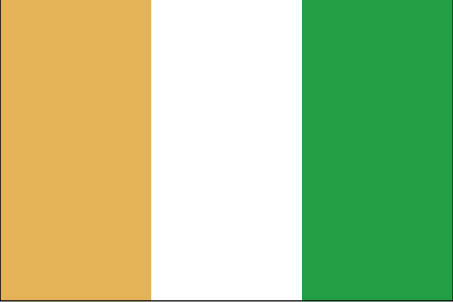
- Flag Symbolism
- three equal vertical bands of orange (hoist side), white, and green; similar to the flag of Ireland, which is longer and has the colors reversed - green (hoist side), white, and orange; also similar to the flag of Italy, which is green (hoist side), white, and red; design was based on the flag of France
- Date of Adoption
- 4 December 1959
National Anthem
- Anthem Lyrics
- L'Abidjanaise (Song of Abidjan) French lyrics Salut ô terre d'espérance; Pays de l'hospitalité. Tes légions remplies de vaillance Ont relevé ta dignité. Tes fils, chère Côte d'Ivoire, Fiers artisans de ta grandeur, Tous rassemblés pour ta gloire Te bâtiront dans le bonheur. Fiers Ivoiriens, le pays nous appelle. Si nous avons dans la paix ramené la liberté, Notre devoir sera d'être un modèle De l'espérance promise à l'humanité, En forgeant, unie dans la foi nouvelle, La patrie de la vraie fraternité.
- Anthem Lyrics (English)
- We salute thee, land of hope, Country of hospitality; Thy gallant legions Have restored thy dignity. Beloved Ivory Coast, thy sons, Proud builders of thy greatness, All gathered together for thy glory, In joy will construct thee. Proud citizens of the Ivory Coast, the country calls us. If we have brought back liberty peacefully, It will be our duty to be an example Of the hope promised to humanity, Forging, united in new faith, The homeland of true brotherhood.
- Anthem History
- It was adopted in 1960 and remains the national anthem, even though the capital city is no longer Abidjan. The words are by Mathieu Ekra, Joachim Bony, and Pierre Marie Coty. Coty also composed the music along with Pierre Michel Pango.