
 English
 Español
 中文
中文 हिन्दी
 Français
Government and Politics
Government and Politics of Colombia
Government structure, leadership, capital, military, and national symbols of Colombia.
Government Structure
Constitutional foundations, branches, parties, and leadership.
- Government Type
- republic; executive branch dominates government structure
- Administrative Divisions
- 32 departments (departamentos, singular - departamento) and 1 capital district* (distrito capital); Amazonas, Antioquia, Arauca, Atlantico, Distrito Capital de Bogota*, Bolivar, Boyaca, Caldas, Caqueta, Casanare, Cauca, Cesar, Choco, Cordoba, Cundinamarca, Guainia, Guaviare, Huila, La Guajira, Magdalena, Meta, Narino, Norte de Santander, Putumayo, Quindio, Risaralda, San Andres y Providencia, Santander, Sucre, Tolima, Valle del Cauca, Vaupes, Vichada
- Legal System
- based on Spanish law; a new criminal code modeled after US procedures was enacted in 1992-93; judicial review of executive and legislative acts; accepts compulsory ICJ jurisdiction, with reservations
- Suffrage
- 18 years of age; universal
- Citizenship
- citizenship by birth: no citizenship by descent only: least one parent must be a citizen or permanent resident of Colombia dual citizenship recognized: yes residency requirement for naturalization: 5 years
- Executive Branch
- chief of state: President Gustavo PETRO Urrego (since 7 August 2022); Vice President Francia MARQUEZ Mina (since 7 August 2022); note - the president is both the chief of state and head of government head of government: President Gustavo PETRO Urrego (since 7 August 2022); Vice President Francia MARQUEZ Mina (since 7 August 2022); note - the president is both the chief of state and head of government cabinet: Cabinet appointed by the president, drawing from a broad coalition that includes members of the Pacto Historico alliance and other allied political movements elections: president and vice president elected by popular vote for a four-year term; a runoff is held if no candidate receives more than 50% of the vote in the first round; election last held on 29 May 2022, with a runoff on 19 June 2022 (next to be held in May 2026) election results: President Gustavo PETRO Urrego won the June 2022 runoff with approximately 50.4% of the vote, defeating Rodolfo HERNANDEZ Suarez; Vice President Francia MARQUEZ Mina was elected on the same ticket
- Legislative Branch
- Bicameral Congress or Congreso consists of the Senate or Senado (108 seats; 100 members elected by popular vote through national constituency, 2 seats reserved for indigenous communities, and 2 additional seats guaranteed to the runner-up presidential candidate and their running mate; members serve four-year terms) and the House of Representatives or Camara de Representantes (172 seats; members are elected by popular vote through departmental and special constituencies to serve four-year terms). Elections: Senate - last held 13 March 2022 (next to be held in March 2026); House of Representatives - last held 13 March 2022 (next to be held in March 2026). Election results: Senate - seats by party - Pacto Historico 20, Partido Conservador Colombiano 15, Partido Liberal Colombiano 14, Cambio Radical 11, Partido de la U 10, Centro Democratico 13, and other parties and movements 25; House of Representatives - seats by party - Partido Liberal Colombiano 32, Pacto Historico 27, Partido Conservador Colombiano 25, Partido de la U 21, Cambio Radical 16, Centro Democratico 16, and other parties and movements 35.
- Judicial Branch
- four roughly coequal, supreme judicial organs; Supreme Court of Justice or Corte Suprema de Justicia (highest court of criminal law; judges are selected by their peers from the nominees of the Superior Judicial Council for eight-year terms); Council of State (highest court of administrative law; judges are selected from the nominees of the Superior Judicial Council for eight-year terms); Constitutional Court (guards integrity and supremacy of the constitution; rules on constitutionality of laws, amendments to the constitution, and international treaties); Superior Judicial Council (administers and disciplines the civilian judiciary; resolves jurisdictional conflicts arising between other courts; members are elected by three sister courts and Congress for eight-year terms)
- Political Parties
- Colombian Communist Party or PCC [Jaime CAICEDO]; Conservative Party or PSC [Carlos HOLGUIN Sardi]; Democratic Pole or PDI [Samuel MORENO Rojas]; Liberal Party or PL [Cesar GAVIRIA] note: Colombia has about 60 formally recognized political parties, most of which do not have a presence in either house of Congress
- Head of State
- President Gustavo PETRO Urrego
- Head of Government
- President Gustavo PETRO Urrego
- Cabinet
- Cabinet consists of a coalition of the three largest parties that supported President URIBE’s reelection - the PSUN, PC, and CR - and independents
- Elections
- Senate - last held 13 March 2022 (next to be held in March 2026); House of Representatives - last held 13 March 2022 (next to be held in March 2026).
- Election Results
- Senate - percent of vote by party - Pacto Histórico 16.7%, Partido Conservador Colombiano 12.5%, Partido Liberal Colombiano 11.7%, Centro Democrático 10.8%, Partido de la U 8.3%, Cambio Radical 9.2%, other parties and movements 30.8%; seats by party - Pacto Histórico 20, Partido Conservador Colombiano 15, Partido Liberal Colombiano 14, Centro Democrático 13, Cambio Radical 11, Partido de la U 10, and other parties and movements 25; House of Representatives - seats by party - Partido Liberal Colombiano 32, Pacto Histórico 27, Partido Conservador Colombiano 25, Partido de la U 21, Centro Democrático 16, Cambio Radical 16, and other parties and movements 35. These figures reflect results from the March 2022 congressional elections, in which no single party secured an outright majority in either chamber, resulting in a fragmented legislature requiring coalition-building to advance legislation.
- Constitution
- 5-Jul-91
- Independence
- 20 July 1810 (from Spain)
- National Holiday
- Independence Day, 20 July (1810)
- International Organization Participation
- BCIE, CAN, Caricom (observer), CDB, FAO, G-3, G-24, G-77, IADB, IAEA, IBRD, ICAO, ICC, ICCt, ICFTU, ICRM, IDA, IFAD, IFC, IFRCS, IHO, ILO, IMF, IMO, Interpol, IOC, IOM, ISO, ITU, LAES, LAIA, NAM, OAS, OPANAL, OPCW, PCA, RG, UN, UNCTAD, UNESCO, UNHCR, UNIDO, UPU, WCL, WCO, WFTU, WHO, WIPO, WMO, WToO, WTrO
- Diplomatic Representation in the U.S.
- chief of mission: Ambassador Andres PASTRANA chancery: 2118 Leroy Place NW, Washington, DC 20008 telephone: [1] (202) 387-8338 FAX: [1] (202) 232-8643 consulate(s) general: Atlanta, Boston, Chicago, Houston, Los Angeles, Miami, New York, San Francisco, San Juan (Puerto Rico), Washington, DC
- U.S. Diplomatic Representation
- chief of mission: Ambassador William B. WOOD embassy: Calle 22D-BIS, numbers 47-51, Apartado Aereo 3831 mailing address: Carrera 45 #22D-45, Bogota, D.C., APO AA 34038 telephone: [57] (1) 315-0811 FAX: [57] (1) 315-2197
Capital City
Seat of government and political history.
- Capital City
- Bogota
- Location
- 4 36 N, 74 05 W
- Time Difference
- UTC-5 (same time as Washington, DC, during Standard Time)
- History
- originally referred to as "Bacata," meaning "enclosure outside of the farm fields," by the indigenous Muisca
Embassy and Diplomatic Representation
Embassy location and contact details.
U.S. Embassy Bogota Calle 24 Bis No. 48-50 Bogotá, D.C. Colombia. Mailing address: Carrera 45 No. 24B-27 Bogotá, D.C. Colombia. Telephone: (571) 275-2000 Emergency after-hours telephone: (571) 275-2701 Facsimile: (571) 275-4501. U.S. Consular Agency Barranquilla Calle 77B, No. 57-141, Piso 5, Centro Empresarial Las Americas, Barranquilla, Atlantico Telephone: (575) 353-2001 Facsimile: (575) 353-5216 For hours and services, please visit the U.S. Embassy Bogota website.
Military
Branches, service obligations, expenditures, and manpower.
- Military Branches
- National Army (Ejercito Nacional), Republic of Colombia Navy (Armada Republica de Colombia, ARC, includes Naval Aviation, Naval Infantry (Infanteria de Marina, IM), and Coast Guard), Colombian Air Force (Fuerza Aerea de Colombia, FAC)
- Service Age and Obligation
- 18-24 years of age for compulsory and voluntary military service; service obligation is 18 months
National Symbols
Flag, anthem, and other symbols of national identity.
National Flag
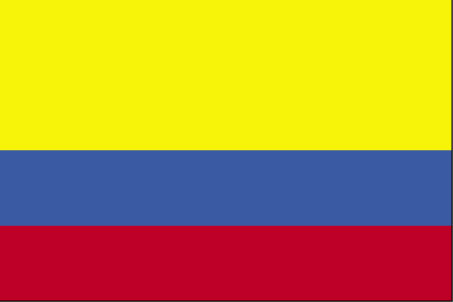
- Flag Symbolism
- three horizontal bands of yellow (top, double-width), blue, and red; similar to the flag of Ecuador, which is longer and bears the Ecuadorian coat of arms superimposed in the center
- Flag History
- Yellow symbolizes sovereignty and justice, blue for nobility, loyalty and vigilance, and red for valor, honor, generosity and victory acheived at the cost of bloodshed. According to another interpretation the yellow stands for universal liberty, the blue is for equality of all races and social classes before God and the law and red for fraternity.
- Date of Adoption
- 26 November 1861
National Anthem
- Anthem Lyrics
- "¡Oh Gloria inmarcesible!" ("Oh Unfading Glory!") Coro: Oh gloria inmarcesible ! Oh Júbilo inmortal ! En surcos de dolores El bien germina ya ! I Cesó la horrible noche ! la libertad sublime derrama las auroras de su invencible luz. La humanidad entera, que entre cadenas gime, comprende las palabras del que murió en la cruz. II Independencia grita el mundo americano; se baña en sangre de héroes la tierra de Colón. Pero este gran principio: el Rey no es soberano, resuena, y los que sufren bendicen su pasión. III Del Orinoco el cauce se colma de despojos; de sangre y llanto un río se mira allí correr. En Bárbula no saben las almas ni los ojos, si admiración o espanto sentir o padecer. IV A orillas del caribe hambriento un pueblo lucha, Horrores prefiriendo a pérfida salud. Oh, sí de Cartagena la abnegación es mucha, y escombros de la muerte desprecia su virtud. V De Boyacá en los campos el genio de la gloria con cada espiga un héroe invicto coronó. Soldados sin coraza ganaron la victoria; su varonil aliento de escudo les sirvió. VI Bolivar cruza el Ande que riega dos océanos; espadas cual centellas fulguran en junín. Centauros indomables descienden a los llanos, y empieza a presentirse de la epopeya el fin. VII La trompa victoriosa en Ayacucho truena; y en cada triunfo crece su formidable son. En su expansivo empuje la libertad se estrena, del cielo americano formando un pabellón. VIII La virgen sus cabellos arranca en agonía y de su amor viuda los cuelga del ciprés. Lamenta su esperanza que cubre loza fría, pero glorioso orgullo circunda su alba tez. IX La patria así se forma termópilas brotando; constelación de cíclopes su noche iluminó. La flor estremecida, mortal el viento hallando, debajo los laureles seguridad buscó. X Mas no es completa gloria vencer en la batalla, que el brazo que combate lo anima la verdad. La independencia sola al gran clamor no acalla; si el sol alumbra a todos, justicia es libertad. XI Del hombre los derechos Nariño predicando, el alma de la lucha profético enseñó. Ricaurte en San Mateo en átomos volando, deber antes que vida con llamas escribió.
- Anthem Lyrics (English)
- CHORUS: Oh unfading glory! Oh immortal joy! In burrows of pain Good germinates now Good germinates now Oh unfading glory! Oh immortal joy! In burrows of pain Good germinates now I The horrible night has ended! the sublime liberty pours the dawns of its invincible light. The whole humanity, crying in its chain, understands the words of the One that died in the Cross. 2. "Independence" cries The American world; In heroes' blood is bathing The Land of Columbus. But this great principle: "The King is not sovereign", Resounds, and those who suffer Praise the passion in it.
- Anthem History
- The words to Colombia's anthem were written by a four-time president of the nation. President Rafael Núñez and the music was composed by Oreste Sindici. The anthem was first performed on November 11 1887 and was officially adopted on July 4, 1946. On TV broadcasts and all events, the chorus, first verse and chorus once again are sung
Other National Symbols
National Flower
Christmas orchid (Cattleya trianae)
They are widely known for their large, showy flowers, and were used extensively in hybridization for the cut-flower trade until quite recently. This genus and the numerous hybrids come close, through their beauty, to the idealized picture we have of the orchids. The flowers of the hybrids can vary in size from 5 cm to 15 cm or more. They occur in all colors except true blue and black. The typical flower has three rather narrow petals : two are fringed, and the third is the conspicuous lip with a fringed margin and various markings and specks. At the base, the fringed margins are folded into a tube. Each flower stalk originates from a pseudobulb. The number of flowers varies; it can be just one or two, or sometimes up to ten.
National Tree
Quindio Wax Palm (Ceroxylon quindiuense)