
 English
 Español
 中文
中文 हिन्दी
 Français
Government and Politics
Government and Politics of Canada
Government structure, leadership, capital, military, and national symbols of Canada.
Government Structure
Constitutional foundations, branches, parties, and leadership.
- Government Type
- confederation with parliamentary democracy
- Administrative Divisions
- 10 provinces and 3 territories*; Alberta, British Columbia, Manitoba, New Brunswick, Newfoundland and Labrador, Northwest Territories*, Nova Scotia, Nunavut*, Ontario, Prince Edward Island, Quebec, Saskatchewan, Yukon Territory*
- Legal System
- based on English common law, except in Quebec, where civil law system based on French law prevails; accepts compulsory ICJ jurisdiction, with reservations
- Suffrage
- 18 years of age; universal
- Citizenship
- citizenship by birth: yes citizenship by descent only: yes dual citizenship recognized: yes residency requirement for naturalization: minimum of 3 of last 5 years resident in Canada
- Executive Branch
- chief of state: King CHARLES III (since 8 September 2022), represented by Governor General Mary SIMON (since 21 July 2021) head of government: Prime Minister Mark CARNEY (since 14 March 2025) cabinet: Federal Ministry chosen by the prime minister, typically from among members of his own party sitting in Parliament elections: none; the monarchy is hereditary; the governor general is appointed by the monarch on the advice of the prime minister for a five-year term; following legislative elections, the leader of the majority party or the leader of the majority coalition in the House of Commons is designated prime minister by the governor general
- Legislative Branch
- Bicameral Parliament or Parlement consists of the Senate or Sénat (105 seats; members appointed by the governor general on the advice of the prime minister and serve until reaching 75 years of age) and the House of Commons or Chambre des Communes (338 seats; members elected by direct, popular vote to serve for up to five-year terms). Elections: House of Commons - last held 20 September 2021 (next to be held no later than 20 October 2025). Election results: House of Commons - percent of vote by party - Liberal Party 32.6%, Conservative Party 33.7%, New Democratic Party 17.8%, Bloc Québécois 7.6%, Green Party 2.3%, other 6%; seats by party - Liberal Party 159, Conservative Party 119, New Democratic Party 25, Bloc Québécois 32, Green Party 2, other 1.
- Judicial Branch
- Supreme Court of Canada (judges are appointed by the prime minister through the governor general); Federal Court of Canada; Federal Court of Appeal; Provincial Courts (these are named variously Court of Appeal, Court of Queens Bench, Superior Court, Supreme Court, and Court of Justice)
- Political Parties
- Bloc Quebecois [Gilles DUCEPPE]; Conservative Party of Canada (a merger of the Canadian Alliance and the Progressive Conservative Party) [Stephen HARPER]; Green Party [Jim HARRIS]; Liberal Party [Paul MARTIN]; New Democratic Party [Jack LAYTON]
- Head of State
- King CHARLES III, represented by Governor General Mary SIMON
- Head of Government
- Prime Minister Mark CARNEY
- Cabinet
- Federal Ministry chosen by the prime minister usually from among the members of his own party sitting in Parliament
- Elections
- House of Commons - last held 20 September 2021 (next to be held no later than 20 October 2025).
- Election Results
- House of Commons - percent of vote by party - Liberal Party 43.7%, Conservative Party 41.3%, New Democratic Party 6.3%, Bloc Québécois 6.3%, Green Party 1.2%, other 1.2%; seats by party - Liberal Party 169, Conservative Party 144, New Democratic Party 7, Bloc Québécois 23, Green Party 1, other 0. The most recent federal election was held on April 28, 2025, resulting in a Liberal minority government led by Prime Minister Mark Carney.
- Constitution
- 17 April 1982 (Constitution Act); originally, the machinery of the government was set up in the British North America Act of 1867; charter of rights and unwritten customs
- Independence
- 1 July 1867 (from UK)
- National Holiday
- Canada Day, 1 July (1867)
- International Organization Participation
- ACCT, AfDB, APEC, ARF, AsDB, ASEAN (dialogue partner), Australia Group, BIS, C, CDB, CE (observer), EAPC, EBRD, ESA (cooperating state), FAO, G-7, G-8, G-10, IADB, IAEA, IBRD, ICAO, ICC, ICCt, ICFTU, ICRM, IDA, IEA, IFAD, IFC, IFRCS, IHO, ILO, IMF, IMO, Interpol, IOC, IOM, ISO, ITU, MICAH, MONUC, NAM (guest), NATO, NEA, NSG, OAS, OECD, OPCW, OSCE, Paris Club, PCA, UN, UNAMSIL, UNCTAD, UNDOF, UNESCO, UNFICYP, UNHCR, UNMIK, UNMOVIC, UNTSO, UPU, WCL, WCO, WFTU, WHO, WIPO, WMO, WToO, WTrO, ZC
- Diplomatic Representation in the U.S.
- chief of mission: Ambassador Michael WILSON chancery: 501 Pennsylvania Avenue NW, Washington, DC 20001 telephone: [1] (202) 682-1740 FAX: [1] (202) 682-7701 consulate(s) general: Atlanta, Boston, Buffalo, Chicago, Dallas, Denver, Detroit, Los Angeles, Miami, Minneapolis, New York, San Francisco, Seattle consulate(s): Anchorage, Houston, Philadelphia, Phoenix, Raleigh, San Diego
- U.S. Diplomatic Representation
- chief of mission: Ambassador David H. WILKINS embassy: 490 Sussex Drive, Ottawa, Ontario K1N 1G8 mailing address: P. O. Box 5000, Ogdensburgh, NY 13669-0430 telephone: [1] (613) 238-5335, 4470 FAX: [1] (613) 688-3082 consulate(s) general: Calgary, Halifax, Montreal, Quebec, Toronto, Vancouver, Winnipeg
Capital City
Seat of government and political history.
- Capital City
- Ottawa
- Location
- 45 25 N, 75 42 W
- Time Difference
- UTC-5 (same time as Washington, DC, during Standard Time) time zone note: Canada has six time zones
- History
- the city lies on the south bank of the Ottawa River, from which it derives its name; the river name comes from the Algonquin word "adawe" meaning "to trade" and refers to the indigenous peoples who used the river as a trade highway
Embassy and Diplomatic Representation
Embassy location and contact details.
U.S. Embassy 490 Sussex Drive, K1N 1G8 Ottawa, Ontario, Canada Telephone: (613) 238-5335 Emergency after-hours telephone: (613) 238-5335 Facsimile: (613) 688-3082 Email: OttawaACS@state.gov The Embassy's consular district includes Ottawa, Eastern Ontario (Kingston, Lanark, Leeds, Prescott, Refrew, Russell, and Stormont), and those parts of Quebec near Ottawa (Outaouais and Abitibi-Témiscamingues). U.S. Consulates General are located in: Calgary, Alberta 615 Macleod Trail SE, 10th Floor Telephone: (403) 266-8962 Emergency after-hours telephone: (403) 266-8962 then press '0' Facsimile: (403) 263-2241 Email: Calgary-ACS@state.gov The consular district includes Alberta, Manitoba, Saskatchewan, and the Northwest Territories, excluding Nunavut. Halifax, Nova Scotia Upper Water Street, Suite 904, Purdy's Wharf Tower II Telephone: (902) 429-2480 Emergency after-hours telephone: (902) 429-2485 Facsimile: (902) 423-6861 Email: Halifax-ACS@state.gov The consular district includes New Brunswick, Newfoundland, Nova Scotia, Prince Edward Island, and the French islands of Saint Pierre and Miquelon. Montreal, Quebec 1155 rue St. Alexandre Telephone: (514) 398-9695 Emergency after-hours telephone: (514) 981-5059 Facsimile: (514) 398-9748 Email: Montreal-ACS@state.gov The consular district includes Greater Montreal and the regions of Southern Quebec Province (Laurentides, Lanaudiere, Laval, Montreal, Montregie, Estrie, and the southern parts of Centre-du-Quebec), including Joliete, Drummondville, and Sherbrooke. Quebec City, Quebec 2 rue de la Terrasse Dufferin Telephone: (418) 692-2095 Emergency after-hours telephone: (418) 692-2096 Facsimile: (418) 692-4640 Email: QuebecACS@state.gov The consular district includes Quebec City and those regions of Quebec Province to the North and East of the Montreal and Ottawa Districts (indicated above), plus the Territory of Nunavut. Toronto, Ontario 360 University Avenue (please note that consular clients must enter the Consulate at 225 Simcoe Street) Telephone: (416) 595-1700 Emergency Telephone: During working hours: (416) 595-6506 After hours: (416) 201-4100 American Citizen Services Telephone: (416) 595-6501 Facsimile: (416) 595-5466 Email: torontopassport@state.gov The consular district includes the province of Ontario except for the counties of Kingston, Lanark, Leeds, Prescott, Refrew, Russell, and Stormont, which are served by the U.S. Embassy in Ottawa. Vancouver, British Columbia 1095 West Pender Street (please note that consular clients must enter the Consulate at 1075 West Pender Street) Telephone: (604) 685-4311 Facsimile: (604) 685-7175 Email: VancouverACS@state.gov The consular district includes British Columbia and the Yukon Territory. Winnipeg, Manitoba 201 Portage Street, Suite 860 Telephone: (204) 940-1800 Facsimile: (204) 940-1809 The consulate provides only emergency services for U.S. citizens in distress; it does not provide consular services. Manitoba-related consular matters such as visas, passports, and notarials are handled at other U.S. Consulates General, primarily Calgary.
Military
Branches, service obligations, expenditures, and manpower.
- Military Branches
- Canadian Forces: Canadian Army, Royal Canadian Navy, Royal Canadian Air Force, Canada Command (homeland security)
- Service Age and Obligation
- 17 years of age for voluntary male and female military service (with parental consent); 16 years of age for Reserve and Military College applicants; Canadian citizenship or permanent residence status required; maximum 34 years of age; service obligation 3-9 years
National Symbols
Flag, anthem, and other symbols of national identity.
National Flag
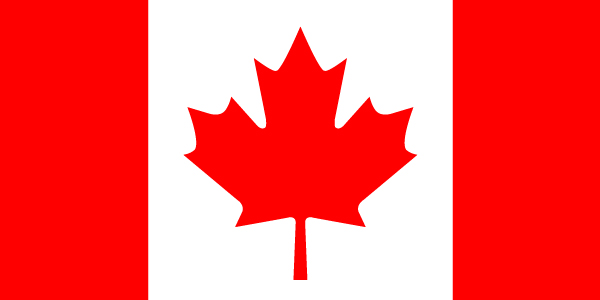
- Flag Symbolism
- two vertical bands of red (hoist and fly side, half width), with white square between them; an 11-pointed red maple leaf is centered in the white square; the official colors of Canada are red and white
- Flag History
- The maple leaf has been the symbol of Canada since at least the middle of the 19th century.
- Date of Adoption
- 15 February 1965
National Anthem
- Anthem Lyrics
- O Canada, terre de nos aieux, Ton front est ceint de fleurons glorieux. Car ton bras sait porter l'épée, Il sait porter la croix. Ton histoire est une épopée Des plus brillants exploits. Et ta valeur, de foi trempée, Protégera nos foyers et nos droits. Protégera nos foyers et nos droits.
- Anthem Lyrics (English)
- Official Lyrics of O Canada! O Canada! Our home and native land! True patriot love in all thy sons command. With glowing hearts we see thee rise, The True North strong and free! From far and wide, O Canada, we stand on guard for thee. God keep our land glorious and free! O Canada, we stand on guard for thee. O Canada, we stand on guard for thee.
- Anthem History
- The History of the National Anthem Summary "O Canada" was proclaimed Canada's national anthem on July 1, 1980, 100 years after it was first sung on June 24, 1880. The music was composed by Calixa Lavallée, a well-known composer; French lyrics to accompany the music were written by Sir Adolphe-Basile Routhier. The song gained steadily in popularity. Many English versions have appeared over the years. The version on which the official English lyrics are based was written in 1908 by Mr. Justice Robert Stanley Weir. The official English version includes changes recommended in 1968 by a Special Joint Committee of the Senate and House of Commons. The French lyrics remain unaltered. Full History of "O Canada" Many people think of Calixa Lavallée as an obscure music teacher who dashed off a patriotic song in a moment of inspiration. The truth is quite different. Lavallée was, in fact, known as "Canada's national musician" and it was on this account that he was asked to compose the music for a poem written by Judge Adolphe-Basile Routhier. The occasion was the "Congrès national des Canadiens-Français" in1880, which was being held at the same time as the St. Jean-Baptiste Day celebrations. There had been some thought of holding a competition for a national hymn to have its first performance on St. Jean-Baptiste Day, June 24, but by January the committee in charge decided there was not enough time, so the Lieutenant Governor of Quebec, the Honourable Théodore Robitaille, commissioned Judge Routhier to write a hymn and Lavallée to compose the tune. Lavallée made a number of drafts before the tune we know was greeted with enthusiasm by his musical friends. It is said that in the excitement of success Lavallée rushed to show his music to the Lieutenant Governor without even stopping to sign the manuscript. The first performance took place on June 24, 1880 at a banquet in the "Pavillon des Patineurs" in Quebec City as the climax of a"Mosaïque sur des airs populaires canadiens" arranged by Joseph Vézina, a prominent composer and bandmaster. Although this first performance of "O Canada" with Routhier's French words was well received on the evening, it does not seem to have made a lasting impression at that time. Arthur Lavigne, a Quebec musician and music dealer, published it without copyright but there was no rush to reprint. Lavallée's obit in 1891 doesn't mention it among his accomplishments, nor does a biography of Judge Routhier published in 1898. French Canada is represented in the 1887 edition of the University of Toronto song book by "Vive la canadienne", "A la claire fontaine" and "Un canadien errant". English Canada in general probably first heard "O Canada" when school children sang it when the Duke and Duchess of Cornwall (later King George V and Queen Mary) toured Canada in 1901. Five years later Whaley and Royce in Toronto published the music with the French text and a translation into English made by Dr. Thomas Bedford Richardson, a Toronto doctor. The Mendelssohn Choir used the Richardson lyrics in one of their performances about this time and Judge Routhier and the French press complimented the author. Richardson version: O Canada! Our fathers' land of old Thy brow is crown'd with leaves of red and gold. Beneath the shade of the Holy Cross Thy children own their birth No stains thy glorious annals gloss Since valour shield thy hearth. Almighty God! On thee we call Defend our rights, forfend this nation's thrall, Defend our rights, forfend this nation's thrall. In 1908 Collier's Weekly inaugurated its Canadian edition with a competition for an English text to Lavallée's music. It was won by Mercy E. Powell McCulloch, but her version did not take. McCulloch version : O Canada! in praise of thee we sing; From echoing hills our anthems proudly ring. With fertile plains and mountains grand With lakes and rivers clear, Eternal beauty, thos dost stand Throughout the changing year. Lord God of Hosts! We now implore Bless our dear land this day and evermore, Bless our dear land this day and evermore. Since then many English versions have been written for "O Canada". Poet Wilfred Campbell wrote one. So did Augustus Bridle, Toronto critic. Some were written for the 1908 tercentenary of Quebec City. One version became popular in British Columbia... Buchan version: O Canada, our heritage, our love Thy worth we praise all other lands above. From sea to see throughout their length From Pole to borderland, At Britain's side, whate'er betide Unflinchingly we'll stand With hearts we sing, "God save the King", Guide then one Empire wide, do we implore, And prosper Canada from shore to shore. However the version that gained the widest currency was made in 1908 by Robert Stanley Weir, a lawyer and at the time Recorder of the City of Montréal. A slightly modified version of the 1908 poem was published in an official form for the Diamond Jubilee of Confederation in 1927, and has since been generally accepted in English speaking Canada. Following further minor amendments, the first verse of Weir's poem was proclaimed as Canada's national anthem in 1980. The version adopted pursuant to the National Anthem Act in 1980 reads as follows: O Canada! Our home and native land! True patriot love in all thy sons command. With glowing hearts we see thee rise, The True North, strong and free! From far and wide, O Canada, We stand on guard for thee. God keep our land glorious and free ! O Canada, we stand on guard for thee. O Canada, we stand on guard for thee. Many musicians have made arrangements of "O Canada" but there appears to be a scarcity of recordings suitable for various purposes. Calixa Lavallée Calixa Lavallée was a "canadien errant", a man who left his country for greener fields, but who nevertheless loved Canada and returned to it, returned with a reputation well earned in the United States and France to become the "national musician" of Canada. He was, in his time, a composer operettas, at least one symphony, various occasional pieces and songs; he was a pianist and organist of considerable note and he was a teacher who wanted to found the first Canadian Conservatory. The famous Canadian choral conductor Augustus Stephen Volt said of him: "I became acquainted with Lavallée in the 80's of the last century, when I was in Boston as a student of music, and he impressed me as a man of extraordinary ability - not merely as a clever executant of the piano, and not merely as an adroit deviser of pretty melodies and sensuous harmonies, but as a genuinely creative artist, a pure musical genius". Calixa Lavallée was born in Verchères, Canada East, on December 28, 1842, the son of Augustin Lavallée, a woodcutter and blacksmith, who became an instrument repairman, bandleader and music teacher. Later when the family moved to St-Hyacinthe, the father worked for the famous organ-builder Joseph Casavant and led the townband. Calixa showed talent early and played the organ in the cathedral at the age of eleven. Two years later he gave a piano recital at the Théâtre Royal in Montréal. In Montréal Lavallée met Léon Derome, a butcher who loved music. He became Lavallée's lifelong patron and friend, often coming to his aid in bad times. About this time, Calixa tired of regular lessons and left Montréal to try his luck in the United States. In New Orleans, he won a competition which in turn won him a job as accompanist to the famous Spanish violinist Olivera. After touring with Olivera in Brazil and the West Indies, Lavallée joined the Northern army during the American Civil War. Leaving the U.S. army as a lieutenant, Lavallée returned to Montréal where he gave piano lessons and played cornet in a theatre orchestra. In 1865 he returned to the United States to teach and give a series of concert tours. He married and began to work with Arnold de Thiers, with whom he composed a comic opera called "Loulou". The night before its first performance, the owner of the opera house was shot and the theatre closed. Lavallée, who had been conductor and artistic director of the theatre, the NewYork Grand Opera House, found himself out of a job. He returned to Montréal in 1872 to a warm welcome from his friends, and had soon set up a studio with Jehin Prume and Rositadel Vecchio, well-known musicians. Success in Montréal brought him the fulfillment of a lifelong dream, to continue his musical education in Paris. A group of friends led by Derome made him a monthly allowance while he studied with Bazin, Boieldieu and Marmontel. A Lavallée symphony was performed by a Paris orchestra in 1874 and his teachers predicted a great future for him. Lavallée decided to devote his life to the establishment of a conservatory in Canada. To prove that talent existed, he mounted a Gounod drama with an all-Canadian cast of 80. The venture was a great success and Lavallée had high hopes of interesting the government in his idea. But although the public responded warmly to his productions, official quarters gave nothing but vague promises. It was during this Quebec period, in 1880 that Lavallée composed the music of "O Canada" for the "Congrès national des Canadiens-Français". But he could see nothing ahead but routine teaching and playing, so once again he took off for the United States. Things took a turn for the better. He was appointed an organist and choirmaster; he toured with the famous Hungarian soprano Etelka Gerster; he increased his composing; many of his works were performed including "Tiq", a "melodramatic musical satire"on the Indian question and his comic opera "The Widow". As a member of the Music Teachers' National Association, he organized a number of very successful concerts, and finally, in 1887, was elected president. In 1888 Lavallée represented the professional musicians of America in London and introduced American compositions in London where the Lord Mayor gave a dinner in his honour. Lavallée's health had been poor for some years and after his return to Boston became much worse. By the autumn of 1890 he was bedridden and in financial straits. He died on January 21, 1891,at the age of 49, leaving some 60 works, only about half of which have been found. Lavallée was buried near Boston but his body was brought back to Canada in 1933 and now rests in Montréal Cemetery Côte-des-Neiges. Sir Adolphe-Basile Routhier Adolphe Routhier (1839-1920) was born in Saint-Placide (Lower Canada). He was a distinguished lawyer who, like many members of his profession, was active in the community life of both his profession and his co-religionists. He was appointed a judge in 1873 and was a founding member of the Royal Society of Canada. He was probably better known as a poet than as a judge, and it was natural that the Honourable Théodore Robitaille, Lieutenant Governor of Quebec, should turn to him to write the words of a hymn for the great "Congrès national des Canadians-Français" in 1880. Since Routhier was president of the Congress at the time, a happier choice could hardly have been made. His poem for "O Canada!" was widely praised on its first presentation. Routhier who wrote under the name of Jean Piquefort, was later Chief Justice of Quebec until his retirement from the Bench in 1906. The Honourable Robert Stanley Weir Robert Stanley Weir (1856-1926) was born in Hamilton, in what was then Canada West. He took all his higher education in Montreal, and was qualified for both teaching and the law. He chose law and rose rapidly in the profession, becoming in due course, like Routhier, a judge first as Recorder of the City of Montréal and later to the Exchequer Court of Canada (now the Federal Court of Canada). He wrote both learned legal works and poetry, and his fame as a writer won him election as a Fellow of the Royal Society which Routhier had helped found. Weir had been a member of the Quebec Legislative Assembly for Argenteuil from 1903 to 1910, during which period he served in the Parent and Gouin Ministries as Minister without portfolio, Minister of Public Works or Speaker of the Legislative Assembly. Parliamentary Action By the time the World War broke out in 1914, "O Canada" was the best known patriotic song in Canada, edging out "The Maple leaf Forever" and others less well-known today. 1924 - The association of Canadian Clubs passed a unanimous resolution recommending the Weir version as suitable for use at Club meetings. Since then the I.O.D.E. and the Canadian Authors Association have endorsed it and in 1958 the Native Sons of Canada found in favour of it. 1927 - An official version of "O Canada" was authorized for singing in Canadian schools and for use at public functions. 1942 - July 27. The Prime Minister, the Right Honourable William Lyon Mackenzie King, was asked if he did not think this an appropriate time for proclaiming a national anthem. He replied that "There are times and seasons for all things and this time of war when there are other more important questions with which parliament has to deal, we might well continue to follow what has become the custom in Canada in recent years of regarding "God Save The King" and "O Canada" each as national anthems and entitled to similar recognition." He said further that this was his opinion, his government's opinion and he had no doubt it was the opinion of most people in the country. Some years later, his successor as Prime Minister, the Right Honourable Louis St-Laurent made a similar statement. 1964 - A government resolution authorized the formation of a special joint committee to consider the status of "God Save The Queen" and "O Canada". 1966 - January 31. The Prime Minister, the Right Honourable Lester B. Pearson, placed a notice of motion on the order paper "That the government be authorized to take such steps as may be necessary to provide that "O Canada" shall be the National Anthem of Canada while "God Save The Queen" shall be the Royal Anthem of Canada. 1967 - March 15. The special joint committee "unanimously recommends that the government be authorized to adopt forthwith the music for "O Canada" composed by Calixa Lavallée as the music of the National Anthem of Canada with the following notation added to the sheet music: With dignity, not too slowly. "God Save The Queen" was found to be in the public domain as the Royal Anthem of Canada, but for "O Canada" the committee deemed it "essential to take such steps as necessary to appropriate the copyright to the music providing that it shall belong to Her Majesty in right of Canada for all time. This provision would also include that no other person shall be entitled to copyright in the music or any arrangements or adaptations thereof." The committee recommended further study of the lyrics. It suggested keeping the original French version and using the Weir English version with minor changes - that is replacing two of the "Stand on guard" phrases with "From far and wide" and "God keep our land". There was no trouble with the music copyright which had by now descended to Gordon V. Thompson. They were willing to sell for $1, but the heirs of Judge Weir objected to the changes in the original version. Since Judge Weir died in 1926, the Weir version would not come into public domain until 1976. There was some doubt that the Weir family had legal grounds for objection since Thompson's apparently held copyright on both music and English words. However the committee preferred to settle the matter amicably if at all possible. The Government acquired the rights from G.V. Thompson in 1970. The version recommended by the committee: O Canada! our home and native land! True patriot love in all thy sons command. With glowing hearts we see thee rise, The True North strong and free! From far and wide, O Canada, We stand on guard for thee. God keep our land glorious and free! O Canada, we stand on guard for thee. O Canada, we stand on guard for thee. 1972 - February 28 - The Secretary of State of Canada, the Honourable Gérard Pelletier, presented a bill in the House of Commons proposing the adoption of "O Canada" as the National Anthem of Canada. The recommendations of the 1967 study in Parliament are incorporated in the bill, which did not receive further study in Parliament and died on the order paper. The same legislation was reintroduced by Mr. Pelletier's successors at further sessions of Parliament; no action was ever taken. 1980 - June 18 - The Secretary of State of Canada, the Honourable Francis Fox, presented a bill, similar to previously presented bills on "O Canada", fulfilling a promise made earlier in the House that "O Canada" be proclaimed as Canada's national anthem as soon as possible in this year of the centenary of the first rendition. The bill was unanimously accepted by the House of Commons and the Senate on June 27; Royal assent was given the same day. July 1 - The Governor General, His Excellency the Right Honourable Edward Schreyer, proclaimed the Act respecting the National Anthem of Canada, thus making "O Canada" an official symbol of the country. A public ceremony was held at noon on Parliament Hill in front of thousands of Canadians. Descendants of Weir and Routhier were on the official platform, as well as the successor of Robitaille, the Honourable Jean-Pierre Côté. Original Poem by Weir Originally "O Canada" was a patriotic poem by Sir Adolphe-Basile Routhier, a Quebec judge. Calixa Lavallée, the well-known Canadian composer, was commissioned to set it to music, and it was first sung in 1880 during a national convention of French Canadians in Quebec City. Many English versions have appeared, but the one which was widely accepted was written in 1908 by another judge, R. Stanley Weir, in honour of the 300th anniversary of the founding of Quebec City. It was amended in 1913, 1914 and 1916 and published in an official form at the time of the Diamond Jubilee of Confederation in 1927 and during the Royal visit of 1939. A slightly modified version of the first verse of Weir's poem was proclaimed as Canada's national anthem in 1980. The original poem of 1908 by Stanley Weir reads as follows: O Canada! Our home and native land! True patriot love thou dost in us command. We see thee rising fair, dear land, The True North, strong and free; And stand on guard, O Canada, We stand on guard for thee. Refrain O Canada! O Canada! O Canada! We stand on guard for thee. O Canada! We stand on guard for thee. O Canada! Where pines and maples grow. Great prairies spread and lordly rivers flow. How dear to us thy broad domain, From East to Western Sea, Thou land of hope for all who toil! Thou True North, strong and free! Refrain O Canada! O Canada! etc. O Canada! Beneath thy shining skies May stalwart sons and gentle maidens rise, To keep thee steadfast through the years From East to Western Sea, Our own beloved native land! Our True North, strong and free! Refrain O Canada! O Canada! etc. Ruler supreme, who hearest humble prayer, Hold our dominion within thy loving care; Help us to find, O God, in thee A lasting, rich reward, As waiting for the Better Day, We ever stand on guard. Refrain O Canada! O Canada! etc. English Translation of the French Version of the National Anthem O Canada! Land of our forefathers Thy brow is wreathed with a glorious garland of flowers. As in thy arm ready to wield the sword, So also is it ready to carry the cross. Thy history is an epic of the most brilliant exploits. Ch. Thy valour steeped in faith Will protect our homes and our rights Will protect our homes and our rights. Music and lyrics As the National Anthem Act only sets the melody for the anthem, musicians are free to arrange the score to suit their requirements. There is no copyright on the melody and the words of the national anthem, the Act having declared them to be in the public domain. It is possible, however, to copyright the arrangements made to the melody. It is possible to translate the words of the national anthem in languages other than English or French; it should be kept in mind, however, that this translated version will not have an official status. Playing of anthems at events There is no specific rule as to when it is appropriate to sing the national anthem at an event. It is up to the organizers to determine if "O Canada" will be sung at the beginning or at the end of a ceremony. If two anthems are to be played at the beginning of an event, "O Canada" should be played first followed by the other one. When anthems are played at the end of an event, "O Canada" should be played last. Etiquette during the playing of the national anthem As a matter of respect and tradition, it is proper to stand for the playing of "O Canada" as well as for the anthem of any other nation. It is traditional for civilian men to take off their hats during the playing of the national anthem. Women as well as children do not remove their hats on such occasions. There is no law or behaviour governing the playing of the national anthem; it is left to the good citizenship of individuals.
Other National Symbols
National Animal
Beaver
The Beaver is the national animal of Canada. It can be found on the nickel (a coin). It is the national animal of Canada because the beaver is one of the main reasons Canada was explored and colonized. Trappers - or Les Couriers De Bois came to Canada for Beaver pelts which were very necessary for the fashions of the time. It represents industry and perseverence.
National Flower
maple leaf
National Tree
maple