
 English
 Español
 中文
中文 हिन्दी
 Français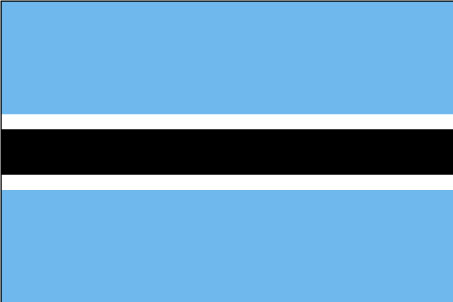
Botswana
Botswana
Declare Your Relationship to Botswana
CountryReports Community
- Studying2
- From Botswana1
- Botswana heritage1
- Visited1
- Want to visit1
Customs and Culture
Customs and Culture
About the People
Attitudes Society is founded on traditional law, with the community as the core of Tswana life and the chief as the symbol of unity. Each individual is expected to benefit the community. The more a person achieves, the greater that person’s status with the group. Anything that can benefit the group is valued. Working family members are expected to support those without jobs, and people are expected to house traveling relatives for as long as necessary.
Cultural Attributes
Individuals are expected to contribute to society rather than have the government support them. Cleanliness and neatness are important throughout the country.

Land of the Kalahari's Keepers
Greetings, Gestures & Visiting
Formal verbal greetings, accompanied by shaking the right hand while supporting one's elbow with the left hand, are used among Setswana acquaintances and when greeting an elder or one of higher social status. Elders and those approaching greet first. Greeting customs vary for other ethnic groups. For example, among the Kalanga the younger person always greets first.
Showing affection publicly is inappropriate. Botswana uses several different gestures to communicate "No thank you". Respect for elders during conversation is best shown by looking toward the ground.
Unannounced visitors are welcome especially if the visitor is a relative. Guests are offered water or a drink at first, anyone who arrives at mealtime is expected to eat with the family and usually helps with meal preparation.
Western dress is common. Despite the heat, urban men wear business suits with ties and women wear dresses or blouses. Rural women often wear a wrap over their dresses to protect them from dirt. Mothers carry their babies on their backs in fabric slings. Married women cover their heads with a kerchief, both sexes typically have very short hair.
Diet
Bogobe a porridge made from sorghum, maize, or millet in the northeast is a staple food. It is served soft and often soured for breakfast, and thickened for the midday and evening meals. A popular relish is made of onions, chicken stock, and tomato sauce. Goats and chickens are raised for meat. Cattle are slaughtered for special occasions such as weddings and funerals. Phane worms are a delicacy gathered from morphane tree in the northeast they are dried in hot ashes and eaten.
Eating habits vary between urban and rural settings, but sharing is the common denominator. For most, family meals involve eating from common bowls or plates. Children share a bowl between them. Everyone usually leaves a little food behind to indicate the meal has been filling. Drinks are never shared; each person has a cup. Smelling the food before eating it implies something is wrong with it. Leftovers are kept for later or given to departing guests.
Bogobe a porridge made from sorghum, maize, or millet in the northeast is a staple food. It is served soft and often soured for breakfast, and thickened for the midday and evening meals. A popular relish is made of onions, chicken stock, and tomato sauce. Goats and chickens are raised for meat. Cattle are slaughtered for special occasions such as weddings and funerals. Phane worms are a delicacy gathered from morphane tree in the northeast they are dried in hot ashes and eaten.

Family
With high unemployment few men work in South Africa, and a continuous search for employment keeps families separate. For instance, married couples who are teachers might work across the country from one another. With men so often absent, women remain primarily responsible for the family and often pursue a home-based business to supplement income.
Dating Customs
Living away from home villages (for work or schooling) has dramatically changed the way young people interact. It was once rather restricted, but the youth now meet at discos and other sites.
When a couple becomes engaged, the two families begin negotiations regarding the bogadi (bride price), which the groom's family will give the bride's family sometime in the future.
Recreation
One of the most popular traditional games is called stalking, which is ideally meant to teach children how to be hunters. It is usually played by eight or more players and all that is needed are two blindfolds. It sharpens listening skills and reflexes, as kids pretend to be a hunter or the springbok (an African antelope) the hunter is pursuing.
Children choose a hunter and a springbok and ask the other kids to form a circle around them. The circle is told that they can be silent or make noises and set a time limit of five minutes for each round. Two children are blindfolded and put in the center and spun around. At the signal, the two must move around the circle, the hunter trying to catch the springbok and the springbok trying to avoid capture. If at the end of the round the springbok has not been caught, he remains to face a new hunter. If he is caught, he too is replaced.
Student Life
Generally, people wake in the morning to a thinner version of porridge leftover from the previous day's meal, sometimes the porridge is enriched with soured milk and/or sugar, and tea. A thicker version of the porridge, known as bogobe, anchors the substantial midday meal, accompanied by a stew of meat and/or cabbage, spinach (or wild greens), or beans. People also use rice, but it is considered more expensive and associated with Europeans. Meats include chicken, goat, sheep, cattle, fish, a caterpillar known as phane, and various wild game.
Pre-school is a luxury, only these parents who are rich enough can afford to take their children to private pre-schools. Most children will not have the privilege of attending a preschool. For most children, the day begins between 4:00 a.m. and 5:00 a.m. when they wake up and prepare to go to school. Going to school involves some walking for the majority of the children and it is only those who go to private schools who may have the privilege of having some organized school transport. What time the child will wake up will depend on the distance they live from school as well as the number of chores they have to perform before they depart. Some of the chores may involve milking the family cow, tending the family garden as well as preparing the younger siblings for school, and before dawn, they will have left. The walk to school is usually a long one and can go as far as 10 kilometers (about 6 miles) in some villages, but the average would be about 5 kilometers (about 3 miles). As the children walk through the village paths they will be in groups as they collect each other on the way, those who live farthest always begin their walk earliest. School begins at 7:15 a.m. but before then there will be the compulsory general cleaning up of the school compound followed by assembly before the start of the day. For the lucky few, there is hopefully going to be just a little lunch but for the majority, lunch is a luxury. Concentration in school becomes a problem so most children will drink water during the day. The only meal that is guaranteed would be the evening meal that is eaten somewhere between 5:00 and 6:00 p.m.
The primary school program takes seven years and most children will begin classes at the age of six. Classes are conducted in two main languages: Setswana and English. Setswana becomes the language of instruction during the first four years of school and this greatly inconveniences those children whose mother tongue is not Setswana. The classes are usually crowded with every class having not less than 50 students. When children begin they are about six to seven years of age. Some schools have a feeding program, and in many schools, each child is required to come with a piece of wood daily as their contribution to the preparation of the lunchtime meal. The lessons take between 35 and 40 minutes each and there are two short breaks before the lunch break. It’s during break time when children run to the washrooms, which are more often than not a few pit latrines. The rest of the time is spent playing a few local games. Due to the lack of facilities such as balls and other playthings, children will always improvise and have something to play with. Like in most other parts of Africa, boys will play soccer with their own balls made of plastic sheets and twine. The school walls are made of compressed earth and the floors are basically earthen. In a few cases, the walls are made of bricks. The children will either sit on the floor or share the few available desks. The rural areas are worst hit when it comes to the shortage of classes and other facilities including teachers. Children are keen to learn the English language and in the first years of learning, they learn English predominantly in an oral way with the help of pictures, chants, rhymes songs, and actions. They also learn writing patterns using coloring sheets as they improve they will learn handwriting using stubs of pencils. Since English is a global language, a lot of emphasis is put on learning English because the children are told they will never secure employment in the future if they cannot speak English. There is an intensive teaching program in primary school known as "breakthrough" which is in its pilot stages and it’s creating a lot of good results since it encourages a lot of student participation, especially in the first years of schooling. The lower classes end at lunch hour and the children have to go home till the following day. The classrooms are made in such a way that there is a teacher’s corner which is likely to have a mat, a chalkboard, and other teaching facilities that may be available in the class. Class typically begins with a warm-up session that may include songs, questions, and answers just to emphasize what was learned earlier. Homework given in the morning may be done during the lunch break. The use of the library, where there is one, is usually timetabled with every class taking about 30 minutes per session. Computers are unheard of and many children will not experience computers until after high school. The afternoon classes begin at 2:00 p.m. and may go on till 4:00 p.m. when the children and their teachers call it a day. The children will then begin the long trek home, which can take up to 2 hours.
The government provides limited support for performance and arts. Schools have choral and dance groups and young people may receive grants to develop song-drama groups. Praise poetry was highly elaborated in the Tswana peoples and there are still a number of older men proficient at it, but modern literary forms are not extensively developed. Crafts, particularly basketry, along with woven hangings and printed textiles, are developed for the urban and tourist markets. Choral groups proliferate, often associated with voluntary associations, and compete in neighborhoods, villages, and nationally; an annual Eisteddfod is held for the school choir and traditional dance groups. Song-drama groups are formed by the young; their performances focus on social problems facing youth, including pregnancy and HIV/AIDS. Some Tswana musical groups are becoming popular regionally.
One of the most popular traditional games is called stalking, which is ideally meant to teach children how to be hunters. It is usually played by eight or more players and all that is needed are two blindfolds. It sharpens listening skills and reflexes, as kids pretend to be a hunter or the springbok (an African antelope) the hunter is pursuing. Children choose a hunter and a springbok and ask the other kids to form a circle around them. The circle is told that they can be silent or make noises and set a time limit of five minutes for each round. Two children are blindfolded and put in the center and spun around. At the signal, the two must move around the circle, the hunter trying to catch the springbok and the springbok trying to avoid capture. If at the end of the round the springbok has not been caught, he remains to face a new hunter. If he is caught, he too is replaced.
Village evening meals may include leftovers from midday, but for many people is often just tea and buttered bread. After eating the older children will most likely do the dishes and try to do their homework and in most cases, it is unsupervised since some of the parents may not have advanced that far in school. About 8:00 p.m. or 9:00 p.m. there is total silence and the whole village has gone to sleep. Since there is no electricity connection in most if not all rural homes. The little kerosene that is available is usually saved so that it could last for a few more days.
Holidays
Independence Day
9/30Independence Day
Dates of Interest
- September 30th
How do people greet each other in Botswana?
Formal verbal greetings are common, with a right-handed handshake while supporting your right elbow with your left hand, especially with acquaintances, elders, or people of higher social status.
Do
- Shake with the right hand while supporting your elbow with the left hand
- As an elder or someone approaching, greet first among Setswana speakers
Good to know
- Greeting customs vary by ethnic group — among the Kalanga, the younger person always greets first
What are the dining customs in Botswana?
Sharing is central to meals, with most families eating from common bowls or plates, though each person has their own cup.
Do
- Leave a little food behind to show the meal was filling
- Expect to eat with the family if you arrive at mealtime, and often help prepare the meal
Don’t
- Don't share drinks — each person has their own cup
- Don't smell food before eating it, as this implies something is wrong with it
Good to know
- Bogobe, a sorghum, maize, or millet porridge, is a staple — soured and soft for breakfast, thickened for later meals
- Phane worms dried in hot ashes are a delicacy in the northeast
- Leftovers may be kept for later or given to departing guests
What etiquette should travelers know in Botswana?
Community is at the heart of Tswana life, and cleanliness and neatness are valued throughout the country.
Do
- Value contributions that benefit the community
- Welcome unannounced visitors, especially relatives, offering water or a drink first
Good to know
- Working family members are expected to support relatives without jobs and to house traveling relatives
What should I wear in Botswana?
Western dress is common; despite the heat, urban men wear business suits with ties and women wear dresses or blouses.
Good to know
- Rural women often wear a wrap over their dresses to protect them from dirt
- Married women cover their heads with a kerchief
- Both sexes typically have very short hair
What gestures should I be aware of in Botswana?
Public displays of affection are inappropriate, and respect for elders in conversation is shown by looking toward the ground.
Don’t
- Don't show affection publicly
Good to know
- Several different gestures are used to communicate 'No thank you'
- Look toward the ground to show respect to elders during conversation
What is family life like in Botswana?
High unemployment and the search for work often keep families separated, so women remain primarily responsible for the family and often run home-based businesses.
Good to know
- Married couples may work far apart from one another
- When a couple becomes engaged, the two families negotiate the bogadi (bride price)
What do people do for recreation in Botswana?
A popular traditional game is 'stalking,' where blindfolded children play a hunter chasing a springbok to sharpen listening skills and reflexes.
Good to know
- Stalking is played by eight or more players and needs only two blindfolds
- A hunter and a springbok are blindfolded, spun, and placed in a circle for timed rounds
Last updated: 2026-07-12 · Sources: CountryReports
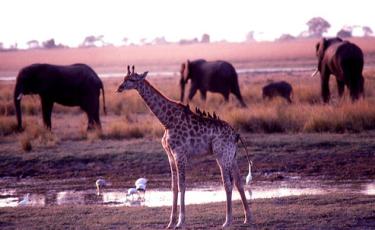
Photos of Botswana
Photos of Botswana


Travel and Tourism
Travel and Tourism
- Travel Alert Status
- Level 1: Exercise Normal Precautions
- Currency
- 10.21
- Time Difference
- UTC+2 (7 hours ahead of Washington, DC, during Standard Time)
- Climate
- Most of its area is an inhospitable semi-desert known as the Kalahari. Even the most arable sections of eastern Botswana are subject to periodic drought and unpredictable rains. Botswana straddles the Tropic of Capricorn and has an average elevation of 3,300 feet. Daily high temperatures during the hottest month, January, average in the upper 90's to over 100°F. Winter daytime temperatures generally reach 70 degrees, but with little cloud cover and no humidity to hold warmth in the air, they plummet to 30 or 40°F at night.
- Airports
- 85
- Recommended Vaccinations
- How important is it to do your research about vaccinations? It might just save your life! Make yourself aware of the different types of vaccinations and which ones you may need to travel to your destination. Schedule an appointment with your doctor at least four to six weeks before you travel to ensure you receive all important shots. Be sure that you and your family are up to date on your routine vaccinations. Which vaccinations you need will depend on a number of factors including your destination, whether you will be spending time in rural areas, the season of the year you are traveling, your age, health status, and previous immunizations.
Read the full travel guide — health, safety, vaccinations, disease risk, sanitation, and transit details.
View full travel guideRecipes
Recipes
History
History
Historical Eras
Pre-colonial Era
200 BCE – 1885
San (Bushmen) hunter-gatherers inhabited the region for millennia before Bantu-speaking Tswana peoples migrated into the area, establishing herding and farming communities under tribal chieftainships. In the early 19th century, the Mfecane — the upheavals driven by Zulu expansion — displaced and reshaped Batswana communities. Tensions with Boer settlers from the Transvaal in the 1870s and 1880s prompted Batswana chiefs to seek British protection.
Bechuanaland Protectorate
1885 – 1966
Britain formally declared Bechuanaland a protectorate in 1885, administering the northern territory directly from a seat of government in Mafikeng. Advisory councils for Africans and Europeans were established in 1920, and proclamations in 1934 regularized tribal governance. Despite pressure from South Africa to absorb the territory, Bechuanaland's inhabitants successfully resisted inclusion in the Union of South Africa, preserving a path toward independent nationhood.
Independence & Nation-Building
1966 – 1980
Botswana gained independence on 30 September 1966, with Seretse Khama — founder of the Bechuanaland Democratic Party and heir to the Bamangwato chieftainship — elected as the country's first president. The discovery of diamonds at Orapa in 1967 transformed the economic outlook of one of the world's poorest nations. Khama established democratic institutions, a nonracial constitution, and a foreign policy of principled opposition to apartheid South Africa, serving until his death in office in 1980.
Consolidation & Growth
1980 – 1999
Vice President Ketumile Masire assumed the presidency after Khama's death and guided Botswana through sustained diamond-led economic expansion, earning it one of the world's highest GDP growth rates. The Botswana Defence Force, established in 1977, was strengthened as regional instability persisted. Multiparty elections held in 1984, 1989, and 1994 reinforced the country's reputation for stable, civilian democratic governance on a continent marked by coups and conflict.
Modern Botswana
1999 – present
President Festus Mogae, who took office in 1998 and was elected in his own right in 1999, oversaw Botswana's response to a devastating HIV/AIDS epidemic — one of the world's worst — through a landmark antiretroviral treatment program. Diamond revenues funded expanded public services, though global demand fluctuations exposed economic vulnerability, prompting efforts to diversify into tourism and conservation. Landmark court victories for the San people in 2006 highlighted ongoing tensions over indigenous land rights and resource access.
Overview
In the 19th century, hostilities broke out between the Batswana and Boer settlers from the Transvaal. After appeals by the Batswana for assistance, the British Government in 1885 put "Bechuanaland" under its protection. The northern territory remained under direct administration and is today’s Botswana, while the southern territory became part of the Cape Colony and is now part of the northwest province of South Africa; the majority of Setswana-speaking people today live in South Africa.
Despite South African pressure, inhabitants of the Bechuanaland Protectorate, Basuotoland (now Lesotho), and Swaziland in 1909 asked for and received British assurances that they would not be included in the proposed Union of South Africa. An expansion of British central authority and the evolution of tribal government resulted in the 1920 establishment of two advisory councils representing Africans and Europeans. Proclamations in 1934 regularized tribal rule and powers. A European-African advisory council was formed in 1951, and the 1961 constitution established a consultative legislative council.
In June 1964, Britain accepted proposals for democratic self-government in Botswana. The seat of government was moved from Mafikeng, in South Africa, to newly established Gaborone in 1965. The 1965 constitution led to the first general elections and to independence in September 1966. Seretse Khama, a leader in the independence movement and the legitimate claimant to traditional rule of the Bamangwato, was elected as the first president, re-elected twice, and died in office in 1980. The presidency passed to the sitting vice president, Ketumile Masire, who was elected in his own right in 1984 and re-elected in 1989 and 1994. Masire retired from office in 1998. The presidency passed to the sitting vice president, Festus Mogae, who was elected in his own right in 1999. Mogae won a second term in elections held October 30, 2004.
Timeline of Key Events
1867
European gold prospectors arrive, mining begins.
European gold prospectors arrive, mining begins.
1885
British proclaim a protectorate called Bechuanaland.
British proclaim a protectorate called Bechuanaland.
1959
Copper mines are established.
Copper mines are established.
1960
Bechuanaland People’s Party (BPP) is established.
Bechuanaland People’s Party (BPP) is established.
1962
Seretse Khama founds Bechuanaland Democratic Party (BDP)
Seretse Khama founds Bechuanaland Democratic Party (BDP), later to become Botswana Democratic Party.
1966
Bechuanaland is granted independence and becomes Republic of Botswana.
Bechuanaland is granted independence and becomes Republic of Botswana with Seretse Khama as president.
1966
Joins the United Nations.
Joins the United Nations.
Read the full history profile — narrative overview, defining eras, and the complete timeline in one place.
View expanded historyInteresting Facts
Interesting Facts
When a child loses a tooth they throw their tooth on the roof and say “Mr. Moon, Mr. Moon, please bring me a new tooth.”
African elephants are different from Indian elephants. They are larger, and both male and female have tusks.
San (The San are the original inhabitants of the land and have been living there for as long as 50,000 years) gatherers carry water in ostrich eggs.
Diamonds were discovered in Botswana in 1967. It took 4 years for mining to start.
In 1830 a French taxidermist stuffed an African Bushman from Botswana and took the body to Europe for exhibition. In 2000 the body was returned from a Spanish museum.
See every fact — trivia, oddities, and curious tidbits gathered from across the country.
View all interesting factsGeography and Environment
Geography and Environment
- Terrain
- predominantly flat to gently rolling tableland; Kalahari Desert in southwest
- Climate
- Most of its area is an inhospitable semi-desert known as the Kalahari. Even the most arable sections of eastern Botswana are subject to periodic drought and unpredictable rains. Botswana straddles the Tropic of Capricorn and has an average elevation of 3,300 feet. Daily high temperatures during the hottest month, January, average in the upper 90’s to over 100 degrees Fahrenheit. Winter daytime temperatures generally reach 70 degrees, but with little cloud cover and no humidity to hold warmth in the air, they plummet to 30 or 40 degrees Fahrenheit at night.
- Natural Hazards
- periodic droughts; seasonal August winds blow from the west, carrying sand and dust across the country, which can obscure visibility
- Current Environmental Issues
- overgrazing; desertification; limited fresh water resources
Read the full geography and environment profile — terrain, climate, natural resources, hazards, land use, and international agreements.
View full geographyPeople & Demographics
People & Demographics
Religion
Languages Spoken
English (official), Setswana
- English
Population
- Population
- 2,029,307
- Population in Major Urban Areas
- GABORONE (capital) 202,000
- Nationality Noun
- Motswana (singular), Batswana (plural)
- Ethnic Groups
- Tswana (or Setswana) 79%, Kalanga 11%, Basarwa 3%, other (including Kgalagadi and white) 7%
- Language Note
- English is the official language while Setswana is considered the national language. Tjikalanga is commonly spoken in northeastern Botswana.
Education
- Literacy Definition
- Age 15 and over can read and write
Health Information
- Major Infectious Diseases — degree of risk
- High
Read the full people and society profile — demographics, health, education, religion, languages, and notable people.
View full people and societyGovernment & Politics
Government & Politics
Country Identity
- Country Name
- Botswana
- Full Country Name
- Republic of Botswana
- Local - Long
- Republic of Botswana
- Local - Short
- Botswana
- Former Name
- Bechuanaland
Government Structure
- Government Type
- parliamentary republic
- Legal System
- based on Roman-Dutch law and local customary law; judicial review limited to matters of interpretation; has not accepted compulsory ICJ jurisdiction
- Executive Branch
- chief of state: President Duma BOKO (since 1 November 2024); note - the president is both the chief of state and head of government head of government: President Duma BOKO (since 1 November 2024); note - the president is both the chief of state and head of government cabinet: Cabinet appointed by the president elections: president indirectly elected by the National Assembly for a five-year term; election last held on 30 October 2024 (next to be held in 2029); vice president appointed by the president election results: Duma BOKO elected president following his Umbrella for Democratic Change coalition's victory in the general election, ending the Botswana Democratic Party's nearly six decades in power
- Legislative Branch
- bicameral Parliament consists of the House of Chiefs (a largely advisory 15-member body consisting of the chiefs of the 8 principal tribes, 4 elected subchiefs, and 3 members selected by the other 12 members) and the National Assembly (61 seats, 57 members are directly elected by popular vote and 4 are appointed by the majority party; members serve five-year terms) elections: National Assembly elections last held 30 October 2004 (next to be held October 2009) election results: percent of vote by party - BDP 52%, BNF 26%, BCP 17%, other 5%; seats by party - BDP 44, BNF 12, BCP 1
- Judicial Branch
- High Court; Court of Appeal; Magistrates' Courts (one in each district)
- Suffrage
- 18 years of age; universal
- Constitution
- March 1965, effective 30 September 1966
- Independence
- 30 September 1966 (from UK)
- National Holiday
- Independence Day (Botswana Day), 30 September (1966)
Capital City
- Capital Name
- Gaborone
- Capital - geographic coordinate
- 24 38 S, 25 54 E
- Capital Time Difference
- UTC+2 (7 hours ahead of Washington, DC, during Standard Time)
named after GABORONE (ca. 1825-1931), a revered kgosi (chief) of the Tlokwa tribe, part of the larger Tswana ethnic group
Military
Branches: Botswana Defense Force (BDF): Ground Forces Command, Air Wing Command, Defense Logistics Command, Special Forces Group
Embassy / Diplomatic Mission
The U.S. Embassy Gaborone is located on Embassy Drive in the Government Enclave.
Mailing address: P.O. Box 90, Gaborone, Botswana
Telephone: 267 395-3982
After-hours Emergency Telephone: 267 395-7111
Fax 267 318-0232
Read the full government profile — flag symbolism, national anthem, and other national symbols.
View full government detailsEconomy
Economy
Botswana has maintained one of the world's most impressive long-term economic growth records since independence in 1966. Through fiscal discipline and prudent management of resource wealth, the country transformed itself from one of the poorest nations in the world into an upper-middle-income economy, with per capita GDP estimated at roughly $7,700 in nominal terms and over $20,000 on a purchasing power parity basis. Major credit rating agencies continue to rank Botswana among the most creditworthy nations in Africa. Diamond mining remains the cornerstone of the economy, accounting for roughly a quarter of GDP, the bulk of export earnings, and a substantial share of government revenue, though efforts to diversify have gained momentum in recent years. Tourism, financial services, beef production, and subsistence farming are other important sectors. On the downside, the government continues to grapple with persistently high unemployment and pronounced income inequality. Official unemployment has climbed above 25 percent, with youth unemployment significantly higher, and informal estimates suggest the true rate may be considerably greater. HIV/AIDS remains a serious public health challenge, though Botswana has made notable strides in expanding antiretroviral treatment access and was among the first African countries to achieve key UNAIDS targets for epidemic control, sharply reducing new infections and AIDS-related mortality compared with earlier decades. Long-term prospects are shaped by the eventual depletion of diamond reserves and softening global demand amid competition from lab-grown stones, making diversification into tourism, technology, financial services, and value-added manufacturing an increasing priority for sustainable growth.
Snapshot
- Currency Name and Code
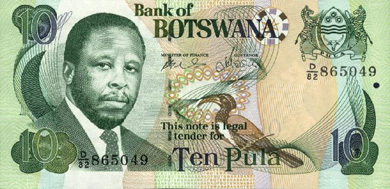
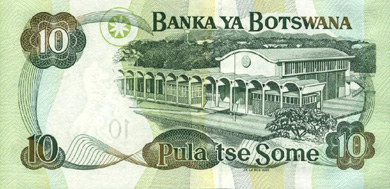
- Pula (BWP)
- GDP — official exchange rate
- $9,046,000,000 (USD)
- GDP Real Growth Rate
- 4.5%
- Gini Index
- 63
Banknotes
Budget & Public Finance
- Fiscal Year
- 1 April - 31 March
- Annual Budget
- $3,767,000,000 (USD)
- Public Debt (% of GDP)
- 7.3%
- External Debt
- $556,000,000 (USD)
- Investment (% of GDP)
- 23.6%
- Economic Aid
- $73,000,000 (USD)
- Current Account Balance
- $562,000,000 (USD)
- Reserves of Foreign Exchange
- $2,147,483,647 (USD)
Labor, Industry & Trade
- Labor Force by Occupation
- NA
- Industries
- diamonds, copper, nickel, salt, soda ash, potash; livestock processing; textiles
- Agriculture Products
- livestock, sorghum, maize, millet, beans, sunflowers, groundnuts
- Export Commodities
- diamonds, copper, nickel, soda ash, meat, textiles
- Export Partners
- European Free Trade Association (EFTA) 87%, Southern African Customs Union (SACU) 7%, Zimbabwe 4%
- Import Commodities
- foodstuffs, machinery, electrical goods, transport equipment, textiles, fuel and petroleum products, wood and paper products, metal and metal products
- Import Partners
- Southern African Customs Union (SACU) 74%, EFTA 17%, Zimbabwe 4%
Energy
- Oil Production
- 0 bbl/day
- Oil Consumption
- 12,000 bbl/day
- Oil Reserves
- 0 bbl/day
- Natural Gas Production
- 0 cu m
- Natural Gas Consumption
- 0 cu m
- Natural Gas Imports
- 0 cu m
- Natural Gas Exports
- 0 cu m
- Natural Gas Reserves
- 0 cu m
Communications
- Telephone System
- General Assessment: Botswana is participating in regional development efforts; expanding a fully digital system with fiber-optic cables linking the major population centers in the east as well as a system of open-wire lines, microwave radio relays links, and radiotelephone communication stations Domestic: fixed-line teledensity has declined in recent years and now stands at roughly 7 telephones per 100 persons; mobile-cellular teledensity now pushing 140 telephones per 100 persons International: country code - 267; international calls are made via satellite, using international direct dialing; 2 international exchanges; digital microwave radio relay links to Namibia, Zambia, Zimbabwe, and South Africa; satellite earth station - 1 Intelsat (Indian Ocean)
- Internet Country Code
- .bw
News & Weather
News & Weather
Current Weather
Latest News
News - SETAF-AF civil affairs team conducts humanitarian assistance audits in Botswana - DVIDS
DVIDS · 17h ago
Botswana Says Citizens Recruited for Russia War at Alarming Rate - Bloomberg.com
Bloomberg.com · 3d ago
Botswana says Anglo picks De Beers buyer, weighs options for "optimal structure" - Reuters
Reuters · 4d ago
WHO Botswana Q1 Newsletter 2026 | OMS | Bureau régional pour l'Afrique - WHO | Regional Office for Africa
WHO | Regional Office for Africa · 6h ago
Guyanese fashion designer Delayna Scott dresses high society in Botswana - caribbeanlife.com
caribbeanlife.com · 10h ago
Water for Life, Knowledge for All: How WikiVerse Botswana is Showcasing Africa’s Water Story Through the Africa Wiki Challenge 2026 - Wikimedia.org
Wikimedia.org · 2d ago
Botswana Says 'Alarming Rise' In Citizens Lured To Russia's War - Barron's
Barron's · 3d ago
Russia’s Fake Job Offers Are Sending Botswana Citizens to Ukraine’s Front Lines at “Alarming Rate” - UNITED24 Media
UNITED24 Media · 2d ago
News via Google News
Climate Overview
Most of its area is an inhospitable semi-desert known as the Kalahari. Even the most arable sections of eastern Botswana are subject to periodic drought and unpredictable rains. Botswana straddles the Tropic of Capricorn and has an average elevation of 3,300 feet. Daily high temperatures during the hottest month, January, average in the upper 90's to over 100°F. Winter daytime temperatures generally reach 70 degrees, but with little cloud cover and no humidity to hold warmth in the air, they plummet to 30 or 40°F at night.
Videos
Videos
1 curated YouTube videos.
Source: YouTube
Frequently Asked Questions
Frequently Asked Questions
What is the population of Botswana?
How do people greet each other in Botswana?
What are the dining customs in Botswana?
What etiquette should travelers know in Botswana?
What should I wear in Botswana?
What gestures should I be aware of in Botswana?
What is family life like in Botswana?
What do people do for recreation in Botswana?
What is the capital of Botswana?
Where is Botswana located?
What countries border Botswana?
What religion is practiced in Botswana?
What is the currency of Botswana?
What language is spoken in Botswana?
What is the geography of Botswana like?
What is Botswana known for?
Last reviewed 2026