
 English
 Español
 中文
中文 हिन्दी
 Français
Government and Politics
Government and Politics of Bolivia
Government structure, leadership, capital, military, and national symbols of Bolivia.
Government Structure
Constitutional foundations, branches, parties, and leadership.
- Government Type
- republic
- Administrative Divisions
- 9 departments (departamentos, singular - departamento); Chuquisaca, Cochabamba, Beni, La Paz, Oruro, Pando, Potosi, Santa Cruz, Tarija
- Legal System
- based on Spanish law and Napoleonic Code; has not accepted compulsory ICJ jurisdiction
- Suffrage
- 18 years of age, universal and compulsory (married); 21 years of age, universal and compulsory (single)
- Citizenship
- citizenship by birth: yes citizenship by descent only: yes dual citizenship recognized: yes residency requirement for naturalization: 3 years
- Executive Branch
- chief of state: President Luis Alberto ARCE Catacora (since 8 November 2020); Vice President David CHOQUEHUANCA Cespedes (since 8 November 2020); note - the president is both chief of state and head of government head of government: President Luis Alberto ARCE Catacora (since 8 November 2020); Vice President David CHOQUEHUANCA Cespedes (since 8 November 2020); note - the president is both chief of state and head of government cabinet: Cabinet appointed by the president elections: president and vice president elected on the same ticket by popular vote for five-year terms; election last held on 18 October 2020 (next to be held in 2025) election results: Luis Alberto ARCE Catacora elected president; percent of vote - Luis Alberto ARCE Catacora (MAS) 55.1%; Carlos Diego MESA Gisbert (CC) 28.8%; Luis Fernando CAMACHO Vaca (Creemos) 14.0%; other 2.1%
- Legislative Branch
- Bicameral Plurinational Legislative Assembly or Asamblea Legislativa Plurinacional consists of the Chamber of Senators or Cámara de Senadores (36 seats; members are elected by proportional representation from party lists to serve five-year terms) and the Chamber of Deputies or Cámara de Diputados (130 seats; 70 are directly elected from single-member districts and 60 are elected by proportional representation from party lists, with 7 seats reserved for indigenous minority representatives; members serve five-year terms). Elections: Chamber of Senators and Chamber of Deputies — last held on 18 October 2020 (next to be held in 2025). Election results: Chamber of Senators — percent of vote by party — MAS-IPSP 55.1%, CC 28.8%, Creemos 14.0%; seats by party — MAS-IPSP 21, CC 11, Creemos 4. Chamber of Deputies — percent of vote by party — MAS-IPSP 55.1%, CC 28.8%, Creemos 14.0%; seats by party — MAS-IPSP 75, CC 39, Creemos 16. Note: The body was renamed and restructured under Bolivia's 2009 constitution, which replaced the former National Congress with the current Plurinational Legislative Assembly, reflecting the country's reconstitution as a plurinational state.
- Judicial Branch
- Supreme Court or Corte Suprema (judges appointed for 10-year terms by National Congress); District Courts (one in each department); provincial and local courts (to try minor cases)
- Political Parties
- Bolivian Socialist Falange or FSB [Romel PANTOJA]; Civic Solidarity Union or UCS [Johnny FERNANDEZ]; Free Bolivia Movement or MBL [Franz BARRIOS]; Marshal of Ayacucho Institutional Vanguard or VIMA [Freddy ZABALA]; Movement of the Revolutionary Left or MIR [Jaime PAZ Zamora]; Movement Toward Socialism or MAS [Juan Evo MORALES Ayma]; Movement Without Fear or MSM [Juan DEL GRANADO]; National Revolutionary Movement or MNR [Gonzalo SANCHEZ DE LOZADA]; New Republican Force or NFR [Manfred REYES-VILLA]; Pachakuti Indigenous Movement or MIP [Felipe QUISPE Huanca]; Poder Democratico Nacional or PODEMOS [Jorge Fernando QUIROGA Ramirez]; Socialist Party or PS [Jeres JUSTINIANO]
- Head of State
- President Luis Alberto ARCE Catacora
- Head of Government
- President Luis Alberto ARCE Catacora
- Cabinet
- Cabinet appointed by the president
- Elections
- Chamber of Senators and Chamber of Deputies — last held on 18 October 2020 (next to be held in 2025).
- Election Results
- Chamber of Senators — percent of vote by party — MAS-IPSP 55.1%, CC 28.8%, Creemos 14.0%; seats by party — MAS-IPSP 21, CC 11, Creemos 4. Chamber of Deputies — percent of vote by party — MAS-IPSP 55.1%, CC 28.8%, Creemos 14.0%; seats by party — MAS-IPSP 75, CC 39, Creemos 16. These results reflect the October 2020 general election, in which Luis Arce of MAS-IPSP won the presidency with approximately 55% of the vote, restoring the party to power following the political upheaval of 2019. Note: The legislative body was renamed and restructured under Bolivia's 2009 constitution, which replaced the former National Congress with the current Plurinational Legislative Assembly, reflecting the country's reconstitution as a plurinational state. Bolivia's next general elections are scheduled for 2025, with MAS-IPSP navigating internal divisions between factions aligned with former president Evo Morales and incumbent president Luis Arce ahead of that vote.
- Constitution
- 2 February 1967; revised in August 1994
- Independence
- 6 August 1825 (from Spain)
- National Holiday
- Independence Day, 6 August (1825)
- International Organization Participation
- CAN, FAO, G-77, IADB, IAEA, IBRD, ICAO, ICCt, ICRM, IDA, IFAD, IFC, IFRCS, ILO, IMF, IMO, Interpol, IOC, IOM, ISO (correspondent), ITU, LAES, LAIA, Mercosur (associate), MONUC, NAM, OAS, OPANAL, OPCW, PCA, RG, UN, UNAMSIL, UNCTAD, UNESCO, UNIDO, UNMIL, UNMISET, UPU, WCL, WCO, WFTU, WHO, WIPO, WMO, WToO, WTrO
- Diplomatic Representation in the U.S.
- chief of mission: Ambassador Jaime APARICIO Otero chancery: 3014 Massachusetts Avenue NW, Washington, DC 20008 telephone: [1] (202) 483-4410 FAX: [1] (202) 328-3712 consulate(s) general: Houston, Miami, New York, Oklahoma City, San Francisco, Seattle, Washington, DC
- U.S. Diplomatic Representation
- chief of mission: Ambassador David N. GREENLEE embassy: Avenida Arce 2780, La Paz mailing address: P. O. Box 425, La Paz; APO AA 34032 telephone: [591] (2) 216-8000 FAX: [591] (2) 216-8111
Capital City
Seat of government and political history.
- Capital City
- La Paz (administrative capital); Sucre (constitutional [legislative and judicial] capital)
- Location
- 16 30 S, 68 09 W
- Time Difference
- UTC-4 (1 hour ahead of Washington, DC, during Standard Time)
- History
- La Paz is a shortening of the original name of the city, Nuestra Senora de La Paz (Our Lady of Peace); Sucre is named after Antonio Jose de SUCRE (1795-1830), military hero in the independence struggle from Spain and the second president of Bolivia note: at approximately 3,630 m above sea level, La Paz's elevation makes it the highest capital city in the world
Embassy and Diplomatic Representation
Embassy location and contact details.
U.S. Embassy La Paz Avenida Arce 2780, La Paz, Bolivia Telephone: 591-2-216-8246 After Hours Emergency Number:591-216-8000 Facsimile: 591-2-216-8808 ConsularLaPazACS@state.gov There are two Consular Agencies in Bolivia that provide limited services to U.S. citizens, including accepting passport applications which are then processed in La Paz. To request routine services at one of the Consular Agencies, please schedule an appointment through the Embassy's web page. U.S. Consular Agency Santa Cruz Avenida Roque Aguilera #146 (3er Anillo), Santa Cruz, Bolivia Telephone: 591-3-351-3477 / 351-3479 Facsimile: 591-3-351-3478 U.S. Consular Agency Cochabamba Edificio "SAAL", Avenida Pando No. 1122, Piso 1, Suites B and C, Cochabamba, Bolivia Telephone: 591-4-411-6313 Facsimile: 591-4- 448-9119
Military
Branches, service obligations, expenditures, and manpower.
- Military Branches
- Bolivian Armed Forces: Bolivian Army (Ejercito Boliviano, EB), Bolivian Naval Force (Fuerza Naval Boliviana, FNB; includes Marines), Bolivian Air Force (Fuerza Aerea Boliviana, FAB)
- Service Age and Obligation
- 18-49 years of age for 12-month compulsory male and female military service; Bolivian citizenship required; 17 years of age for voluntary service; when the annual number of volunteers falls short of the goal, compulsory recruitment is effected, including conscription of boys as young as 14; 15-19 years of age for voluntary premilitary service, provides an exemption from further military service.
National Symbols
Flag, anthem, and other symbols of national identity.
National Flag
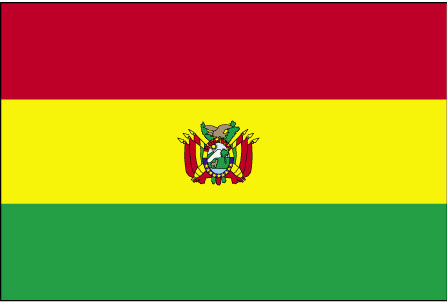
- Flag Symbolism
- three equal horizontal bands of red (top), yellow, and green. The state flag also has a coat of arms centered on the yellow band; similar to the flag of Ghana, which has a large black five-pointed star centered in the yellow band
- Flag History
- Red symbolizes the blood of the national heroes, sacrifice and love. The yellow stands for the mineral resourses and for the Incas, who were the fist to make use of them. Green is a symbol of eternal hope, evolution and progress.
- Date of Adoption
- 14 July 1888
National Anthem
- Anthem Lyrics
- "Canción Patriótica" (Patriotic Song) Bolivianos el hado propicio Coronó nuestros votos y anhelo; Es ya libre, ya libre este suelo, Ya cesó su servil condición. Al estruendo marcial que ayer fuera Y al clamor de la guerra horroroso, Siguen hoy en contraste armonioso Dulces himnos de paz y de unión. Siguen hoy en contraste armonioso Dulces himnos de paz y de unión. CHORUS: De la Patria, el alto nombre En glorioso esplendor conservemos Y en sus aras de nuevo juremos ¡morir antes que esclavos vivir! ¡morir antes que esclavos vivir! ¡morir antes que esclavos vivir! Aqui alzó la justicia su trono, Que la vil opresión desconoca. Y este timbre glorioso legóse. Libertad! Libertad! Libertad! Que los hijos del grande Bolívar Han ya mil y mil veces jurado, Morir antes que ver humillado De la Patria el augusto pendón. CHORUS Loor eterno a los bravos guerreros, Cuyo heroíco valor y firmeza, Conquistaron las glorias que empieza Hoy Bolivia feliz a gozar. Que sus nombres el mármol y el bronce A remotas edades transmitan y en sonoros cantares repitan: Nuestros hijos y nietos a par. CHORUS
- Anthem Lyrics (English)
- Bolivians, a favourable destiny Has crowned our vows and longings; This land is free, Your servile state has ended. The martial turmoil of yesterday And the horrible clamour of war Are followed today, in harmonious contrast, By sweet hymns of peace and unity. Are followed today, in harmonious contrast, By sweet hymns of peace and unity. CHORUS: We have kept the lofty name of our country In glorious splendour, And on its altars we once more swear To die, rather than live as slaves. To die, rather than live as slaves. To die, rather than live as slaves. This innocent and beautiful land, Which owes its name to Bolivar, Is the happy homeland where men Enjoy the benefits of good fortune and peace. For the sons of the great Bolivar Have sworn, thousands upon thousands of times, To die rather than see the country's Majestic flag humiliated. CHORUS Eternal praise to the brave warriors Whose heroic valour and firmness Conquered the glories that now A happy Bolivia begins to enjoy! Let their names, in marble and in bronze, Transmit to remote ages And in resounding song repeat the call: Freedom! Freedom! Freedom! CHORUS
- Anthem History
- The composer of the music (Leopoldo Benedetto Vincenti) is an Italian, which is not that uncommon for "Latin American epic anthems" such as this one, as they often resemble Italian operatic pieces. The author of the lyrics was an ardent patriot, a signer of the Bolivian declaration of Independence and of the first constitution of the country.
Other National Symbols
National Flower
Kantuta (Cantua buxifolia)
a flower found in the high valleys of the yungas, and is considered the National Flower of Bolivia (along with the Patujú - Heliconia rostrata - in the latter case). One variety of kantuta, the kantuta tricolor, has red and yellow petals coming from a green base, the same colors as the Bolivian flag.