
 English
 Español
 中文
中文 हिन्दी
 Français
Government and Politics
Government and Politics of Bhutan
Government structure, leadership, capital, military, and national symbols of Bhutan.
Government Structure
Constitutional foundations, branches, parties, and leadership.
- Government Type
- monarchy; special treaty relationship with India
- Administrative Divisions
- 18 districts (dzongkhag, singular and plural); Bumthang, Chhukha, Chirang, Dagana, Geylegphug, Ha, Lhuntshi, Mongar, Paro, Pemagatsel, Punakha, Samchi, Samdrup Jongkhar, Shemgang, Tashigang, Thimphu, Tongsa, Wangdi Phodrang
- Legal System
- based on Indian law and English common law; has not accepted compulsory ICJ jurisdiction
- Suffrage
- each family has one vote in village-level elections; note - in late 2003 Bhutan's legislature passed a new election law, though no elections have been held
- Citizenship
- citizenship by birth: no citizenship by descent only: the father must be a citizen of Bhutan dual citizenship recognized: no residency requirement for naturalization: 10 years
- Executive Branch
- chief of state: King Jigme Khesar Namgyel WANGCHUCK (since 9 November 2008 coronation; acceded to the throne 15 December 2006 following the abdication of his father) head of government: Prime Minister Tshering TOBGAY (since 28 January 2024, serving his second term) cabinet: Council of Ministers (Lhengye Shungtsog) nominated by the monarch and approved by the National Assembly; members serve fixed five-year terms; a Royal Advisory Council (Lodoi Tsokde) also advises the throne, with members nominated by the monarch elections: the monarch is hereditary; Bhutan transitioned from an absolute to a constitutional monarchy in 2008, with the adoption of a formal constitution that established a parliamentary democracy; the Prime Minister is the leader of the party that wins the majority of seats in the National Assembly through direct popular elections held every five years; the most recent parliamentary elections were held in January 2024
- Legislative Branch
- Bhutan transitioned from a unicameral to a bicameral Parliament following its shift to a constitutional monarchy in 2008. The Parliament now consists of two chambers: the National Assembly (lower house) and the National Council (upper house). The National Assembly has 47 seats, with members elected by proportional representation to serve five-year terms. The National Council has 25 seats, comprising 20 members elected from each of Bhutan's 20 districts and 5 members appointed by the monarch; members also serve five-year terms. Bhutan's first parliamentary elections under the new constitutional framework were held in 2008, marking a historic democratic transition. Subsequent elections have been held on a five-year cycle, with the most recent National Assembly elections held in January 2024, in which the People's Democratic Party won a majority of seats.
- Judicial Branch
- Supreme Court of Appeal (the monarch); High Court (judges appointed by the monarch)
- Political Parties
- no legal parties
- Head of State
- King Jigme Khesar Namgyel WANGCHUCK (since 9 November 2008 coronation
- Head of Government
- Prime Minister Tshering TOBGAY (since 28 January 2024, serving his second term)
- Cabinet
- Council of Ministers (Lhengye Shungtsog) nominated by the monarch, approved by the National Assembly; members serve fixed, five-year terms; note - there is also a Royal Advisory Council (Lodoi Tsokde), members nominated by the monarch
- Election Results
- Bhutan operates as a constitutional monarchy with a parliamentary democratic system established under the Constitution of 2008. The country's legislature consists of a bicameral Parliament composed of the National Assembly (lower house) and the National Council (upper house). The most recent National Assembly elections were held in January 2024, marking Bhutan's fourth general election since the transition to democracy. The Bhutan Tendrel Party (BTP), led by Tshering Tobgay as Prime Minister, won a decisive majority, securing 30 of the 47 seats in the National Assembly. The People's Democratic Party (PDP) had also been a dominant force in earlier cycles. Voter turnout in the 2024 election was reported at approximately 52 percent, reflecting a modest but notable level of civic participation given the country's small electorate of around 480,000 registered voters. The 2024 election followed a two-round system, with a primary round in November 2023 narrowing the field to two parties before the final vote. The Druk Nyamrup Tshogpa (DNT) and the Druk Phuensum Tshogpa (DPT) were eliminated in the primary round, leaving the BTP and PDP to compete in the general round. Bhutan's electoral process is overseen by the Election Commission of Bhutan, an independent constitutional body responsible for ensuring free and fair elections. Political parties in Bhutan are required to be national in character and are prohibited from appealing to religious sentiment or regional identity during campaigning. The National Council, which functions as a house of review, consists of 25 members — 20 elected from Bhutan's 20 districts (Dzongkhags) and five appointed by the King. National Council elections are held separately and are non-partisan in nature, with candidates running as individuals rather than under party affiliation. Since the introduction of multiparty democracy, Bhutan has conducted its elections peacefully, and power has transferred between parties through the ballot box, demonstrating the country's gradual consolidation of democratic governance within its unique cultural and monarchical framework.
- Constitution
- no written constitution or bill of rights; note - in 2001 the King commissioned the drafting of a constitution, which is to become effective in 2005
- Independence
- 8 August 1949 (from India)
- National Holiday
- National Day (Ugyen WANGCHUCK became first hereditary king), 17 December (1907)
- International Organization Participation
- AsDB, CP, FAO, G-77, IBRD, ICAO, IDA, IFAD, IMF, IOC, IOM (observer), ITU, NAM, OPCW (signatory), SAARC, UN, UNCTAD, UNESCO, UNIDO, UPU, WCO, WHO, WIPO, WMO, WToO, WTrO (observer)
- Diplomatic Representation in the U.S.
- none; note - Bhutan has a Permanent Mission to the UN; address: 2 United Nations Plaza, 27th Floor, New York, NY 10017; telephone [1] (212) 826-1919; FAX [1] (212) 826-2998; the Bhutanese mission to the UN has consular jurisdiction in the US consulate(s) general: New York
- U.S. Diplomatic Representation
- the US and Bhutan have no formal diplomatic relations, although informal contact is maintained between the Bhutanese and US Embassy in New Delhi (India)
Capital City
Seat of government and political history.
- Capital City
- Thimphu
- Location
- 27 28 N, 89 38 E
- Time Difference
- UTC+6 (11 hours ahead of Washington, DC, during Standard Time)
- History
- the origins of the name are unclear; the traditional explanation, dating to the 14th century, is that thim means "dissolve" and phu denotes "high ground" to express the meaning of "dissolving high ground," in reference to a local deity that dissolved before a traveler's eyes, becoming a part of the rock on which the present city stands
Embassy and Diplomatic Representation
Embassy location and contact details.
There is no U.S. Embassy or Consulate in Bhutan. Although no formal diplomatic relations exist between the United States and Bhutan, engagement is maintained through the U.S. Embassy in New Delhi, India. Updated information on travel and security in Bhutan may be obtained at the U.S. Embassy in New Delhi. The U.S. Embassy in New Delhi is located on Shanti Path, Chanakya Puri, New Delhi 110 021, India, telephone (91)(11) 2419-8000, fax (91)(11) 2419-8407. In the case of an emergency involving a U.S. citizen, please call the 24-hour operator at (91)(11) 2419-8000 and ask for American Citizen Services.
Military
Branches, service obligations, expenditures, and manpower.
- Military Branches
- Royal Bhutan Army (includes Royal Bodyguard and Royal Bhutan Police)
- Service Age and Obligation
- 18 years of age for voluntary military service; no conscription; militia training is compulsory for males aged 20-25, over a 3-year period
National Symbols
Flag, anthem, and other symbols of national identity.
National Flag
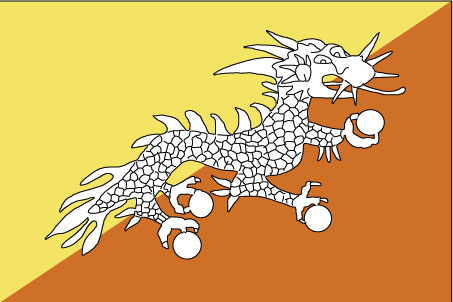
- Flag Symbolism
- The rectangular national flag of Bhutan is diagonally segmented and depicts a white dragon across the middle. The upper part of the flag is golden yellow, which represents the secular power of the king. The lower part, which is orange, indicates the Bhuddist influence. The dragon, whose white colour is associated with purity, represents Bhutan. The jewels it holds in its claws represent the wealth and perfection of the country.
- Date of Adoption
- 1969
National Anthem
- Anthem Lyrics
- Druk tsendhen Druk tsendhen koipi gyelkhap na Loog ye ki tenpa chongwai gyon Pel mewang ngadhak rinpo chhe Ku jurmey tenching chhap tsid pel Chho sangye ten pa goong dho gyel Bang che kyed nyima shar warr sho.
- Anthem Lyrics (English)
- In the Thunder Dragon Kingdom, where cypresses grow Refuge of the glorious monastic and civil traditions, The King od Druk, precious soverign, His being is eternal, his reign prosperous The enlightenment teachings thrive and flourish May the people shine like the sun of peace and happiness!
- Anthem History
- "Druk tsendhen" (The Thunder Dragon Kingdom) is how Bhutanese also refer to their country. The music is reminiscent of the native style of music in that region. The composer of the anthem was trained in India, becoming that country's first bandmaster. After his return to Bhutan, the Indian prime minsiter paid a visit to the country, and the anthem was composed for the occassion, on the request of the Bhutanese king. The original tune was based on the folk song "thri nyampa med pa pemai thri" ("The Unchanging Lotus Throne"). An interesting note is that the folk song has choreography that goes along with it, making this possibly the only national anthem to be based on a choreographical work.
Other National Symbols
National Flower
Blue poppy (Meconopsis betonicifolia)
National Tree
Bhutan Cypress (Cupressus cashmeriana)