
 English
 Español
 中文
中文 हिन्दी
 Français
Government and Politics
Government and Politics of Austria
Government structure, leadership, capital, military, and national symbols of Austria.
Government Structure
Constitutional foundations, branches, parties, and leadership.
- Government Type
- federal republic
- Administrative Divisions
- 9 states (Bundeslaender, singular - Bundesland); Burgenland, Kaernten, Niederoesterreich, Oberoesterreich, Salzburg, Steiermark, Tirol, Vorarlberg, Wien
- Legal System
- civil law system with Roman law origin; judicial review of legislative acts by the Constitutional Court; separate administrative and civil/penal supreme courts; accepts compulsory ICJ jurisdiction
- Suffrage
- 18 years of age; universal; compulsory for presidential elections
- Citizenship
- citizenship by birth: no citizenship by descent only: at least one parent must be a citizen of Austria dual citizenship recognized: no residency requirement for naturalization: 10 years
- Executive Branch
- chief of state: President Alexander VAN DER BELLEN (since 26 January 2017; re-elected December 2022) head of government: Chancellor Karl NEHAMMER (OeVP) (since 6 January 2022); Vice Chancellor Werner KOGLER (Greens) (since 7 January 2020) cabinet: Council of Ministers chosen by the president on the advice of the chancellor elections: president elected by direct popular vote for a six-year term; presidential election last held on 9 October 2022 (next to be held in 2028); chancellor traditionally chosen by the president from the plurality party in the National Council; vice chancellor chosen by the president on the advice of the chancellor election results: Alexander VAN DER BELLEN re-elected president in the first round; percent of vote - Alexander VAN DER BELLEN (independent) 56.7%, Walter ROSENKRANZ (FPOe) 17.7%, other candidates combined 25.6% note: government coalition - OeVP and Greens
- Legislative Branch
- Bicameral Federal Assembly or Bundesversammlung consists of the Federal Council or Bundesrat (61 members; members represent each of the nine states on the basis of population, but with each state having at least 3 representatives; members serve terms corresponding to the legislative period of the respective state parliament) and the National Council or Nationalrat (183 seats; members elected by direct popular vote to serve five-year terms). Elections: National Council - last held on 29 September 2024 (next to be held in 2029). Election results: National Council - percent of vote by party - FPOe 28.8%, OeVP 26.3%, SPOe 21.1%, NEOS 9.0%, Greens 8.2%; seats by party - FPOe 57, OeVP 51, SPOe 41, NEOS 18, Greens 16. Following coalition negotiations, the OeVP, SPOe, and NEOS formed a three-party coalition government in January 2025, marking the first time the Freedom Party was excluded from government formation despite finishing first in the election.
- Judicial Branch
- Supreme Judicial Court or Oberster Gerichtshof; Administrative Court or Verwaltungsgerichtshof; Constitutional Court or Verfassungsgerichtshof
- Political Parties
- Alliance for the Future of Austria or BZOe [Joerg HAIDER]; Austrian People's Party or OeVP [Wolfgang SCHUESSEL]; Freedom Party of Austria or FPOe [Heinz Christian STRACHE]; Social Democratic Party of Austria or SPOe [Alfred GUSENBAUER]; The Greens [Alexander VAN DER BELLEN]
- Head of State
- President Alexander VAN DER BELLEN (since 26 January 2017
- Head of Government
- Chancellor Karl NEHAMMER (OeVP)
- Cabinet
- Council of Ministers chosen by the president on the advice of the chancellor
- Elections
- National Council - last held on 29 September 2024 (next to be held in 2029).
- Election Results
- National Council - percent of vote by party - FPOe 28.8%, OeVP 26.3%, SPOe 21.1%, NEOS 9.0%, Greens 8.2%; seats by party - FPOe 57, OeVP 51, SPOe 41, NEOS 18, Greens 16. Following extended coalition negotiations, the OeVP, SPOe, and NEOS formed a three-party coalition government in January 2025, with OeVP leader Herbert Kickl's FPOe passed over despite finishing first. This marked the first time in Austrian post-war history that a party winning the most votes was excluded from government formation. OeVP's Karl Nehammer was designated Chancellor to lead the new coalition.
- Constitution
- 1920; revised 1929 (reinstated 1 May 1945)
- Independence
- 1156 (from Bavaria)
- National Holiday
- National Day, 26 October (1955); note - commemorates the State Treaty restoring national sovereignty and the end of occupation and the passage of the law on permanent neutrality
- International Organization Participation
- AfDB, AsDB, Australia Group, BIS, BSEC (observer), CE, CEI, CERN, EAPC, EBRD, EIB, EMU, ESA, EU, FAO, G- 9, IADB, IAEA, IBRD, ICAO, ICC, ICCt, ICFTU, ICRM, IDA, IEA, IFAD, IFC, IFRCS, ILO, IMF, IMO, Interpol, IOC, IOM, ISO, ITU, MINURSO, NAM (guest), NEA, NSG, OAS (observer), OECD, OPCW, OSCE, Paris Club, PCA, PFP, UN, UNCTAD, UNDOF, UNESCO, UNFICYP, UNHCR, UNIDO, UNITAR, UNMEE, UNMIK, UNMISET, UNOMIG, UNTSO, UPU, WCL, WCO, WEU (observer), WFTU, WHO, WIPO, WMO, WToO, WTrO, ZC
- Diplomatic Representation in the U.S.
- chief of mission: Ambassador Eva NOWOTNY chancery: 3524 International Court NW, Washington, DC 20008-3035 telephone: [1] (202) 895-6700 FAX: [1] (202) 895-6750 consulate(s) general: Chicago, Los Angeles, New York
- U.S. Diplomatic Representation
- chief of mission: Ambassador Susan R. McCAW embassy: Boltzmanngasse 16, A-1090, Vienna mailing address: use embassy street address telephone: [43] (1) 31339 FAX: [43] (1) 3100682
Capital City
Seat of government and political history.
- Capital City
- Vienna
- Location
- 48 12 N, 16 22 E
- Time Difference
- UTC+1 (6 hours ahead of Washington, DC, during Standard Time)
- History
- the origin of the name is disputed but may derive from early Celtic settlements of the area; a plausible reconstructed Celtic name from several centuries B.C. is Vedunia (meaning "forest stream"), which in Old High German became uuenia (wenia), and later wien (its current German form) in New High German; another possibility is that the name stems from the Roman settlement Vindobona, established around 15 B.C., and its Celtic-derived name (likely from the Celtic windo, meaning "white, fair, or bright" and bona meaning "base, fortification, or settlement" to give a connotation of "white settlement" or "white fort"); archeological remains of the latter survive at many sites in the center of Vienna
Embassy and Diplomatic Representation
Embassy location and contact details.
EMBASSY LOCATION: U.S. Embassy in Vienna, Consular Section Parkring 12a Telephone: 43- 1-31339-7535 After hours: 43-1-31339 Facsimile: 43-1-512 58 35 E-mail: ConsulateVienna@state.gov
Military
Branches, service obligations, expenditures, and manpower.
- Military Branches
- Land Forces (KdoLdSK), Air Forces (KdoLuSK)
- Service Age and Obligation
- Registration requirement at age 17, the legal minimum age for voluntary military service; 18 is the legal minimum age for compulsory service; males under the age of 35 must complete basic military training (6-month duration); males 18 to 50 years old in the militia or inactive reserve are subject to compulsory service
National Symbols
Flag, anthem, and other symbols of national identity.
National Flag
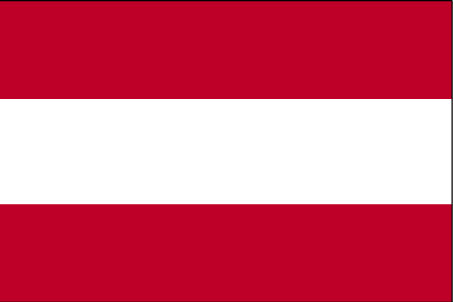
- Flag Symbolism
- has three equal horizontal bands of red (top), white, and red. The flag appeared under Duke Friedrich II and a seal in use after November 30, 1230, and a seal dated December 18, 1254, shows the Austrian standard bearer with the same flag. Legend has it that the colors were granted Duke Leopold V (1177-1194) by King Heinrich VI at the battle of Ptolemais in 1191, when Leopold's tunic was so blood-drenched that the only white color remaining was on that part of his tunic shielded by his sword belt These colors were declared as the national flag of Austria by Emperor Joseph II on March 20, 1786. Most recently the colours were officially adopted October 21 1919 in the Federal Constitution by the new Austrian Republic based on the flag of the Babenberg dynasty
- Date of Adoption
- Oct 21, 1919
National Anthem
- Anthem Lyrics
- Land der Berge, Land am Strome, Land der Äcker, Land der Dome, Land der Hämmer zukunftsreich! Heimat bist du großer Söhne, Volk begnadet für das Schöne, Vielgerühmtes Österreich, Vielgerühmtes Österreich! Heiß umfehdet, wild umstritten, Liegst dem Erdteil du inmitten Einem starken Herzen gleich. Hast seit frühen Ahnentagen Hoher Sendung Last getragen, Vielgeprüftes Österreich, Vielgeprüftes Österreich. Mutig in die neuen Zeiten, Frei und gläubig sieh uns schreiten, Arbeitsfroh und hoffnungsreich Einig laß in Bruderchören, Vaterland, dir Treue schwören. Vielgeliebtes Österreich, Vielgeliebtes Österreich.
- Anthem History
- After the first world war and the dissolution of Austria-Hungary, Austria's ties to Germany became stronger, and the melody of Austria's anthem was now being used in Germany as well, and Austria was eventually annexed by Germany in 1938. On 9 April 1946, the Austrian Federal Government announced a competition for the text of a new national anthem. It was to be "a song of hymn-like character paying tribute in words and music to the new Austrian federal state and its people both at home and abroad." The old anthem, now being used by Germany, could not be used because of its association with the Nazi regime. Agreement was soon reached on the melody; popular belief is that it is a work from Austrian composer Wolfgang Amadeus Mozart, but study has shown that it was not. They believe that evidence points instead to his contemporary Johann Holzer. Minister of Education Felix Hurdes persuaded his mother, the writer --herself the granddaughter of a Croatian national poet--to submit an entry for the competition. However, she was busy working on a new novel, had little time to spare for her entry, and Education Minister Hurdes had to jog her memory several times. When her unaffected, affecting lines did finally reach the jury--made up of literary figures, musicians and politicians--they awarded her text the highest points. The text was never published in the official Legal Gazette but appeared in the 22 March 1947 issue of the Die Presse newspaper. Two weeks earlier the anthem had been played on the radio. It established its popularity relatively fast, although the melody was considerably more complex than that of the former anthem. When Education Minister Hurdes reported to the cabinet on the outcome of the competition, the cabinet passed a motion--at the instigation of the Federal President--that in the course of the State Treaty negotiations Austria should insist that "Germany be prohibited from using the Haydn anthem because it is a long-standing Austrian cultural asset."
Other National Symbols
National Flower
Edelweiss
Flowering stalks of edelweiss can grow to a size of 3-20 cm (in cultivation, up to 40 cm). The leaves appear woolly because of the covering of white hairs. The flowers are felted and woolly with white hairs, with characteristic bloom consisting of five to six small yellow flower heads (5 mm) surrounded by leaflets in star form. The flowers are in bloom between July and September. It is unequally distributed and prefers rocky limestone places at 2000-2900 m altitude. It is not toxic, but has been used traditionally in folk medicine as a remedy against abdominal and respiratory diseases.