
 English
 Español
 中文
中文 हिन्दी
 Français
Government and Politics
Government and Politics of Australia
Government structure, leadership, capital, military, and national symbols of Australia.
Government Structure
Constitutional foundations, branches, parties, and leadership.
- Government Type
- democratic, federal-state system recognizing the British monarch as sovereign
- Administrative Divisions
- 6 states and 2 territories*; Australian Capital Territory*, New South Wales, Northern Territory*, Queensland, South Australia, Tasmania, Victoria, Western Australia
- Legal System
- based on English common law; accepts compulsory ICJ jurisdiction, with reservations
- Suffrage
- 18 years of age; universal and compulsory
- Citizenship
- citizenship by birth: no citizenship by descent only: at least one parent must be a citizen or permanent resident of Australia dual citizenship recognized: yes residency requirement for naturalization: 4 years
- Executive Branch
- chief of state: King of Australia CHARLES III (since 8 September 2022), represented by Governor General Sam MOSTYN (since 1 July 2024) head of government: Prime Minister Anthony ALBANESE (since 23 May 2022); Deputy Prime Minister Richard MARLES (since 23 May 2022) cabinet: prime minister nominates, from among members of Parliament, candidates who are subsequently sworn in by the governor general to serve as government ministers elections: none; the monarch is hereditary; governor general appointed by the monarch on the recommendation of the prime minister; following legislative elections, the leader of the majority party or leader of a majority coalition is sworn in as prime minister by the governor general note: the ruling government coalition consists of the Australian Labor Party, which holds a majority in the House of Representatives
- Legislative Branch
- Bicameral Federal Parliament consists of the Senate (76 seats — 12 from each of the six states and 2 from each of the two mainland territories; one-half of state members are elected every three years by popular vote to serve six-year terms, while all territory members are elected every three years by popular vote to serve three-year terms) and the House of Representatives (151 seats; members elected by preferential voting to serve terms of up to three years; no state can have fewer than 5 representatives). Elections: Senate — last held 21 May 2022 (next to be held no later than May 2025); House of Representatives — last held 21 May 2022 (next to be held no later than May 2025). Election results: Senate — seats by party — Australian Labor Party 26, Liberal Party 24, Australian Greens 11, National Party 6, One Nation 2, Liberal Democratic Party 1, Jacqui Lambie Network 2, United Australia Party 1, independents 3; House of Representatives — seats by party — Australian Labor Party 77, Liberal Party 38, National Party 16, Australian Greens 4, independents and others 16.
- Judicial Branch
- High Court (the chief justice and six other justices are appointed by the governor general)
- Political Parties
- Australian Democrats [Lyn ALLISON]; Australian Greens [Bob BROWN]; Australian Labor Party [Kim BEAZLEY]; Country Liberal Party [Jodeen CARNEY]; Family First Party [Steve FIELDING]; Liberal Party [John Winston HOWARD]; The Nationals [Mark VAILE]
- Head of State
- King of Australia CHARLES III, represented by Governor General Sam MOSTYN
- Head of Government
- Prime Minister Anthony ALBANESE
- Cabinet
- prime minister nominates, from among members of Parliament, candidates who are subsequently sworn in by the governor general to serve as government ministers
- Elections
- Senate — last held 21 May 2022 (next to be held no later than May 2025); House of Representatives — last held 21 May 2022 (next to be held no later than May 2025).
- Election Results
- Senate — seats by party — Australian Labor Party 25, Liberal Party 24, Australian Greens 11, National Party 7, One Nation 2, Jacqui Lambie Network 2, David Pocock (independent) 1, Libertarian Party 1, independents and others 4; House of Representatives — seats by party — Australian Labor Party 77, Liberal Party 38, National Party 16, Australian Greens 4, independents and others 16.
- Constitution
- 9 July 1900, effective 1 January 1901
- Independence
- 1 January 1901 (federation of UK colonies)
- National Holiday
- Australia Day, 26 January (1788)
- International Organization Participation
- ANZUS, APEC, ARF, AsDB, ASEAN (dialogue partner), Australia Group, BIS, C, CP, EBRD, FAO, IAEA, IBRD, ICAO, ICC, ICCt, ICFTU, ICRM, IDA, IEA, IFAD, IFC, IFRCS, IHO, ILO, IMF, IMO, Interpol, IOC, IOM, ISO, ITU, NAM (guest), NEA, NSG, OECD, OPCW, Paris Club, PCA, PIF, Sparteca, UN, UNCTAD, UNESCO, UNHCR, UNMEE, UNMISET, UNTSO, UPU, WCO, WFTU, WHO, WIPO, WMO, WTrO, ZC
- Diplomatic Representation in the U.S.
- chief of mission: Ambassador Dennis J. RICHARDSON chancery: 1601 Massachusetts Avenue NW, Washington, DC 20036 telephone: [1] (202) 797-3000 FAX: [1] (202) 797-3168 consulate(s) general: Atlanta, Chicago, Honolulu, Los Angeles, New York, San Francisco
- U.S. Diplomatic Representation
- chief of mission: Ambassador (vacant); Charge d'Affaires ad interim William A. STANTON embassy: Moonah Place, Yarralumla, Canberra, Australian Capital Territory 2600 mailing address: APO AP 96549 telephone: [61] (02) 6214-5600 FAX: [61] (02) 6214-5970 consulate(s) general: Melbourne, Perth, Sydney
Capital City
Seat of government and political history.
- Capital City
- Canberra
- Location
- 35 16 S, 149 08 E
- Time Difference
- UTC+10 (14 hours ahead of Washington, DC, during Standard Time) time zone note: Australia has four time zones, including Lord Howe Island (UTC+10:30)
- History
- the name is claimed to derive from either Kambera or Camberry, which are names corrupted from the original native designation for the area "Nganbra" or "Nganbira"
Embassy and Diplomatic Representation
Embassy location and contact details.
Australian Capital Territory (ACT) or Queanbeyan: U.S. Embassy in Canberra Moonah Place Yarralumla, ACT 2600 Telephone: (61) (2) 6214- 5600 Emergency after-hours telephone: (61) (2) 411-424-608 Facsimile: (61) (2) 6214-5970 NOTE: The U.S. Embassy in Canberra only provides emergency assistance for U.S. citizens in the ACT. The U.S. Embassy does not issue U.S. passports or visas. Passports and other routine citizen services for Canberra and the rest of the ACT are provided by the U.S. Consulate General in Sydney (see contact information below). New South Wales, Norfolk Island, Lord Howe Island, and Queensland: U.S. Consulate General Sydney Level 10, MLC Centre, 19-29 Martin Place, Sydney, NSW 2000 Telephone: (61) (2) 9373-9200 Emergency after-hours telephone: (61) (2) 4422-2201 Facsimile: (61) (2) 9373-9184 Email: SydneyACS@state.gov NOTE: The Consulate General offers an online appointment system for U.S. citizens seeking routine non-emergency services such as registration, passport, and other consular services. To make an appointment, visit their website. Hours open to the public: 8:00 a.m. to 11:30 a.m., Monday to Friday (except U.S. and Australian holidays and the first Wednesday of each month). For emergency services (e.g., the arrest, death, or serious injury of a U.S. citizen) after 5:00 p.m. on weekdays, holidays and weekends, please call (61) (2) 4422-2201. Victoria, Tasmania, South Australia, and the Northern Territory: U.S. Consulate General Melbourne 553 St. Kilda Road, Melbourne, VIC 3004 Telephone: (61) (3) 9526-5900 Emergency after-hours telephone: (61) (3) 9389-3601 Facsimile: (61) (3) 9525-0769 Email: MelbourneACS@state.gov NOTE: The U.S. Consulate General offers an online appointment system for U.S. citizens seeking routine non-emergency services such as registration, passport, and other consular services. To make an appointment, visit their website. Hours open to the public: 8:00 am – 3:30 pm Monday to Friday. All services other than emergencies require an appointment. For emergency services (e.g., the arrest, death, or serious injury of a U.S. citizen) after 4:30 p.m. or on holidays and weekends, please call (61) (3) 9389-3601. Western Australia: U.S. Consulate General Perth 16 St. Georges Terrace, Perth WA 6000 Telephone: (61)(8) 6144- 5100 Emergency after-hours telephone: (61) (8) 9476-0081 Facsimile: (61)(8) 9231-9444 Email: PerthACS@state.gov NOTE: The Consulate General offers an online appointment system for U.S. citizens seeking routine non-emergency services such as registration, passport, and other consular services. To make an appointment, please visit the Consulate's website. Hours open to the public for American Citizen Services: 8:30 to 11:30 a.m., Monday through Thursday. For emergency services (e.g., the arrest, death, or serious injury of a U.S. citizen) outside of business hours, please call (61) (8) 9476-0081.
Military
Branches, service obligations, expenditures, and manpower.
- Military Branches
- Australian Defense Force (ADF): Australian Army; Royal Australian Navy (includes Naval Aviation Force); Royal Australian Air Force; Joint Operations Command (JOC)
- Service Age and Obligation
- 17 years of age for voluntary military service (with parental consent); no conscription; women allowed to serve in most combat roles, except the Army special forces
National Symbols
Flag, anthem, and other symbols of national identity.
National Flag
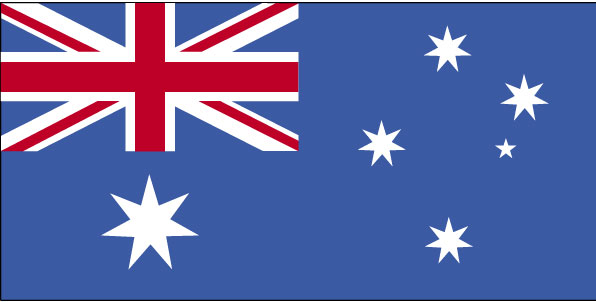
- Flag Symbolism
- is blue with the flag of the UK in the upper hoist-side quadrant and a large seven-pointed star in the lower hoist-side quadrant known as the Commonwealth Star, representing the federation of the colonies of Australia in 1901; the star depicts one point for each of the six original states and one representing all of Australia's internal and external territories; the remaining half is a representation of the Southern Cross constellation in white with one small five-pointed star and four larger, seven-pointed stars The Australian Flag comprises three distinct parts: the Southern Cross, the Commonwealth Star and the Union Jack. The background of the flag is blue. On the right-hand side are the five white stars that make up the Southern Cross constellation as seen in the skies of the Southern Hemisphere. Four of the stars have seven points, and one has five. The large white star in the bottom left-hand corner has seven points, one for each of the six states and one for the territories. This symbolic star is called the Commonwealth Star. In the upper left-hand corner is the Union Jack, Great Britain's flag. Australia has kept the Union Jack in its flag as a reminder of where many of the early settlers came from and because Australia is a member of the British Commonwealth.
- Flag History
- When Australia became an independent nation in 1901 it needed a flag to identify itself to the world. A competition to design a national flag was won by five strikingly similar designs. Apart from a minor change in 1908, the flag has remained unchanged since then. The flag first flew from the Exhibition Building in Melbourne on 3 September 1901. This date has been set aside as Australian National Flag Day. The flag has accompanied Australians to the ends of the earth - it has been with them to war and on missions of peace; it is often seen on sporting fields of the world and on the roof of the world, and currently flies in Antarctica and in East Timor.
- Date of Adoption
- The Australian national flag was declared the flag of Australia under the Flags Act 1953.
National Anthem
- Anthem Lyrics
- (Note: Current anthem only uses 1st & 3rd verses when being sung.) Australians all let us rejoice, For we are young and free; We’ve golden soil and wealth for toil, Our home is girt by sea; Our land abounds in Nature’s gifts Of beauty rich and rare; In history’s page, let every stage Advance Australia fair! In joyful strains then let us sing, “Advance Australia fair!” When gallant Cook from Albion sail’d, To trace wide oceans o’er, True British courage bore him on, Till he landed on our shore. Then here he raised Old England’s flag, The standard of the brave; With all her faults we love her still, “Britannia rules the wave!” In joyful strains then let us sing, “Advance Australia fair!” Beneath our radiant southern Cross, We’ll toil with hearts and hands; To make this Commonwealth of ours Renowned of all the lands; For those who’ve come across the seas We’ve boundless plains to share; With courage let us all combine To advance Australia fair, In joyful strains then let us sing, “Advance Australia fair!” While other nations of the globe Behold us from afar, We’ll rise to high renown and shine Like our glorious southern star; From England, Scotia, Erin’s Isle, Who come our lot to share, Let all combine with heart and hand to Advance Australia fair! In joyful strains then let us sing, “Advance Australia fair!” Should foreign foe e’er sight our coast, Or dare a foot to land, We’ll rouse to arms like sires of yore To guard our native strand; Britannia then shall surely know, Beyond wide oceans roll, Her sons in fair Australia’s land Still keep a British soul. In joyful strains then let us sing, “Advance Australia fair!”
- Anthem History
- In 1974 the Australian Bureau of Statistics conducted a national opinion poll of 60,000 and in 1977 a plebiscite for a national song was conducted. On each occasion, Advance Australia Fair was the preferred option, and it was in consideration of such support that Advance Australia Fair was proclaimed as the national anthem by the Governor-General on 19 April 1984. It is usually the first and third verses that are sung
Other National Symbols
National Flower
When in flower, the golden wattle displays the national colours, green and gold. <P>As one species of a large genus of flora growing across Australia, the golden wattle is a symbol of unity. Wattle is purpose-built to withstand Australia’s droughts, winds and bushfires. The resilience of wattle represents the spirit of the Australian people. <P>In recent times, the golden wattle has been used as a symbol of remembrance and reflection. On national days of mourning, for example, Australians are invited to wear a sprig of wattle. <P>The golden wattle has been used in the design of Australian stamps and many awards in the Australian honors system. A single wattle flower is the emblem of the Order of Australia.
National Flower
Golden Wattle (Acacia pycnantha Benth.).
When in flower, the golden wattle displays the national colours, green and gold. <P>As one species of a large genus of flora growing across Australia, the golden wattle is a symbol of unity. Wattle is purpose-built to withstand Australia’s droughts, winds and bushfires. The resilience of wattle represents the spirit of the Australian people. <P>In recent times, the golden wattle has been used as a symbol of remembrance and reflection. On national days of mourning, for example, Australians are invited to wear a sprig of wattle. <P>The golden wattle has been used in the design of Australian stamps and many awards in the Australian honors system. A single wattle flower is the emblem of the Order of Australia.
Gemstone
opal
Australia's national gemstone is the opal, a stone famous across the world for its brilliant colours. <P>In Indigenous stories, a rainbow created the colours of the opal when it touched the earth. <P>Opal, also known to Indigenous people as the fire of the desert, is a powerful symbol of Australia's arid interior. <P>Australia is home to the world's highest quality, precious opal. The most famous is black opal from Lightning Ridge in New South Wales. Black opal has a colour play of red, green, blue, violet, magenta or yellow against a dark background. <P>Australia's opal fields are bigger than those found in the rest of the world combined. Opal production was worth $71.4 million to Australia in 2003 and supports many communities in South Australia, New South Wales and Queensland. <P>Australian opals are valued for their stability as well as brilliance. Opals from other countries are associated with volcanic rock and have high water content and tend to crack or craze during cutting or polishing, or during hot or dry conditions. <P>Australia's precious opals include black opal, white opal, crystal opal, fire opal and boulder opal. Proclamation <P>The Governor-General, the Hon Bill Hayden AC, proclaimed the opal Australia's national gemstone on 27 July 1993.
National Flower
Golden Wattel
Adopted: August 19, 1988
Acacia pycnantha, Golden Wattle, is a shrub or small tree about 4 to 8 metres tall. After the seedling stage, true leaves are absent, their function being performed by phyllodes which are modified flattened leaf stalks lacking leaf blades. The leathery phyllodes are 6 to 20 cm long, broadly lance or sickle-shaped and bright green in colour. In spring large fluffy golden-yellow flower-heads with up to eighty minute sweetly scented flowers provide a vivid contrast with the foliage. The dark brown mature fruit, 7 to 12 cm long, splits along one side to release the seeds. Golden Wattle occurs in the understorey of open forest or woodland and in open scrub formations in South Australia, Victoria, New South Wales and the Australian Capital Territory, in temperate regions with mean annual rainfall of 350 mm to 1000 mm. It has been introduced into the Stirling Ranges near Perth where it threatens to become weedy. It regenerates freely after fires, which usually kill the parent plants but stimulate the germination of seeds stored in the soil if rain follows soon after. Regeneration may produce dense thickets in forests and woodlands and along roadsides. The brilliant yellow, fragrant flowers of Golden Wattle make it a popular garden plant. It is moderately frost tolerant and grows well in a wide range of soils provided drainage is effective, but tends to be short-lived in cultivation. It is easily propagated from seed soaked in hot water to break the hard seed coat, and the seedlings can be transplanted to pots of soil mix for growing on before planting out in a lightly shaded or open position. Golden Wattle is grown abroad in temperate regions for its bark which has a higher content of tannin than other species of Acacia cultivated for tanbark, although its relatively small size reduces the overall yield. Golden Wattle flowers have been used in perfume making. It was introduced to horticulture in the northern hemisphere about the middle of the nineteenth century. In Britain it survives outdoors only in the mildest areas. In California it has escaped from garden cultivation and now grows wild but it is not considered a pest. In South Africa, however, it has become a significant weed species.
National Flower
Golden Wattel
Adopted: August 19, 1988
Acacia pycnantha, Golden Wattle, is a shrub or small tree about 4 to 8 metres tall. After the seedling stage, true leaves are absent, their function being performed by phyllodes which are modified flattened leaf stalks lacking leaf blades. The leathery phyllodes are 6 to 20 cm long, broadly lance or sickle-shaped and bright green in colour. In spring large fluffy golden-yellow flower-heads with up to eighty minute sweetly scented flowers provide a vivid contrast with the foliage. The dark brown mature fruit, 7 to 12 cm long, splits along one side to release the seeds. Golden Wattle occurs in the understorey of open forest or woodland and in open scrub formations in South Australia, Victoria, New South Wales and the Australian Capital Territory, in temperate regions with mean annual rainfall of 350 mm to 1000 mm. It has been introduced into the Stirling Ranges near Perth where it threatens to become weedy. It regenerates freely after fires, which usually kill the parent plants but stimulate the germination of seeds stored in the soil if rain follows soon after. Regeneration may produce dense thickets in forests and woodlands and along roadsides. The brilliant yellow, fragrant flowers of Golden Wattle make it a popular garden plant. It is moderately frost tolerant and grows well in a wide range of soils provided drainage is effective, but tends to be short-lived in cultivation. It is easily propagated from seed soaked in hot water to break the hard seed coat, and the seedlings can be transplanted to pots of soil mix for growing on before planting out in a lightly shaded or open position. Golden Wattle is grown abroad in temperate regions for its bark which has a higher content of tannin than other species of Acacia cultivated for tanbark, although its relatively small size reduces the overall yield. Golden Wattle flowers have been used in perfume making. It was introduced to horticulture in the northern hemisphere about the middle of the nineteenth century. In Britain it survives outdoors only in the mildest areas. In California it has escaped from garden cultivation and now grows wild but it is not considered a pest. In South Africa, however, it has become a significant weed species.
Coat of Arms
Adopted: 1912
The Australian Coat of Arms was granted by King George V in 1912. It consists of a shield containing the badges of the six Australian States, enclosed by an ermine border. The shield is a symbol for the federation of the States, which took place in 1901.The Crest, the device above the shield and helmet on a coat of arms, in this instance is a seven-pointed gold star on a blue and gold wreath. Six of the points represent each of the States of the Commonwealth, the seventh point represents the Commonwealth Territories.The Supporters are native Australian animals: the red kangaroo (Macropus rufus) and the emu (Dromaius novaehollandiae). Usually the Arms is depicted on a background of sprays of golden wattle (Acacia pycnantha) with a scroll beneath it containing the word “Australia”. The wattle and scroll, however, are not part of the armorial design and are not mentioned in the Royal Warrant.The first official coat of arms of Australia was granted by a Royal Warrant of King Edward VII in 1908. This Coat of Arms was used on some Australian coins after it was superseded and last appeared on the sixpenny piece in 1966. The Australian Government uses the Coat of Arms to authenticate documents and for other official purposes. Its uses range from embellishing the Australian passport to being widely recognised as the badge on the new test-series cricket helmet.Australia has never adopted any official motto or faunal or bird emblem. By popular tradition, however, the kangaroo and emu are widely accepted as national faunal and bird emblems.For many years, the motto “Advance Australia” appeared on unofficial Coats of Arms, even before the Federation of the States in 1901. It was included in the 1908 Arms, and was popularly accepted in association with the 19th century song “Advance Australia Fair”. A revised version of this song officially became Australia’s national anthem in 1984. The Australian Coat of Arms consists of the Badges of the six States of the Commonwealth arranged on a shield in two rows of three columns: New South Wales – Golden Lion passant (right to left) on a red St George’s Cross on a silver background (usually depicted white), with an 8-pointed star on each extremity of the cross. Victoria – White Southern Cross (one star of 8 points, 2 of 7 points one of 6 points and one of 5 points), beneath an Imperial Crown, on a blue background. Queensland – light blue Maltese Cross with an Imperial Crown at its Centre, on a white background. South Australia – the White-Backed Magpie (or Piping Shrike), erect, wings outstretched, on a yellow background. Western Australia – Black Swan swimming, left to right, on a yellow background. Tasmania – Red Lion passant (right to left) on a white background.