
 English
 Español
 中文
中文 हिन्दी
 Français
Government and Politics
Government and Politics of Armenia
Government structure, leadership, capital, military, and national symbols of Armenia.
Government Structure
Constitutional foundations, branches, parties, and leadership.
- Government Type
- republic
- Administrative Divisions
- 11 provinces (marzer, singular - marz); Aragatsotn, Ararat, Armavir, Geghark'unik', Kotayk', Lorri, Shirak, Syunik', Tavush, Vayots' Dzor, Yerevan
- Legal System
- based on civil law system
- Suffrage
- 18 years of age; universal
- Citizenship
- citizenship by birth: no citizenship by descent only: at least one parent must be a citizen of Armenia dual citizenship recognized: yes residency requirement for naturalization: 3 years
- Executive Branch
- chief of state: President Vahagn KHACHATURYAN (since 13 March 2022) head of government: Prime Minister Nikol PASHINYAN (since 8 May 2018, reconfirmed following subsequent elections) cabinet: Council of Ministers appointed by the prime minister elections: president elected by the National Assembly for a seven-year term (eligible for a single term); election last held on 2 March 2022 (next to be held in 2029); prime minister nominated by the parliamentary majority and appointed by the president following National Assembly elections election results: Vahagn KHACHATURYAN elected president by the National Assembly; Nikol PASHINYAN's Civil Contract party won a majority in the June 2021 parliamentary elections, securing his continued tenure as prime minister
- Legislative Branch
- Unicameral National Assembly (Parliament) or Azgayin Zhoghov (105 seats; members elected by proportional representation from party lists to serve five-year terms; a party must receive at least 5% of the vote to enter parliament, while blocs require at least 7%). Elections: Last held on June 20, 2021 (next to be held in 2026). Election results: Percent of vote by party — Civil Contract Party 53.9%, Armenia Alliance 21.0%, I Have Honour Alliance 5.2%; seats by party — Civil Contract Party 71, Armenia Alliance 29, I Have Honour Alliance 7 (two additional seats were allocated under minority representation provisions, bringing the total to 107 seats with gender and minority quotas applied). The Civil Contract Party, led by Prime Minister Nikol Pashinyan, secured a commanding majority, continuing its dominance following the snap elections called in the aftermath of the 2020 Nagorno-Karabakh war. The two opposition blocs — Armenia Alliance, led by former President Robert Kocharyan, and I Have Honour Alliance, associated with former President Serzh Sargsyan — represent the principal opposition forces. Under constitutional reforms adopted by referendum in 2015 and enacted progressively through 2018, Armenia transitioned from a semi-presidential to a fully parliamentary system of government, substantially increasing the role and authority of the National Assembly in shaping governance.
- Judicial Branch
- Constitutional Court; Court of Cassation (Appeals Court)
- Political Parties
- Agro-Industrial Party [Vladimir BADALYAN]; Armenia Party [Myasnik MALKHASYAN]; Armenian National Movement or ANM [Alex ARZUMANYAN, chairman]; Armenian Ramkavar Liberal Party or HRAK [Harutyun MIRZAKHANYAN, chairman]; Armenian Revolutionary Federation (“Dashnak” Party) or ARF [Levon MKRTCHYAN]; Democratic Party [Aram SARKISYAN]; Justice Bloc (comprised of the Democratic Party, National Democratic Party, National Democratic Union, the People's Party, and the Republic Party) [Stepan DEMIRCHYAN]; National Democratic Party [Shavarsh KOCHARIAN]; National Democratic Union or NDU [Vazgen MANUKIAN]; National Revival Party [Albert BAZEYAN]; National Unity Party [Artashes GEGHAMYAN, chairman]; People's Party of Armenia [Stepan DEMIRCHYAN]; Republic Party [Aram SARKISYAN, chairman]; Republican Party or RPA [Andranik MARGARYAN]; Rule of Law Party [Samvel BALASANYAN]; Union of Constitutional Rights [Hrant KHACHATURYAN]; United Labor Party [Gurgen ARSENYAN]
- Head of State
- President Vahagn KHACHATURYAN
- Head of Government
- Prime Minister Nikol PASHINYAN (since 8 May 2018, reconfirmed following subsequent elections)
- Cabinet
- Council of Ministers appointed by the prime minister
- Elections
- Last held on June 20, 2021 (next to be held in 2026).
- Election Results
- Percent of vote by party — Civil Contract Party 53.9%, Armenia Alliance 21.0%, I Have Honour Alliance 5.2%; seats by party — Civil Contract Party 71, Armenia Alliance 29, I Have Honour Alliance 7, with additional seats allocated under minority and gender representation provisions, bringing the total to 107 seats. The Civil Contract Party, led by Prime Minister Nikol Pashinyan, secured a commanding parliamentary majority in the June 2021 snap elections, which were called in the aftermath of Armenia's defeat in the 2020 Nagorno-Karabakh war and the political turmoil that followed. The result reaffirmed public support for Pashinyan despite widespread criticism over the handling of the conflict. The two opposition blocs — the Armenia Alliance, led by former President Robert Kocharyan, and the I Have Honour Alliance, associated with former President Serzh Sargsyan — represent the principal opposition forces in the National Assembly. Both alliances drew significant support from voters dissatisfied with the terms of the Russian-brokered ceasefire agreement that ended the 2020 war. Under constitutional reforms approved by referendum in 2015 and fully implemented through 2018, Armenia completed its transition from a semi-presidential to a fully parliamentary system of government, substantially increasing the legislative authority of the National Assembly and reducing the powers of the presidency to a largely ceremonial role.
- Constitution
- adopted by nationwide referendum 5 July 1995
- Independence
- 21 September 1991 (from Soviet Union)
- National Holiday
- Independence Day, 21 September (1991)
- International Organization Participation
- BSEC, CE, CIS, EAPC, EBRD, FAO, IAEA, IBRD, ICAO, ICCt (signatory), ICRM, IDA, IFAD, IFC, IFRCS, ILO, IMF, Interpol, IOC, IOM, ISO, ITU, NAM (observer), OAS (observer), OPCW, OSCE, PFP, UN, UNCTAD, UNESCO, UNIDO, UPU, WCO, WFTU, WHO, WIPO, WMO, WToO, WTrO
- Diplomatic Representation in the U.S.
- chief of mission: Ambassador Tatoul MARKARIAN chancery: 2225 R Street NW, Washington, DC 20008 telephone: [1] (202) 319-1976 FAX: [1] (202) 319-2982 consulate(s) general: Los Angeles
- U.S. Diplomatic Representation
- chief of mission: Ambassador John M. EVANS embassy: 1 American Ave., Yerevan 375082 mailing address: American Embassy Yerevan, Department of State, 7020 Yerevan Place, Washington, DC 20521-7020 telephone: [374](10) 464-700 FAX: [374](10) 464-742
Capital City
Seat of government and political history.
- Capital City
- Yerevan
- Location
- 40 10 N, 44 30 E
- Time Difference
- UTC+4 (9 hours ahead of Washington, DC during Standard Time)
- History
- name likely derives from the ancient Urartian fortress of Erebuni established on the current site of Yerevan in 782 B.C. and whose impressive ruins still survive
Embassy and Diplomatic Representation
Embassy location and contact details.
U.S. Embassy Yerevan 1 American Avenue Embassy switchboard: 374 10 46 47 00 Emergency after-hours telephone: 374 10 49 44 44 Facsimile: 374 46 47 37
Military
Branches, service obligations, expenditures, and manpower.
- Military Branches
- Armenian Armed Forces: Ground Forces, Air Force, and Air Defense; "Nagorno-Karabakh Republic": Nagorno-Karabakh Self-Defense Force (NKSDF)
- Service Age and Obligation
- 18-27 years of age for voluntary or compulsory military service; 2-year conscript service obligation; 17-year-olds are eligible to become cadets at military higher education institutes, where they are classified as military personnel
National Symbols
Flag, anthem, and other symbols of national identity.
National Flag
- Flag Symbolism
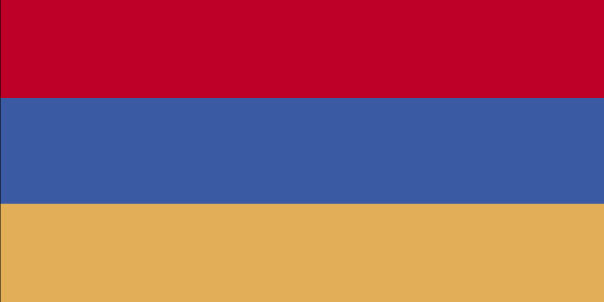
- has three equal horizontal bands of red (top), blue, and orange There are many interpertations on the meanings of the colors, but a widely accepted one is that the red symbolizes the blood spilt by Armenians in defense of their country, orange symbolizes the fertile soil of the nation, and blue is for the sky. The flag was originally the official flag of the nation during it's short independence after World War I, and was brought back after Armenia broke away from the Soviet Union.
- Flag History
- The red represents the blodd shed in the struggle for national existence. The blue is for the skies, hope and the unchanging character of the land. The orange represents the courage of the people.
- Date of Adoption
- 24 August 1990
National Anthem
- Anthem Lyrics
- Mer hayrenik‘, Azat Ankakh, Vor aprel eh tareh tar, Yoor vorik‘e ard kanchum eh Azat, Ankakh Hayastan. Aha‘, yeghpayr, kez mi drosh, Vor im dzerkov gortsetsi, Gishernere yes koon cheghah, Artasukov lvatsi. Nayir nran yerek guynov, Nvirakan mer nshan, Togh poghpoghi t‘shnamu dem, Togh misht pandsah Hayastan. Amenayn tegh mah‘e mi eh, Mard mi angam pit merni, Bayts yerani ovr yur azgi Azatutyan k‘e zohvi.
- Anthem Lyrics (English)
- Land of our fathers, free, independent, Which has endured from age to age. Its sons and daughters now proclaim Armenia, sovereign and free. Its sons and daughters now proclaim Armenia, sovereign and free. Brother, take this banner, Made with my own hands, During sleepless nights, And bathed in my tears. During sleepless nights, And bathed in my tears. See, it has three colours; A single hallowed symbol. May it sparkle before the foe, May Armenia flourish ever! May it sparkle before the foe, May Armenia flourish ever! Death is everywhere the same, Man is born just once to die, But blest is he who gives his life To defend his nation's freedom. But blest is he who gives his life To defend his nation's freedom.
- Anthem History
- The words to "Mer Hayrenik", taken from a poem by Miqayél Ghazari, were set to music long before Armenia adopted it as her anthem upon regaining her independence from the Soviet Union in 1991. The present anthem is a modified version of the original song, which consisted of five clauses. Some of the words have also been changed appropriately to reflect the freedom and independence of the country.
Other National Symbols
Coat of Arms
Coat of Arms
The coat of arms of the Republic of Armenia as defined by article 13 of the the constitution depicts, in the center on a shield, Mount Ararat with Noah's ark and the coats of arms of the four kingdoms of historical Armenia. The shield is supported by a lion and an eagle while a sword, a branch, a sheaf, a chain and a ribbon are portrayed under the shield