
 English
 Español
 中文
中文 हिन्दी
 Français
Government and Politics
Government and Politics of Angola
Government structure, leadership, capital, military, and national symbols of Angola.
Government Structure
Constitutional foundations, branches, parties, and leadership.
- Government Type
- republic, nominally a multiparty democracy with a strong presidential system
- Administrative Divisions
- 18 provinces (provincias, singular - provincia); Bengo, Benguela, Bie, Cabinda, Cuando Cubango, Cuanza Norte, Cuanza Sul, Cunene, Huambo, Huila, Luanda, Lunda Norte, Lunda Sul, Malanje, Moxico, Namibe, Uige, Zaire
- Legal System
- based on Portuguese civil law system and customary law; recently modified to accommodate political pluralism and increased use of free markets
- Suffrage
- 18 years of age; universal
- Citizenship
- citizenship by birth: no citizenship by descent only: at least one parent must be a citizen of Angola dual citizenship recognized: no residency requirement for naturalization: 10 years
- Executive Branch
- chief of state: President João Manuel GONÇALVES LOURENÇO (since 26 September 2017); note - the president is both chief of state and head of government head of government: President João Manuel GONÇALVES LOURENÇO (since 26 September 2017); note - the position of prime minister was abolished under the 2010 constitution, consolidating executive authority in the presidency cabinet: Council of Ministers appointed by the president elections: under the 2010 constitution, the president is no longer directly elected; instead, the leader of the party winning the most seats in the National Assembly automatically becomes president; the most recent legislative elections were held on 24 August 2022, in which the ruling People's Movement for the Liberation of Angola (MPLA) won a majority, allowing GONÇALVES LOURENÇO to begin a second five-year term election results: in the August 2022 elections, the MPLA received approximately 51.2% of the vote, followed by UNITA with approximately 43.9%; GONÇALVES LOURENÇO was subsequently confirmed for a second term as president; he had first assumed the presidency following the 2017 elections, succeeding José Eduardo DOS SANTOS, who had held power since 1979
- Legislative Branch
- unicameral National Assembly or Assembleia Nacional (220 seats; members elected by proportional representation vote to serve five-year terms) elections: last held on 24 August 2022 (next to be held in 2027) election results: percent of vote by party - MPLA 51.2%, UNITA 43.9%, FNLA 1.1%, PHA 1.0%, PRS 0.9%, other 1.9%; seats by party - MPLA 124, UNITA 90, FNLA 2, PHA 2, PRS 2
- Judicial Branch
- Supreme Court and separate provincial courts (judges are appointed by the president)
- Political Parties
- Liberal Democratic Party or PLD [Analia de Victoria PEREIRA]; National Front for the Liberation of Angola or FNLA [disputed leadership: Lucas NGONDA, Holden ROBERTO]; National Union for the Total Independence of Angola or UNITA [Isaias SAMAKUVA], largest opposition party; Popular Movement for the Liberation of Angola or MPLA [Jose Eduardo DOS SANTOS], ruling party in power since 1975; Social Renewal Party or PRS [disputed leadership: Eduardo KUANGANA, Antonio MUACHICUNGO] note: about a dozen minor parties participated in the 1992 elections but only won a few seats; they and the other 115 smaller parties have little influence in the National Assembly
- Head of State
- President João Manuel GONÇALVES LOURENÇO
- Head of Government
- President João Manuel GONÇALVES LOURENÇO
- Cabinet
- Council of Ministers appointed by the president
- Elections
- last held on 24 August 2022 (next to be held in 2027)
- Election Results
- Percent of vote by party - MPLA 51.2%, UNITA 43.9%, FNLA 1.1%, PHA 1.0%, PRS 0.9%, other 1.9%; seats by party - MPLA 124, UNITA 90, FNLA 2, PHA 2, PRS 2. These results reflect the August 2022 general elections, in which the ruling MPLA, led by President João Lourenço, secured a narrow majority despite significant gains by the opposition UNITA party under Adalberto Costa Júnior, marking one of the most competitive electoral contests in Angola's post-civil war history.
- Constitution
- 11 November 1975; revised 7 January 1978, 11 August 1980, 6 March 1991, and 26 August 1992; note - new constitution has not yet been approved
- Independence
- 11 November 1975 (from Portugal)
- National Holiday
- Independence Day, 11 November (1975)
- International Organization Participation
- ACP, AfDB, AU, FAO, G-77, IAEA, IBRD, ICAO, ICCt (signatory), ICFTU, ICRM, IDA, IFAD, IFC, IFRCS, ILO, IMF, IMO, Interpol, IOC, IOM, ISO (correspondent), ITU, NAM, OAS (observer), SADC, UN, UN Security Council (temporary), UNCTAD, UNESCO, UNIDO, UPU, WCO, WFTU, WHO, WIPO, WMO, WToO, WTrO
- Diplomatic Representation in the U.S.
- chief of mission: Ambassador Josefina Perpetua Pitra DIAKITI chancery: 2108 16th Street NW, Washington, DC 20009 telephone: [1] (202) 785-1156 FAX: [1] (202) 785-1258 consulate(s) general: Houston, New York
- U.S. Diplomatic Representation
- chief of mission: Ambassador Cynthia EFIRD embassy: number 32 Rua Houari Boumedienne (in the Miramar area of Luanda), Luanda mailing address: international mail: Caixa Postal 6468, Luanda; pouch: US Embassy Luanda, Department of State, 2550 Luanda Place, Washington, DC 20521-2550 telephone: [244] (222) 64-1000 FAX: [244] (222) 64-1232
Capital City
Seat of government and political history.
- Capital City
- Luanda
- Location
- 8 50 S, 13 13 E
- Time Difference
- UTC+1 (6 hours ahead of Washington, DC during Standard Time)
- History
- originally named "Sao Paulo da Assuncao de Loanda" (Saint Paul of the Assumption of Loanda), which over time was shortened and corrupted to just Luanda
Military
Branches, service obligations, expenditures, and manpower.
- Military Branches
- Angolan Armed Forces (Forcas Armadas Angolanas, FAA): Army, Navy (Marinha de Guerra Angola, MGA), Angolan National Air Force (Forca Aerea Nacional Angolana, FANA; under operational control of the Army)
- Service Age and Obligation
- 20-45 years of age for compulsory male and 18-45 years for voluntary male military service (registration at age 18 is mandatory); 20-45 years of age for voluntary female service; conscript service obligation - 2 years; Angolan citizenship required; the Navy (MGA) is entirely staffed with volunteers
National Symbols
Flag, anthem, and other symbols of national identity.
National Flag
- Flag Symbolism
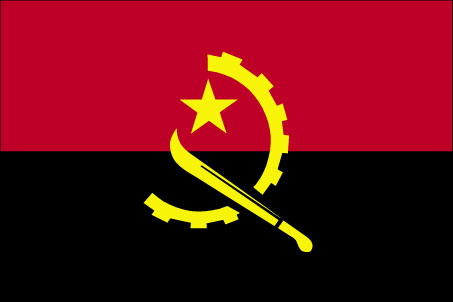
- has two equal horizontal bands of red (top) and black with a centered yellow emblem consisting of a five-pointed star within half a cogwheel crossed by a machete (in the style of a hammer and sickle) A golden star, part of a cog wheel and a machete is centered. That symbol is said to be inspired by the hammer and sickle, and represents industrial and agricultural workers. Yellow is symbolic of the country's mineral wealth, and red and black are said to stand for 'Freedom or Death'.
- Date of Adoption
- adopted 11 Nov 1975; new flag adopted 27 Aug 2003 - not yet ratified
National Anthem
- Anthem Lyrics
- O Pátria, nunca mais esqueceremos Os heróis do quatro de Fevereio. O Pátria, nós saudamos os teus filhos Tombados pela nossa Independência. Honramos o passado e a nossa História, Construindo no Trabalho o Homem novo, Honramos o passado e a nossa História, Construindo no Trabalho o Homem novo. CHORUS (twice) Angola, avante! Revolução, pelo Poder Popular! Pátria Unida, Liberdade, Um só povo, uma só Nação! Levantemos nossas vozes libertadas Para glóriados povos africanos. Marchemos, combatentes angolanos, Solidários com os poroso primidos. Orgulhosos lutaremos Pela Paz Com as forças progressistas do mundo. Orgulhosos lutaremos Pela Paz Com as forças progressistas do mundo. CHORUS (twice) Angola, avante! Revolução, pelo Poder Popular! Pátria Unida, Liberdade, Um só povo, uma só Nação!
- Anthem Lyrics (English)
- O Fatherland, we shall never forget The heroes of the Fourth of February. O Fatherland, we salute your sons Who died for our Independence. We honour the past and our history As by our work we build the New Man. We honour the past and our history As by our work we build the New Man. CHORUS (twice) Forward, Angola! Revolution through the power of the People! A United Country, Freedom, One People, one Nation! Let us raise our liberated voices To the glory of the peoples of Africa. We shall march, Angolan fighters, In solidarity with oppressed peoples. We shall fight proudly for Peace Along with the progressive forces of the world. We shall fight proudly for Peace Along with the progressive forces of the world. CHORUS (twice)
- Anthem History
- "Angola Avante" was adopted upon independence from Portugal