
 English
 Español
 中文
中文 हिन्दी
 Français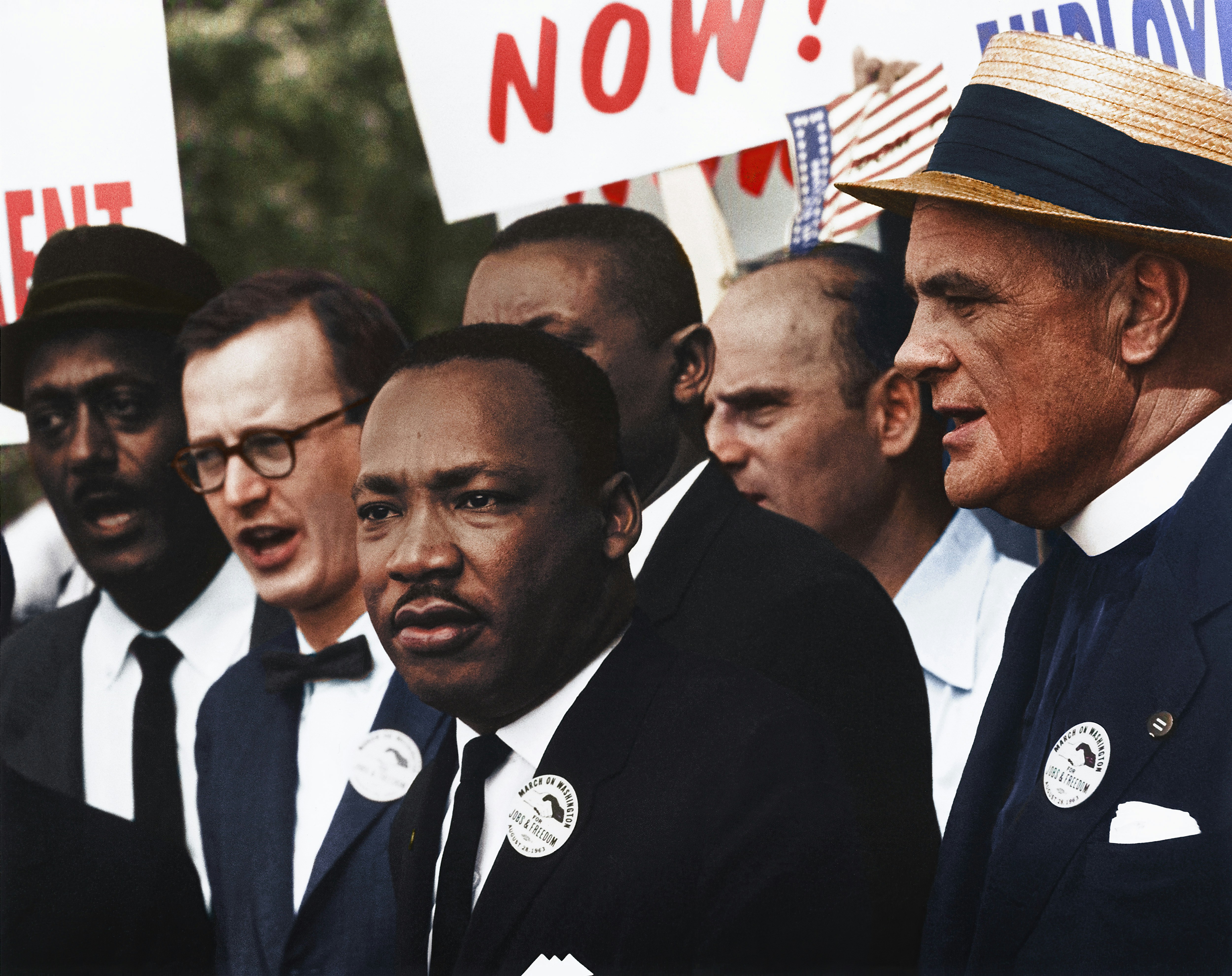
Martin Luther King Jr.
Martin Luther King Jr. — Baptist minister, civil rights leader, Nobel Peace Prize laureate, and prophet of American democracy — compressed into thirteen years of public activism an achievement that transformed the legal and moral landscape of the United States and inspired liberation movements across the world. Born in Atlanta, Georgia, in 1929 into a family of Baptist ministers, he died by an assassin's bullet in Memphis, Tennessee, in 1968 at the age of thirty-nine. In the years between, he led the Montgomery Bus Boycott, organized the Southern Christian Leadership Conference, marched from Selma to Montgomery, delivered the "I Have a Dream" speech at the March on Washington, and helped to win the Civil Rights Act of 1964 and the Voting Rights Act of 1965 — the most significant expansion of American democracy since Reconstruction.
King's power derived from multiple sources: his extraordinary oratory, which combined the cadences of the Black Baptist preaching tradition with the philosophical sophistication of the Boston personalist theology in which he had been trained; his strategic genius for choosing confrontations that would expose the violence of segregation to a national and international audience; his theological grounding in the social gospel and the philosophy of nonviolent resistance he had learned from Gandhi; and his personal courage in the face of bombings, beatings, arrests, and eventually the assassination that cut short his life and work.
But King was more than the sanitized icon of the Martin Luther King Day holiday — the safe, palatable prophet of racial harmony that American commemoration has tended to produce. The real King was a more challenging and more radical figure: a man who opposed the Vietnam War at considerable political cost, who called for a radical redistribution of economic power and challenged the fundamental injustice of American capitalism, and who in his final years was organizing a Poor People's Campaign that brought together Black, white, Latino, and Native American poor people in a demand for economic justice that cut across racial lines. This King — the economic radical, the antiwar activist, the organizer of the poor — was the figure that the American establishment found most threatening and that history has been slowest to fully incorporate into the national memory.
Atlanta Childhood: the King Family and the Black Church
Michael King Jr. — he did not take the name Martin Luther King Jr. until his father changed both their names in 1934, in honor of the German Reformation leader — was born on January 15, 1929, at 501 Auburn Avenue in Atlanta, Georgia, the second child of Reverend Michael King Sr. and Alberta Williams King. He was born into one of the most distinguished families in Atlanta's Black community: his grandfather, Alfred Daniel Williams, had been a founding member of the Atlanta NAACP and the pastor of Ebenezer Baptist Church, which his father Michael Sr. now led. The church, the family, and the community of Sweet Auburn — the prosperous Black business and residential district of Atlanta — were the world of King's childhood.
The Black Baptist church in which King grew up was not merely a religious institution but the central organizing structure of African American community life in the segregated South — the one institution that white society had not fully penetrated and controlled, the space in which Black culture, education, mutual support, and political aspiration could be expressed and developed. The preaching tradition he absorbed as a child — the call and response between preacher and congregation, the musical cadences of the sermonic tradition, the interweaving of scripture with social commentary and prophetic vision — became the foundation of his own extraordinary oratorical power.
He grew up in the era of Jim Crow segregation — the system of racial separation and subordination that governed every aspect of life in the South, from the schools to the buses to the drinking fountains to the restaurants to the hospitals. His first encounters with segregation's cruelties came early: the white playmate whose parents prevented their friendship when the boys began school, the confrontations with white adults who addressed him with the racial epithets of the era, the daily navigation of a social world designed to communicate Black inferiority at every point. The anger these experiences produced was, by his own account, the emotional fuel of his later activism.
He was a precocious student — he skipped grades nine and twelve — and entered Morehouse College in Atlanta at fifteen, in 1944. At Morehouse he came under the influence of its president, Benjamin Mays, a theologian of exceptional intellectual force who became one of the most important mentors of King's intellectual life. Mays combined a rigorous academic theology with a passionate commitment to social justice and a deep engagement with the social gospel tradition — the strain of Protestant Christianity that insisted on the church's obligation to address social sin as well as individual sin. Under Mays's influence, King decided to enter the ministry, and he was ordained as a Baptist minister at eighteen.
The Education of a Theologian: Crozer and Boston
After graduating from Morehouse in 1948, King entered Crozer Theological Seminary in Chester, Pennsylvania, where he received his first sustained exposure to the theological traditions of liberal Protestantism and began the intellectual journey that would shape his mature philosophy of nonviolence and social change.
At Crozer, King studied Walter Rauschenbusch's Christianity and the Social Crisis (1907), the foundational text of the Social Gospel movement, which argued that Christianity required not merely individual salvation but the transformation of social structures that produced poverty, exploitation, and injustice. Rauschenbusch's synthesis of Protestant theology and progressive social analysis became one of the permanent foundations of King's thought. He also encountered at Crozer the philosophy of Mohandas Gandhi — particularly through a lecture by Howard University president Mordecai Johnson — and was immediately captivated by the possibility that nonviolent direct action could be not merely a moral stance but an effective political strategy.
The encounter with Gandhi was transformative. Gandhi's concept of Satyagraha — truth-force or soul-force — the idea that nonviolent resistance to injustice drew its power from the spiritual strength of the resisters and the moral weight of their cause rather than from physical coercion — gave King a philosophical framework for the activism he was already committed to. The Montgomery campaign, the Birmingham demonstrations, the Selma marches were all applications of this Gandhian strategy adapted to the specific conditions of the American South.
King graduated from Crozer first in his class in 1951 and entered Boston University's School of Theology for his doctoral work. Boston was intellectually formative in a different direction: at Boston University he studied personalism — the theological philosophy that held that persons, as the primary category of reality, were the foundation of all moral and metaphysical thinking, and that God was to be understood as a personal being whose nature encompassed love, reason, and the creative ground of all existence. Personalism gave King's theology its characteristic emphasis on the infinite worth of every human personality and on love as the ultimate organizing principle of reality.
He also met Coretta Scott at Boston, introduced to her by a mutual friend; she was a student at the New England Conservatory of Music. Their courtship was both romantic and intellectual — she was a woman of considerable beauty, musical talent, and strong political convictions — and they married on June 18, 1953. Coretta King would prove to be not merely a supportive spouse but an independent force in the civil rights movement, sustaining the cause through the years of her husband's imprisonment, continuing his work after his assassination, and becoming a significant public figure in her own right.
He completed his doctoral dissertation — a study comparing the conceptions of God in the theologies of Paul Tillich and Henry Nelson Wieman — and received his Ph.D. from Boston University in 1955. He was twenty-six years old.
Montgomery: the Birth of a Movement
In 1954 King accepted a call to Dexter Avenue Baptist Church in Montgomery, Alabama — a distinguished church in the shadow of the Alabama State Capitol — and moved south with Coretta to begin his ministry. He had barely settled into his congregation when the event occurred that would change his life and American history.
On December 1, 1955, Rosa Parks, a seamstress and secretary of the Montgomery chapter of the NAACP, was arrested for refusing to give up her seat to a white passenger on a Montgomery city bus. Parks's arrest was not spontaneous or accidental: she was a trained civil rights activist who had attended the Highlander Folk School in Tennessee, and the Montgomery NAACP had been waiting for an appropriate case to challenge bus segregation. Her arrest provided the occasion.
The Montgomery Improvement Association was formed to organize a boycott of the city's buses, and King — new to the city, without the local political entanglements of longer-established figures — was chosen as its president. He was twenty-six years old, had been in Montgomery for less than a year, and had not sought the leadership; it was thrust upon him and he accepted it.
The Montgomery Bus Boycott lasted 381 days — from December 5, 1955, to December 20, 1956, when the Supreme Court's ruling in Browder v. Gayle, declaring bus segregation unconstitutional, was implemented. During those 381 days the Black community of Montgomery organized an extraordinary alternative transportation system, walked miles to work in all weathers, sustained their solidarity under economic pressure, police harassment, and actual violence — King's home was bombed in January 1956 — and demonstrated that organized nonviolent direct action could defeat segregation.
King's leadership during the boycott established the essential elements of the method he would employ throughout his career: the moral framing of the struggle in terms of American democratic ideals, the appeal to the conscience of the nation and the world, the insistence on nonviolent discipline among the protesters, and the strategic use of confrontation to expose the violence of the segregationist system. His oratory during the boycott was already extraordinary; his composure under pressure — when his home was bombed and he appeared on his porch to calm the crowd that had gathered, preventing a violent response — showed a personal courage and moral authority that were not merely performed but genuine.
The boycott's success made King a national figure and a symbol of the new civil rights movement. Time magazine put him on its cover in February 1957. He was twenty-eight years old.
The Southern Christian Leadership Conference
In January 1957, King and a group of Black Southern ministers met in Atlanta and founded the Southern Christian Leadership Conference (SCLC), the organizational vehicle through which King would lead the civil rights movement for the remainder of his life. The SCLC was deliberately built on the organizational infrastructure of the Black church — its networks of congregations, its trained leadership, its ability to mobilize communities quickly — and it operated primarily in the South, working to build local movements that could challenge segregation and voting restrictions.
The SCLC's relationship with other civil rights organizations — particularly the NAACP, which focused on legal challenges, and the Student Nonviolent Coordinating Committee (SNCC), which emerged from the 1960 student sit-in movement with a more confrontational and less hierarchical approach — was always complex and sometimes tense. The NAACP resented King's celebrity and the resources it attracted away from their legal strategy; SNCC's younger, more radical activists sometimes viewed King as too cautious, too willing to negotiate, too dependent on federal goodwill. These tensions were a permanent feature of the movement's internal life and reflected genuine strategic differences.
King traveled extensively in the late 1950s — to India in 1959, where he met with Gandhi's family and deepened his understanding of nonviolent resistance by seeing the society that Gandhi's movement had transformed — and visited Ghana, which had just become independent under Kwame Nkrumah, seeing in African independence movements a parallel to and inspiration for the American civil rights struggle. These international connections gave his vision a global dimension that distinguished it from purely domestic civil rights politics.
Birmingham: Project C and the Letter from Birmingham Jail
The Birmingham campaign of spring 1963 — officially called Project C, for Confrontation — was the most strategically decisive of the great civil rights campaigns and the one that most directly produced the Civil Rights Act of 1964. Birmingham was chosen deliberately: it was the most segregated major city in America, its Public Safety Commissioner, Bull Connor, was a notoriously brutal enforcer of segregation who could be counted on to respond to demonstrations with violence, and its economic and political structures were representative of the Deep South at its most resistant.
The campaign began in April 1963 with a series of sit-ins, marches, and economic boycotts. Bull Connor's response was exactly what the SCLC had anticipated: fire hoses, police dogs, and mass arrests. The images that went out across the world — fire hoses knocking demonstrators off their feet, police dogs lunging at peaceful marchers, children being dragged off to jail — shocked the conscience of the nation and the world in ways that months of patient organizing and legal argumentation had not.
King himself was arrested on Good Friday, April 12, 1963, and held in solitary confinement. While in jail, he read a newspaper statement signed by eight white Alabama clergymen — "A Call for Unity" — which called the demonstrations "unwise and untimely" and urged the Black community to pursue its goals through the courts rather than through street demonstrations. King's response, written in the margins of the newspaper and on scraps of paper smuggled out of the jail, became the "Letter from Birmingham Jail" — one of the great documents of American moral argument.
The Letter was addressed nominally to the eight clergymen but in reality to the white moderate American whose sympathy for civil rights was real but whose commitment to order and gradualism led him to prefer an unjust peace to a just disturbance. King argued, with philosophical precision and moral urgency, that the moderates' criticism of "direct action" revealed a fundamental misunderstanding of how justice was achieved: it was never voluntarily given by the oppressor; it was always wrested through the organized pressure of the oppressed. He cited Augustine, Aquinas, Reinhold Niebuhr, Paul Tillich, and Martin Buber alongside Jefferson, Lincoln, and the Declaration of Independence in an argument that demonstrated both the breadth of his intellectual formation and the depth of his moral commitment.
"Injustice anywhere is a threat to justice everywhere," he wrote. "We are caught in an inescapable network of mutuality, tied in a single garment of destiny." The Letter was smuggled out of jail and distributed nationwide; it became immediately recognized as a masterpiece of moral argument and has remained central to the curriculum of American political philosophy.
The March on Washington and the Dream
On August 28, 1963, approximately 250,000 people marched in Washington D.C. in the March on Washington for Jobs and Freedom — the largest political demonstration in American history to that point — and gathered before the Lincoln Memorial to hear King deliver the speech that would become the most famous in American history.
The march was organized by a coalition of civil rights organizations and labor unions — the A. Philip Randolph-Bayard Rustin organization, the NAACP, the Urban League, SNCC, CORE, and the SCLC — and it was conceived as a statement of support for the Civil Rights Bill that President Kennedy had introduced to Congress and as a demand for economic justice as well as civil rights. The "Jobs and Freedom" in the march's title reflected the understanding that formal legal equality without economic opportunity was insufficient.
King was the final speaker, and the speech he delivered — famously departing from his prepared text when Mahalia Jackson called from behind him "Tell them about the dream, Martin!" — was a fusion of the formal political argument and the prophetic Baptist sermon that represented his oratory at its absolute peak. The prepared text spoke of the "promissory note" that America had given to all its citizens in the Declaration of Independence — the promise that all men are created equal and endowed with unalienable rights — and declared that the time had come for America to honor that note.
The extemporaneous "dream" passage that followed drew on imagery he had used in previous speeches and sermons: the dream that his children would one day be judged not by the color of their skin but by the content of their character; the dream that descendants of slaves and descendants of slave owners would sit together at the table of brotherhood; the vision of a day when freedom would ring from every mountainside across America. The speech's biblical cadences — drawn from Isaiah and the Psalms and the prophetic tradition — gave it a universality and a beauty that transcended its immediate political context and made it one of the enduring statements of human aspiration in the English language.
The March on Washington and the "I Have a Dream" speech created enormous pressure for legislative action. President Kennedy met with the march's organizers in the White House afterward. Kennedy was assassinated in November 1963, and President Johnson — convinced that passing civil rights legislation was necessary both as a tribute to Kennedy and as a moral imperative — pushed the Civil Rights Act through Congress in 1964.
The CIVIL Rights Act, the Nobel Prize, and Selma
The Civil Rights Act of 1964, signed by President Johnson on July 2, 1964, was one of the most significant pieces of legislation in American history. It prohibited discrimination based on race, color, religion, sex, or national origin in employment and in places of public accommodation — the restaurants, hotels, theaters, and other public spaces where segregation had been enforced throughout the South. It gave the federal government the tools to enforce these prohibitions and established the Equal Employment Opportunity Commission.
In October 1964 King was awarded the Nobel Peace Prize, becoming at thirty-five the youngest person to receive the award. He donated the entire prize money — approximately $54,000 — to the civil rights movement. His Nobel lecture articulated his philosophy of nonviolence and his vision of a world in which the law of love governed human relations, a vision he knew was far from realization but that he believed was the only alternative to the mutual destruction that violence and hatred promised.
The Selma to Montgomery marches of early 1965 were the final major campaign of the classic civil rights era and the direct cause of the Voting Rights Act of 1965. Selma, Alabama, had been a center of SNCC voting registration work for two years, but the county's Black residents — who constituted a majority of the population — had been systematically prevented from registering by registrars who applied literacy tests selectively and capriciously and by the threat of economic retaliation and violence.
On March 7, 1965 — Bloody Sunday — approximately six hundred marchers attempting to cross the Edmund Pettus Bridge at the start of a march from Selma to Montgomery were attacked by state troopers and sheriff's deputies with clubs and tear gas. The images of the attack, broadcast on television that evening, shocked the nation. Two weeks later, on March 21, with federal protection ordered by President Johnson, King led the full march of approximately 25,000 people from Selma to Montgomery, arriving on March 25. The Voting Rights Act was signed by President Johnson on August 6, 1965.
The Last Years: Vietnam, Economic Justice, and Memphis
The final three years of King's life — from 1965 until his assassination in April 1968 — were marked by the expansion of his political vision beyond the legal framework of civil rights into a broader critique of American society and American foreign policy, and by a growing sense of embattlement as his positions alienated former allies and the movement he had led began to fragment.
His opposition to the Vietnam War, which he expressed publicly and systematically beginning in April 1967 in a speech at Riverside Church in New York, cost him significant political support. President Johnson, who had been his most important ally in the passage of the Civil Rights and Voting Rights Acts, was furious; the NAACP and many other civil rights leaders, fearing that opposition to the war would undermine support for civil rights legislation, publicly distanced themselves from King's antiwar position. The FBI, which had been surveilling and harassing King since the early 1960s under J. Edgar Hoover's direction, intensified its campaign against him.
But King's opposition to the war was not a political calculation; it was a moral conviction rooted in his theology of nonviolence and his understanding of the connections between racism, poverty, and militarism. "The greatest purveyor of violence in the world today is my own government," he said at Riverside Church — a statement that struck many of his contemporaries as excessive but that reflected his genuine belief that the war was a moral catastrophe for America and for Vietnam.
The Poor People's Campaign, which he began planning in late 1967, was the most ambitious project of his career: a multiracial coalition of poor people — Black, white, Latino, Native American — who would occupy Washington D.C. in a sustained demonstration demanding economic justice, a guaranteed annual income, and a reorientation of national priorities away from war and toward the needs of the poor. The campaign reflected King's growing conviction that legal civil rights, while necessary, were insufficient without economic transformation.
He went to Memphis in late March 1968 to support a strike by the city's sanitation workers — predominantly Black men who were demanding recognition of their union and decent wages. On April 3, he delivered what would be his final speech — the "Mountaintop" speech — in which he seemed to anticipate his death: "I've been to the mountaintop... I may not get there with you. But I want you to know tonight that we, as a people, will get to the Promised Land." He was shot and killed on the balcony of the Lorraine Motel in Memphis on April 4, 1968, by James Earl Ray.
The Legacy of Martin Luther King Jr.
King's assassination was followed by riots in more than one hundred American cities — a final cruel irony for a man who had devoted his life to nonviolence. His funeral in Atlanta on April 9, 1968, drew over a hundred thousand mourners. Robert Kennedy, who had announced King's death to a Black crowd in Indianapolis with words that may have prevented riots there, was himself assassinated two months later.
The legal legacy of the civil rights movement he led was substantial and durable: the Civil Rights Act and Voting Rights Act, the Fair Housing Act of 1968 passed just days after his assassination, and the Equal Employment Opportunity Commission established by the 1964 act created the legal framework for the ongoing struggle against racial discrimination. The Voting Rights Act in particular transformed American politics, enabling millions of Black Southerners to participate in elections for the first time since Reconstruction.
The Martin Luther King Jr. federal holiday, established by Congress in 1983 and first observed in 1986, was a recognition of his national significance that had taken fifteen years to achieve — a measure of both the continuing controversy that surrounded him and the depth of the opposition he had faced during his lifetime. The holiday has been both a vehicle for genuine commemoration and a temptation for the kind of sanitization that removes the radical challenge from the radical prophet.
The King Papers Project at Stanford University, directed by Clayborne Carson and publishing the full Collected Works of Martin Luther King Jr. in fourteen volumes, has made available the complete record of his thought — his sermons, speeches, correspondence, and writings — in a form that allows posterity to encounter the full King rather than the selected and simplified version of national commemoration. The discovery that his doctoral dissertation contained significant passages that were not properly attributed — an issue of scholarly integrity that emerged in the early 1990s — complicated his academic legacy without diminishing his moral and political achievement.
His most important legacy may be the model of leadership he provided: the combination of prophetic moral vision, strategic intelligence, personal courage, and democratic accountability that allowed him to lead a mass movement without becoming a tyrant, to pursue radical change without abandoning nonviolence, and to speak truth to power without ceasing to love the people he was confronting. These qualities — rarer in political leaders than intelligence or energy — are what made him extraordinary and what make him, fifty-seven years after his death, still the most admired figure in the history of American social movements.
The Philosophy of Nonviolent Direct Action
King's commitment to nonviolence was not a pragmatic calculation but a philosophical and theological conviction — rooted in the Gandhian tradition, the social gospel, and the personalist theology he had absorbed at Boston University — that nonviolent direct action was the morally correct and strategically effective response to injustice.
He articulated this philosophy most systematically in Stride Toward Freedom (1958), his account of the Montgomery Bus Boycott, and in the "Letter from Birmingham Jail." The argument had several distinct strands. First, a theological strand: love — agape, the unconditional love of the Christian tradition — was the most powerful force in the universe, and nonviolent resistance was the political expression of love, refusing to retaliate against the oppressor's violence while simultaneously refusing to accept injustice. Violence, by contrast, was spiritually self-destructive even when politically effective, because it substituted hatred for love and could not build the beloved community that was the ultimate goal.
Second, a strategic strand: nonviolent direct action was more politically effective than violence in the specific conditions of the American civil rights movement, because the movement's power rested on the moral claim that segregation was unjust and that Black Americans were being denied rights guaranteed by the Constitution and by their humanity. Violence by protesters would undermine that moral claim and provide the segregationist system with the justification it needed for continued repression; nonviolent suffering in the face of violence, by contrast, exposed the moral bankruptcy of segregation and appealed to the conscience of the white moderate and the international community.
Third, a sociological strand: violence breeds violence, and a movement that won through violence would create a society shaped by the values of violence — a society in which the formerly oppressed would oppress in turn. The goal was not merely the defeat of segregation but the creation of what King called the beloved community — an interracial society of mutual respect and genuine equality — and that goal could only be achieved through means consistent with it.
The six principles of nonviolent resistance that King articulated — that nonviolent resistance is not passive, that it seeks to win the friendship of the opponent, that it is directed against forces of evil rather than persons, that it accepts suffering without retaliation, that it avoids internal as well as external violence, and that it is grounded in the conviction that the universe is on the side of justice — provided the philosophical framework for the training of civil rights demonstrators and the planning of campaigns.
Coretta Scott King: Partner and Continuer
Coretta Scott King was far more than the supportive spouse of a great man; she was an independent political and cultural force who sustained the civil rights cause through the most difficult years of her husband's life and continued his work for nearly forty years after his assassination. The sanitized image of Coretta King as the grieving widow has obscured the reality of an exceptional woman who made her own substantial contributions to the movement.
Coretta Scott was born on April 27, 1927, in Marion, Alabama — in the heart of the Black Belt South — and grew up in a family that emphasized education and cultural achievement alongside religious faith. She was an exceptionally talented singer who won a scholarship to the New England Conservatory of Music, where she was studying when she met Martin. The musical career she had planned was set aside, not entirely willingly, by the demands of his ministry and activism, and the sacrifice was not without personal cost.
During the movement years, she managed the household and raised their four children — Yolanda (Yoki), Martin Luther King III, Dexter, and Bernice — while maintaining the family through Martin's long absences, the constant threat of violence, and the chronic financial insecurity of movement leadership. When the family's home in Montgomery was bombed, Coretta kept her composure; when Martin was arrested, she organized support; when the FBI's harassment campaign included anonymous letters urging Martin to commit suicide, she was the anchor of his emotional survival.
She delivered concerts on behalf of the civil rights movement — freedom concerts that raised funds and awareness — at a time when she could have built a professional singing career. Her cultural work was an important dimension of the movement's appeal to audiences who might not have responded to purely political arguments.
After Martin's assassination, she founded the Martin Luther King Jr. Center for Nonviolent Social Change in Atlanta, led the campaign for the federal holiday, and became a significant public voice on issues ranging from apartheid in South Africa to gay rights — a position that put her ahead of many civil rights organizations of her era in the breadth of her commitment to human dignity. She died on January 30, 2006.
The Fbi and J. Edgar Hoover: Surveillance and Harassment
The Federal Bureau of Investigation's campaign against Martin Luther King Jr. — directed by J. Edgar Hoover, who regarded King as the most dangerous Negro in America — was one of the most sustained and systematic violations of civil liberties by an American government agency in the twentieth century, and its full dimensions were not revealed until long after King's death.
Hoover's hostility to King began in the late 1950s and intensified after the Birmingham campaign and the March on Washington. The FBI's COINTELPRO program — a systematic program of illegal counterintelligence operations against domestic political organizations — targeted King and the SCLC with particular intensity. The FBI placed wiretaps on King's phones and installed bugs in his hotel rooms with the personal authorization of Attorney General Robert Kennedy, who approved the surveillance in 1963 partly in response to FBI claims that King's adviser Stanley Levison was a communist.
The surveillance produced evidence of King's extramarital affairs, which the FBI compiled and used in an extraordinary campaign of harassment. In November 1964, just weeks after King received the Nobel Peace Prize, the FBI sent him a letter — accompanied by recordings of sexual encounters — that suggested he should commit suicide before his infidelity became public. The letter was signed "A FRIEND" but was clearly from the FBI. King and Coretta discussed it together; the episode was devastating but ultimately strengthened rather than destroyed their partnership.
The full extent of the FBI's campaign was revealed by the Senate's Church Committee investigation in 1975-1976 and by subsequent Freedom of Information Act releases. The documents showed a program of deliberate character assassination, illegal surveillance, and active attempts to destroy King's relationships with allies and supporters — all conducted by an agency of the federal government against a man who had committed no crime and was pursuing entirely legitimate political and social goals.
The FBI's files on King remain partially sealed by court order, with a scheduled release date of 2027, and historians await that release with considerable interest for what it may reveal about the bureau's activities and about the surveillance of other civil rights leaders.
King and Malcolm X: the Two Faces of Black Liberation
The relationship between Martin Luther King Jr. and Malcolm X — the two most important Black political voices of their era — was one of the defining tensions of the civil rights movement and a window onto the debate about strategy, identity, and the nature of American racism that continued long after both men's deaths.
Malcolm X, born Malcolm Little and later taking the name el-Hajj Malik el-Shabazz after his pilgrimage to Mecca, was the leading voice of the Nation of Islam and then of a more broadly pan-African nationalism that rejected integration into white American society as both impossible and undesirable. Where King appealed to the conscience of white America and sought integration into a transformed American society, Malcolm urged Black Americans to reject white America's values, to embrace Black identity and Black institutions, and to defend themselves against white violence by any means necessary.
The contrast between "by any means necessary" and "nonviolent direct action" was the public headline of their disagreement, and it was real: Malcolm regarded King's nonviolence as submission to white power and King regarded Malcolm's advocacy of violence as strategically counterproductive and morally wrong. But the disagreement was more complex than the headline suggested. Malcolm's critiques of American racism were often more penetrating than King's, and his insistence on the psychological dimensions of white supremacy — its internalization by Black Americans, the damage it did to Black self-conception — anticipated much of the Black Power and Black consciousness analysis that followed.
King and Malcolm met only once — briefly at the Capitol on March 26, 1964, when both were attending a Senate debate on civil rights — but each followed the other's work closely and each was more influenced by the other than their public positions suggested. In his last year before his assassination in February 1965, Malcolm was moving toward a more inclusive politics that had abandoned the Nation of Islam's racial separation for a broader human rights framework; King in his last years was moving toward a more radical economic critique that had some parallels with Malcolm's analysis. The convergence, cut off by assassination, is one of the great might-have-beens of American political history.
Sncc and the Internal Tensions of the Movement
The Student Nonviolent Coordinating Committee, founded in April 1960 by student activists who had been conducting sit-ins at segregated lunch counters across the South, represented a generational and strategic challenge to King's leadership of the civil rights movement that produced some of the most important and most painful debates in the movement's history.
SNCC's founders — including John Lewis, who became its most prominent figure, and Diane Nash, a strategic thinker of considerable brilliance — shared King's commitment to nonviolence and many of his values but developed a more grassroots, less hierarchical model of organizing that sometimes put them in tension with the SCLC's more minister-led approach. SNCC organizers went into communities and stayed — living with local families, building relationships, developing indigenous leadership — rather than the "come in, campaign, leave" model that some SNCC members accused King and the SCLC of practicing.
The Freedom Rides of 1961 — organized by CORE but heavily supported by SNCC — showed the tensions at work: when SNCC riders were beaten at bus stations across the South, King declined to join the rides himself, arguing that he was on probation from a previous arrest. The decision was criticized by SNCC activists who felt that King's celebrity leadership required personal participation in dangerous actions, and the criticism stung.
The Albany movement of 1961-1962 was the movement's most significant failure — a sustained campaign in Albany, Georgia, that failed to achieve its objectives because the Albany police chief, Laurie Pritchett, had studied King's strategy and countered it by arresting demonstrators without the public violence that attracted national attention. The failure taught King and the SCLC crucial lessons about the importance of choosing confrontations where the local power structure would be unable to restrain its own violence — leading directly to the strategic choice of Birmingham.
By the mid-1960s, SNCC had moved toward the Black Power position articulated by Stokely Carmichael and had explicitly rejected nonviolence as a strategic commitment. The rift between King and the radicalized SNCC reflected genuine strategic and philosophical differences, but also the exhaustion and frustration of young organizers who had experienced years of violence, prison, and federal inaction and had lost faith in the strategy of moral appeal.
The Social Gospel and King's Theological Roots
King's civil rights work was inseparable from his theology — not the theology of private salvation and individual morality that characterized much of American Protestantism, but the social gospel tradition that demanded the transformation of social structures as a religious obligation. Understanding King's theology is essential to understanding both his methods and his vision.
The social gospel, developed by Walter Rauschenbusch, Washington Gladden, and others in the late nineteenth and early twentieth centuries, argued that the Christian gospel required attention to "social sin" — the structural injustices embedded in economic and political systems — as well as to individual sin. The kingdom of God was not merely a future heavenly state but a present obligation to transform the conditions of human life in accordance with the values of love, justice, and human dignity. This theological framework gave King's political activism its religious justification and its characteristic language.
The personalist theology he studied at Boston University — particularly in the work of Edgar Sheffield Brightman and Harold DeWolf, his doctoral advisor — added a philosophical dimension to the social gospel framework. Personalism's insistence on the absolute worth of every person — grounded in the conviction that persons were the primary reality and that God was a personal being whose nature encompassed love — gave King's commitment to human dignity a metaphysical foundation and connected it to the mainstream of Western moral philosophy.
Reinhold Niebuhr, the neo-orthodox theologian whose work King engaged critically, provided a counterweight to the more optimistic strands of the social gospel. Niebuhr's analysis of the persistence of human sin and the intractability of social evil — his argument that moral suasion alone was insufficient to overcome entrenched power — influenced King's understanding of why direct action and organized pressure were necessary alongside moral argument. King accepted Niebuhr's realism about human nature while rejecting his pessimism about the possibilities of social transformation.
The Black preaching tradition in which King had been formed from childhood was the emotional and performative foundation on which all this theological learning was built. The call-and-response tradition of the Black Baptist church, the musicality of the sermonic tradition, the prophetic role of the preacher as the voice of the community's aspirations and the interpreter of its suffering — all of this gave his oratory its distinctive quality, the combination of philosophical argument with emotional power that could move audiences from thought to feeling and from feeling to action.
King in Chicago: the Northern Campaigns
King's campaigns in the South from Montgomery through Selma operated in a context where the targets — explicit legal segregation, literacy tests, denial of the vote — were relatively clear and where the methods of nonviolent direct action had proven effective in exposing the violence of the system to a national audience. When King moved north, to Chicago in 1966, he encountered a different and in some ways more intractable form of racial inequality: de facto segregation maintained not by law but by housing discrimination, economic exclusion, and the complex patterns of residential segregation that had concentrated Black poverty in ghettos while white prosperity expanded into the suburbs.
The Chicago campaign — organized as the Chicago Freedom Movement in partnership with the Coordinated Council of Community Organizations — focused on housing segregation and demanded open housing: the right of Black families to buy or rent homes in any neighborhood regardless of race. King and his family moved into a dilapidated apartment in the Lawndale neighborhood of Chicago's West Side, experiencing directly the conditions of urban Black poverty. The marches through all-white neighborhoods on the Southwest Side — Marquette Park, Gage Park, Cicero — were met with mobs of angry white residents throwing rocks, bottles, and epithets, violence that King later described as worse than anything he had encountered in the South.
The campaign achieved limited formal success — an "open city" agreement negotiated with Mayor Richard J. Daley that civil rights leaders criticized as hollow — and exposed the limits of the Southern movement's methods in the Northern urban context. The white working class of Chicago's ethnic neighborhoods had no sympathy for the integrationist vision; their racial solidarity was rooted in economic anxiety and cultural identity in ways that moral suasion and legal pressure had difficulty reaching. King left Chicago largely defeated, with a clearer understanding of the depth of the problem he faced.
The Chicago experience reinforced his conviction that legal civil rights were insufficient without economic transformation — that the ghetto and its poverty were not merely the residue of Southern slavery but the product of ongoing discrimination and deliberate exclusion from the economic opportunities that white Americans had used to build their prosperity. This conviction drove the development of the Poor People's Campaign.
King's Writings: Sermons, Speeches, and Books
King's published writings constitute one of the most important bodies of work produced by any American public figure of the twentieth century — not merely as historical documents but as works of sustained moral argument and literary achievement. He published four books during his lifetime, delivered hundreds of sermons and speeches that were recorded and published posthumously, and wrote essays and letters of considerable intellectual power.
Stride Toward Freedom: The Montgomery Story (1958) was his account of the Montgomery Bus Boycott and the first systematic exposition of his philosophy of nonviolent direct action. Written with grace and accessibility, it brought the lessons of Montgomery to a national audience and established the framework that his subsequent campaigns would follow.
Strength to Love (1963), a collection of sermons, showed King the preacher at his most accessible and most searching — preaching on texts from the Bible but always with reference to the social and political conditions of his time. The sermons were widely read in congregations across the country and became one of the primary vehicles through which his theology reached ordinary Americans.
Why We Can't Wait (1964), which included the "Letter from Birmingham Jail" and his account of the Birmingham campaign, was his fullest account of the strategic and moral dimensions of nonviolent direct action and remains one of the essential documents of the civil rights movement.
Where Do We Go from Here: Chaos or Community? (1967), written in the last year of his life, was his most searching and prophetic book — an analysis of the movement's achievements and limitations, a critique of the shallow optimism that saw the Civil Rights and Voting Rights Acts as the completion of the journey, and a call for the radical economic transformation without which formal civil rights would remain insufficient. The book was both a diagnosis of American racism and a vision of the beloved community that remained the ultimate goal.
The CIVIL Rights Act of 1964: Legislative History and Significance
The Civil Rights Act of 1964 was the product of years of civil rights activism, a political crisis created by the Birmingham campaign and the March on Washington, and the legislative skill of Lyndon Johnson — whose understanding of Congress and whose commitment, in the wake of Kennedy's assassination, to passing civil rights legislation as a tribute to his predecessor were essential to the Act's passage.
The legislative battle was fierce. Southern senators, led by Richard Russell of Georgia, organized a filibuster that lasted sixty days — the longest in Senate history. The filibuster was broken by a cloture vote on June 10, 1964, the first successful cloture vote in Senate history on a civil rights bill, achieved by the coalition of liberal Democrats and moderate Republicans that Johnson had carefully assembled. The Act passed the Senate on June 19 and was signed by Johnson on July 2.
The Act's provisions went beyond the public accommodations desegregation that had been the central demand of the sit-in movement. Title II prohibited discrimination in public accommodations. Title VI prohibited discrimination in programs receiving federal financial assistance — a provision with enormous long-term impact, since it gave the federal government leverage over schools, hospitals, and other institutions that received federal money. Title VII prohibited employment discrimination on grounds of race, color, religion, sex, or national origin — the addition of "sex" to the list, inserted by opponents of the Act as a wrecking amendment they believed would make the bill unpassable, became the legal foundation of American sex discrimination law.
The Equal Employment Opportunity Commission established by Title VII became one of the most consequential institutional legacies of the civil rights movement, providing a mechanism for addressing employment discrimination that has been used by millions of Americans of all backgrounds in the decades since 1964.
King's response to the Act's signing was characteristically measured: he celebrated the achievement while insisting that it was only a beginning. The absence of meaningful voting rights protection — voting discrimination could be challenged only through the slow process of individual litigation — meant that the formal equality the Act promised would remain unenforceable in the South until the barriers to voting were removed.
The Voting Rights Act of 1965 and Its Aftermath
The Voting Rights Act of 1965 was in some respects the more transformative piece of legislation — more directly targeted at the specific mechanisms of racial exclusion in the South and more immediately effective in changing the demographics of American political participation. Its passage was the direct result of the Selma campaign and the events of Bloody Sunday.
The Act's central provisions suspended literacy tests and other devices used to deny voting rights, provided for federal registrars to register voters in jurisdictions with histories of discrimination, and established a preclearance requirement under Section 5 — the most innovative provision — that required jurisdictions with histories of voting discrimination to obtain federal approval before making any changes to their voting laws or procedures. The preclearance requirement was the mechanism by which the federal government could prevent the constant adoption of new discriminatory devices to replace those that litigation had struck down.
The Act's impact was immediate and profound. Black voter registration in the South rose dramatically in the months and years following its passage: in Mississippi, Black registration went from approximately six percent to sixty percent within three years. The Black political leaders elected from previously all-white districts in the South over the following decades — mayors, state legislators, members of Congress — were the direct product of the Voting Rights Act.
The Act was renewed by Congress multiple times, most recently in 2006 for twenty-five years. In 2013, the Supreme Court's decision in Shelby County v. Holder struck down the preclearance coverage formula — the provision that determined which jurisdictions were subject to preclearance — effectively nullifying Section 5. The decision, which King did not live to see, was followed by the adoption of voting restrictions in multiple states that critics argued were designed to reduce Black political participation — restrictions that would likely have been blocked under the preclearance requirement.
King's Oratory: the Craft of the Sermon
The oratorical achievement of Martin Luther King Jr. is inseparable from his political achievement — his speeches were not merely accompaniments to action but were themselves forms of action, creating the moral consensus and emotional commitment that sustained the movement through years of difficulty and danger. Understanding the craft behind the speeches is essential to understanding how they worked.
King's oratory drew on several distinct traditions. The Black Baptist preaching tradition provided the emotional and musical framework: the rhythmic repetition, the call-and-response relationship with the audience, the use of biblical narrative and imagery, the gradual intensification from intellectual argument to emotional resolution. These were techniques he had absorbed from childhood, watching his father preach at Ebenezer Baptist Church.
The rhetorical tradition of American political speech — particularly the Declaration of Independence and the Gettysburg Address — provided the political content and the framework of appeals to American democratic ideals. King's consistent strategy was to hold America to its own stated values: the Declaration, the Constitution, the American creed — all of which proclaimed principles of equality and freedom that the reality of racial segregation violated. This strategy was both morally effective and politically shrewd, placing the burden of justification on the defenders of segregation rather than on its opponents.
The philosophical tradition of Western humanism — the traditions of natural rights, human dignity, and universal moral obligation that ran from Plato and Aristotle through Kant and Hegel to the Boston personalist theology he had studied — provided the theoretical foundation for the appeals to conscience that were the intellectual backbone of his argument.
The famous "drum major" sermon of February 4, 1968 — delivered at Ebenezer Baptist Church just two months before his death — is perhaps the most revealing of his late period. Beginning with an analysis of the human desire to be first and great, the sermon moved through the paradox of Jesus's teaching that greatness lay in service, to a meditation on what it meant to be a drum major for justice. He then imagined his own eulogy — asking that no one speak of his Nobel Prize or his honors, but only that he had tried to give his life in service, tried to love somebody, tried to be right on the war question, tried to feed the hungry, clothe the naked, visit the imprisoned. The sermon was simultaneously an act of preparation for death and a final statement of the values that had guided his life.
The Poor People's Campaign and Economic Radicalism
The Poor People's Campaign that King was organizing at the time of his death represented the most ambitious attempt of his career to translate the moral power of the civil rights movement into concrete economic demands that transcended race. The campaign proposed to bring thousands of poor people — Black, white, Latino, Native American, Asian American — to Washington D.C. to erect a tent city they called Resurrection City on the National Mall and to sustain a presence until Congress acted on a bill of rights for the poor.
The demands of the campaign — a guaranteed annual income, full employment, adequate housing for every American — were derived from King's analysis that the legal victories of the civil rights movement had not addressed the fundamental economic injustice that kept millions of Americans in poverty. The Kerner Commission report, published in February 1968, had found that the riots of the previous summers were the product of white racism and the conditions of Black poverty — a finding that King welcomed as confirmation of what the movement had been saying for years.
King's economic vision in this period drew on the traditions of democratic socialism and the social democratic welfare state rather than on the laissez-faire capitalism that dominated American political discourse. He spoke of the need for a "reconstruction of the entire society, a revolution of values" that would challenge the fundamental assumptions of an economic system that allowed some to accumulate enormous wealth while others lacked the necessities of life. He cited Sweden and other social democratic states as models of what was possible.
This economic radicalism — combined with his antiwar position — had significantly eroded his support among the white liberal establishment that had been his most important political ally in the legislative campaigns of 1964-1965. The transition from the integrationist civil rights agenda to the broader economic justice agenda was not supported by the same coalition, and King was increasingly politically isolated in his final years — more admired internationally than at home, more honored in history than in his lifetime.
The Poor People's Campaign went forward after his assassination, organized by the SCLC under Ralph Abernathy, but without King's leadership it lacked the strategic direction and media attention that his presence would have generated. Resurrection City was established on the Mall but was eventually cleared by the government after a period of disorganization and rain-sodden misery that seemed a pale shadow of what King had envisioned.
James Earl Ray and the Assassination
King was shot at 6:01 PM on April 4, 1968, while standing on the balcony of room 306 of the Lorraine Motel in Memphis, Tennessee. He had gone to Memphis to support the city's striking sanitation workers and was preparing to go to dinner with friends. The bullet struck him in the jaw and severed his spinal cord; he was pronounced dead at St. Joseph's Hospital at 7:05 PM. He was thirty-nine years old.
James Earl Ray, a career criminal who had escaped from Missouri State Penitentiary in 1967, was identified as the shooter within days of the assassination. He fled to Canada, then to England, where he was arrested at Heathrow Airport on June 8, 1968. Extradited to the United States, he pleaded guilty to first-degree murder on March 10, 1969, and was sentenced to ninety-nine years in prison. He subsequently recanted his guilty plea and for the rest of his life — he died in prison in 1998 — maintained that he had not acted alone and that there was a larger conspiracy.
The question of conspiracy has never been definitively resolved. King's family — particularly his son Dexter and his widow Coretta — became convinced that Ray had not acted alone and that elements of the United States government or other powerful interests were involved. A 1999 civil trial brought by the King family resulted in a jury verdict finding that "Loyd Jowers and other unknown co-conspirators" were responsible for the assassination — a verdict that the Department of Justice, which investigated the conspiracy claims, ultimately found insufficient to support any criminal charges.
The assassination and its unresolved conspiracy questions have remained a source of ongoing investigation, speculation, and controversy. What is not disputed is the devastating impact of the loss: the most gifted and most consequential leader of the American civil rights movement, cut down at thirty-nine, at the beginning of what might have been his most ambitious campaign, leaving behind an unfinished project that half a century of subsequent effort has not fully completed.
King's Influence on Subsequent Movements
The influence of King's philosophy and methods on subsequent movements for social justice — in America and around the world — has been pervasive and continues to shape political activism in the twenty-first century.
The anti-apartheid movement in South Africa drew explicitly on King's example. Nelson Mandela, who admired King and maintained connections with the American civil rights movement through the 1950s before his imprisonment, credited King's philosophy of nonviolent direct action as one of the influences on the ANC's early strategy. Desmond Tutu's leadership of the anti-apartheid campaign from within South Africa explicitly invoked King's legacy.
The Solidarity movement in Poland, the democratic movements in Eastern Europe in the late 1980s, and the anti-authoritarian movements of the Arab Spring all drew on the tradition of nonviolent civil resistance that King had exemplified. Gene Sharp, the American political scientist whose analysis of nonviolent resistance as a political strategy influenced countless democracy movements, acknowledged King as one of the practical demonstrations of the theory he had developed.
The Black Lives Matter movement, founded in 2013 following the acquittal of George Zimmerman in the shooting of Trayvon Martin, was both heir to King's legacy and a critique of it — insisting on the inadequacy of the civil rights legislative gains in the face of continuing police violence against Black Americans, questioning the limits of formal legal equality, and adopting a more decentralized, less hierarchical organizational model than King's SCLC had employed. The movement's explicit engagement with King's legacy — citing him in support of their agenda, sometimes challenging the sanitized King of national commemoration with the more radical King of his final years — has been one of the most visible instances of the ongoing conversation about what his legacy requires of the present.
His influence on American religious life has been equally profound. The social gospel tradition he represented, which had been in decline in American Protestantism through the mid-twentieth century, was revitalized by his example and has continued to inspire religious communities to engage with issues of poverty, racial justice, and economic equality as religious obligations rather than merely political preferences.
King and the Beloved Community
The concept of the beloved community — King's vision of the ultimate goal toward which the civil rights movement was working — was perhaps the most distinctive and most demanding element of his political philosophy. It was a vision that went beyond desegregation and voting rights, beyond civil rights legislation and economic opportunity, to imagine a transformed human community in which the law of love governed human relations and every person's dignity was unconditionally recognized and respected.
The beloved community was not a utopian fantasy — King was too clear-eyed about human nature and the persistence of sin and self-interest to imagine that it could be achieved by an act of will or legislative fiat. It was rather the horizon toward which the movement was oriented, the standard by which present arrangements were to be judged and found wanting, and the motivation that kept the movement going through years of difficulty and failure.
The concept derived from the personalist theology in which King had been formed — the conviction that persons were the primary reality and that the universe was structured toward the realization of values of love and community — and from the social gospel's insistence that the kingdom of God was both a present obligation and an eschatological hope. It was, in other words, both a political program and a theological conviction, and the combination gave it a force that purely political visions of change could not achieve.
The beloved community required not merely the end of discrimination but the positive construction of relationships of mutual respect and care across the barriers that history had erected. This was why King insisted on nonviolence not just as a tactic but as a constitutive principle: a community built through violence would not be a community of love; a victory achieved through hatred would not be a step toward the beloved community. The means had to be consistent with the ends.
Fifty-seven years after his death, the beloved community remains unrealized — the racial wealth gap, the criminal justice disparities, the inequalities of health and education and political power that persist in American society all testify to the distance between the vision and the reality. But the vision itself — the insistence that a transformed human community organized around dignity and love was both possible and obligatory — remains one of the most powerful statements in American political thought, and the work of moving toward it remains the most important political project the King legacy demands.
The Montgomery Improvement Association and Early Organizing
The organizational vehicle of the Montgomery Bus Boycott — the Montgomery Improvement Association — was King's first experience leading a mass organization under conditions of crisis and opposition, and the lessons he learned there shaped his leadership methods throughout his career.
The MIA was established hastily on December 2, 1955, the day after Rosa Parks's arrest, at a meeting of local Black leaders at Dexter Avenue Baptist Church. The speed of the organization's creation reflected both the urgency of the moment and the existing organizational infrastructure of Montgomery's Black community — the churches, the NAACP chapter, the women's political organizations, and the professional networks that could be mobilized quickly when a galvanizing event provided the occasion.
The boycott's logistics were formidable: approximately 40,000 Black residents of Montgomery depended on the bus system to travel to work, and creating an alternative transportation system for 381 days required continuous coordination, funding, and problem-solving. The MIA organized a carpool system of more than three hundred vehicles, collected donations from Black churches and sympathetic organizations across the country and internationally, and maintained the morale and discipline of a community under sustained economic and legal pressure.
King's leadership of the MIA showed qualities that would characterize his work throughout his career: the ability to articulate the movement's goals in terms that were simultaneously deeply specific — ending segregated seating on Montgomery buses — and broadly principled — the assertion of human dignity and constitutional rights. The nightly mass meetings at Montgomery's Black churches, where King preached and the community sustained its commitment, were the organizational heartbeat of the boycott and the template for every subsequent campaign.
The decision to hold mass meetings in churches was not merely logistical but strategic: the churches were the one space in Montgomery's Black community that white authority could not easily penetrate or control, and the religious framework of the meetings — the singing, the praying, the preaching — gave the boycott a spiritual dimension that sustained commitment through months of difficulty. The sacralization of the political struggle — the framing of the civil rights movement as not merely a political campaign but a religious obligation — was one of King's most distinctive contributions to American political life.
The Sixteenth Street Baptist Church Bombing
On September 15, 1963, a bomb planted by members of the Ku Klux Klan exploded at the Sixteenth Street Baptist Church in Birmingham, Alabama — the gathering place that had served as the organizational center of the Birmingham campaign — killing four young girls: Addie Mae Collins (14), Cynthia Wesley (14), Carole Robertson (14), and Carol Denise McNair (11).
The bombing was the most devastating act of racial terrorism of the civil rights era — the murder of four children in their church on a Sunday morning — and its impact on King, on the movement, and on the national conscience was profound. King spoke at the funeral of three of the girls, in a eulogy that remains one of the most moving passages in his public oratory: "These children — unoffending, innocent, and beautiful — were the victims of one of the most vicious and tragic crimes ever perpetrated against humanity."
The bombing and its aftermath tested the commitment to nonviolence in the most direct way possible. The impulse toward retaliatory violence in Birmingham's Black community was powerful and understandable; that the community held to nonviolent discipline in the face of such provocation was a testament to the moral authority of the movement's leadership and to the depth of the conviction — shared by thousands of ordinary people — that nonviolence was the right course.
The bombing also accelerated the legislative process that produced the Civil Rights Act. The images of four murdered girls were, in the months following the March on Washington, part of the accumulating evidence of the moral urgency of federal action. President Johnson, who succeeded the assassinated Kennedy in November 1963, cited the Birmingham bombing and the deaths of the four girls as part of his motivation for pushing the Civil Rights Act through a resistant Congress.
The church bombing's perpetrators were not brought to justice for decades. Robert Chambliss was convicted of murder in 1977, Thomas Blanton Jr. and Bobby Frank Cherry were convicted in 2001 and 2002 respectively. The fourth man suspected of involvement, Herman Frank Cash, died in 1994 before being charged.
Gandhi's Influence: the 1959 India Visit
King's 1959 trip to India — invited by Prime Minister Jawaharlal Nehru and the Gandhi Memorial Fund — was one of the most significant intellectual experiences of his life, deepening his understanding of nonviolent resistance by encountering the society that Gandhi's movement had transformed and the people who had worked directly with Gandhi.
He spent almost a month in India, traveling across the country, meeting with students, politicians, and ordinary people, and immersing himself in the details of how the Gandhian independence movement had been organized and sustained. He was particularly moved by the Untouchables — the most oppressed caste of Indian society — and drew explicit parallels between their situation and that of Black Americans, both subjected to a system of caste oppression that denied their full humanity.
The meetings with Nehru and with other veterans of the independence movement gave King a perspective on nonviolent resistance that went beyond what he could learn from books. He heard directly how the British had been unable to maintain their colonial authority in the face of mass nonviolent resistance, how the movement had sustained itself through years of repression and imprisonment, and how the willingness to suffer without retaliation had ultimately proved more powerful than the colonial state's capacity for violence.
He returned from India more deeply committed to nonviolent direct action than when he had left, and more convinced that the philosophy he had absorbed from Gandhi was not merely theoretically correct but practically effective — that it had worked in the specific historical conditions of colonial India and could work in the specific historical conditions of the American South. The India visit reinforced the global dimensions of his civil rights vision, connecting the American struggle to the broader movement of colonial peoples toward self-determination and human dignity.
King and the Jewish Community
Martin Luther King Jr.'s relationship with the American Jewish community was one of the most important alliances in the civil rights movement and one that was founded on genuine mutual recognition as well as political solidarity.
Jewish Americans were disproportionately represented among the white participants in the civil rights movement — providing legal support through the NAACP Legal Defense Fund (which was largely funded and staffed by Jewish lawyers), marching in demonstrations, and providing financial support for civil rights organizations. Andrew Goodman and Michael Schwerner, two of the three civil rights workers murdered in Mississippi in the summer of 1964, were Jewish; the third, James Chaney, was Black. Rabbi Abraham Joshua Heschel, one of the most important Jewish theologians of the twentieth century, marched with King at Selma and became one of his close associates.
King reciprocated this solidarity with explicit appreciation and with a theological framework that connected the Jewish experience of oppression and liberation — particularly the Exodus narrative — with the African American experience. His sermons and speeches drew constantly on the language and imagery of the Hebrew Bible: the children of Israel in bondage in Egypt, the Promised Land of freedom across the Jordan, the prophets' denunciation of injustice and their vision of a transformed society. This biblical framework was not merely rhetorical; it reflected a genuine theological kinship between the Jewish prophetic tradition and the Black church tradition in which King had been formed.
The relationship was not without tensions. Some Black nationalists in the late 1960s, moving away from King's integrationist vision, expressed hostility toward Jewish merchants in Black neighborhoods and toward Jewish organizational influence in civil rights institutions — tensions that would intensify in the years after King's death. And King's antiwar position created friction with elements of the Jewish community who were concerned about the implications of antiwar politics for American support for Israel. But during King's lifetime, the Black-Jewish alliance in the civil rights movement was one of the most important interracial political partnerships in American history.
Religion in America and King's Theological Challenge
King's life and work represented a profound challenge to the dominant forms of American Christianity of his era — not from outside the tradition but from within it, from a position of deep theological seriousness that exposed the gap between the professed beliefs of American Christianity and its actual practice.
The white Protestant churches of the South — the denominations whose theology and whose membership most directly determined the culture of the segregated society King was fighting — had largely accommodated themselves to racial segregation and often actively defended it on theological grounds. The biblical defense of slavery and segregation — the "curse of Ham," the argument that God had made the races separate and that integration violated the divine order — was not merely a fringe position but a mainstream element of Southern white Christianity.
King's response to this theological defense of segregation was not to reject the Bible or Christian theology but to challenge the interpretation — to insist that the prophetic tradition, the teachings of Jesus, and the core Christian commitment to the infinite worth of every person all pointed unmistakably toward the demands of justice and equality. His "Letter from Birmingham Jail" addressed specifically to white clergymen — "Fellow clergymen," he called them at the letter's opening — was a theological argument as much as a political one, challenging the white moderate clergy to live up to the implications of the faith they professed.
The church's accommodation to segregation was, for King, not merely a political failure but a theological one — a betrayal of the gospel that had shaped his own identity and his understanding of his vocation. His challenge was not to secularize the civil rights movement but to call the church back to what he believed were its deepest commitments, to insist that Christianity required social engagement with injustice as a condition of authentic faith rather than an optional supplement to it.
This theological challenge — the demand that American Christianity account for the gap between its professed values and its accommodation to racial injustice — was perhaps the most radical dimension of King's work and the dimension that remains most relevant to the ongoing debate about the relationship between faith and social responsibility in American public life.
The King Holiday and National Commemoration
The establishment of the Martin Luther King Jr. federal holiday required fifteen years of political struggle — a struggle that itself revealed something important about the divisions in American society over King's legacy and over the assessment of his radicalism.
King was assassinated on April 4, 1968. Congressman John Conyers introduced a bill to establish a federal holiday in King's honor on April 8, 1968 — four days after the assassination. The bill was reintroduced in every subsequent Congress for fifteen years before finally passing in 1983. The opposition came primarily from conservative Republicans and Southern Democrats who objected to honoring a man they considered a communist sympathizer, a criminal (his many arrests), and a subversive. Senator Jesse Helms of North Carolina led the opposition, arguing — with some documentary support from the FBI's COINTELPRO files — that King had been associated with communists.
President Reagan, who had been skeptical of the holiday, signed the bill on November 2, 1983, after it passed Congress with overwhelming bipartisan support. His signing statement was notably ambiguous; he reportedly told a reporter who asked about King's communist associations that "we'll know in thirty-five years, won't we?" — a reference to the sealed FBI files. The FBI's surveillance records on King are scheduled for release in 2027.
The holiday is now observed on the third Monday in January, close to King's January 15 birthday, and has become one of the most widely observed federal holidays. Its observance has evolved from a day primarily commemorating King to a day of service — organizations encourage Americans to spend the day volunteering in their communities, a development that reflects the "drum major" sermon's vision of greatness through service.
The tension between the holiday as commemoration and the holiday as challenge — between honoring King's legacy and actually living up to it — is a permanent feature of its observance. The sanitized King of the holiday — the King of "I Have a Dream" and racial harmony — coexists uneasily with the more radical King who opposed the Vietnam War, called for a guaranteed annual income, and described the United States as the greatest purveyor of violence in the world. Recovering the full King, with all the challenge that entails, is the ongoing work of historical understanding and political commitment that his legacy demands.