
 English
 Español
 中文
中文 हिन्दी
 Français
Government and Politics
Government and Politics of Korea, South
Government structure, leadership, capital, military, and national symbols of Korea, South.
Government Structure
Constitutional foundations, branches, parties, and leadership.
- Government Type
- republic
- Administrative Divisions
- 9 provinces (do, singular and plural) and 7 metropolitan cities* (gwangyoksi, singular and plural); Cheju-do, Cholla-bukto, Cholla-namdo, Ch'ungch'ong-bukto, Ch'ungch'ong-namdo, Inch'on-gwangyoksi*, Kangwon-do, Kwangju-gwangyoksi*, Kyonggi-do, Kyongsang-bukto, Kyongsang-namdo, Pusan-gwangyoksi*, Soul-t'ukpyolsi*, Taegu-gwangyoksi*, Taejon-gwangyoksi*, Ulsan-gwangyoksi*
- Legal System
- combines elements of continental European civil law systems, Anglo-American law, and Chinese classical thought
- Suffrage
- 20 years of age; universal
- Citizenship
- citizenship by birth: no citizenship by descent only: at least one parent must be a citizen of South Korea dual citizenship recognized: no residency requirement for naturalization: 5 years
- Executive Branch
- chief of state: President YOON Suk-yeol (since 10 May 2022) head of government: Prime Minister HAN Duck-soo (since 21 May 2022); Deputy Prime Ministers CHOI Sang-mok (Economy and Finance) and LEE Ju-ho (Education) cabinet: State Council appointed by the president on the prime minister's recommendation elections: president elected by popular vote for a single five-year term; election last held 9 March 2022 (next to be held in March 2027); prime minister appointed by president with consent of National Assembly; deputy prime ministers appointed by president on prime minister's recommendation election results: results of the 9 March 2022 election - YOON Suk-yeol elected president; percent of vote - YOON Suk-yeol (PPP) 48.6%; LEE Jae-myung (DP) 47.8%; other 3.6%
- Legislative Branch
- Unicameral National Assembly or Gukkhoe (300 seats — 254 members elected in single-seat constituencies and 46 seats allocated by proportional representation; members serve four-year terms) Elections: last held on 10 April 2024 (next to be held in April 2028) Election results: percent of vote by party — Democratic Party of Korea (DP) 52.3%, People Power Party (PPP) 45.7%, Rebuilding Korea Party 24.0% (proportional), others and independents; seats by party — Democratic Party of Korea 175, People Power Party 108, Rebuilding Korea Party 12, others and independents 5 Note: The April 2024 general election resulted in a decisive majority for the opposition Democratic Party of Korea and its affiliated bloc, significantly limiting the legislative influence of the ruling People Power Party led by then-President Yoon Suk-yeol. The Rebuilding Korea Party, founded by former Democratic Party leader Lee Jae-myung, competed separately in the proportional vote before later merging back with the Democratic Party. The National Assembly plays a central role in South Korean governance, with its composition frequently reflecting sharp divisions between progressive and conservative political forces. (2024)
- Judicial Branch
- Supreme Court (justices appointed by president with consent of National Assembly); Constitutional Court (justices appointed by president based partly on nominations by National Assembly and Chief Justice of the court)
- Political Parties
- Democratic Labor Party or DLP [KWON Young-ghil, interim chairman]; Democratic Party or DP [HAHN Hwa-kap, chairman]; Grand National Party or GNP [PARK Geun-hye, chairwoman]; People-Centered Party or PCP [SHIM Dae-pyong, chairman]; Uri Party [YOO Jay-gun, chairman]
- Head of State
- President YOON Suk-yeol
- Head of Government
- Prime Minister HAN Duck-soo
- Cabinet
- State Council appointed by the president on the prime minister’s recommendation
- Elections
- last held on 10 April 2024 (next to be held in April 2028)
- Election Results
- percent of vote by party — Democratic Party of Korea (DP) 52.3%, People Power Party (PPP) 45.7%, Rebuilding Korea Party 24.0% (proportional), others and independents; seats by party — Democratic Party of Korea 175, People Power Party 108, Rebuilding Korea Party 14, others and independents 3 Note: The April 2024 general election delivered a decisive victory for the opposition Democratic Party of Korea and its affiliated bloc, sharply curtailing the legislative influence of the ruling People Power Party led by President Yoon Suk-yeol. The result was widely seen as a rebuke of Yoon's administration and set the stage for intensifying political conflict. The Rebuilding Korea Party, founded by former Democratic Party leader Lee Jae-myung to contest the proportional vote separately, subsequently merged back into the Democratic Party, consolidating the opposition's majority. The political crisis deepened dramatically in December 2024, when President Yoon declared martial law — the first such declaration in South Korea in over four decades — before the National Assembly voted to lift it within hours. Yoon was impeached by the National Assembly in December 2024 and suspended from his presidential duties pending a Constitutional Court ruling. The episode underscored the National Assembly's central role in South Korean governance and the sharp, ongoing divisions between the country's progressive and conservative political forces. (2024)
- Constitution
- 17-Jul-48
- Independence
- 15 August 1945 (from Japan)
- National Holiday
- Liberation Day, 15 August (1945)
- International Organization Participation
- AfDB, APEC, ARF, AsDB, ASEAN (dialogue partner), Australia Group, BIS, CP, EBRD, FAO, IAEA, IBRD, ICAO, ICC, ICCt, ICFTU, ICRM, IDA, IEA, IFAD, IFC, IFRCS, IHO, ILO, IMF, IMO, Interpol, IOC, IOM, ISO, ITU, MINURSO, NAM (guest), NEA, NSG, OAS (observer), OECD, OPCW, OSCE (partner), PCA, UN, UNCTAD, UNESCO, UNFICYP, UNIDO, UNMIL, UNMISET, UNMOGIP, UNOMIG, UPU, WCL, WCO, WHO, WIPO, WMO, WToO, WTrO, ZC
- Diplomatic Representation in the U.S.
- chief of mission: Ambassador LEE Tae-sik chancery: 2450 Massachusetts Avenue NW, Washington, DC 20008 telephone: [1] (202) 939-5600 FAX: [1] (202) 387-0205 consulate(s) general: Atlanta, Boston, Chicago, Honolulu, Houston, Los Angeles, New York, San Francisco, Seattle consulate(s): Agana (Guam), New York
- U.S. Diplomatic Representation
- chief of mission: Ambassador Alexander VERSHBOW embassy: 32 Sejong-no, Jongno-gu, Seoul 110-710 mailing address: American Embassy Seoul, Unit 15550, APO AP 96205-5550 telephone: [82] (2) 397-4114 FAX: [82] (2) 738-8845
Capital City
Seat of government and political history.
- Capital City
- Seoul; note - Sejong, located some 120 km (75 mi) south of Seoul, serves as an administrative capital for segments of the South Korean Government
- Location
- 37 33 N, 126 59 E
- Time Difference
- UTC+9 (14 hours ahead of Washington, DC, during Standard Time)
- History
- the name originates from the Korean word meaning "capital city" and which is believed to be derived from Seorabeol, the name of the capital of the ancient Korean Kingdom of Silla
Embassy and Diplomatic Representation
Embassy location and contact details.
U.S. Embassy, Seoul, Republic of Korea 188 Sejong-daero, Jongno-gu, Seoul, Republic of Korea, 110-710 APO address is Unit 15550, APO, AP 96205-5550 Telephone: (82-2) 397-4114 (from a cell phone in the Republic of Korea: 02-397-4114) Emergency after-hours telephone: 82-2-397-4114. If you have access to DSN, please call 721-4114. Facsimile: (82-2) 397-4101.
Military
Branches, service obligations, expenditures, and manpower.
- Military Branches
- Republic of Korea Army; Navy (includes Marine Corps); Air Force
- Service Age and Obligation
- 20-30 years of age for compulsory military service, with middle school education required; conscript service obligation - 21 months (Army, Marines), 23 months (Navy), 24 months (Air Force); 18-26 years of age for voluntary military service; women, in service since 1950, admitted to 7 service branches, including infantry, but excluded from artillery, armor, anti-air, and chaplaincy corps; HIV-positive individuals are exempt from military service
National Symbols
Flag, anthem, and other symbols of national identity.
National Flag
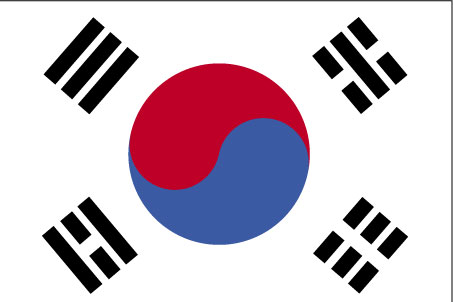
- Flag Symbolism
- white with a red (top) and blue yin-yang symbol, a synthesis of the Great Beginning - called tateguk in Korean, in the center; there is a different black trigram from the ancient I Ching (Book of Changes) in each corner of the white field White is the national color, a symbol of purity, peace and justice.
- Flag History
- The trigrams symbolize: I - heaven, the south and summer II - moon, the west, autumn and water III - the earth, the north and winter IV - the sun, the east, spring, and fire. The black stands for vigilance, perseverance, justice and chastity.
- Date of Adoption
- 25 January 1950
National Anthem
- Anthem Lyrics
- Aegukka 1. Donghae mul gwa Baekdu sani mareugo dal torok, Haneunimi bo-u hasa uri nara manse, Refrain:Mu gunghwa sam cheolli hwaryeo gang san, Daehan saram Daehan euro giri bojeonhase 2. Namsan uye chusonamu Chulkapeul turultut Paramsuli pulbyunhamum Uri kisang ilsae.
- Anthem Lyrics (English)
- 1. Until the East Sea's waves are dry, (and) Mt. Baekdusan worn away, God watch o'er our land forever! Our country forever! REFRAIN: Rose of Sharon, thousand miles of range and river land! Guarded by her people, ever may Korea stand! 2. Like that Mt. Namsan armored pine, standing on duty still, wind or frost, unchanging ever, be our resolute will. 3. In autumn's, arching evening sky,crystal, and cloudless blue, Be the radiant moon our spirit, steadfast, single, and true. 4. With such a will, (and) such a spirit, loyalty, heart and hand, Let us love, come grief, come gladness, this, our beloved land!
- Anthem History
- The beautiful South Korean anthem, "Aegukka", was adopted in 1948 after being liberated from Japan. Before the Japanese takeover of 1935, the melody for the Korean anthem was the popular Scottish song "Auld Lang Syne", with the words being the same as the anthem in use today. The words are by Yun Ch'i-Ho or An Ch'ang-Ho. It has been in use since 1948. The music is by Ahn Eaktay
Other National Symbols
National Flower
Hibiscus
National Tree
gingko, magnolia