
 English
 Español
 中文
中文 हिन्दी
 Français
Government and Politics
Government and Politics of Zimbabwe
Government structure, leadership, capital, military, and national symbols of Zimbabwe.
Government Structure
Constitutional foundations, branches, parties, and leadership.
- Government Type
- parliamentary democracy
- Administrative Divisions
- 8 provinces and 2 cities* with provincial status; Bulawayo*, Harare*, Manicaland, Mashonaland Central, Mashonaland East, Mashonaland West, Masvingo, Matabeleland North, Matabeleland South, Midlands
- Legal System
- mixture of Roman-Dutch and English common law
- Suffrage
- 18 years of age; universal
- Citizenship
- citizenship by birth: no citizenship by descent only: the father must be a citizen of Zimbabwe; in the case of a child born out of wedlock, the mother must be a citizen dual citizenship recognized: no residency requirement for naturalization: 5 years
- Executive Branch
- chief of state: Executive President Emmerson Dambudzo MNANGAGWA (since 24 November 2017); Vice President Constantino CHIWENGA (since 28 December 2017) and Vice President Kembo MOHADI (since 28 December 2017); note - the president is both the chief of state and head of government head of government: Executive President Emmerson Dambudzo MNANGAGWA (since 24 November 2017); Vice President Constantino CHIWENGA (since 28 December 2017) and Vice President Kembo MOHADI (since 28 December 2017); note - the president is both the chief of state and head of government cabinet: Cabinet appointed by the president; responsible to the National Assembly elections: presidential candidates nominated with a nomination paper signed by registered voters and elected by popular vote for a five-year term; election last held on 23 August 2023 (next to be held in 2028); co-vice presidents appointed by the president election results: Emmerson MNANGAGWA reelected president in the August 2023 general election; percent of vote - Emmerson MNANGAGWA (ZANU-PF) 52.6%, Nelson CHAMISA (CCC) 44.0%, other 3.4%
- Legislative Branch
- Bicameral Parliament consists of a Senate (80 seats; 60 members directly elected in multi-seat constituencies by proportional representation vote, 16 appointed by the president, and 18 reserved for chiefs; members serve five-year terms) and a National Assembly (280 seats; 210 members directly elected in single-seat constituencies by simple majority vote, 60 seats reserved for women elected by proportional representation, and 10 seats reserved for youths elected by proportional representation; members serve five-year terms). Elections: National Assembly last held on 23–24 August 2023 (next to be held in 2028); Senate last held on 23–24 August 2023 (next to be held in 2028). Election results: National Assembly – percent of vote by party – ZANU-PF 54.9%, CCC 21.8%, other and independent 23.3%; seats by party – ZANU-PF 190, CCC 73, other 17. Senate – seats by party – ZANU-PF 57, CCC 21, other 2.
- Judicial Branch
- Supreme Court; High Court
- Political Parties
- Movement for Democratic Change or MDC [Morgan TSVANGIRAI]; United Parties [Abel MUZOREWA]; United People's Party [Daniel SHUMBA]; Zimbabwe African National Union-Ndonga or ZANU-Ndonga [Wilson KUMBULA]; Zimbabwe African National Union-Patriotic Front or ZANU-PF [Robert Gabriel MUGABE]; Zimbabwe African Peoples Union or ZAPU [Agrippa MADLELA]
- Head of State
- Executive President Emmerson Dambudzo MNANGAGWA
- Head of Government
- Executive President Emmerson Dambudzo MNANGAGWA
- Cabinet
- Cabinet appointed by the president; responsible to the House of Assembly
- Elections
- National Assembly last held on 23–24 August 2023 (next to be held in 2028); Senate last held on 23–24 August 2023 (next to be held in 2028).
- Election Results
- National Assembly – percent of vote by party – ZANU-PF 54.9%, CCC 21.8%, other and independents 23.3%; seats by party – ZANU-PF 190, CCC 73, other 17. Senate – seats by party – ZANU-PF 57, CCC 21, other 2. These figures reflect results from the August 2023 general elections, in which ZANU-PF secured a dominant majority in both chambers. The elections were contested amid widespread allegations of irregularities, voter intimidation, and logistical failures, with international observers raising concerns about the fairness of the process. The Citizens Coalition for Change (CCC), led by Nelson Chamisa, disputed the results but fell short of mounting a successful legal challenge.
- Constitution
- 21-Dec-79
- Independence
- 18 April 1980 (from UK)
- National Holiday
- Independence Day, 18 April (1980)
- International Organization Participation
- ACP, AfDB, AU, FAO, G-15, G-77, IAEA, IBRD, ICAO, ICCt (signatory), ICFTU, ICRM, IDA, IFAD, IFC, IFRCS, ILO, IMF, Interpol, IOC, IOM, ISO, ITU, NAM, OPCW, PCA, SADC, UN, UNCTAD, UNESCO, UNIDO, UNMIK, UNMIL, UPU, WCL, WCO, WFTU, WHO, WIPO, WMO, WToO, WTrO
- Diplomatic Representation in the U.S.
- chief of mission: Ambassador Dr. Machivenyika T. MAPURANGA chancery: 1608 New Hampshire Avenue NW, Washington, DC 20009 telephone: [1] (202) 332-7100 FAX: [1] (202) 483-9326
- U.S. Diplomatic Representation
- chief of mission: Ambassador Christopher W. DELL embassy: 172 Herbert Chitepo Avenue, Harare mailing address: P. O. Box 3340, Harare telephone: [263] (4) 250-593 and 250-594 FAX: [263] (4) 796488
Capital City
Seat of government and political history.
- Capital City
- Harare
- Location
- 17 49 S, 31 02 E
- Time Difference
- UTC+2 (7 hours ahead of Washington, DC, during Standard Time)
- History
- named after a village of Harare at the site of the present capital; the village name derived from a Shona chieftain, NE-HARAWA, whose name meant "he who does not sleep"
Embassy and Diplomatic Representation
Embassy location and contact details.
U.S. Embassy Harare, Zimbabwe 172 Herbert Chitepo Avenue, Harare Telephone: (263)-4-250-593/4 Emergency, after-hours telephone: (263)-4-250-595 Fax: (263)-4-250-343.
Military
Branches, service obligations, expenditures, and manpower.
- Military Branches
- Zimbabwe Defense Forces (ZDF): Zimbabwe National Army (ZNA), Air Force of Zimbabwe (AFZ)
- Service Age and Obligation
- 18-24 years of age for voluntary military service; no conscription; women are eligible to serve
National Symbols
Flag, anthem, and other symbols of national identity.
National Flag
- Flag Symbolism
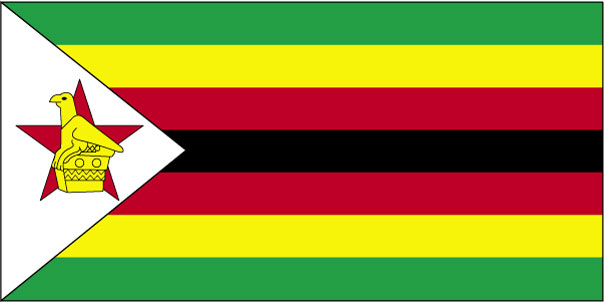
- seven equal horizontal bands of green, yellow, red, black, red, yellow, and green with a white isosceles triangle edged in black with its base on the hoist side; a yellow Zimbabwe bird representing the long history of the country is superimposed on a red five-pointed star in the center of the triangle, which symbolizes peace; green symbolizes agriculture, yellow - mineral wealth, red - blood shed to achieve independence, and black stands for the native people
- Date of Adoption
- 18 April 1980
National Anthem
- Anthem Lyrics
- 1.Simudzai mureza wedu weZimbabwe Yakazvarwa nomoto wechimurenga; Neropa zhinji ramagamba Tiidzivirire kumhandu dzose; Ngaikomborerwe nyika yeZimbabwe. 2.Tarisai Zimbabwe nyika yakashongedzwa Namakomo, nehova, zvinoyevedza Mvura ngainaye, minda ipe mbesa Vashandi vatuswe, ruzhinji rugutswe; Ngaikomborerwe nyika yeZimbabwe. 3.Mwari ropafadzai nyika yeZimbabwe Nyika yamadzitateguru edu tose; Kubva Zambezi kusvika Limpopo, Navatungamiri vave nenduramo; Ngaikomborerwe nyika yeZimbabwe.
- Anthem Lyrics (English)
- Blessed be the Land of Zimbabwe 1.O lift high the banner, the flag of Zimbabwe The symbol of freedom proclaiming victory; We praise our heros' sacrifice, And vow to keep our land from foes; And may the Almighty protect and bless our land. 2.O lovely Zimbabwe, so wondrously adorned With mountians, and rivers cascading, flowing free; May rain abound, and fertile fields; May we be fed, our labour blessed; And may the Almighty protect and bless our land. 3.O God, we beseech Thee to bless our native land; The land of our fathers bestowed upon us all; From Zambezi to Limpopo May leaders be exemplary; And may the Almighty protect and bless our land.
Other National Symbols
National Flower
flame lily