
 English
 Español
 中文
中文 हिन्दी
 Français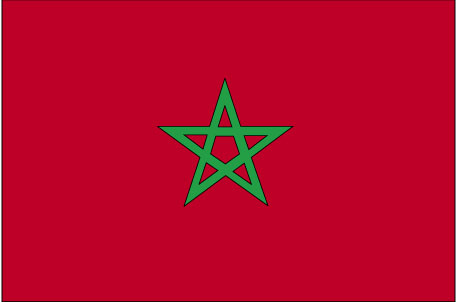
Morocco
Al Maghrib
Declare Your Relationship to Morocco
CountryReports Community
- Studying1
- From Morocco0
- Morocco heritage2
- Visited0
- Want to visit1
Customs and Culture
Customs and Culture
About the People
Moroccan culture is deeply rooted in Islam. When fortunes turn, people tend to attribute the cause to Allah, and the phrase Insha’allah (If God wills) is frequently heard. Moroccans value family, honor, dignity, generosity, and hospitality. Recently Amazigh Children started learning their native language “Berber” in schools. To resurrect the writing means bringing back an ancient script called Tifinagh, which originated around the same time as Egyptian hieroglyphics. The language and writing of the Amazighs is a sister of ancient Egyptian.
Cultural Attributes
Moroccans place great value on family and are generous. Amazigh children learn their native language, "Berber", in schools. To resurrect the writing means bringing back an ancient script called Tifinagh, which originated around the same time as Egyptian hieroglyphics. The language and writing of the Amazighs is a sister of ancient Egyptian.

Land of the Atlas and Ancient Berber Soul
Greetings, Gestures & Visiting
Shaking hands is the common greeting between people. To show one's pleasure to see the other person one might touch the heart often after shaking hands. Children kiss the right hand of their parents to show respect. The most common general greeting is "Assalam Oualaikoum" (Peace be upon you) which is used as "Hello". Titles are typically used to address people that are not as well known. Friends address each other by first name.
Diet
Foods made of barley and wheat are the basis of the Moroccan diet. Lamb, beef and chicken are the main meats eaten in Morocco. Rice and couscous are staples. Mint tea is the national drink. As the vast majority of Moroccans are Muslim, they do not eat pork or drink alcohol. Harira is the traditional meal eaten to break the fast during Ramadan. It is usually served with dates, figs and special sweets called chabakiya.

Family
The extended family is the most important element in Moroccan social life. Adult children expect to care for their aging parents when it becomes necessary. Polygamy is legal but not frequently practiced. A man may have up to four wives, but he must have permission from any wives he already has and must provide for each equally
Dating Customs
Boys and girls do not openly associate, and traditionally brides and grooms often do not meet until they are to be married. When a couple is to be married, the man pays the woman's father or eldest brother a sum of money to meet her expenses in the wedding. This sometimes inhibits a man from marrying because he cannot afford to pay the family. Girls usually bring a dowry into the marriage.
Recreation
In Morocco, recreational activities encompass diverse cultural, natural, and sporting pursuits, offering locals and visitors alike a rich tapestry of leisure experiences.
Holidays
Throne Day
7/30Other
accession of King MOHAMED VI to the throne
Dates of Interest
- November 18th
This festival is a traditional Berber marriage festival held annually in the High Atlas Mountains. It is known for its unique cultural practices and ceremonies.
How do people greet each other in Morocco?
Shaking hands is the common greeting, and the most common verbal greeting is "Assalam Oualaikoum" (Peace be upon you), meaning "Hello".
Do
- Shake hands when meeting
- Touch your heart after shaking hands to show pleasure at seeing someone
- Use titles for people you don't know well
- Address friends by their first name
Good to know
- Children kiss the right hand of their parents to show respect
What are the dining customs in Morocco?
Families eat the main meal together from a large communal dish, using only the right hand, and hosts encourage guests to eat generously.
Do
- Wash your hands before and after eating (a basin is usually provided)
- Eat with the fingers of your right hand from the communal dish
- Join in the mealtime conversation
- Accept more food when hosts urge you
Don’t
- Don't finish eating before your hosts, as it implies the food was not good
- Don't stay silent during the meal, as it embarrasses the hosts
- Don't expect pork or alcohol, as most Moroccans are Muslim and avoid them
Good to know
- Barley and wheat foods, rice, couscous, and meats like lamb, beef and chicken are staples
- Mint tea is the national drink
- During Ramadan, harira is eaten to break the fast, served with dates, figs and sweets called chabakiya
What etiquette should I follow when visiting Moroccans?
Moroccans are warm, gracious hosts and visiting friends and relatives is important; social visits can last several hours.
Do
- Accept refreshments offered to you
Don’t
- Don't refuse offered refreshments, as it is impolite
Good to know
- Men and women do not always socialize together
- Cafes, the busy marketplace, and the weekly rural souk are popular gathering places
What should I wear in Morocco?
Dress varies by location and occasion: traditional garments like the djellaba and kaftan are common, while Western-style clothing is widespread in cities and business settings.
Good to know
- The djellaba is a hooded robe worn by men and women; the jellaba is similar but hoodless for everyday wear
- Kaftans are formal robes women wear for weddings and religious festivals
- Some women wear modest Islamic attire such as hijabs or abayas, especially in conservative regions
- Coastal cities like Casablanca and Essaouira favor casual, lightweight clothing; rural and mountain areas favor traditional dress
What gestures should I be aware of in Morocco?
Use the right hand (or both hands) for passing items, and avoid gestures considered rude such as pointing or showing the sole of your foot.
Do
- Pass items with the right hand or both hands
- Raise a hand to hail a taxi
- Snap fingers to call a waiter in coffee houses and restaurants
Don’t
- Don't pass items with the left hand
- Don't point at people
- Don't let the bottom of your foot face a person
- Don't cross your legs
How important is family in Morocco?
The extended family is the most important element of social life, with adult children expecting to care for aging parents.
Good to know
- A traditional household includes parents, unmarried children, married sons and their families
- Polygamy is legal but not frequently practiced; a man may have up to four wives with permission and equal provision
- Traditionally brides and grooms may not meet until marriage, and a woman is expected to be a virgin before marriage
What do people do for recreation in Morocco?
Recreation includes exploring historic cities and souks, outdoor adventures in the mountains and desert, sports, and relaxation in traditional bathhouses.
Good to know
- Explore cities like Marrakech, Fes and Casablanca and haggle in souks
- Trek in the Atlas Mountains or Toubkal National Park, or camel trek in the Sahara
- Football is the favorite sport; water sports like surfing and windsurfing are popular in Essaouira and Agadir
- Visit a hammam for steam baths, scrubs and massages
Last updated: 2026-07-12 · Sources: CountryReports
Photos of Morocco
Photos of Morocco
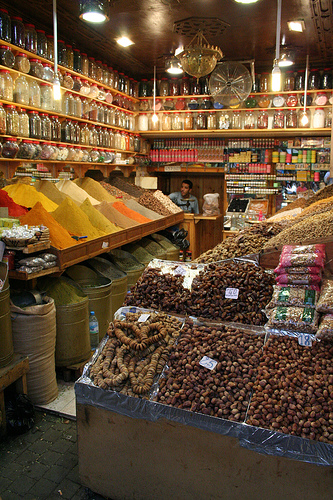
Spice shop in Marrakesh, Morocco.
High Atlas Mountains, Morocco
High Atlas Mountains, Morocco
High Atlas Mountains, Morocco
A man prepares to go to work with his horse.
High Atlas Mountains, Morocco
kids play by a water pump in Essaouira, Morocco
Horse bridle shop in Marrakesh, Morocco.
Food for sale in Marrakesh, Morocco
A shop in Marrakesh, Morocco.
A woodmakers shop in Marrakesh, Morocco.
Fishing boats in the harbour at Essaouira, Morocco


Travel and Tourism
Travel and Tourism
- Travel Alert Status
- Level 2: Exercise Increased Caution
- Currency
- Moroccan dirham (MAD)
- Time Difference
- UTC+1 (6 hours ahead of Washington, DC, during Standard Time)
- Climate
- The High Atlas are snow-capped and collect moisture from the Atlantic Ocean which climate patterns distribute over the western part of Morocco. Because this region lies between the Atlantic and the mountains, it enjoys a temperate climate. The Atlas range cannot, however, shut out an occasional shergui, the hot easterly wind from the desert. The eastern slopes of the High Atlas have a semi-desert aspect and a rigorous pre-Saharan climate. In the north, and separate from the Atlas ranges, the Rif Mountains loom up sharply along the Mediterranean coast. Here, also, a mild climate prevails, which permits agriculture typical of the Mediterranean region.
- Airports
- 64
Read the full travel guide — health, safety, vaccinations, disease risk, sanitation, and transit details.
View full travel guideRecipes
Recipes
History
History
Historical Eras
Ancient & Roman Morocco
1100 BCE – 788
Phoenician traders established coastal settlements around 1100 BCE, followed by Carthaginian expansion and eventual Roman incorporation as the province of Mauretania Tingitana from the 1st century AD. After Rome's decline, Vandals, Visigoths, and Byzantine Greeks successively held portions of the region, laying fragmented groundwork before the transformative Arab conquests of the 7th century brought Islam and a new civilization to the Maghreb.
Early Islamic Dynasties
788 – 1062
Arab forces completed the Islamization of Morocco, and in 788 Idris I founded the Idrissid dynasty, the first major Arab-Islamic ruling house of Morocco, claiming descent from the Prophet Muhammad. Successive Berber and Arab dynasties consolidated Islamic governance, and the founding of fortified cities like Marrakech in 788 reflected growing political ambition and urban sophistication across the region.
Berber Imperial Dynasties
1062 – 1554
The Almoravid dynasty unified Morocco and extended its rule deep into the Iberian Peninsula and West Africa, followed by the Almohads and then the Merenids, who presided over a golden age of art, architecture, and scholarship in Fes. The period saw Morocco emerge as a confident independent state and a major Mediterranean and trans-Saharan power, though it also faced repeated challenges including a Spanish invasion attempt in 1267 and the arrival of Jewish refugees expelled from Spain in 1492.
Saadian Dynasty
1554 – 1669
The Saadian sultans expelled Portuguese forces from most coastal fortresses and dramatically expanded Moroccan influence by sacking Timbuktu in 1591 and dominating trans-Saharan gold trade routes. Their reign produced notable architectural achievements in Marrakech, including the celebrated Saadian Tombs, and represented the last great pre-Alaouite dynasty before political fragmentation opened the door to the Alaouites.
Alaouite Sultanate
1649 – 1912
The Alaouite dynasty, claiming descent from the Prophet Muhammad, consolidated Morocco under centralized rule and has governed continuously to the present day. European commercial and imperial pressure intensified through the 19th century, with France asserting a sphere of influence recognized by Britain in 1904 and formalized at the Algeciras Conference of 1906, ultimately culminating in the Treaty of Fes in 1912 which established a French protectorate and divided northern and southern zones between France and Spain.
Protectorate & Independence
1912 – 1956
Under French and Spanish protectorate rule, Moroccan nationalist sentiment grew steadily, crystallizing in the Istiqlal Party's 1944 independence manifesto and galvanized when France exiled the revered Sultan Mohammed V in 1953. His return in 1955 signaled the end of French resistance, and Morocco recovered full political independence on March 2, 1956, with Tangier reintegrated later that year under the Tangier Protocol.
Independent Kingdom
1956 – present
The Kingdom of Morocco under the Alaouite monarchy navigated post-independence nation-building, the contentious annexation of Western Sahara beginning in the late 1970s, and gradual democratization through the 1990s that established a bicameral legislature in 1997. The country has pursued moderate political reform and regional diplomacy while the status of Western Sahara remains one of Africa's longest-standing unresolved territorial disputes.
Overview
Morocco’s strategic location has shaped its history. Beginning with the Phoenicians, many foreigners were drawn to this area. Romans, Vandals, Visigoths, and Byzantine Greeks successively ruled the area. Arab forces began occupying Morocco in the seventh century A.D., bringing their civilization and Islam. The Alaouite dynasty, which has ruled Morocco since 1649, claims descent from the Prophet Muhammad.
Timeline of Key Events
1100 BCE
Phoenician settlements in Morocco
Phoenician settlements in Morocco during the Bronze Age. First trading port is in Lixus near Larache.
500 BCE
Carthaginians take over and expand the Moroccan Phoenician settlements
Carthaginians take over and expand the Moroccan Phoenician settlements.
146 BCE
Carthage falls to Rome
Carthage falls to Rome in the Third Punic War. Roman influence spreads into the Berber kingdoms of Mauretania-Numidia.
27
Morocco comes under direct Roman rule during the reign of Emperor Caligula.
Morocco comes under direct Roman rule during the reign of Emperor Caligula.
535
Byzantines occupy Ceuta on the north coast.
Byzantines occupy Ceuta on the north coast.
600 – 700
Muslims began a wave of invasions.
Muslims began a wave of invasions.
788 – 923
Idrissid Dynasty
Idrissid Dynasty.
Read the full history profile — narrative overview, defining eras, and the complete timeline in one place.
View expanded historyInteresting Facts
Interesting Facts
When a child loses a tooth they put their tooth under their pillow when they go to bed. The next morning they must rise with the sun and throw their tooth toward the say while they say “I give you a donkey's tooth and ask you to replace it with a gazelle's tooth.” Otherwise they believe that they might get donkey teeth.
The word “Morocco” was derived from Marrakesh, the name of the capital city in the 11th and 12th centuries. “Marrakesh” means “a pass.” The city was an important stop on the caravan route through the Atlas Mountains.
The region in which Morocco islocated is known as the Maghreb or “sunset”. It is so named becasue it lies to the west of the other Arab nations. Morocco is sometimes known as El Maghreb el Aqsa, whihc is Arabic for “The Extreme West”.
Marrakesh is called the “Red City,” because of the colour of its buildings, which were constructed using the red sand found in that region.
See every fact — trivia, oddities, and curious tidbits gathered from across the country.
View all interesting factsGeography and Environment
Geography and Environment
- Terrain
- northern coast and interior are mountainous with large areas of bordering plateaus, intermontane valleys, and rich coastal plains
- Climate
- The High Atlas are snow-capped and collect moisture from the Atlantic Ocean which climate patterns distribute over the western part of Morocco. Because this region lies between the Atlantic and the mountains, it enjoys a temperate climate. The Atlas range cannot, however, shut out an occasional shergui, the hot easterly wind from the desert. The eastern slopes of the High Atlas have a semi-desert aspect and a rigorous pre-Saharan climate. In the north, and separate from the Atlas ranges, the Rif Mountains loom up sharply along the Mediterranean coast. Here, also, a mild climate prevails, which permits agriculture typical of the Mediterranean region.
- Natural Hazards
- northern mountains geologically unstable and subject to earthquakes; periodic droughts
- Current Environmental Issues
- land degradation/desertification (soil erosion resulting from farming of marginal areas, overgrazing, destruction of vegetation); water supplies contaminated by raw sewage; siltation of reservoirs; oil pollution of coastal waters
Read the full geography and environment profile — terrain, climate, natural resources, hazards, land use, and international agreements.
View full geographyPeople & Demographics
People & Demographics
Religion
Languages Spoken
Arabic (official), Berber dialects, French
- Arabic
- French
Population
- Population
- 31,627,428
- Population in Major Urban Areas
- Casablanca 3.046 million; RABAT (capital) 1.843 million; Fes 1.088 million; Marrakech 939,000; Tangier 810,000; Agadir 805,000
- Nationality Noun
- Moroccan(s)
- Ethnic Groups
- Arab-Berber 99.1%, other 0.7%, Jewish 0.2%
- Language Note
- The official language is Arabic, and the Moroccan dialect of Arabic, called Derija, is the most widely spoken tongue. Derija is quite different from the classical Arabic of the Qur’an (koran), the scriptural text of Islam. Berber is the native language of about 35 % of the population, and it also includes several dialects. Other dialects are Rif, Tamazight and Shluh. French is widely spoken, especially in business, government, and higher education. Spanish can still be heard in the north, which was formerly under Spanish control. English is gaining popularity.
Education
- Literacy Definition
- age 15 and over can read and write
Read the full people and society profile — demographics, health, education, religion, languages, and notable people.
View full people and societyGovernment & Politics
Government & Politics
Country Identity
- Country Name
- Morocco
- Full Country Name
- Kingdom of Morocco
- Local - Long
- Al Mamlakah al Maghribiyah
- Local - Short
- Al Maghrib
Government Structure
- Government Type
- constitutional monarchy
- Legal System
- based on Islamic law and French and Spanish civil law system; judicial review of legislative acts in Constitutional Chamber of Supreme Court
- Executive Branch
- chief of state: King MOHAMED VI (since 30 July 1999) head of government: Prime Minister Aziz AKHANNOUCH (since 7 October 2021) cabinet: Council of Ministers appointed by the monarch elections: none; the monarch is hereditary; prime minister appointed by the monarch following legislative elections, typically the leader of the party or coalition securing the most seats in parliament
- Legislative Branch
- bicameral Parliament consists of an upper house or Chamber of Counselors (270 seats; members elected indirectly by local councils, professional organizations, and labor syndicates for nine-year terms; one-third of the members are renewed every three years) and a lower house or Chamber of Representatives (325 seats; 295 by multi-seat constituencies and 30 from national lists of women; members elected by popular vote for five-year terms) elections: Chamber of Counselors - last held 6 October 2003 (next to be held in 2006); Chamber of Representatives - last held 27 September 2002 (next to be held in 2007) election results: Chamber of Counselors - percent of vote by party - NA; seats by party - RNI 42, MDS 33, UC 28, MP 27, PND 21, PI 21, USFP 16, MNP 15, PA 13, FFD 12, other 42; Chamber of Representatives - percent of vote by party - NA; seats by party - USFP 50, PI 48, PJD 42, RNI 41, MP 27, MNP 18, UC 16, PND 12, PPS 11, UD 10, other 50
- Judicial Branch
- Supreme Court (judges are appointed on the recommendation of the Supreme Council of the Judiciary, presided over by the monarch)
- Suffrage
- 18 years of age; universal (as of January 2003)
- Constitution
- 10 March 1972, revised 4 September 1992, amended (to create bicameral legislature) September 1996
- Independence
- 2 March 1956 (from France)
- National Holiday
- Throne Day (accession of King MOHAMED VI to the throne), 30 July (1999)
Capital City
- Capital Name
- Rabat
- Capital - geographic coordinate
- 34 01 N, 6 49 W
- Capital Time Difference
- UTC+1 (6 hours ahead of Washington, DC, during Standard Time)
name derives from the Arabic title "Ribat el-Fath," meaning "stronghold of victory," applied to the newly constructed citadel in 1170
Military
Branches: Royal Armed Forces (Forces Armees Royales, FAR): Royal Moroccan Army (includes Air Defense), Royal Moroccan Navy (includes Coast Guard, Marines), Royal Moroccan Air Force (Al Quwwat al Jawyiya al Malakiya Marakishiya; Force Aerienne Royale Marocaine)
Embassy / Diplomatic Mission
U.S. Embassy in Rabat
2 Avenue de Mohamed El Fassi (formerly Avenue de Marrakech), Rabat
Telephone: (212) (537) 76-22-65, Fax: (212) (537)76-56-61
For emergency services after-hours, please call the Duty Officer cell phone at (212) (661)13-19-39.
U.S. Consulate General in Casablanca
8 Boulevard Moulay Youssef, Casablanca
Telephone: (212) (522) 26-45-50, Fax number: (212) (522) 20-80-97For emergency services after-hours, please call (212) (661) 13-19-39
Read the full government profile — flag symbolism, national anthem, and other national symbols.
View full government detailsEconomy
Economy
Morocco has made significant economic progress over the past two decades, transitioning from a primarily agrarian economy to one of the more diversified markets in North Africa. The country has pursued sustained structural reforms, liberalized trade, and invested heavily in infrastructure, including the Tanger-Med port complex—now the largest container port in the Mediterranean—and Africa's first high-speed rail line. Key sectors driving growth include automotive manufacturing, aerospace, phosphates and fertilizers, tourism, textiles, and renewable energy. Morocco has emerged as Africa's leading automobile producer, with major plants operated by Renault and Stellantis.
Despite these advances, the economy still faces considerable challenges. Agriculture remains a substantial employer and continues to make GDP vulnerable to rainfall variability, as demonstrated by recurring droughts that have weighed on growth in recent years. Unemployment, particularly among youth and university graduates, remains stubbornly high, and regional and social inequalities persist. Inflation surged in 2022 and 2023 due to global commodity shocks before easing in 2024, while the dirham operates under a gradually widening managed float against a euro-dollar basket.
The government's New Development Model and the 2021–2035 strategic roadmap aim to raise living standards, expand the social safety net, and double GDP per capita. Morocco is also positioning itself as a green energy hub, with ambitious targets for solar, wind, and green hydrogen production. Co-hosting the 2030 FIFA World Cup with Spain and Portugal is expected to accelerate infrastructure investment. Long-term priorities include improving education and human capital, deepening industrial integration with European and African markets, attracting foreign direct investment, and building resilience to climate change and water scarcity.
Snapshot
- Currency Name and Code
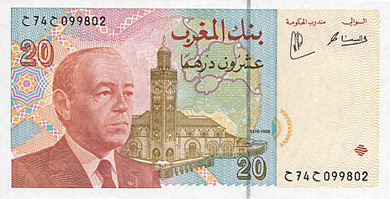
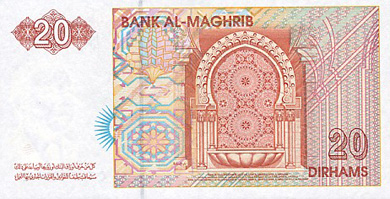
- Moroccan Dirham (MAD)
- GDP — official exchange rate
- $5,194,000,000 (USD)
- GDP Real Growth Rate
- 1.8%
- Gini Index
- 40
Banknotes
Budget & Public Finance
- Fiscal Year
- calendar year
- Annual Budget
- $16,770,000,000 (USD)
- Public Debt (% of GDP)
- 72.3%
- External Debt
- $15,600,000,000 (USD)
- Investment (% of GDP)
- 23.5%
- Economic Aid
- $565,600,000 (USD)
- Current Account Balance
- -$607,500,000 (USD)
- Reserves of Foreign Exchange
- $2,147,483,647 (USD)
Labor, Industry & Trade
- Labor Force by Occupation
- agriculture 40%; services 45%; industry 15%
- Household Income — highest 10%
- 30.9%
- Industries
- phosphate rock mining and processing, food processing, leather goods, textiles, construction, tourism
- Agriculture Products
- barley, wheat, citrus, wine, vegetables, olives; livestock
- Export Commodities
- clothing, fish, inorganic chemicals, transistors, crude minerals, fertilizers (including phosphates), petroleum products, fruits, vegetables
- Export Partners
- France 25.9%, Spain 14%, UK 7.8%, Germany 5.7%, Italy 5.5%, US 4.7%
- Import Commodities
- crude petroleum, textile fabric, telecommunications equipment, wheat, gas and electricity, transistors, plastics
- Import Partners
- France 21.1%, Spain 12.7%, Italy 6.4%, Germany 5.6%, US 4.6%, UK 4.1%, Saudi Arabia 4.1%
Energy
- Oil Production
- 300 bbl/day
- Oil Consumption
- 158,000 bbl/day
- Oil Reserves
- 100,000,000 bbl/day
- Natural Gas Production
- 50,000,000 cu m
- Natural Gas Consumption
- 650,000,000 cu m
- Natural Gas Imports
- 0 cu m
- Natural Gas Exports
- 0 cu m
- Natural Gas Reserves
- 1,218,000,000 cu m
Communications
- Telephone System
- general assessment: good system composed of open-wire lines, cables, and microwave radio relay links; principal switching centers are Casablanca and Rabat; national network nearly 100% digital using fiber-optic links; improved rural service employs microwave radio relay; Internet available but expensive domestic: fixed-line teledensity is roughly 10 per 100 persons; mobile-cellular subscribership exceeds 100 per 100 persons international: country code - 212; landing point for the Atlas Offshore, Estepona-Tetouan, Euroafrica, Spain-Morocco, and SEA-ME-WE-3 fiber-optic telecommunications undersea cables that provide connectivity to Asia, the Middle East, and Europe; satellite earth stations - 2 Intelsat (Atlantic Ocean) and 1 Arabsat; microwave radio relay to Gibraltar, Spain, and Western Sahara; coaxial cable and microwave radio relay to Algeria; participant in Medarabtel; fiber-optic cable link from Agadir to Algeria and Tunisia
- Internet Country Code
- .ma
News & Weather
News & Weather
Current Weather
Latest News
Spain go back to top of FIFA rankings, Morocco reach record high - Reuters
Reuters · 1d ago
At their forefront Morocco.. 6 national teams have officially qualified for the 2030 World Cup - Goal.com
Goal.com · 1d ago
World Cup: Spain Overtakes Argentina in FIFA Rankings, Morocco Ranks Sixth - Morocco World News
Morocco World News · 1d ago
Rabat demands answers after Moroccan man dies during arrest in Italy - Al Jazeera
Al Jazeera · 3h ago
Morocco urges investigation after arrested national dies in Bologna - Reuters
Reuters · 1h ago
West Africa signs off $25bn mega gas-pipeline plan - BBC
BBC · 1d ago
West African leaders approve Nigeria-Morocco gas pipeline - africanews.com
africanews.com · 2d ago
Morocco has no gas. So how did it sell the world a $25bn gas pipeline? - Middle East Eye
Middle East Eye · 2d ago
News via Google News
Climate Overview
The High Atlas are snow-capped and collect moisture from the Atlantic Ocean which climate patterns distribute over the western part of Morocco. Because this region lies between the Atlantic and the mountains, it enjoys a temperate climate. The Atlas range cannot, however, shut out an occasional shergui, the hot easterly wind from the desert. The eastern slopes of the High Atlas have a semi-desert aspect and a rigorous pre-Saharan climate. In the north, and separate from the Atlas ranges, the Rif Mountains loom up sharply along the Mediterranean coast. Here, also, a mild climate prevails, which permits agriculture typical of the Mediterranean region.
Videos
Videos
1 curated YouTube videos.
Source: YouTube
Frequently Asked Questions
Frequently Asked Questions
What is the population of Morocco?
How do people greet each other in Morocco?
What are the dining customs in Morocco?
What etiquette should I follow when visiting Moroccans?
What should I wear in Morocco?
What gestures should I be aware of in Morocco?
How important is family in Morocco?
What do people do for recreation in Morocco?
What is the capital of Morocco?
Where is Morocco located?
What countries border Morocco?
What is the main religion of Morocco?
What currency does Morocco use?
What languages are spoken in Morocco?
What is Morocco known for?
What is Morocco's system of government?
Last reviewed 2026