
 English
 Español
 中文
中文 हिन्दी
 Français
Government and Politics
Government and Politics of Guinea-Bissau
Government structure, leadership, capital, military, and national symbols of Guinea-Bissau.
Government Structure
Constitutional foundations, branches, parties, and leadership.
- Government Type
- republic, multiparty since mid-1991
- Administrative Divisions
- 9 regions (regioes, singular - regiao); Bafata, Biombo, Bissau, Bolama, Cacheu, Gabu, Oio, Quinara, Tombali; note - Bolama may have been renamed Bolama/Bijagos
- Legal System
- NA
- Suffrage
- 18 years of age; universal
- Citizenship
- Citizenship by birth: Yes Citizenship by descent only: Yes Dual citizenship recognized: No Residency requirement for naturalization: 5 years
- Executive Branch
- chief of state: President Umaro Sissoco EMBALO (since 27 February 2020, reelected for a second term in November 2023) head of government: Prime Minister Rui Duarte DE BARROS (since 20 December 2023) cabinet: Cabinet of Ministers appointed by the president elections: president elected by popular vote for a five-year term; election last held on 24 November 2019, with a runoff on 29 December 2019 (next election held in November 2023); prime minister appointed by the president election results: Umaro Sissoco EMBALO elected president in the December 2019 runoff; percent of vote - Umaro Sissoco EMBALO 53.6%, Domingos Simoes PEREIRA 46.4%; reelected in November 2023 with approximately 53% of the vote in the first round
- Legislative Branch
- unicameral National People's Assembly or Assembleia Nacional Popular (102 seats; members are elected by popular vote to serve four-year terms) elections: last held on 4 June 2023 (next to be held in 2027) election results: percent of vote by party - PAIGC 54.5%, Madem G15 28.9%, PRS 12.6%, other 4.0%; seats by party - PAIGC 54, Madem G15 29, PRS 12, other 7
- Judicial Branch
- Supreme Court or Supremo Tribunal da Justica (consists of nine justices appointed by the president and serve at his pleasure; final court of appeals in criminal and civil cases); Regional Courts (one in each of nine regions; first court of appeals for Sectoral Court decisions; hear all felony cases and civil cases valued at over $1,000); 24 Sectoral Courts (judges are not necessarily trained lawyers; they hear civil cases under $1,000 and misdemeanor criminal cases)
- Political Parties
- African Party for the Independence of Guinea-Bissau and Cape Verde or PAIGC [Carlos GOMES Junior]; Democratic Social Front or FDS [leader NA]; Electoral Union or UE [leader NA]; Party for Democratic Convergence or PCD [Victor MANDINGA]; Social Renovation Party or PRS [Alberto NAMBEIA]; Union for Change or UM [Jorge MANDINGA, president, Dr. Anne SAAD, secretary general]; United Platform or UP [coalition formed by PCD, FDS, FLING, and RGB-MB]; United Popular Alliance or APU [leader NA]; United Social Democratic Party or PUSD [Francisco Jose FADUL]
- Head of State
- President Umaro Sissoco EMBALO (since 27 February 2020, reelected for a second term in November 2023)
- Head of Government
- Prime Minister Rui Duarte DE BARROS
- Elections
- last held on 4 June 2023 (next to be held in 2027)
- Election Results
- Percent of vote by party - PAIGC 54.5%, Madem G15 28.9%, PRS 12.6%, other 4.0%; seats by party - PAIGC 54, Madem G15 29, PRS 12, other 7. These results reflect the March 2019 legislative elections, in which the African Party for the Independence of Guinea and Cape Verde (PAIGC) secured a commanding majority in the 102-seat National People's Assembly, marking a significant consolidation of support for the long-dominant party amid a period of ongoing political instability in the country.
- Constitution
- 16 May 1984, amended 4 May 1991, 4 December 1991, 26 February 1993, 9 June 1993, and 1996
- Independence
- 24 September 1973 (unilaterally declared by Guinea-Bissau); 10 September 1974 (recognized by Portugal)
- National Holiday
- Independence Day, 24 September (1973)
- International Organization Participation
- ACCT, ACP, AfDB, AU, ECOWAS, FAO, FZ, G-77, IBRD, ICAO, ICCt (signatory), ICFTU, ICRM, IDA, IDB, IFAD, IFC, IFRCS, ILO, IMF, IMO, Interpol, IOC, IOM, ITU, NAM, OIC, OPCW (signatory), UN, UNCTAD, UNESCO, UNIDO, UNMIL, UPU, WADB (regional), WAEMU, WFTU, WHO, WIPO, WMO, WToO, WTrO
- Diplomatic Representation in the U.S.
- chief of mission: Ambassador (vacant); Charge d'Affaires Henrique Adriano DA SILVA; note - his address is 15929 Yukon Lane, Rockville, MD 20855 mailing address: P. O. Box 33813, Washington, DC 20033 telephone: [1] (301) 947-3958 FAX: [1] (202) 347-3954
- U.S. Diplomatic Representation
- the US Embassy suspended operations on 14 June 1998 in the midst of violent conflict between forces loyal to then President VIEIRA and military-led junta; US Embassy Dakar is responsible for covering Guinea-Bissau: telephone - [221] 823-4296; FAX - [221] 822-5903
Capital City
Seat of government and political history.
- Capital City
- Bissau
- Location
- 11 51 N, 15 35 W
- Time Difference
- UTC 0 (5 hours ahead of Washington, DC, during Standard Time)
- History
- The meaning of Bissau is uncertain, it might be an alternative name for the Papel people who live in the area of the city of Bissau
Embassy and Diplomatic Representation
Embassy location and contact details.
U.S. Embassy Dakar Route des Almadies – B.P. 49 Dakar, Senegal Telephone: 221 33-879-4000 Emergency after-hours telephone: 221 33-879-4444 Regional Security Office: 221 33-879-4420 Facsimile: 221 33-879-4050
Military
Branches, service obligations, expenditures, and manpower.
- Military Branches
- People's Revolutionary Armed Force (FARP): Army, Navy, National Air Force (Forca Aerea Nacional); Presidential Guard
- Service Age and Obligation
- 18-25 years of age for selective compulsory military service (Air Force service is voluntary); 16 years of age or younger, with parental consent, for voluntary service
National Symbols
Flag, anthem, and other symbols of national identity.
National Flag
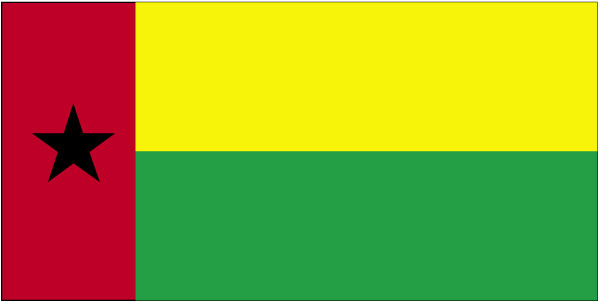
- Flag Symbolism
- two equal horizontal bands of yellow (top) and green with a vertical red band on the hoist side; there is a black five-pointed star centered in the red band; uses the popular pan-African colors of Ethiopia
- Flag History
- In August 1961 the African Party for the Independence of Guinea and Cape Verde adopted a flag in pan-African colors with the party initials (PAIGC) beneath a black star. When independence was proclaimed the flag, without the initial, became the national flag of Guinea-Bissau. The red stands for the suffering under colonial rule and for the blood shed in the struggle for independece. The yellow symbolizes the fruits of work that contribute to well-being. The green represents the tropical forests of the country and hope for a bright future. The star is a symbol of Africa and its people.
- Date of Adoption
- 24 September 1973
National Anthem
- Anthem Lyrics
- Sol, suor e o verde e mar, Séculos de dor e esperança: Esta é a terra dos nossos avós! Fruto das nossas mãos, Da flor do nosso sangue: Esta é a nossa pátria amada. CHORUS: Viva a pátria gloriosa! Floriu nos céus a bandeira da luta. Avante, contra o jugo estrangeiro! Nós vamos construir Na pátria immortal A paz e o progresso! Nós vamos construir Na pátria imortal A paz e o progresso! paz e o progresso! Ramos do mesmo tronco, Olhos na mesma luz: Esta é a força da nossa união! Cantem o mar e a terra A madrugada e o sol Que a nossa luta fecundou. CHORUS
- Anthem Lyrics (English)
- Sun, sweat, verdure and sea, Centuries of pain and hope; This is the land of our ancestors. Fruit of our hands, Of the flower of our blood: This is our beloved country. CHORUS: Long live our glorious country! The banner of our struggle Has fluttered in the skies. Forward, against the foreign yoke! We are going to build Peace and progress In our immortal country! Peace and progress In our immortal country! Branches of the same trunk, Eyes in the same light; This is the force of our unity! The sea and the land, The dawn and the sun are singing That our struggle has borne fruit! CHORUS
- Anthem History
- "Esta é a Nossa Pátria Bem Amada" ("This Is Our Beloved Country") is the national anthem of Guinea-Bissau. Written and composed by Amílcar Cabral, it was adopted upon independence in 1974.