
 English
 Español
 中文
中文 हिन्दी
 Français
Thailand
Siam
Declare Your Relationship to Thailand
CountryReports Community
- Studying10
- From Thailand2
- Thailand heritage2
- Visited3
- Want to visit0
Customs and Culture
Customs and Culture
Cultural Attributes
Traditionally, success is measured by a person's wealth and education. Wealth is generally looked on as a reflection of virtue. Thais are reserved people and usually consider criticism of others to be poor taste. A sense of humor, laughter, and a pleasant, smiling attitude are highly regarded.
Wealth can be described in the following classes: Upper class: Can buy a big house downtown, have a European car or many cars, and they can travel out of the country every few months for vacation. The medium-wealth class can buy a house and have an SUV or sports car. Their children can attend an international school and they can travel up-country once a year. The poor typically rent a house in the "slum" community.

Land of the Free, Kingdom of the Lotus
Get More Customs and Culture
6 more cultural topics for members
Social Customs & Etiquette · Diet · Family · Dating Customs · Recreation · Student Life
Every country, every topic, all activities & recipes
✓ Instant access on this device · ✓ No subscription
Holidays
Birthday of King PHUMIPHON
12/5Birthday
Christmas
12/25xmas
Dates of Interest
- Mid-April
Festival is celebrated in Surin province in northeastern Thailand and honors the importance of elephants in Thai culture and history. The festival features elephant parades, demonstrations of traditional elephant training and handling techniques, and cultural performances.
How do people greet each other in Thailand?
The traditional greeting is the "wai," performed by placing the palms together with fingers extended at chest level and bowing slightly; how it's done depends on the relationship between the people.
Do
- Let the younger person greet first, with the older person responding with a lower wai
- Place your hands higher to show more respect
- Use first names in normal situations and last names in formal circumstances
Good to know
- More pronounced bows and curtsies show greater respect
What are the dining customs in Thailand?
Rice is the staple, usually served with spicy dishes, curries, and pepper sauces; diners choose small portions from shared central dishes to eat with rice.
Do
- Hold the spoon in your right hand and the fork in your left
- Use chopsticks for noodle dishes and in Chinese homes
- Place utensils together on the plate when finished
- Expect a second helping and try to eat as much as you can
Good to know
- Water is the standard mealtime drink and is drunk at the end of the meal
What etiquette should I follow when visiting a Thai home?
Status and age determine how you interact with others, and the person of highest rank or age is treated with the greatest respect.
Do
- Remove your shoes when entering a Buddhist temple or private home
- Sit with women tucking legs to the side and behind, and men sitting cross-legged
- Consider bringing a gift of appreciation for extended stays
Don’t
- Do not stretch your feet out in front of you
- Don't feel obligated to bring a gift for a regular visit
How should I dress in Thailand?
Western clothing is common, especially in larger cities, though traditional clothing is also often worn.
Do
- Wear shoes in formal situations
Good to know
- Sandals are popular, and straw hats are common due to the heat
What gestures should I know in Thailand?
Gestures reflect respect and religious belief, so be mindful of your hands, feet, and how you move around others.
Do
- Pass and receive items, especially gifts, with the right hand only
- Lower your upper body slightly when passing in front of someone, especially an elder
Don’t
- Never pass or receive items with the left hand
- Never raise your fingertips higher than your face
- Do not step on a door sill when entering a building
Good to know
- Thais believe a deity resides in the door sill
What is family life like in Thailand?
Thais have great respect for parents and elders, and families usually have two or three children.
Good to know
- Family members are traditionally expected to follow the advice of elders, though this is fading with modernization
- The youngest daughter inherits the parents' home and cares for them in old age
What do people do for recreation in Thailand?
Popular pastimes include takraw, a game keeping a rattan ball in the air using any body part except the hands, and muay thai (Thai boxing).
Good to know
- Takraw can be played casually in a circle or formally like volleyball with a net
- Muay thai allows fists, elbows, knees, shins, and feet, and includes rituals like the "ram muay" dance
- Children play games like jacks with stones, mon sorn pha, and pio
Last updated: 2026-07-12 · Sources: CountryReports
Photos of Thailand
Photos of Thailand
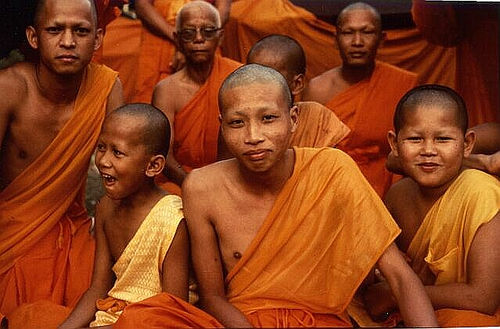
Young Thai monks at Buddhist monestery, Phitsanulok, Thailand
Bangkok Thailand
Statues in Thailand
Woman delivering fruits and nuts in the market place
Wat Prah Kaew Temple
Imperial Palace in Bangkok
Wat Run Temple
Streetside shop sells dried squid
The Kings Palace- Bangkok, Thailand
Wat Arun Temple, Bangkok
Mass transit near Poipet
Man sells various brooms- Bangkok


Travel and Tourism
Travel and Tourism
- Travel Alert Status
- Level 1: Exercise Normal Precautions
- Currency
- 34.61
- Time Difference
- UTC+7 (12 hours ahead of Washington, DC, during Standard Time)
- Climate
- Located at 20 degrees north latitude, Thailand is generally hot and humid with a climate that is classified as tropical monsoon. A pronounced rainy season lasts from July to October. From November to February, the northeast monsoon brings a cooler, drier period, when the humidity drops from an average high of 95 percent to an average low of 58 percent. During this season, temperatures typically range from the mid-60s in the early morning to the mid-80s during the day. The period from March to June is Bangkok's summer, which is usually hot and humid; temperatures can reach 100° Fahrenheit.
- Airports
- 109
- Recommended Vaccinations
- How important is it to do your research about vaccinations? It might just save your life! Make yourself aware of the different types of vaccinations and which ones you may need to travel to your destination. Schedule an appointment with your doctor at least four to six weeks before you travel to ensure you receive all important shots. Be sure that you and your family are up to date on your routine vaccinations. Which vaccinations you need will depend on a number of factors including your destination, whether you will be spending time in rural areas, the season of the year you are traveling, your age, health status, and previous immunizations.
Read the full travel guide — health, safety, vaccinations, disease risk, sanitation, and transit details.
View full travel guideRecipes
Recipes
Thai Raw Papaya Salad
Side Dish
Main Dish
Pad Thai (Thai Fried Noodles)
Main Dish
Gkai Kamin (Lemongrass Chicken)
Main Dish
Kal Polt (Fish Sauce, Egg and Rice, stirred into a Pork, Onion and Tomato Stir-Fry)
Main Dish
(Thai Coconut Chicken)
Main Dish
MiangKam
Main Dish
Tom Khaa'kai (Chicken with Coconut Milk)
Main Dish
PremiumNahm Prik Ohng (A tasty meat sauce studded with tomatoes and onions)
Side Dish
PremiumTHAI GLASS NOODLES (YAM WOON SEN)
Side Dish
PremiumYam Gai (Thai Broiled Chicken Salad)
History
History
Historical Eras
Sukhothai
1238 – 1351
The Sukhothai Kingdom, established in 1238, is traditionally regarded as the first Thai kingdom and the birthplace of Thai culture, art, and the Thai writing system created by King Ramkhamhaeng the Great. The period is often considered a golden age of Thai civilization, characterized by the development of Theravada Buddhism as the state religion.
Ayutthaya
1351 – 1782
The Ayutthaya Kingdom (1351-1767) succeeded Sukhothai as the dominant Thai state and grew into one of the largest and most cosmopolitan cities in the world by the 17th century, with a population exceeding one million and active trade with China, Japan, India, Persia, and European nations.
Bangkok / Chakri Dynasty
1782 – 1932
King Rama I founded the Chakri Dynasty in 1782 and moved the capital across the river to Bangkok. Thailand holds the unique distinction of being the only Southeast Asian nation never colonized by a European power, navigating the colonial era through careful diplomacy and modernization.
Democracy
1932 – 1973
A bloodless coup in 1932 ended absolute monarchy and ushered in constitutional government. The decades that followed were marked by political instability, military influence, and Thailand's involvement in World War II and the Cold War as a U.S. ally in Southeast Asia.
Modern Era
From 1973 onward, Thailand has navigated waves of democracy, military intervention, and rapid economic development. Today the country is a constitutional monarchy with a globalized economy, a regional tourism hub, and a founding member of ASEAN.
Overview
Stone Wheel of Law, Dvaravati Period (sixth-ninth centuries
Every country, every topic, all activities & recipes
✓ Instant access on this device · ✓ No subscription
Timeline of Key Events
600 BCE
Chinese T’ai migration recorded
Chinese T’ai migration recorded.
300 BCE
Indian settlements bringing the Hindu religion.
Indian settlements bringing the Hindu religion.
1000
The Mons, from Burma, had established themselves in Central Thailand.
The Mons, from Burma, had established themselves in Central Thailand.
1350
A monarchy was established in Thailand under the rule of King Ramathibodi.
A unified Thai kingdom is established under the rule of King Ramathibodi. A series of kings follow, ruling what was then known as Siam.
1516
Portuguese send an envoy to Thai Court and sign a treaty.
Portuguese send an envoy to Thai Court and sign a treaty.
1529 – 1569
War with Burma
War with Burma.
1782
Beginning of the Chakri dynasty under King Rama I.
Beginning of the Chakri dynasty under King Rama I.
Read the full history profile — narrative overview, defining eras, and the complete timeline in one place.
View expanded historyInteresting Facts
Interesting Facts
When a child loses a tooth their sisters and brothers tell them to throw their lower teeth on the roof and put ther upper teeth under the bed or on the ground.
The lotus is a Buddhist symbol of goodness, purity and intelligence. It grows in swamps with its roots in the mud, but its beautiful flower faces the sun. Buddhists believe the lotus is like a person who tries to be good in the midst of evil and suffering.
The Mekong River, which flows between Thailand and Laos in the northeast, is home to the giant catfish pla buek. The pla buek is said to be the largest freshwater fish in the world, measuring up to 3 metres in length and weighing about 300 kg.
During the Second World War, Japan forced 200,000 Asian labourers and prisoners of war to build a bridge over the River Kwai to ensure a supply route to Burma. They worked under inhumane conditions on almost impassable ground. By the time the bridge was finished, more than 100,000 workers had died. The route was called the “Death Railway.”
2 more facts for members
Every country, every topic, all activities & recipes
✓ Instant access on this device · ✓ No subscription
Geography and Environment
Geography and Environment
- Terrain
- central plain; Khorat Plateau in the east; mountains elsewhere
- Climate
- Located at 20 degrees north latitude, Thailand is generally hot and humid with a climate that is classified as tropical monsoon. A pronounced rainy season lasts from July to October. From November to February, the northeast monsoon brings a cooler, drier period, when humidity drops from an average high of 95 percent to an average low of 58 percent. During this season, temperatures typically range from the mid-60s in the early morning to the mid-80s during the day. The period from March to June is Bangkok's summer, which is usually hot and humid; temperatures can reach 100° Fahrenheit.
- Natural Hazards
- land subsidence in Bangkok area resulting from the depletion of the water table; droughts
- Current Environmental Issues
- air pollution from vehicle emissions; water pollution from organic and factory wastes; deforestation; soil erosion; wildlife populations threatened by illegal hunting
Read the full geography and environment profile — terrain, climate, natural resources, hazards, land use, and international agreements.
View full geographyPeople & Demographics
People & Demographics
Religion
Languages Spoken
Thai, English, ethnic and regional dialects
- Thai
Population
- Population
- 71,668,011
- Population: Male/Female
- male: 34,065,311 female: 35,855,687
- Population Distribution
- highest population density is found in and around Bangkok; significant population clusters found througout large parts of the country, particularly north and northeast of Bangkok and in the extreme southern region of the country
- Urban Population
- urban population: 53.6% of total population rate of urbanization: 1.43% annual rate of change
- Population in Major Urban Areas
- 11.070 million BANGKOK (capital), 1.454 Chon Buri, 1.359 million Samut Prakan, 1.213 million Chiang Mai, 1.005 million Songkla, 1.001 million Nothaburi
- Nationality Noun
- noun: Thai (singular and plural) adjective: Thai
- Ethnic Groups
- Thai 97.5%, Burmese 1.3%, other 1.1%, unspecified <0.1%
- Language Note
- Thai (official) only 90.7%, Thai and other languages 6.4%, only other languages 2.9% (includes Malay, Burmese); note - data represent population by language(s) spoken at home; English is a secondary language of the elite
Demographic Profile
Thailand has experienced a substantial fertility decline since the 1960s largely due to the nationwide success of its voluntary family planning program. In just one generation, the total fertility rate (TFR) shrank from 6.5 children per woman in the 1960s to below the replacement level of 2.1 in the late 1980s. Reduced fertility occurred among all segments of the Thai population, despite disparities between urban and rural areas in terms of income, education, and access to public services. The country’s “reproductive revolution” gained momentum in the 1970s as a result of the government’s launch of an official population policy to reduce population growth, the introduction of new forms of birth control, and the assistance of foreign non-government organizations. Contraceptive use rapidly increased as new ways were developed to deliver family planning services to Thailand’s then overwhelmingly rural population. The contraceptive prevalence rate increased from just 14% in 1970 to 58% in 1981 and has remained about 80% since 2000.
Thailand’s receptiveness to family planning reflects the predominant faith, Theravada Buddhism, which emphasizes individualism, personal responsibility, and independent decision-making. Thai women have more independence and a higher status than women in many other developing countries and are not usually pressured by their husbands or other family members about family planning decisions. Thailand’s relatively egalitarian society also does not have the son preference found in a number of other Asian countries; most Thai ideally want one child of each sex.
Because of its low fertility rate, increasing life expectancy, and growing elderly population, Thailand has become an aging society that will face growing labor shortages. The proportion of the population under 15 years of age has shrunk dramatically, the proportion of working-age individuals has peaked and is starting to decrease, and the proportion of elderly is growing rapidly. In the short-term, Thailand will have to improve educational quality to increase the productivity of its workforce and to compete globally in skills-based industries. An increasing reliance on migrant workers will be necessary to mitigate labor shortfalls.
Thailand is a destination, transit, and source country for migrants. It has 3-4 million migrant workers as of 2017, mainly providing low-skilled labor in the construction, agriculture, manufacturing, services, and fishing and seafood processing sectors. Migrant workers from other Southeast Asian countries with lower wages – primarily Burma and, to a lesser extent, Laos and Cambodia – have been coming to Thailand for decades to work in labor-intensive industries. Many are undocumented and are vulnerable to human trafficking for forced labor, especially in the fisheries industry, or sexual exploitation. A July 2017 migrant worker law stiffening fines on undocumented workers and their employers, prompted tens of thousands of migrants to go home. Fearing a labor shortage, the Thai Government has postponed implementation of the law until January 2018 and is rapidly registering workers. Thailand has also hosted ethnic minority refugees from Burma for more than 30 years; as of 2016, approximately 105,000 mainly Karen refugees from Burma were living in nine camps along the Thailand-Burma border.
Thailand has a significant amount of internal migration, most often from rural areas to urban centers, where there are more job opportunities. Low- and semi-skilled Thais also go abroad to work, mainly in Asia and a smaller number in the Middle East and Africa, primarily to more economically developed countries where they can earn higher wages.
Education
- Literacy Definition
- age 15 and over can read and write
Education is provided by the Thai government through the Ministry of Education starting from preschool to senior high school. It is stipulated in their constitution that the government provide free basic education for twelve years and children are expected to have a minimum of nine years of school attendance. Because of these, almost all villages have their own primary school, sub-districts (tambon) have a school that provides education from age 6 through 14, and all districts (amphoe) have secondary schools that cater to children aged 12 through 17. A classroom normally has 30 to 40 students in a class with one teacher.
A typical classroom has books, tables, and chairs provided by the government. You can also find other references like encyclopedias, dictionaries, storybooks, and even toys. Some classrooms have their own television where children can watch ETV programs. Meanwhile, most private schools have their own computers and other audiovisual equipment which they can use to teach children. Most schools also have their own toilet and sink.
Compared with other countries, Thailand’s national budget allocates considerable funds for education, especially in urban areas. Most schools lack computers and other audiovisual equipment. In some rural areas, children are crammed in one classroom. The lack of textbooks also hinders the delivery of quality education. At present, the Education Minister intends to provide free textbooks and learning materials to Thai children for the duration of their 15 years of free education from the government. This program ensures that learning does not stop within the four walls of the classroom but should also extend at home.
Health Information
- Life Expectancy at Birth
- Total population: 80.3 years Male: 77.6 years Female: 83.0 years
- Major Infectious Diseases — degree of risk
- degree of risk: high food or waterborne diseases: bacterial diarrhea vectorborne diseases: dengue fever, Japanese encephalitis, and malaria
- Alcohol consumption per capita
- total: 6.86 liters of pure alcohol beer: 1.85 liters of pure alcohol wine: 0.23 liters of pure alcohol spirits: 4.78 liters of pure alcohol other alcohols: 0 liters of pure alcohol
- Tobacco Use
- total: 22.1% male: 41.3% female: 2.9%
- Child Marriage
- women married by age 15: 3% women married by age 18: 20.2% men married by age 18: 9.8%
- Infant Mortality Rate
- total: 5.8 deaths/1,000 live births male: 6.4 deaths/1,000 live births female: 5.1 deaths/1,000 live births
Life Expectancy
- Life Expectancy at Birth
- Total population: 80.3 years Male: 77.6 years Female: 83.0 years
- Median Age
- total: 41.5 years male: 40.2 years female: 42.7 years
- Age Structure
- 0-14 years: 15.8% (male 5,669,592/female 5,394,398) 15-64 years: 69% (male 23,681,528/female 24,597,535) 65 years and over: 15.1% (male 4,714,191/female 5,863,754)
- Infant Mortality Rate
- total: 5.8 deaths/1,000 live births male: 6.4 deaths/1,000 live births female: 5.1 deaths/1,000 live births
Read the full people and society profile — demographics, health, education, religion, languages, and notable people.
View full people and societyGovernment & Politics
Government & Politics
Country Identity
- Country Name
- Thailand
- Full Country Name
- Kingdom of Thailand
- Local - Short
- Siam
Government Structure
- Government Type
- constitutional monarchy
- Legal System
- based on civil law system, with influences of common law; has not accepted compulsory ICJ jurisdiction
- Executive Branch
- chief of state: King VAJIRALONGKORN Bodindradebayavarangkun, also known as Rama X (since 13 October 2016); the king is also the head of the Royal House of Chakri head of government: Prime Minister PAETONGTARN Shinawatra (since 18 August 2024); Deputy Prime Ministers ANUTIN Charnvirakul, PHOOMTHAM Wechayachai, and SURIYA Juangroongruangkit cabinet: Council of Ministers nominated by the prime minister and appointed by the king note: there is also a Privy Council that serves as an advisory body to the monarch elections: none; the monarch is hereditary; following national elections for the House of Representatives, the prime minister is typically the leader of the party or coalition commanding a parliamentary majority and is formally appointed by the king; the Constitutional Court and the Senate have at times played significant roles in determining who holds the office
- Legislative Branch
- bicameral National Assembly or Rathasapha consists of the Senate or Wuthisapha (200 seats; members selected by a professional-based committee process to serve five-year terms) and the House of Representatives or Sapha Phuthaen Ratsadon (500 seats; members elected by popular vote to serve four-year terms) elections: Senate - last held May 2024 under a new selection process established by the 2017 constitution, replacing direct popular election with a peer-voting system among occupational and professional groups; House of Representatives - last held 14 May 2023 (next to be held in 2027) election results: Senate - seats filled through occupational group selection rather than party-based popular vote; House of Representatives - percent of vote by party - NA; seats by party - Move Forward Party 151, Pheu Thai Party 141, Bhumjaithai Party 71, Palang Pracharath Party 40, United Thai Nation Party 36, Democrat Party 25, Thai Liberal Party 13, others 23
- Judicial Branch
- Supreme Court or Sandika (judges appointed by the monarch)
- Suffrage
- 18 years of age; universal and compulsory
- Constitution
- new constitution signed by King PHUMIPHON on 11 October 1997
- Independence
- 1238 (traditional founding date; never colonized)
- National Holiday
- Birthday of King PHUMIPHON, 5 December (1927)
Capital City
- Capital Name
- Bangkok
- Capital - geographic coordinate
- 13 45 N, 100 31 E
- Capital Time Difference
- UTC+7 (12 hours ahead of Washington, DC, during Standard Time)
Bangkok was likely originally a colloquial name, but one that was widely adopted by foreign visitors; the name may derive from bang ko, where bang is the Thai word for "village on a stream" and ko means "island," both referencing the area's landscape, which was carved by rivers and canals; alternatively, the name may come from bang makok, where makok is the name of the Java plum, a plant bearing olive-like fruit; this possibility is supported by the former name of Wat Arun, a historic temple in the area, that used to be called Wat Makok;
Krung Thep Maha Nakhon, the city's Thai name, means "City of Angels, Great City" or simply "Great City of Angels" and is a shortening of the full ceremonial name: Krungthepmahanakhon Amonrattanakosin Mahintharayutthaya Mahadilokphop Noppharatratchathaniburirom Udomratchaniwetmahasathan Amonphimanawatansathit Sakkathattiyawitsanukamprasit; translated the meaning is: "City of angels, great city of immortals, magnificent city of the nine gems, seat of the king, city of royal palaces, home of gods incarnate, erected by Vishvakarman at Indra's behest"; it holds the world's record as the longest place name (169 letters); Krung Thep is used colloquially
Military
Branches: Royal Thai Army (Kongthap Bok Thai, RTA), Royal Thai Navy (Kongthap Ruea Thai, RTN, includes Royal Thai Marine Corps), Royal Thai Air Force (Kongthap Agard Thai, RTAF)
Embassy / Diplomatic Mission
U.S. Embassy, Bangkok
95 Wireless Road, Bangkok 10330, Thailand
Telephone: 66-2-205-4049, 02-205-4049 (within Thailand)
Emergency after-hours telephone: 66-2-205-4000, 02-205-4000 (within Thailand)
Facsimile: 66-2-205-4103, 02-205-4103 (within Thailand)
U.S. Consulate General, Chiang Mai
387 Wichayanond Road, Chiang Mai 50300, Thailand
Telephone: 66-53-107-700, 053-107-700 (within Thailand)
Emergency after-hours telephone: 66-81-881-1878, 081-881-1878 (within Thailand)
Facsimile: 66-53-252-633, 053-252-633 (within Thailand)
Read the full government profile — flag symbolism, national anthem, and other national symbols.
View full government detailsEconomy
Economy
Thailand has a free-enterprise economy and actively welcomes foreign investment, ranking as the second-largest economy in Southeast Asia after Indonesia.
Snapshot
- Currency Name and Code
- Thai Baht (THB)
- GDP — official exchange rate
- $183,900,000,000 (USD)
- GDP Real Growth Rate
- 2.7%
- Gini Index
- 51.1
Every country, every topic, all activities & recipes
✓ Instant access on this device · ✓ No subscription
News & Weather
News & Weather
Current Weather
Latest News
In Thailand, Weary U.S. Warship Crew Gets First Break in Months - nytimes.com
nytimes.com · 2d ago
USS Lincoln sailors bathe with elephants in Thailand - NBC News
NBC News · 3h ago
Scientists discover a bizarre “devil flower” hidden in Thailand - Science Daily
Science Daily · 21h ago
Thailand: Conviction and prison sentence of pro-democracy student activist Tantawan Tuatulanon on lèse-majesté charges - Fédération internationale pour les droits humains
Fédération internationale pour les droits humains · 11h ago
Pedicures and a pair of socks: sailors from USS Abraham Lincoln go wild in party resort of Pattaya - The Guardian
The Guardian · 9h ago
Building Thailand’s Future Today - World Bank Group
World Bank Group · 2d ago
Miss Thailand could not be competing at Miss Universe 2026 as MUO and Nawat Itsaragrisil dispute escalates - HOLA
HOLA · 3h ago
US carrier visit to Thailand's Pattaya lifts hope and sex-tourism risk - Reuters
Reuters · 1d ago
News via Google News
Climate Overview
Located at 20 degrees north latitude, Thailand is generally hot and humid with a climate that is classified as tropical monsoon. A pronounced rainy season lasts from July to October. From November to February, the northeast monsoon brings a cooler, drier period, when the humidity drops from an average high of 95 percent to an average low of 58 percent. During this season, temperatures typically range from the mid-60s in the early morning to the mid-80s during the day. The period from March to June is Bangkok's summer, which is usually hot and humid; temperatures can reach 100° Fahrenheit.
Videos
Videos
2 curated YouTube videos.
Source: YouTube
Source: YouTube
Frequently Asked Questions
Frequently Asked Questions
What is the population of Thailand?
How do people greet each other in Thailand?
What are the dining customs in Thailand?
What etiquette should I follow when visiting a Thai home?
How should I dress in Thailand?
What gestures should I know in Thailand?
What is family life like in Thailand?
What do people do for recreation in Thailand?
What is the capital of Thailand?
Where is Thailand located?
What countries border Thailand?
What is the main religion in Thailand?
What currency does Thailand use?
What language is spoken in Thailand?
What is the geography of Thailand like?
What is Thailand known for?
Last reviewed 2026