
 English
 Español
 中文
中文 हिन्दी
 Français
Government and Politics
Government and Politics of Haiti
Government structure, leadership, capital, military, and national symbols of Haiti.
Government Structure
Constitutional foundations, branches, parties, and leadership.
- Government Type
- elected government
- Administrative Divisions
- 9 departments (departements, singular - departement); Artibonite, Centre, Grand 'Anse, Nord, Nord-Est, Nord-Ouest, Ouest, Sud, Sud-Est
- Legal System
- based on Roman civil law system; accepts compulsory ICJ jurisdiction
- Suffrage
- 18 years of age; universal
- Citizenship
- Citizenship by birth: No Citizenship by descent only: At least one parent must be a native-born citizen of Haiti Dual citizenship recognized: Yes Residency requirement for naturalization: 5 years
- Executive Branch
- chief of state: President (acting) Edgarnd GOUSSE (2024); note: Haiti has experienced prolonged political instability following the assassination of President Jovenel MOÏSE on 7 July 2021; Ariel HENRY served as prime minister and de facto head of state from July 2021 until his resignation in March 2024 amid a severe security crisis driven by gang violence; a transitional presidential council was subsequently established to guide the country toward new elections head of government: Prime Minister Garry CONILLE (since June 2024), appointed by the Transitional Presidential Council; note: Haiti's transitional governance structure was formed in 2024 with the support of the international community to restore stability and prepare conditions for democratic elections cabinet: Cabinet chosen by the prime minister in consultation with the transitional presidential council elections: Under the 1987 constitution, the president is elected by popular vote for a five-year term and is ineligible for a consecutive second term; no presidential elections have been held since 2016, when Jovenel MOÏSE was elected; elections remain suspended due to ongoing security and political instability; the prime minister is appointed by the president and must be ratified by the National Assembly election results: Jovenel MOÏSE was elected president in the November 2016 election with approximately 55.6% of the vote; he was assassinated in July 2021 before completing his term; Haiti has since operated under transitional governance arrangements
- Legislative Branch
- Haiti's legislative branch was established as a bicameral National Assembly (Assemblée Nationale), consisting of the Senate (30 seats) and the Chamber of Deputies (119 seats). However, Haiti's legislative institutions have been effectively non-functional for an extended period. The terms of the last sitting legislators expired in January 2020, leaving the country without a functioning parliament. Since that time, the executive branch has governed by decree, a situation that has persisted through significant political upheaval, including the assassination of President Jovenel Moïse in July 2021 and the subsequent transitional governance arrangements. Under the constitutional framework, senators were elected by popular vote to serve six-year terms, with one-third of seats renewed every two years, while deputies served four-year terms elected by popular vote. No legislative elections have been successfully organized since 2016, owing to chronic insecurity, political instability, gang violence, and institutional dysfunction that have made the conduct of free and fair elections effectively impossible. As of the mid-2020s, Haiti continues to be governed without a functioning legislature. A transitional presidential council was established in 2024 to help guide the country toward eventual elections and the restoration of democratic institutions, though significant obstacles remain. The reconstitution of a functional National Assembly is widely regarded as a critical step in Haiti's broader political stabilization process, but no confirmed election dates have been firmly established.
- Judicial Branch
- Supreme Court or Cour de Cassation
- Political Parties
- Alliance for the Liberation and Advancement of Haiti or ALAH [Reynold GEORGES]; Assembly of Progressive National Democrats or RDNP [Leslie MANIGAT]; Ayiti Kapab [Ernst VERDIEU]; Convention for Democratic Unity or KID [Evans PAUL]; Democratic Movement for the Liberation of Haiti or MODELH [Francois LATORTUE]; Grand Center Right Front coalition (composed of MDN, MRN, and PDCH) [Hubert de RONCERAY, Jean BUTEAU, Osner FEVRY and Marie-Denise CLAUDE]; Haitian Christian Democratic Party or PDCH [Osner FEVRY and Marie-Denise CLAUDE]; Haitian Democratic and Reform Movement or MODEREH [Dany TOUSSAINT and Pierre Soncon PRINCE]; Haitian Democratic Party or PADEMH [Clark PARENT]; Heads Together [Dr. Gerard BLOT]; Lavalas Family or FL [leader NA]; Liberal Party of Haiti or PLH [Michael MADSEN]; Mobilization for National Development or MDN [Hubert DE RONCERAY]; Movement for National Reconstruction or MRN [Jean Henold BUTEAU]; Movement for the Installation of Democracy in Haiti or MIDH [Marc BAZIN]; National Congress of Democratic Movements or KONAKOM [Victor BENOIT]; National Front for the Reconstruction of Haiti or FRON [Guy PHILIPPE]; National Progressive Democratic Party or PNDPH [Turneb DELPE]; Nationalist Progressive Revolutionary Party or PANPRA [Serge GILLES]; New Christian Movement for a New Haiti or MOCHRENA [Luc MESADIEU]; Open the Gate Party (Parti Louvri Bayre) or PLB [leader NA]; Popular Party for the Renewal of Haiti, or Generation 2000 [Claude ROMAIN and Daniel SUPPLICE]; Struggling People's Organization or OPL [Edgard LEBLANC]; MNP28 [Dejean BELIZAIRE]; KOMBA [Evans LESCOUFLAIR]
- Head of State
- President (acting) Edgarnd GOUSSE (2024)
- Head of Government
- Prime Minister Garry CONILLE (since June 2024), appointed by the Transitional Presidential Council
- Cabinet
- Cabinet chosen by the prime minister in consultation with the president
- Election Results
- Haiti has experienced significant political instability and electoral challenges throughout its modern history, with election results frequently contested and marred by allegations of fraud, low voter turnout, and logistical difficulties. The 2010–2011 presidential election cycle proved particularly turbulent. Following the devastating January 2010 earthquake, elections were held in November 2010 amid widespread accusations of irregularities. After international pressure and a review process, Michel Martelly of the Repons Peyizan party won the runoff election in March 2011 with approximately 67.6 percent of the vote against Mirlande Manigat, who received around 31.7 percent. Martelly was inaugurated in May 2011. Subsequent electoral cycles struggled to maintain continuity. Presidential elections scheduled for 2015 were annulled after widespread fraud allegations. Fresh elections in November 2016 resulted in Jovenel Moïse of the Haitian Tèt Kale Party (PHTK) winning with approximately 55.6 percent of the vote. Moïse was inaugurated in February 2017 but faced persistent political opposition and governance crises throughout his term. Moïse was assassinated in July 2021, creating a severe constitutional and political vacuum. No presidential elections have successfully been held since his death. Ariel Henry, who had been appointed Prime Minister shortly before the assassination, assumed leadership of the country and remained in power in a caretaker capacity without an electoral mandate. Henry eventually resigned in March 2024 under pressure as security conditions in Haiti deteriorated dramatically due to gang violence controlling large portions of the country, including much of Port-au-Prince. A Transitional Presidential Council was subsequently established in 2024 to guide Haiti toward eventual democratic elections, though no firm electoral timeline has been established as of the most recent reporting period. Legislative elections have also been long overdue, with Haiti's parliament having been dissolved in January 2020 after terms expired without replacement elections being held. International bodies, including CARICOM and the United Nations, continue to monitor the situation and support efforts to restore democratic governance.
- Constitution
- approved March 1987; suspended June 1988 with most articles reinstated March 1989; in October 1991 government claimed to be observing the constitution; returned to constitutional rule in October 1994
- Independence
- 1 January 1804 (from France)
- National Holiday
- Independence Day, 1 January (1804)
- International Organization Participation
- ACCT, ACP, Caricom, FAO, G-77, IADB, IAEA, IBRD, ICAO, ICCt (signatory), ICRM, IDA, IFAD, IFC, IFRCS, ILO, IMF, IMO, Interpol, IOC, IOM, ITU, LAES, OAS, OPANAL, OPCW (signatory), PCA, UN, UNCTAD, UNESCO, UNIDO, UPU, WCL, WCO, WFTU, WHO, WIPO, WMO, WToO, WTrO
- Diplomatic Representation in the U.S.
- chief of mission: Charge d'Affaires Raymond JOSEPH (as of November 2004) chancery: 2311 Massachusetts Avenue NW, Washington, DC 20008 telephone: [1] (202) 332-4090 FAX: [1] (202) 745-7215 consulate(s) general: Boston, Chicago, Miami, New York, San Juan (Puerto Rico)
- U.S. Diplomatic Representation
- chief of mission: Ambassador Timothy M. CARNEY embassy: 5 Harry S Truman Boulevard, Port-au-Prince mailing address: P. O. Box 1761, Port-au-Prince telephone: [509] 222-0200 FAX: [509] 223-9038
Capital City
Seat of government and political history.
- Capital City
- Port-au-Prince
- Location
- 18 32 N, 72 20 W
- Time Difference
- UTC-5 (same time as Washington, DC, during Standard Time)
- History
- According to tradition, in 1706, a Captain de Saint-Andre named the bay and its surrounding area after his ship Le Prince; the name of the town that grew there means, "the Port of The Prince"
Embassy and Diplomatic Representation
Embassy location and contact details.
Embassy of the United States Port-au-Prince Haiti Boulevard du 15 October, Tabarre 41, Tabarre, Haiti Telephone: (509) (2) 229-8000 Facsimile: (509) (2) 229-8027 Email: acspap@state.gov After hours, weekend & holidays: Please call (509) (2) 229-8000. American Citizens Services Unit office hours are 7:00 a.m. to 3:30 p.m., Monday through Friday. The Consular Section is closed on U.S. and local holidays.
Military
Branches, service obligations, expenditures, and manpower.
- Military Branches
- No regular military forces - small Coast Guard; a Ministry of National Defense established May 2012; the regular Haitian Armed Forces (FAdH) - Army, Navy, and Air Force - have been demobilized but still exist on paper until or unless they are constitutionally abolished
National Symbols
Flag, anthem, and other symbols of national identity.
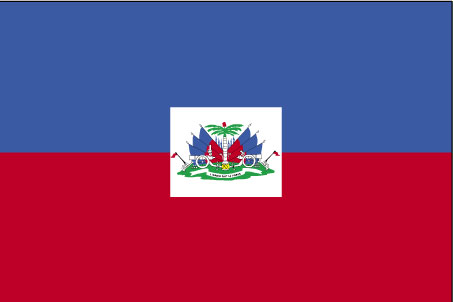
National Flag
- Flag Symbolism
- two equal horizontal bands of blue (top) and red with a centered white rectangle bearing the coat of arms, which contains a palm tree flanked by flags and two cannons above a scroll bearing the motto L'UNION FAIT LA FORCE (Union Makes Strength)
- Flag History
- The colors represent the union of blacks and mulattoes.
- Date of Adoption
- 25 February 1986
National Anthem
- Anthem Lyrics (English)
- La Dessalinienne March on! For ancestors and country, United march, United march; Loyal subjects all remain, And lords of our domain United march, March on! United march for ancestors and country, March on, united march, march on! Unite for ancestors and country! For sacred soil, For sires of old We gladly toil. When teem field and wold The soul is strong and bold. We gladly toil, we gladly toil For sacred soil, For sires of old. For land we love And sires of old We give our sons. Free, happy, and bold, One brotherhood we'll hold. We give our sons, we give our sons For land we love And sires of old. For those who gave For country all, God of the brave, To thee, O God, we call; Without thee we must fall, God of the brave, God of the brave. For those who gave For country all. For flag on high For Native land 'Tis fine to die. Our traditions demand Be ready, heart and hand, 'Tis fine to die, 'tis find to die For flag on high, For Native land.
- Anthem History
- La Dessalinienne honoring Jean-Jacques Dessalines. It was written by Justin Lhérisson and composed by Nicolas Geffrard and adopted in 1904.
Other National Symbols
Coat of Arms
The coat of arms of the Republic are: a Palmette surrounded by the liberty cap, and under the palms a trophy with the legend: In Union there is Strength [L'Union Fait la Force].
Motto
In Union there is Strength
Seal
The outstanding feature of the Seal is the stylized Angel of Peace centered with outstretched wings. Around the Angel, from the top and moving clockwise: 24 point star representing the 21 municipalities of the Republic. The four longer rays represent the 4 sub-centers of Majuro (the capital), Jaluit, Wotje, and Kwajalein Atolls. On either side of the star are the rays which are on the flag. Each ray is of two colors, one, orange representing bravery, and the other, white representing peace. The two-colored rays also represent the two chains of atolls, the Ratak (Sunrise) and the Ralik (Sunset). Next is a stylized fishing net, fish being the main staple of the diet of the Marshallese people. Next, a stylized sailing canoe, outrigger type, sails on the ocean (covering the bottom 1/3 of the seal). Under the stick chart is the word “SEAL.” An island with stylized palm trees (coconut) is next. All of the Marshall Islands are low lying atolls. Above the right wing of the Angel is a “pounder”, made out of a giant clam shell, and treasured by every family that owns one. This pounder is used to pound pandanus leaves, which are used for making mats, sails, and, traditionally, clothing. Around the outer edges are the words “Republic of the Marshall Islands” and at the bottom, “Jepilpilin ke ejukaan.” The rim of the seal is a link chain representing that the islands are all linked together, half of the chain representing the Ralik group and the other half the Ratak. Protection of the Seal: A person who uses the seal or a representation of it, or anything that so resembles the seal as to be calculated to deceive or advertise or promote any commercial purposes, or for any purpose whatsoever without the permission of the Cabinet, shall be guilty of a misdemeanor and shall, upon conviction, be subject to a fine of not less than $500 and no more than $2500, a term of imprisonment of not less that 6 months nor more than one year or both. Each individual use of the seal shall be considered a separate offense.